
Industrial panel filters are the first line of defense in factory air handling units, process ventilation, paint shops, equipment air intakes and plant HVAC systems. They are also the most underestimated component in the system. Because they are inexpensive and replaced often, they are usually bought on price alone. Yet the panel filter you choose has a direct effect on fan energy use, on the service life of the bag and HEPA filters behind it, and on how clean your cooling coils stay.
This guide brings together everything a plant engineer, maintenance manager or industrial buyer needs to specify panel filters correctly: types, efficiency ratings, sizes, frame materials, pressure drop, industry applications, total cost of ownership and sourcing. Each section gives the key facts and links to a detailed guide when you need to go deeper.
Definition and basic construction
An industrial panel filter is a flat, rigid air filter, usually 1 to 4 inches (25 to 100 mm) deep, that fits into a filter rack, frame or housing across the airstream. Every panel filter is built from four elements:
Filter media: synthetic fiber, fiberglass, activated carbon or a blend. The media captures the particles.
Frame: beverage board, galvanized steel, aluminum or stainless steel. The frame holds the media in shape and seals it into the housing.
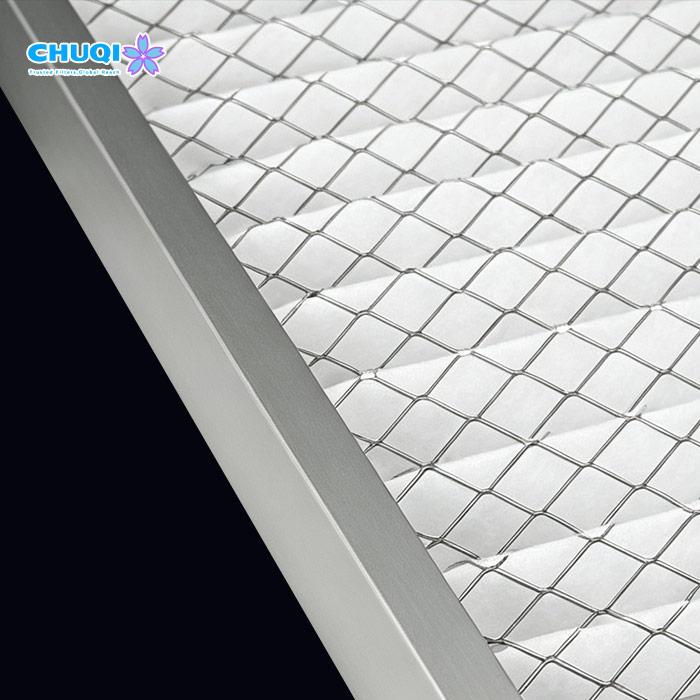
Media support: wire mesh, expanded metal or an internal skeleton. The support keeps the media from bowing or collapsing under airflow.
Seal: the frame edge, plus a gasket where needed. The seal stops air from bypassing the media.
How Panel Filters capture particles
Panel filters do not work like a sieve. They capture particles through three main mechanisms:
Inertial impaction: large, heavy particles cannot follow the air around a fiber, so they hit it and stick.
Interception: mid-size particles following the airflow touch a fiber as they pass and are held.
Diffusion: very small particles move randomly and eventually contact a fiber.
Coarse panel filters rely mainly on impaction and interception, which is why they are so effective against process dust, lint, fibers, pollen and insects, and less effective against fine particles below 1 µm.
Where panel filters sit in a multi-stage system
In most industrial air systems, filtration is arranged in stages:
| Stage | Typical filter | Main job |
|---|---|---|
| 1. Pre-filtration | Panel filter (flat, pleated, skeleton) | Remove coarse dust, fibers, insects; protect everything downstream |
| 2. Medium / fine filtration | Bag (pocket) filter, deep-pleated or mini-pleat filter | Remove fine particles (PM2.5, PM1) for workplace air quality and process protection |
| 3. Terminal filtration (where required) | HEPA / ULPA filter | Meet cleanroom or critical-process requirements |

2. Types of Panel Filters
Industrial panel filters come in three core designs and several specialty versions. The right design depends on how much dust the plant generates, how often you can change filters, and the temperature, humidity and chemicals in the airstream.
Flat (pad) panel filters
A single layer of synthetic or fiberglass media in a simple frame. Flat pads have the lowest initial resistance and the lowest unit price, and some versions are washable. Their limitation is media area: with less surface to hold dust, they load faster and need more frequent changes. They suit low-dust ventilation, budget pre-filtration and equipment air intakes. → Flat panel air filters
Pleated panel filters
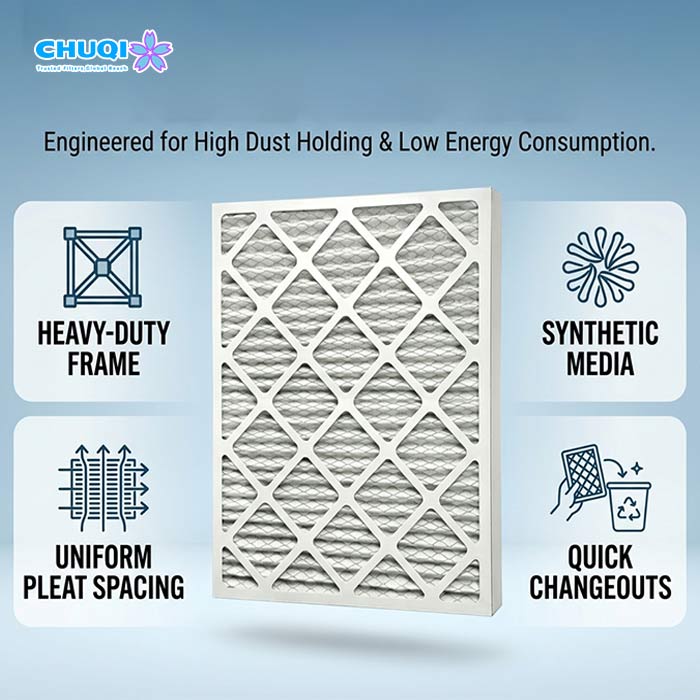
The media is folded into pleats, which multiplies the filtration area within the same frame. Pleated filters start at a higher initial resistance than flat pads, but hold far more dust and keep a flatter resistance curve, so they usually last longer and cost less over their service life. They are the standard choice for factory AHUs and plant HVAC pre-filtration. → Pleated pre-filters
Skeleton (reusable-frame) panel filters
A durable metal frame with an internal support skeleton stays in the system, and only a lightweight media pad is replaced. This cuts waste volume and disposal cost, and a well-made frame keeps a consistent seal. Skeleton filters suit high-dust plants, sites with sustainability targets, and in-house maintenance teams. → Skeleton panel filters
Specialty panel filters
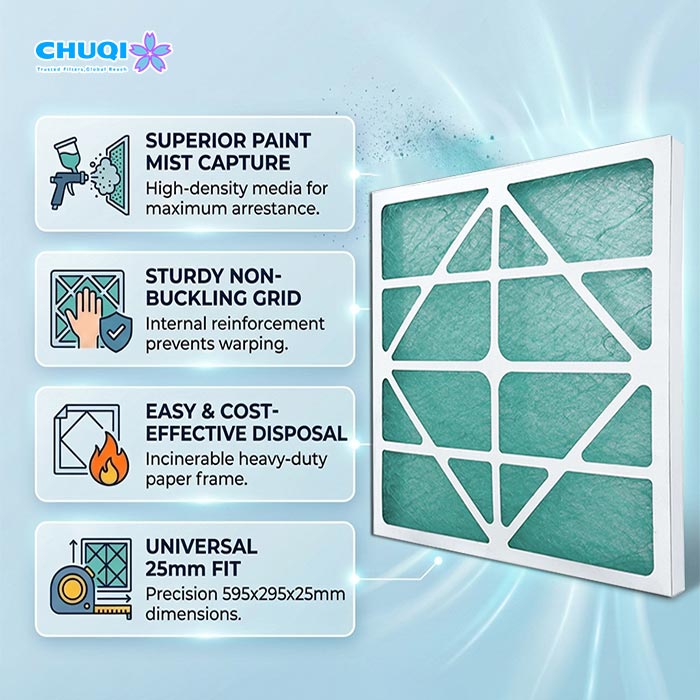
Fiberglass panel filters: progressive-density glass fiber for capturing paint overspray and coarse dust in spray booth exhausts. → Fiberglass panel filters
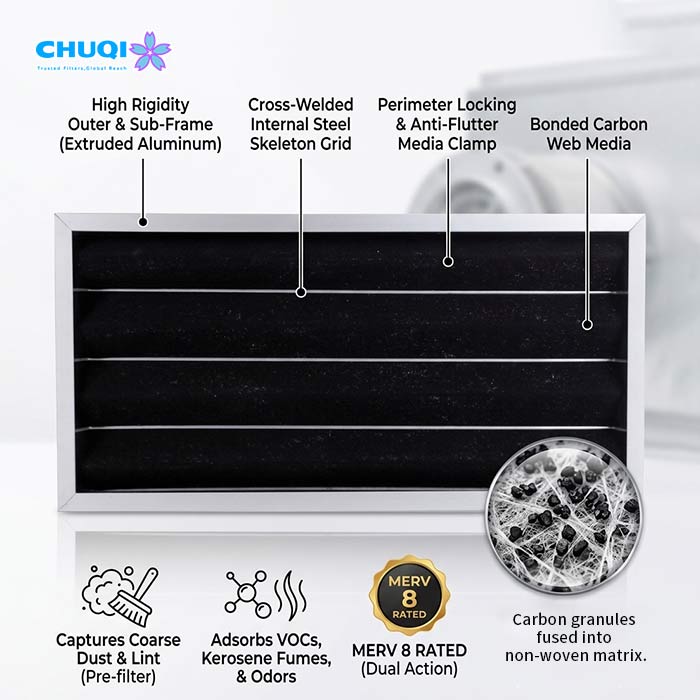
Activated carbon panel filters: combine particle capture with adsorption of odors and low-concentration VOCs. → Activated carbon flat panel filters
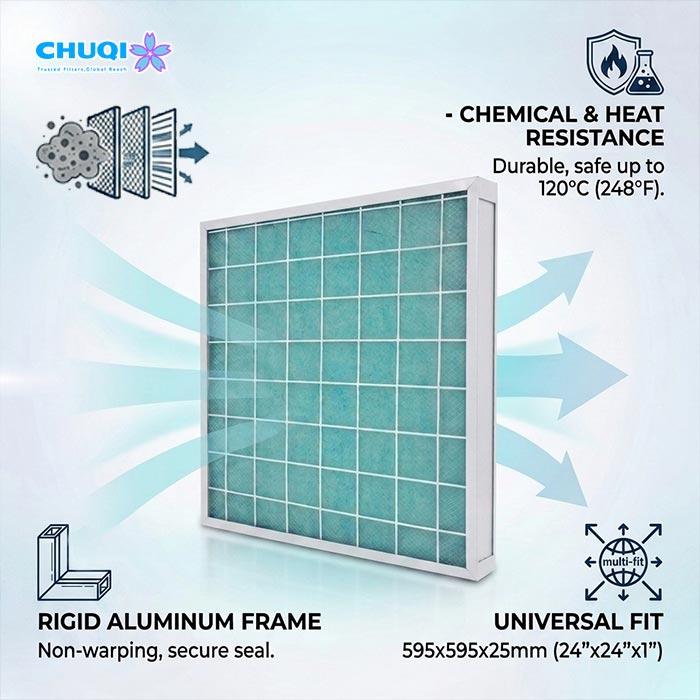
Heat-resistant panel filters: metal frames and temperature-resistant media for ovens, drying tunnels and paint curing, rated up to 300°C (572°F). → Heat-resistant pre-filters
Deep dive: Flat, Pleated, or Skeleton Panel Filters: Which Design Is Best for Your Application?
3. Efficiency Ratings: MERV, ISO 16890 and EN 779
Industrial panel filter efficiency is described by three different systems. North American specifications use MERV; international projects increasingly use ISO 16890; and many suppliers, especially in Europe and Asia, still quote the older EN 779 G/F grades.
ASHRAE 52.2 and MERV
MERV (Minimum Efficiency Reporting Value) is defined by ANSI/ASHRAE Standard 52.2. A filter is tested against particles in three size groups: E1 (0.3–1.0 µm), E2 (1.0–3.0 µm) and E3 (3.0–10.0 µm). The rating runs from MERV 1 to MERV 16. Most panel pre-filters fall between MERV 4 and MERV 8; MERV 9–13 is typically handled by pleated medium-efficiency filters.
ISO 16890
ISO 16890 groups filters by how well they remove particulate matter in three size fractions: ePM1, ePM2.5 and ePM10. Filters that capture less than 50% of PM10 are classed as ISO Coarse, rated by gravimetric arrestance. Most flat and many pleated panel pre-filters are ISO Coarse or ISO ePM10.
Legacy EN 779 G/F grades: why you still see them
EN 779:2012 classified filters as G1–G4 (coarse) and M5–F9 (medium and fine). It was withdrawn in Europe on 30 June 2018 and replaced by ISO 16890. G-grades are still widely used in quotations and datasheets, so you will often see a panel filter described as “G4 / MERV 8”.
Approximate comparison
| ISO 16890 | Approximate MERV | Legacy EN 779 | Typical panel filter design |
|---|---|---|---|
| ISO Coarse | MERV 2–4 | G2–G3 | Flat synthetic or fiberglass pad |
| ISO ePM10 ≥ 50% | MERV 5–8 | G3-G4 | Pleated synthetic panel |
| ISO ePM2.5 ≥ 50% | MERV 9–15 | F5-F9 | High-capacity pleated panel |
| ISO ePM1 ≥ 50% | MERV 11–15 | F6–F9 | Mini-pleat medium filter (rigid frame) |
A higher rating does not automatically mean a higher energy cost. What matters is pressure drop, which depends on media area and quality as much as on efficiency.
Deep dive: Panel Filter Efficiency Standards: MERV vs. ISO 16890 & Airflow Performance · Related: G1–G4 vs. F5–F9 explained
4. Panel Filter Sizes and Dimensions
Sizing errors are one of the most common causes of poor filter performance. A filter that is even slightly undersized lets dirty air bypass the media through the gap around the frame.
Nominal vs. actual dimensions
North American filters are sold by nominal size, a rounded figure such as 24 × 24 × 2. The actual size is slightly smaller, so the filter slides into a rack of the same nominal size. For example, a nominal 24 × 24 × 2 filter typically measures 23⅜” × 23⅜” × 1¾” , and a nominal 16 × 25 × 1 filter typically measures 15.5″ × 24.5″ × 0.75″ .
Common North American panel filter sizes
| Nominal size (in) | Typical actual size (in) | Common use |
|---|
| Nominal size (in) | Typical actual size (in) | Common use |
|---|---|---|
| 16 × 20 × 1 | 15½ × 19½ × ¾ | Small RTUs, control-room and office HVAC |
| 16 × 25 × 1 | 15½ × 24½ × ¾ | Small RTUs, equipment cabinets |
| 20 × 20 × 1 | 19½ × 19½ × ¾ | RTUs, return grilles, equipment intakes |
| 20 × 25 × 1 | 19½ × 24½ × ¾ | RTUs, return grilles |
| 12 × 24 × 2 | 11⅜ × 23⅜ × 1¾ | Half-size AHU positions |
| 20 × 20 × 2 | 19⅜ × 19⅜ × 1¾ | Rooftop units on plant buildings |
| 20 × 25 × 2 | 19⅜ × 24⅜ × 1¾ | Rooftop units on plant buildings |
| 24 × 24 × 2 | 23⅜ × 23⅜ × 1¾ | Factory AHU filter banks |
| 24 × 24 × 4 | 23⅜ × 23⅜ × 3¾ | High-capacity AHU pre-filters, dusty plants |
Depth options: 1″, 2″ and 4″
Deeper filters hold more media. At the same airflow, moving from 1″ to 2″ or 4″ pleated media usually lowers initial resistance, increases dust-holding capacity and extends service life. If the rack allows it, a deeper filter is often the simplest TCO upgrade available.
Metric sizes for export projects
European and many international AHUs use the header frame dimensions defined in EN 15805, based on a full-size face of 592 × 592 mm, with partial sizes such as 592 × 287 mm and 490 × 592 mm . 592 mm (about 23.3″) is close to, but not the same as, the 23⅜” actual size of a 24″ nominal filter. Always confirm which system the housing was designed for before ordering.
Custom sizes and tolerances
OEM equipment, spray booths, older plants and process units often use non-standard sizes. For custom orders, specify the actual dimensions, the tolerance, the airflow direction and whether a gasket is required. Chuqi manufactures panel filters to custom dimensions;
How to measure: measure the rack or the old filter’s width, height and depth in inches or millimeters, note the airflow arrow, and send a photo of the label if available.
5. Frame Materials and Construction Quality
The frame is what turns filter media into a working filter. A weak or poorly sealed frame can cancel out the efficiency of even the best media.
Frame options
| Frame material | Moisture resistance | Rigidity | Weight | Relative cost | Best for |
|---|---|---|---|---|---|
| Beverage board / moisture-resistant paperboard | Moderate | Moderate | Light | Low | Disposable filters in clean, dry plant HVAC |
| Galvanized steel | Good | High | Heavy | Medium | Industrial AHUs, reusable and skeleton frames |
| Aluminum | Very good | High | Light | Medium–High | Humid areas, high-temperature panels, export (lighter freight) |
| Stainless steel | Excellent | Very high | Heavy | High | Washdown, corrosive, food and pharmaceutical areas |
Air always takes the path of least resistance. If there is a gap between filters, between a filter and the rack, or at the corners of the frame, air will flow through it unfiltered, and the measured efficiency of the media becomes irrelevant. Look for:
Tight, consistent frame dimensions within tolerance
Sealed corners and media-to-frame joints
Gaskets on filters installed in holding frames or side-access housings
Racks that are clean, square and fully filled
Media support
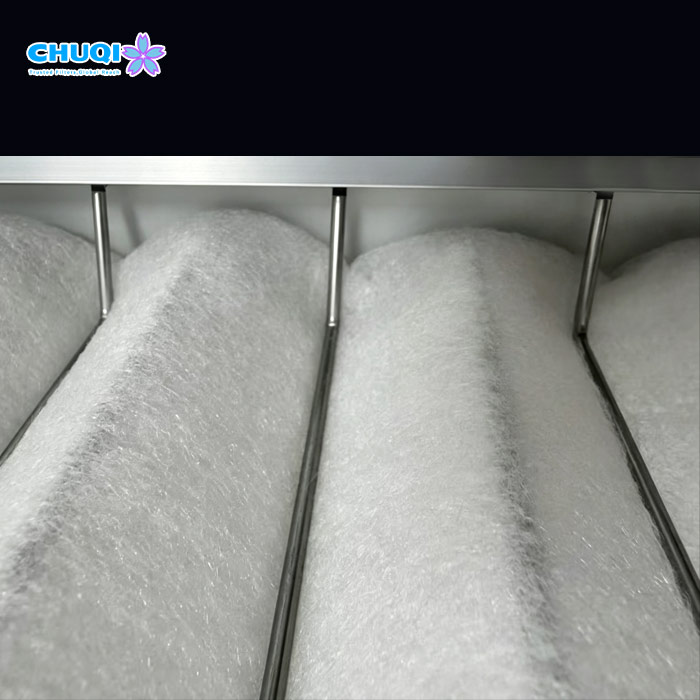
Under airflow, unsupported media bows toward the fan. As it loads with dust, it can collapse or pull out of the frame. Wire mesh backing, expanded metal grids or an internal skeleton keep pleats evenly spaced and the media flat, which protects both efficiency and pressure drop.
For the construction checks we recommend during factory audits, including frame rigidity and corner sealing, see the Panel Filter Manufacturing & Sourcing Guide.

6. Panel Filter Selection Decision Matrix
Use this matrix as a starting point for specification. Values are typical for Chuqi standard products at rated airflow. Request the datasheet for the exact size and configuration you need.
| Design | Typical grade | Initial resistance | Dust-holding capacity | Max. temperature / RH | Reusable? | Best for |
|---|---|---|---|---|---|---|
| Flat pad (synthetic) | G2–G4 | ~35 Pa | Low | 80°C~100°C | Some washable | Low-dust ventilation, budget pre-filtration |
| Pleated (synthetic) | G3–G4 /F5-F9 | ~35 Pa | High | 80°C~100°C | Some washable | Factory AHUs, plant HVAC pre-filters |
| Skeleton + replaceable media | G3–G4 | ~50 Pa | High | 80°C~100°C | Frame: yes | Heavy dust, low-waste maintenance |
| Fiberglass | G2–G4 | ~25 Pa (G2, 25 mm) | Medium | 80°C~100°C | No | Paint booth exhaust, coarse dust |
| Activated carbon | G3–G4/F5-F9+ carbon | ~35 Pa | Medium | 80°C~100°C | No | Odor and low-level VOC control |
| Heat-resistant | G3 | ~40 Pa | Medium | Up to 300°C (572°F) | No | Ovens, curing, drying tunnels |
7. Pressure Drop, Replacement and Total Cost of Ownership
Why energy is the biggest cost?
In plants that run two or three shifts, filters work almost around the clock, and every filter adds resistance that the supply fan must overcome. Life-cycle cost studies find that energy typically accounts for 70–80% of an air filter’s total cost of ownership, with the purchase price, labor and disposal making up the rest.
As a rule of thumb, for a 24″ × 24″ filter position at 2,000 CFM, running year-round with a fan system efficiency of 0.70, each 1 Pa of average pressure drop costs about $1.71 per year at the U.S. average commercial electricity price of 14.53¢/kWh in July 2026. A filter bank that runs just 25 Pa (0.1 in. w.g.) higher on average costs roughly $43 more per position, every year.
That is why the cheapest filter is rarely the cheapest to own. What counts is the average pressure drop over the filter’s life, and that depends on dust-holding capacity and media area, not just on initial resistance.
When to replace?
Replace panel filters on condition, not on a fixed calendar. The European AHU standard prEN 13053 sets these maximum final pressure drops:
| Filter class | Maximum recommended final pressure drop |
|---|---|
| G1–G4 (most panel pre-filters) | 150 Pa (≈ 0.6 in. w.g.) |
| F5–F7 | 200 Pa (≈ 0.8 in. w.g.) |
| F8–F9 | 300 Pa (≈ 1.2 in. w.g.) |
Deep dive: Panel Filter TCO: When to Replace & Cut HVAC Energy Costs, including a worked cost comparison of flat, pleated and skeleton filters and the economic changeout point.
8. Panel Filters by Industry
Every industry stresses panel filters in a different way. The table below summarizes the most common industrial applications.
| Application | Main challenge | Typical panel filter choice |
|---|---|---|
| Industrial HVAC and factory ventilation | Outdoor dust, pollen, continuous operation | Pleated G4 / MERV 8 pre-filter ahead of bag or pleated medium filters |
| Automotive manufacturing and paint shop air supply | Particles that cause paint defects; overspray in exhaust | Pleated or flat intake pre-filters; fiberglass panels in exhaust |
| Industrial equipment and air intake systems | Protecting compressors, motors and process equipment | Flat or pleated panels in custom sizes, with rigid frames |
| Heavy manufacturing and metalworking | Heavy dust and fine metal particles | Skeleton or high-capacity pleated panels; frequent pressure monitoring |
| Cement, bulk material handling and dusty environments | Very high dust loading | High dust-holding pleated or skeleton panels as a first stage |
| Ovens, drying and curing processes | High temperature | Heat-resistant panels with metal frames, up to 300°C |
| Odor and VOC control | Gases and odors | Activated carbon panels |
Deep dive: Industrial Panel Filter Applications: How to Select Pre-Filters by Industry · Related solutions: Industrial HVAC filters, Paint booth filter media
9. How to Specify and Source Panel Filters
What to include in a panel filter RFQ
A complete request for quotation gets you accurate prices faster and prevents costly mismatches. Include:
Dimensions: nominal and actual size (W × H × D), tolerance, and quantity per size
Efficiency: required MERV, ISO 16890 or EN 779 grade, and the test report you need
Design: flat, pleated, skeleton, carbon or heat-resistant
Frame: material, plus gasket requirement
Operating conditions: airflow per filter (CFM or m³/h), temperature, humidity, contaminants
Performance limits: maximum initial resistance at rated airflow
Compliance: fire-performance or other certifications required by your project or local code
Packaging and labeling: bulk cartons, private label, retail or Amazon-ready packaging
Volume and schedule: annual volume, order frequency and target delivery date
How to evaluate a manufacturer
When comparing suppliers, look beyond unit price and check four things:
Media integrity and pleat stability: are pleats evenly spaced and supported?
Frame rigidity and sealing: are corners sealed and dimensions within tolerance?
Media consistency: does the progressive-density structure hold without fiber shedding?
Batch-to-batch test data: can the factory show resistance and efficiency results for each production batch?
For industrial buyers, buying direct from the factory removes trader margins and gives you direct access to engineering support and customization.
Deep dive: Panel Filter Manufacturing & Sourcing Guide: How to Audit a Direct Factory


10. Panel Filter Glossary
Air bypass: Air that flows around a filter instead of through it, through gaps at the frame or rack. It reduces real-world efficiency.
Arrestance: The percentage, by weight, of a standard test dust captured by a filter. Used to rate coarse filters.
Beverage board: A moisture-resistant paperboard used for disposable filter frames.
Differential pressure (dP): The pressure difference between the upstream and downstream sides of a filter. It is the standard way to monitor filter loading.
Dust-holding capacity (DHC): The amount of test dust a filter can hold before reaching its final pressure drop. A higher DHC usually means longer service life.
ePM1 / ePM2.5 / ePM10: ISO 16890 efficiency classes based on the removal of particulate matter of ≤1 µm, ≤2.5 µm and ≤10 µm.
Final pressure drop: The resistance at which a filter should be replaced.
Initial resistance: The pressure drop of a clean filter at its rated airflow.
ISO Coarse: The ISO 16890 class for filters that remove less than 50% of PM10.
Media velocity: The speed of air passing through the filter media. A larger media area lowers the velocity, which lowers resistance.
MERV: Minimum Efficiency Reporting Value, the ASHRAE 52.2 rating from 1 to 16.
Nominal size: The rounded size used to identify a filter. The actual size is slightly smaller.
Pleat density: The number of pleats per inch or per 100 mm. It affects media area, airflow and dust-holding capacity.
Pre-filter: The first filter stage, which protects the downstream filters and equipment.
Progressive-density media: Media that is more open on the air-entering side and denser on the air-leaving side, so dust is held throughout its depth.
Static pressure: The resistance to airflow in a duct system, measured in Pa or inches of water gauge (in. w.g.).
UL 900: The Underwriters Laboratories standard for the flammability and smoke generation of air filter units.
11. Frequently Asked Questions
What is the difference between a panel filter and a bag (pocket) filter?
A panel filter is flat and shallow, usually 1–4 inches deep, and is mainly used for pre-filtration. A bag filter has deep fabric pockets that provide much more media area, and is typically used as the second, finer stage after a panel pre-filter. See our guide to pocket bag air filters.
Are pleated panel filters better than flat panel filters?
For systems that run continuously, usually yes. Pleated filters have a higher initial resistance, but they hold much more dust and last longer, which normally lowers total cost. Flat pads remain a good choice for low-dust or short-run applications, and where a washable filter is preferred.
What MERV rating do I need for an industrial facility?
It depends on the process, local code and project specification. For general plant HVAC, a common arrangement is a MERV 8 panel pre-filter followed by a MERV 13 final filter. Cleanrooms, paint shops and food areas usually need additional or higher-efficiency stages. Always follow the design engineer’s specification.
How long do panel filters last?
There is no fixed lifespan. In general plant HVAC, coarse panel pre-filters are often changed every one to three months, while in dusty processes such as metalworking or cement handling they may need changing within weeks, but dust load, airflow and season can change this a lot. Replace at the final pressure drop rather than on a fixed schedule.
Can panel filters be washed and reused?
Some can. Washable synthetic pads and skeleton-frame systems are designed for reuse or media replacement. Standard disposable pleated filters should not be washed, because water damages the media and the frame. For details, see our washable vs. disposable maintenance guide.
What frame material is best for humid environments?
Aluminum or stainless steel frames resist moisture and corrosion best. Standard paperboard frames can soften in very humid or wet conditions. Moisture-resistant beverage board is a cost-effective option for dry plant HVAC.
Do panel filters need UL 900 classification?
Many North American projects and local codes require filters to meet UL 900, the standard for the flammability and smoke generation of air filter units. Check your project specification and local code, and ask your supplier for the current UL listing or test certificate for the exact product.
Can you manufacture custom-size panel filters for OEM equipment?
Yes. Chuqi manufactures panel filters to custom dimensions, media grades and frame materials, with private-label and retail-ready packaging available. Contact our team with your drawings or sample.
Work with a Direct Industrial Panel Filter Manufacturer
Chuqi is a direct factory for industrial air filters and filter media. We produce flat, pleated, skeleton, fiberglass, activated-carbon and heat-resistant panel filters in standard North American and metric sizes, as well as custom dimensions. We support OEM, private-label and Amazon-ready packaging, provide datasheets and test data for every model, and our engineering team can recommend a specification for your system.