
In high-performance commercial and industrial HVAC design, specifying a panel filter based solely on nominal MERV or ISO class ratings is an engineering liability. System design engineers and facility energy managers frequently encounter a critical performance paradox: a panel filter rated with high initial efficiency often triggers premature terminal pressure drop (Pa), forcing constant fan frequency escalation and destroying the calculated Total Cost of Ownership (TCO).
The root cause lies in a fundamental misunderstanding of media mechanics. Filtration efficiency is not a static property; it is a dynamic equilibrium dictated by fiber denier gradients, media porosity, dust-holding capacity (DHC), and aerodynamic face velocity. As a direct manufacturer engineering custom panel filter media and structural assemblies, we cut through marketing metrics. This guide provides a rigorous, engineering-level breakdown of ASHRAE 52.2 and ISO 16890 standards, translating laboratory test parameters into real-world fan curve and coil protection realities.
MERV Standards Deep Dive (ASHRAE 52.2) and the Limitation of Composite Charge
The Minimum Efficiency Reporting Value (MERV), governed by ASHRAE 52.2, establishes particulate capture performance across three distinct optical particle counter (OPC) size bands.
The E1, E2, E3 Particle Spectrum Mechanics:
E3 Range (3.0 to 10.0 micrometers): Inertial impaction domain. Captures large lint, pollen, and heavy textile fibers via direct collision with target fibers.
E2 Range (1.0 to 3.0 micrometers): Interception domain. Captures fine mineral dust and fungal spores as they follow streamlines around filter fibers.
E1 Range (0.3 to 1.0 micrometers): Diffusion and electrostatic attraction domain. Captures sub-micron aerosols, combustion soot, and bacteria primarily through Brownian motion and electrostatic charge gradients.
The Electrostatic Decay Vulnerability in Synthetic Panel Filters: A critical engineering limitation within the ASHRAE 52.2 framework is the conditioning step. Many synthetic panel filters rely on electrostatically charged split-fiber media to artificially boost their clean-state MERV rating. However, under real-world industrial loading—exposed to hydrocarbon aerosols, high relative humidity, and continuous particulate bombardment—this electrostatic charge neutralizes (electrostatic decay). Consequently, a panel filter boasting a clean MERV 13 rating may experience a performance drop in the field, behaving closer to its baseline mechanical MERV 8 structure. Understanding this delta prevents unexpected indoor air quality (IAQ) failures.
ISO 16890 Standard: The Real-World Gravimetric and Aerosol Shift
Adopted to eliminate the ambiguities of legacy standards, ISO 16890 revolutionized panel filter testing by anchoring evaluations to ambient atmospheric aerosol distributions and mass-based fractions rather than isolated particle counts.
The Four ISO Particulate Classifications & Engineering Implications:
ISO Coarse: Requires less than 50% capture of ISO ePM10 mass. Strictly applicable only to low-grade pre-filtration where downstream bag or HEPA stages bear the primary burden.
ISO ePM10 ( >= 50%): Targets particulate matter up to 10 micrometers (heavy urban dust, pollens). Essential for standard commercial ventilation where occupant respiratory comfort is prioritized.
ISO ePM2.5 ( >= 50%): Targets fine particulate matter (combustion particles, secondary inorganic aerosols). Critical for urban downtown facilities and high-occupancy corporate HQs.
ISO ePM1 ( >= 50%): Targets sub-micron fractions down to 0.3 micrometers (viruses, nanoparticles). Specifying an ISO ePM1 panel filter requires high-density synthetic or micro-fiber wet-laid media designed for deep-bed loading rather than surface blinding.
ASHRAE MERV vs. ISO 16890 Engineering Conversion Matrix
Because ASHRAE relies on charged particle tracking in controlled laboratory ducts while ISO 16890 measures gravimetric mass efficiency against neutral atmospheric dust, direct mathematical conversion is flawed. Use this empirical engineering matrix to align your procurement specifications:
| ISO 16890 Classification | Approximate ASHRAE MERV Equivalent | Dominant Filtration Mechanism | Recommended Panel Filter Construction & Media Density |
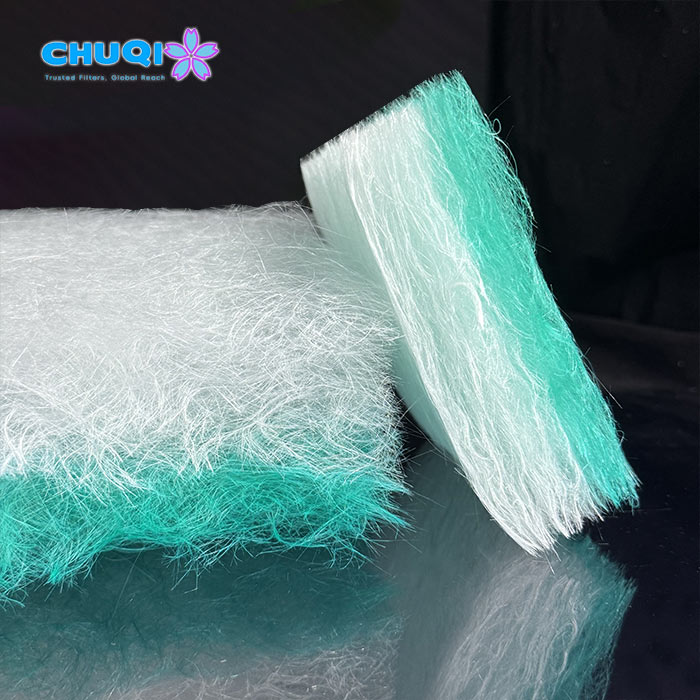
| ISO Coarse | MERV 1 to 4 | Inertial Impaction | Standard flat synthetic pad (GSM 150-200), metal mesh backer |
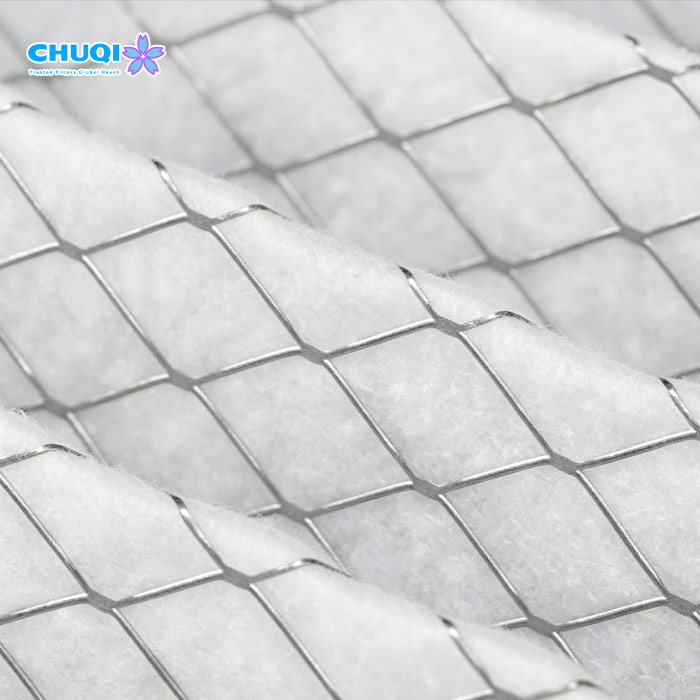
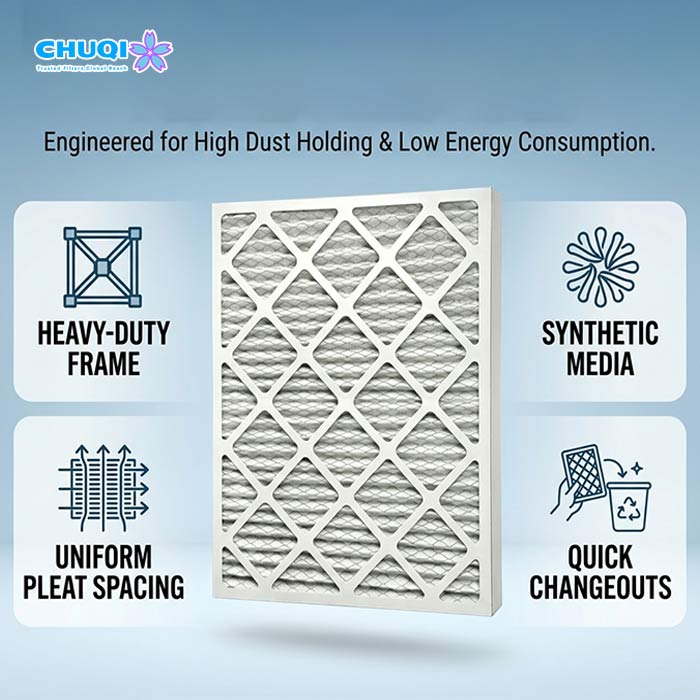
| ISO ePM10 ( >= 50%) | MERV 6 to 8 | Interception & Direct Impaction | Pleated synthetic panel filter, expanded metal grid, 30-40% media pleat density |
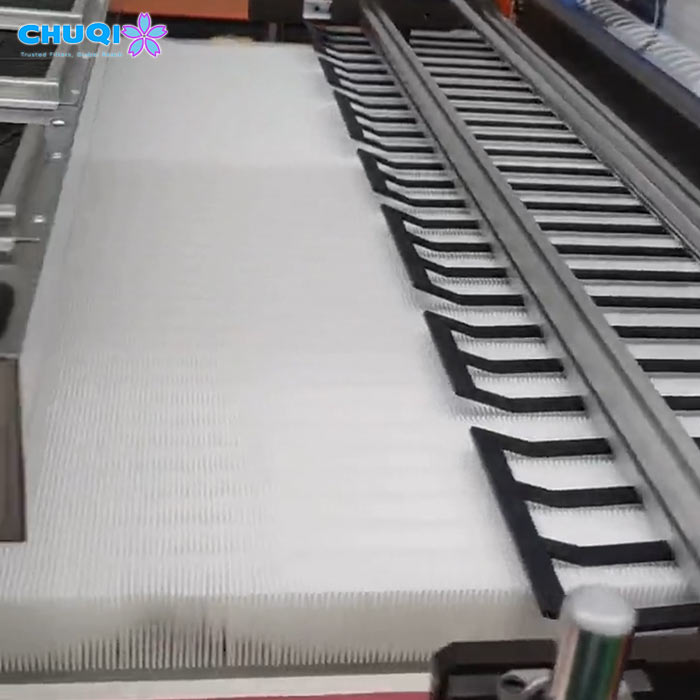
| ISO ePM2.5 ( >= 50%) | MERV 11 to 13 | Diffusion & Mechanical Capture | High-capacity pleated panel filter, gradient-density synthetic fiber matrix |
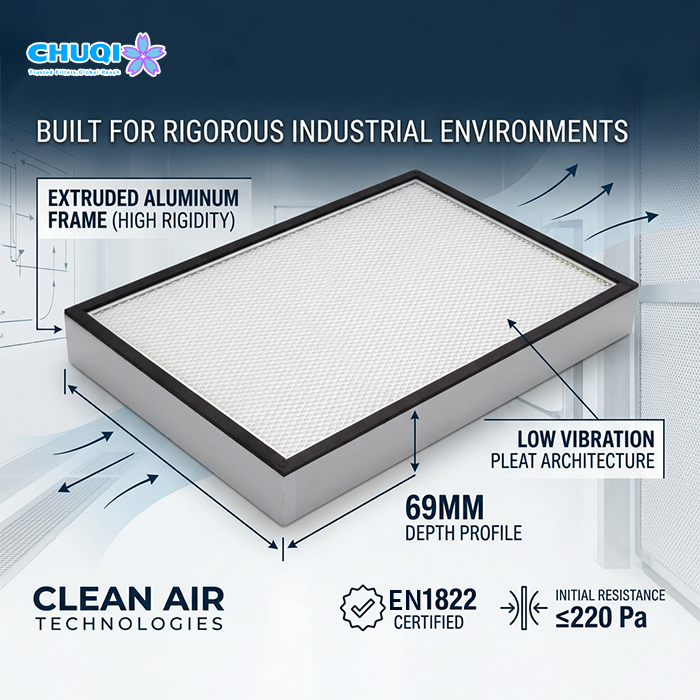
| ISO ePM1 ( >= 50%) | MERV 14 to 16 | High-Density Brownian Diffusion | Mini-pleated Medium Filter, ultra-fine glass fiber paper, rigid box frame |
The Aerodynamic Physics: Pressure Drop (Pa), Dust Loading Curves, and Coil Fouling
Specifying a panel filter without analyzing system static pressure dynamics inevitably destabilizes the air handling unit’s (AHU) operating point.
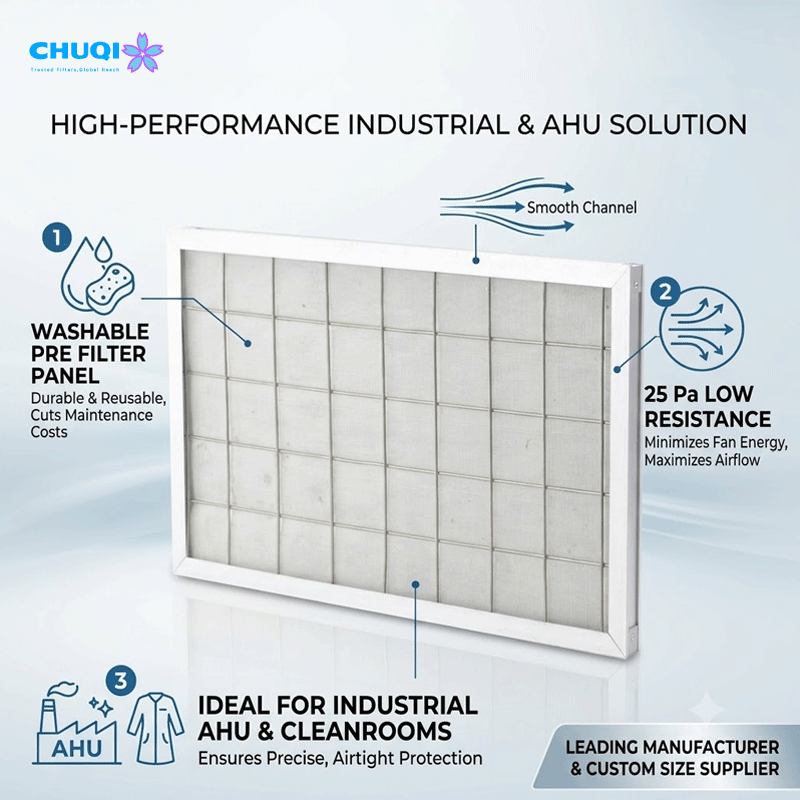
Non-Linear Pressure Drop and Dust Loading (Resistance Curve): As air flows through a panel filter at standard rated velocity (typically 2.5 m/s), clean-air initial resistance scales with media fiber packing density and grammage (GSM)—ranging from 35 Pa to 45 Pa for low-resistance flat pads up to 75 Pa to 95 Pa for high-efficiency pleated designs. As particulate matter accumulates, dust cakes form on the fiber surfaces, causing static pressure to rise exponentially (non-linearly) toward the terminal recommended changeout resistance (typically 250 Pa to 300 Pa).
The Fluid Mechanics of Coil “Cementing”: If a panel filter’s efficiency is mismatched (e.g., deploying ISO Coarse/MERV 4 upstream of a delicate cooling coil), sub-micron particles slip through the media matrix. When these particles strike wet, chilled-water evaporator coils, they combine with condensate water to form an impermeable, rock-hard layer of sludge over the aluminum fins. This phenomenon—known as coil cementing—degrades thermal heat transfer coefficients by up to 30% and turns the coil into a biological breeding ground for mold and bacteria.
The Fan Affinity Law Penalty: According to the fan laws, air volume flow is proportional to fan speed, but static pressure and brake horsepower scale exponentially. Every extra 25 Pascal of constant pressure drop imposed by an over-dense or prematurely blinded panel filter forces the supply fan motor to consume excess kilowatt-hours (kWh). Partnering with a direct manufacturer capable of fine-tuning media denier grading and pleat geometry is vital to flatten the pressure drop curve and safeguard facility energy budgets.
Why does a high-efficiency panel filter cause my AHU fan to trip on high static pressure?
Upgrading panel filter efficiency (e.g., from MERV 8 to MERV 13 or ISO ePM1) fundamentally increases fiber packing density and flow resistance.
When a facility transitions to a higher efficiency rating without recalibrating the air handling unit’s (AHU) Variable Frequency Drive (VFD) fan curve, the system encounters a sharp spike in clean-air initial pressure drop—often jumping from a baseline 40 Pa up to 90 Pa or higher. As dust loading begins immediately upon startup, the operating point rapidly breaches the maximum static pressure trip threshold set in the building management system (BMS).
Solution: Avoid blunt-force efficiency upgrades. Instead, specify high-capacity pleated panel filters featuring engineered gradient-density media and optimized pleat counts. This geometric configuration maximizes total effective surface area, successfully mitigating initial resistance spikes while maintaining strict particulate capture compliance.
Why does static pressure increase after panel filter replacement?
It is a common counter-intuitive operational puzzle for maintenance teams to observe an immediate rise in static pressure right after installing a fresh set of panel filters. This phenomenon is driven by two distinct aerodynamic factors:
1. Restoration of Design Media Density: Replacing old, stretched, or structurally degraded filters with a correctly specified, higher-density or higher-MERV/ISO grade panel filter inherently introduces the proper clean-air initial resistance (clean initial drop) required by the system design. Degraded old filters offered lower resistance simply because their media had thinned or torn.
2. Elimination of Air Bypass and Media Sagging: Worn-out or poorly secured filters often sag under airflow load, creating gaps along the frame edges where air bypasses the filtration matrix with minimal resistance. A tightly fitted, properly sealed replacement panel filter forces 100% of the rated airflow directly through the dense media matrix, instantly restoring true design static pressure. Always evaluate performance against manufacturer clean-air baselines rather than comparing against worn, bypassed filter readings.
Engineering Equilibrium in Panel Filter Procurement
Optimizing an air filtration stage requires balancing three conflicting parameters: indoor air quality (IAQ) compliance, static pressure resistance, and total cost of ownership (TCO). Over-specifying filtration efficiency triggers chronic energy penalties, while under-specifying leads to catastrophic downstream equipment fouling. Furthermore, tackling non-standard dimensional slots, high humidity thresholds, or legacy AHU retrofits demands a manufacturing partner who understands micro-level media mechanics.
To explore the physical frames and housings that support these media specifications, review our engineering resource on the Panel Filter Types Guide: Flat, Pleated, or Skeleton. For a complete system blueprint, return to our Panel Filters Ultimate Guide.
Need Technical Consultation or Custom Panel Filter Engineering?
Bridging the gap between theoretical air filtration standards and physical HVAC performance requires precise manufacturing control. Whether you are migrating legacy ASHRAE parameters to ISO 16890, auditing system static pressure curves, or sourcing non-standard panel filters for specialized retrofits, our engineering team is ready to collaborate.
[Browse Panel Filter Catalog] (Explore specifications, materials, and standard dimensions across our flat, pleated, and mini-pleated panel filter lines)
[Consult an Air Filtration Engineer Direct] (Get professional analysis on fan curves, media grading, and TCO optimization with guaranteed factory lead times within 24 hours)
[Request Custom Panel Filter Sample] (Evaluate actual clean-air pressure drop, media GSM, and frame rigidity hands-on)