
When designing a commercial ventilation network or sourcing inventory for an industrial HVAC portfolio, engineering teams and procurement specialists face a constant dilemma: Should you choose standard flat pads, high-capacity pleated panels, or reusable skeleton systems?
Choosing the wrong filter architecture leads to a cascade of operational issues—from premature pressure spikes and rapid media blinding to skyrocketing total cost of ownership (TCO) driven by excessive fan energy consumption and frequent maintenance labor. Two filters may share identical nominal face dimensions (e.g., 24×24 inches), yet their internal media tortuosity, fiber denier grading, frame rigidity, and initial resistance (Pa) behave entirely differently under dynamic airflow conditions.
Whether you are configuring a cleanroom pre-filtration stage, optimizing a multi-story commercial building’s central air handler, or developing a private-label OEM line, matching the precise filter design to your exact operational environment is critical. As a direct manufacturer supplying a complete, vertically integrated portfolio of flat, pleated, and skeleton panel filters, we eliminate the guesswork. This guide cuts through the confusion, comparing the structural advantages, aerodynamic performance, and ideal applications across all three core solutions to help you make the right engineering choice.
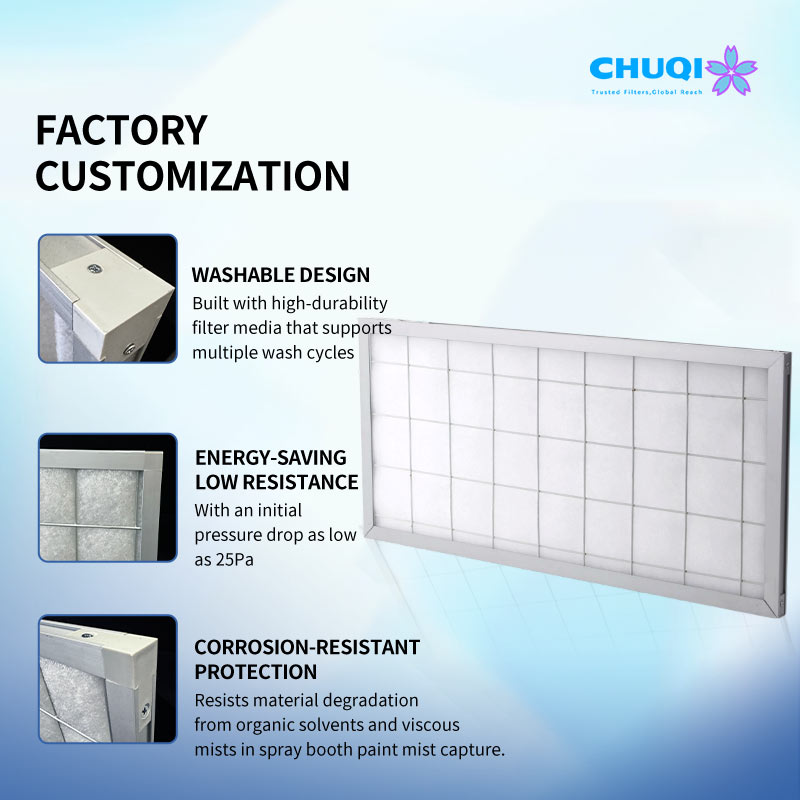
Flat panel filters represent the foundational tier of primary particulate capture. Because the media surface is flat and unextended, filtration occurs via surface loading. Our manufacturing advantage lies in precise die-cutting tolerances (±1.0 mm) and diverse media formulation, making these pads ideal for budget-conscious pre-filtration or targeted environmental challenges:
Standard Synthetic Flat Pads (The Economic Pre-Filter Choice):
Advantages: Manufactured from uniform-density synthetic fibers, offering a high initial airflow rate with minimal clean-air pressure drop (30 Pa to 40 Pa at 2.5 m/s). They provide an economical, lightweight barrier against coarse lint and insects.
Ideal Application: Light commercial pre-filtration protecting secondary medium-bag filters in office buildings and retail spaces where initial project budgets are tight.
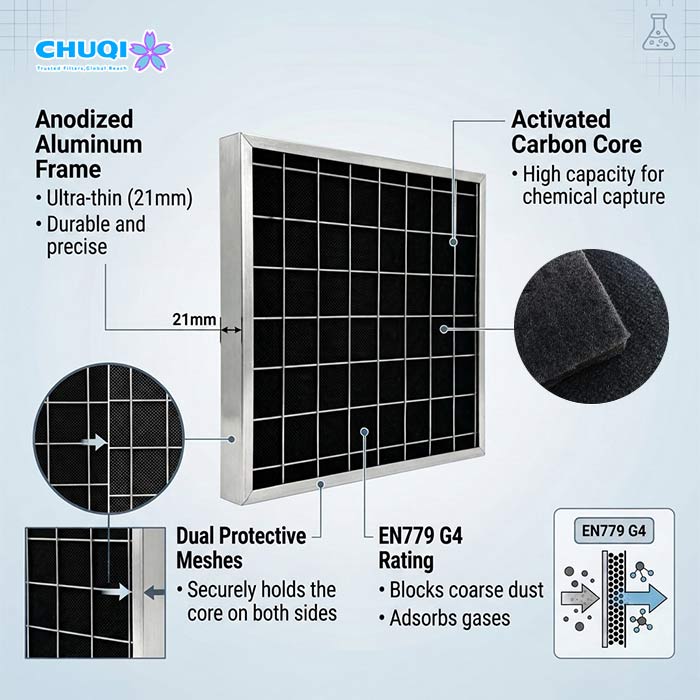
Activated Carbon Flat Panels (The Odor & VOC Solution):
Advantages: Integrates high-surface-area activated carbon granules or carbon-impregnated fleece, utilizing van der Waals forces to chemically adsorb gaseous pollutants and volatile organic compounds (VOCs).
Ideal Application: Urban commercial complexes, airport terminals, and museum archives where outdoor air streams carry heavy chemical fumes, exhaust odors, or cooking smoke.
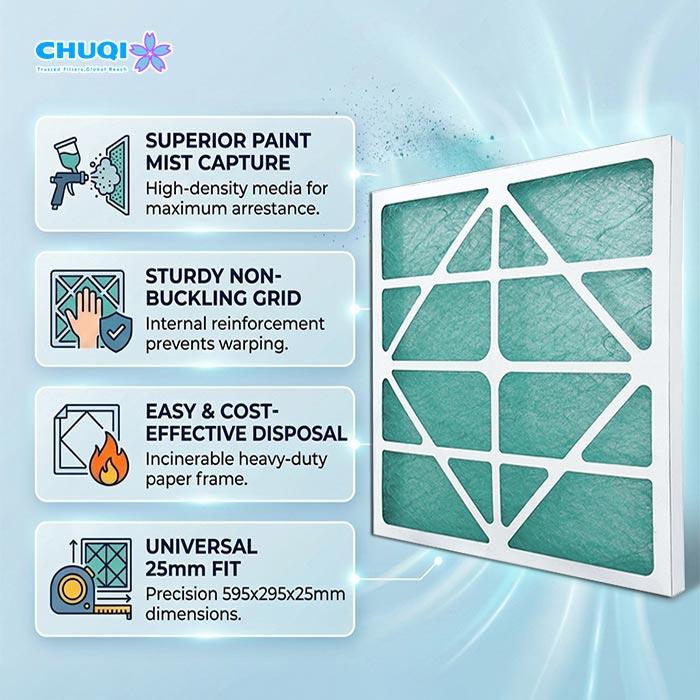
Fiberglass Paint Arrestors (The Industrial Spray Booth Standard):
Advantages: Composed of heavy-denier continuous glass filaments with a progressive density gradient, coated with tackifiers to capture sticky paint droplets without premature blinding. Offers inherent UL 900 Class 2 fire retardancy and thermal tolerance up to 120°C.
Ideal Application: Automotive manufacturing lines and industrial coating booths to protect exhaust fans and ductwork from overspray accumulation.
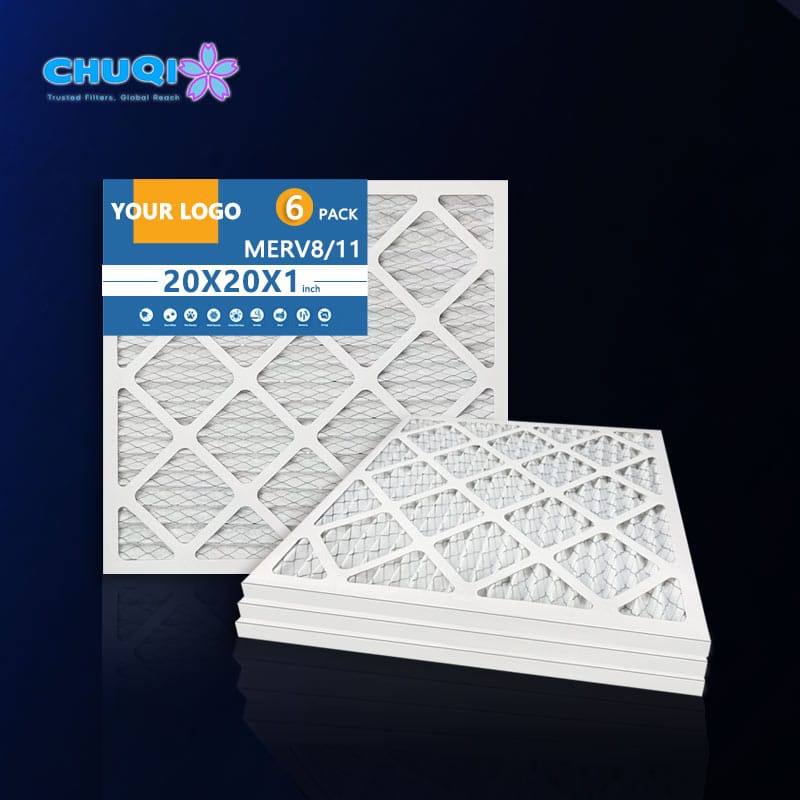
For the vast majority of commercial and industrial HVAC applications, pleated panel filters are our most popular, high-performance recommendation due to their exceptional balance of high dust capacity and structural durability.
Advantages & Structural Excellence:
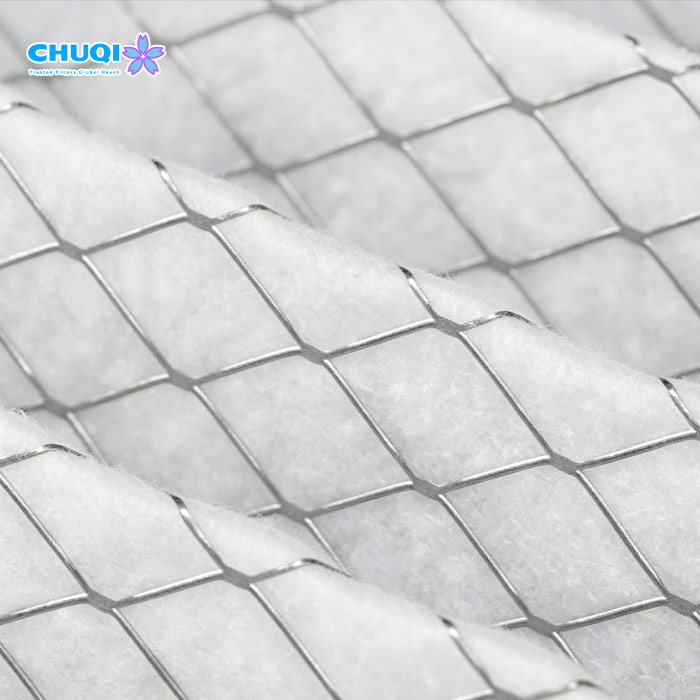
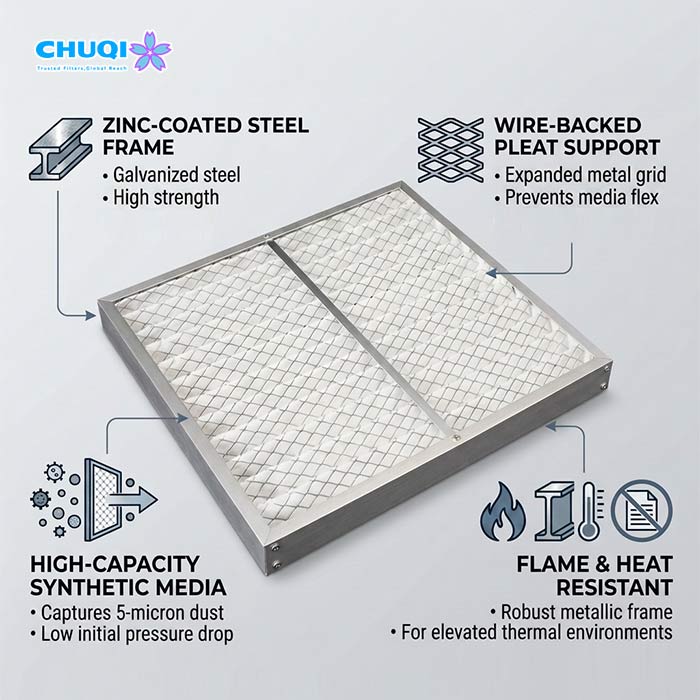
Maximized Surface Area: By mechanically folding synthetic media into uniform V-shaped pleats, we expand the Effective Filtration Area (EFA) by 300% to 500% compared to flat pads, driving down face velocity and extending changeout intervals threefold.
Expanded Metal Grid Lamination: To prevent “pleat flutter” or collapse under turbulent industrial airflows (>500 Pa), our pleated filters are laminated with a high-tensile expanded metal backing (galvanized steel or aluminum mesh) on the air-leaving side, locking the pleat matrix into place under heavy dust loads.
Ideal Industrial Applications:
Central air handling units (AHUs) in commercial office towers, hospitals, educational institutions, and manufacturing plants requiring reliable, long-lasting primary-to-medium filtration.
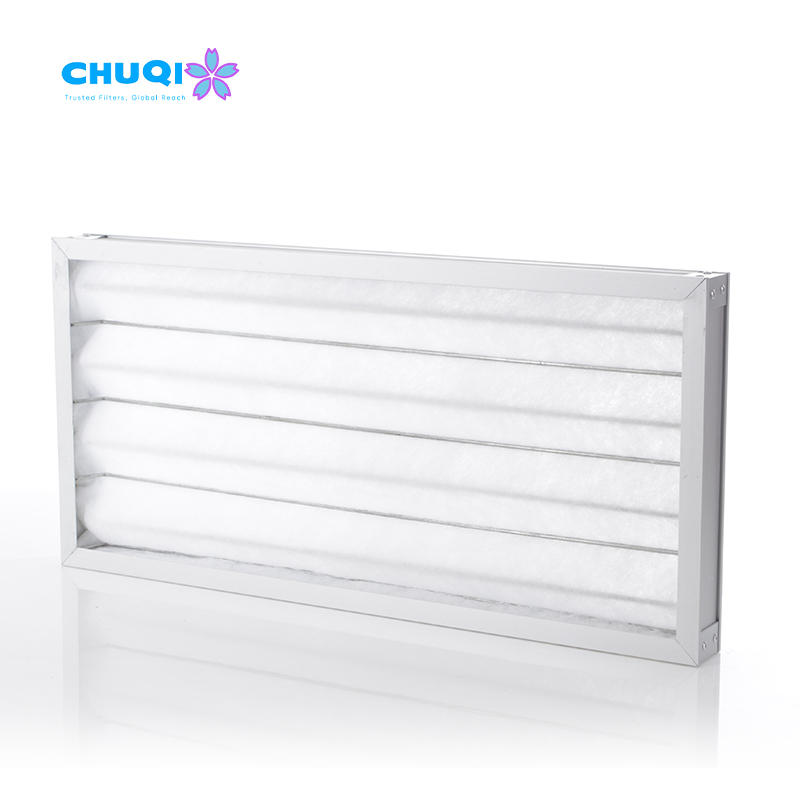
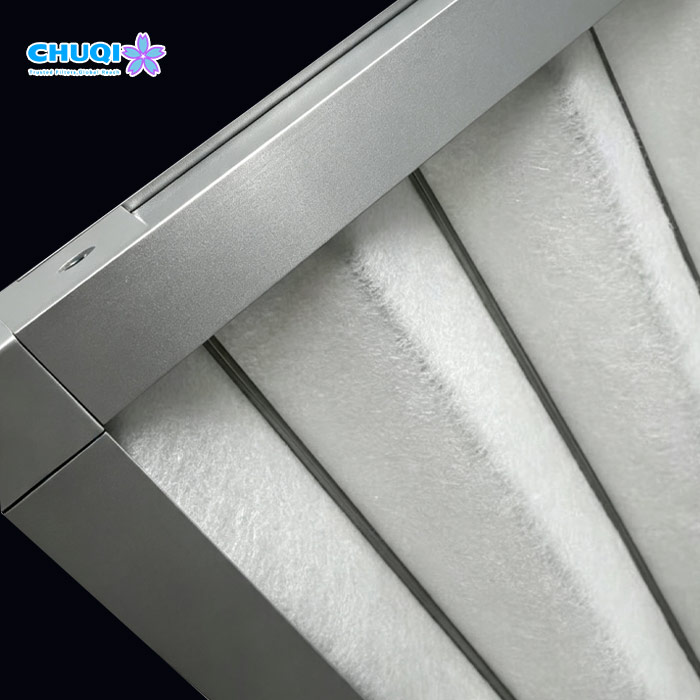
Skeleton panel filters—engineered as permanent, robust external frames housing replaceable media pads—represent our premier sustainable solution designed for high-demand facilities prioritizing long-term structural resilience, dimensional precision, and waste reduction.
Advantages & Core Engineering:
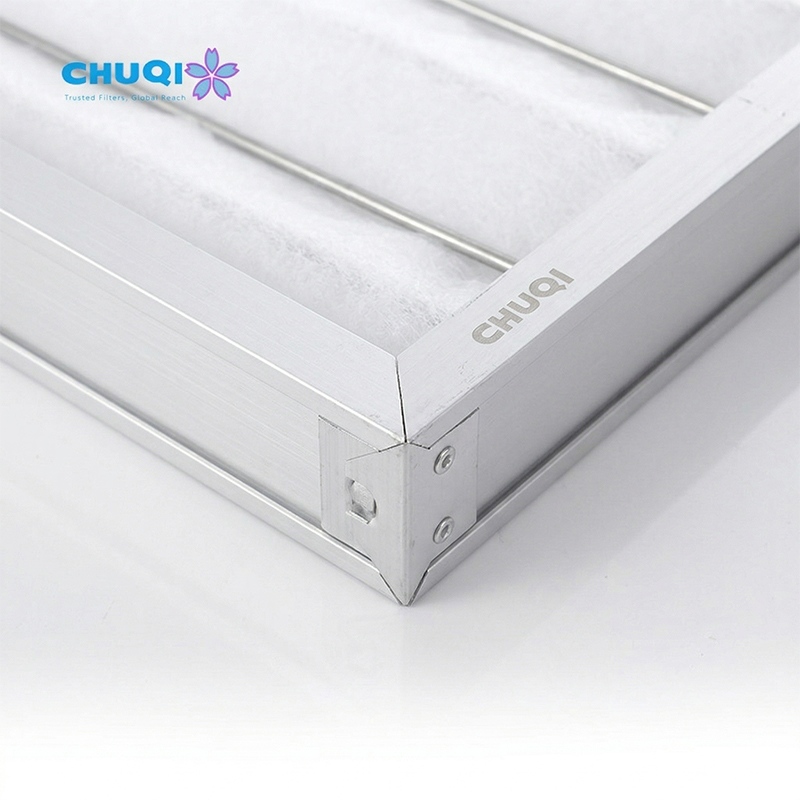
Zero Air Bypass & Precision Fit: Built from heavy-gauge galvanized steel, extruded aluminum, or thick plastic profiles with precision die-cutting controls (±0.5 mm frame squareness tolerance). Mitered corners and structural adhesives eliminate sub-millimeter gaps, ensuring absolute zero bypass under high static pressure.
Replaceable Media & ESG Waste Reduction: Facility technicians retain the metal skeleton and swap out only the exhausted internal synthetic pad. This slashes inbound freight costs, minimizes on-site storage footprints, and cuts industrial solid waste volume by up to 70%, directly supporting corporate ESG (Environmental, Social, and Governance) mandates.
Low Initial Resistance: Maintains stable airflow channels with initial pressure drops between 50 Pa and 60 Pa, preventing premature blower motor wear.
Ideal Industrial Applications:
Large-scale commercial properties, data centers, and industrial plants with strict environmental sustainability targets and high maintenance frequency where frame reusability maximizes long-term savings.
Frame Material Selection and Environmental Compatibility
Regardless of which filter design you choose, the operational environment dictates the required metallurgy or composite integrity of the frame. We supply full material customization to prevent galvanic corrosion, frame warping, or biological failure:
Beverage Board (Moisture-Resistant Kraft Paper): Treated to resist high relative humidity (up to 90% RH non-condensing). Fully incinerable and economical for standard commercial HVAC up to 70°C.
Galvanized Steel (G60 / G90 Coating): The heavy industrial benchmark. Offers robust mechanical strength against impact and corrosion resistance in mechanical rooms and outdoor air intakes (up to 100°C).
Extruded Aluminum: Lightweight, structurally rigid, and completely rust-free. Anodized finish ideal for cleanrooms, pharmaceutical plants, and export-compliant equipment (up to 100% RH and 90°C).
Stainless Steel (AISI 304 / 316): Specified for aggressive chemical exposures, marine atmospheres, or high-temperature sterile processing (withstanding continuous temperatures up to 250°C and caustic daily washdowns).
Technical Comparison Matrix
| Filter Design Type | Initial Resistance (Pa) | Dust-Holding Capacity (DHC) | Thermal & Humidity Limits | Primary Industrial Application & Our Supply Advantage |
| Standard Flat Pad | Lowest (~30 to 40 Pa) | Low | Max 70°C / 90% RH | General pre-filtration / Cost-effective bulk supply |
| Activated Carbon Flat | Medium (~50 to 70 Pa) | Medium | Max 60°C / 80% RH | Odor & VOC control / High-adsorption media matrix |
| Pleated Panel Filter | Medium (~60 to 90 Pa) | High | Max 80°C / 95% RH (Metal frame) | Commercial HVAC / High EFA with mesh backing |
| Skeleton Panel Filter | Low to Med (~50 to 60 Pa) | High | Max 120°C / 100% RH (Metal frame) | Sustainable facilities / Reusable frame & zero bypass |
Matching Filter Architecture to Engineering and Environmental Demands
Optimizing an air filtration network requires looking beyond initial unit acquisition costs. Selecting the correct panel filter layout must be driven strictly by your specific engineering specifications, operating environment, and thermal-humidity thresholds rather than a one-size-fits-all approach. Relying solely on low upfront prices invariably escalates total cost of ownership (TCO) through excessive fan energy consumption, frequent maintenance labor, and premature component degradation.
To achieve long-term system efficiency and supply chain reliability, partnering directly with a verified manufacturing source is essential. Before locking in your procurement specifications, we invite you to review our Panel Filter Manufacturing & Sourcing Guide: How to Audit a Direct Factory to understand what makes a reliable production partner. As your direct factory partner, we empower you to customize the exact media matrix, frame materials, and precise dimensions your projects demand.
To explore our complete overview and access more technical documentation, return to our Panel Filters Ultimate Guide.
Every ventilation system has unique engineering constraints, and off-the-shelf dimensions rarely solve complex industrial challenges. Whether you need to tighten manufacturing tolerances down to ±0.5 mm, source high-temperature specialty frames for harsh environments, or scale a private-label OEM portfolio, our engineering team is here to partner with you directly from prototype to volume production.
[Browse Full Catalog & Technical Data Sheets] (Explore complete specifications across flat, pleated, and skeleton lines)
[Claim Your Free Engineering Sample Kit] (Test our media density and frame rigidity hands-on)
[Upload CAD Drawings for a 24-Hour Custom Quote] (Get direct factory pricing and lead times fast)