
In modern cleanroom engineering, pharmaceutical manufacturing, and precision electronic fabrication, absolute air purity is non-negotiable. However, facility managers, HVAC system designers, and Original Equipment Manufacturers (OEMs) constantly face a rigorous engineering paradox: achieving the highest possible sub-micron particle capture efficiency without triggering excessive pressure drops, escalating facility energy consumption, or exceeding tight spatial footprints.
Traditional deep-pleat filters utilizing bulky aluminum corrugated separators often introduce unwanted turbulence and excessive resistance in high-density airflow configurations. This comprehensive engineering guide examines why mini-pleat HEPA filters have become the undisputed industry benchmark, how they operate across efficiency tiers, and how procurement and engineering teams can select and deploy them for optimal operational performance and lifecycle cost control.
Note: This comprehensive engineering reference serves as the central hub for our mini-pleat filtration technical series. Explore our specialized insights across the cluster:
Technology & Principles: Mini-Pleat vs. Deep-Pleat HEPA Comparison | Why Mini-Pleat Technology Outperforms Traditional Separator Filters | Efficiency Ratings: H13 vs. H14
Performance & TCO: Pressure Drop & TCO Optimization | FFU Integration Guide | Cleanroom Leak Testing Standards
Procurement & OEM: Custom OEM Manufacturing Solutions | How to Choose a Reliable Manufacturer
To understand why modern filtration has shifted away from legacy designs, we must examine the internal fluid dynamics and structural physics.
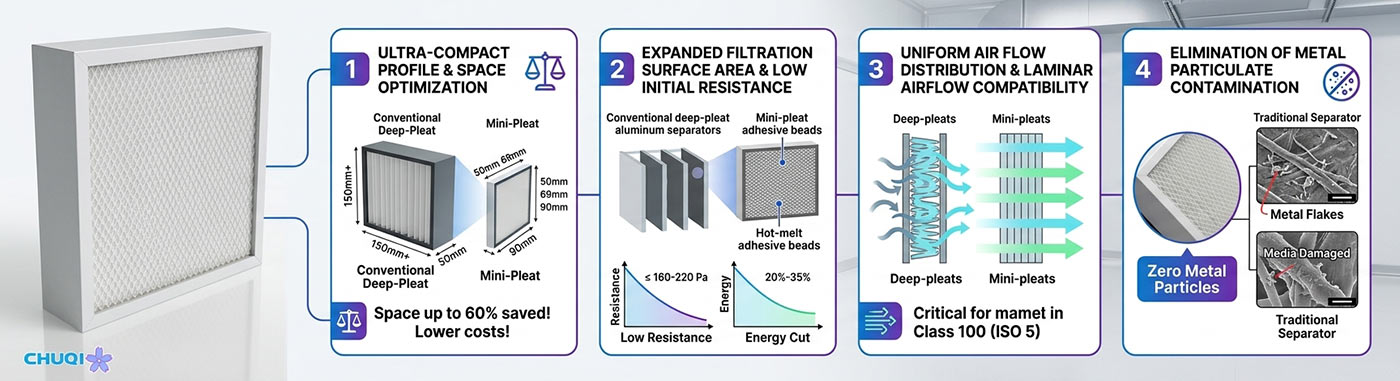
The Limitations of Legacy Separators: Traditional high-efficiency filters rely on corrugated aluminum foil separators to maintain distance between media folds. While structurally rigid, these sharp metallic edges create localized airflow turbulence, increase initial pressure drop, and add unnecessary structural weight to the air handling unit. (For a complete side-by-side mechanical and airflow breakdown, read our comprehensive analysis on Mini-Pleat vs. Deep-Pleat Separator HEPA Filters)
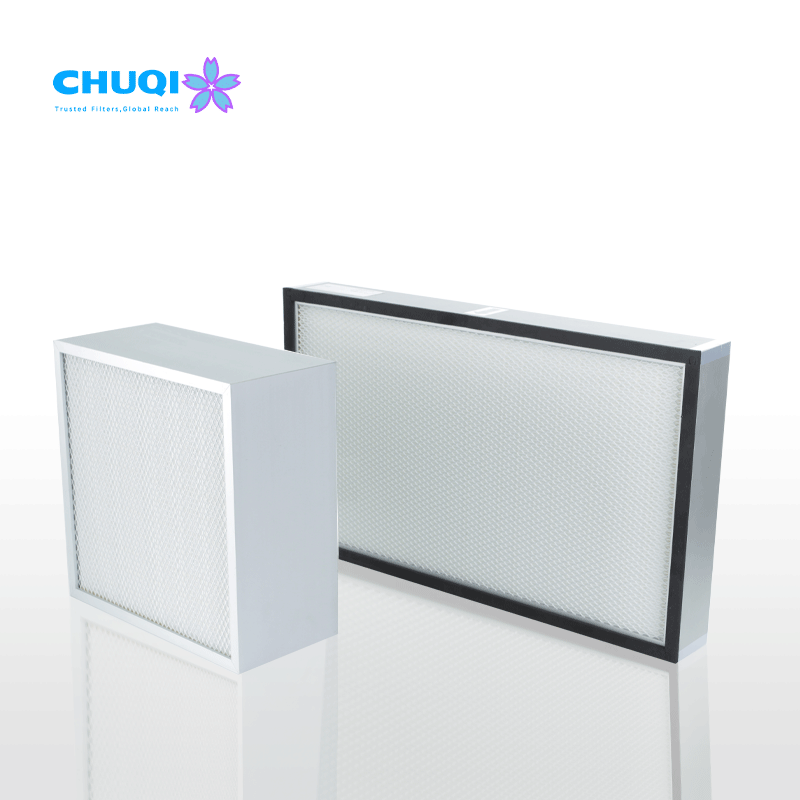
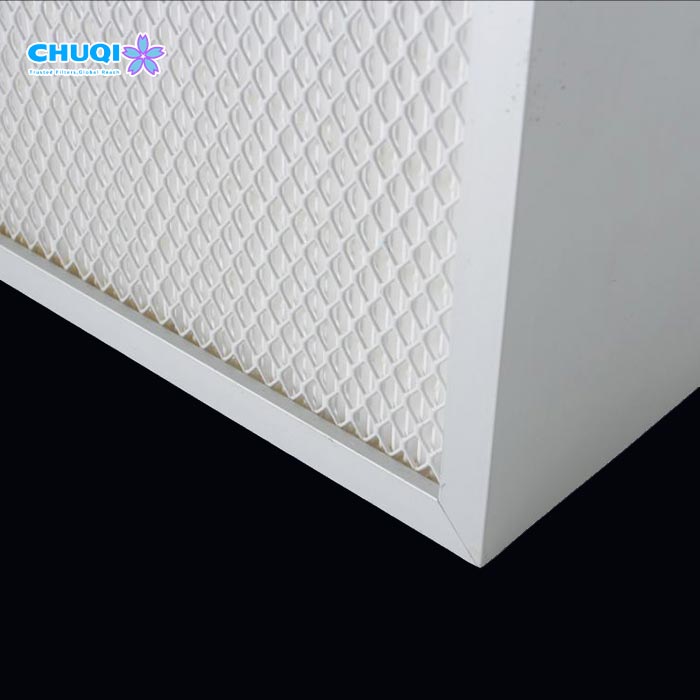
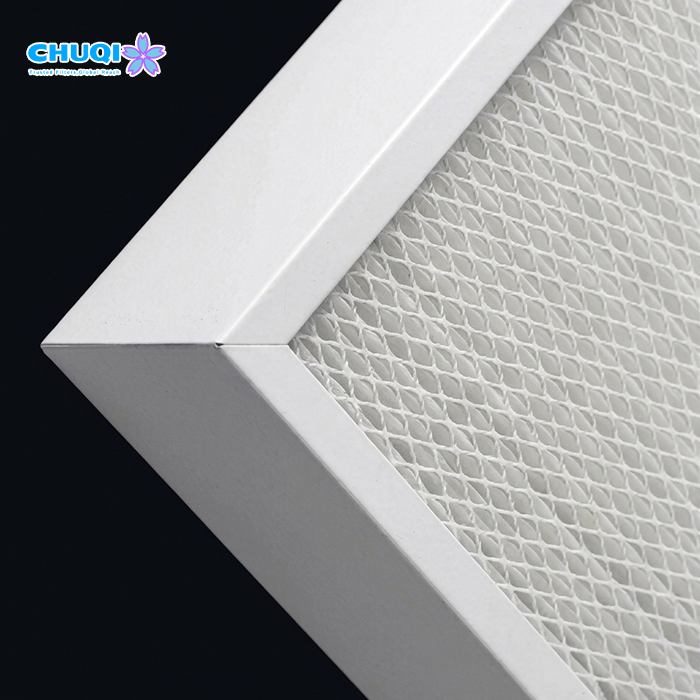
Precision Hot-Melt Technology: Modern high-performance mini-pleat filters replace metallic separators with ultra-thin, computer-extruded hot-melt adhesive beads. These continuous polymer ropes maintain exact, uniform channel spacing across the entire media pack.
Aerodynamic Superiority: This close, uniform pleat geometry allows incoming air to glide smoothly through the media channels, significantly minimizing flow distortion, eliminating media collapse under high face velocities, and dramatically lowering initial resistance.
For a deeper dive into structural physics and media geometry, read our detailed analysis on Why Mini-Pleat Technology Outperforms Traditional Separator Filters.
Efficiency Standards & Tiers: Navigating H10 to U16
Air filtration efficiency is not a guessing game; it is governed by rigorous international benchmarks, primarily EN 1822 and ISO 29463. These standards evaluate filters based on their performance against the MPPS (Most Penetrating Particle Size), typically ranging between 0.1 to 0.3 micrometers—the hardest particle size to capture.
Quick Reference: EN 1822 Efficiency Classifications
| Filter Class | MPPS Efficiency (EN 1822) | Typical Cleanroom & Industrial Application |
| H10 – H12 | 85% to 99.5% | Commercial HVAC upgrades, hospital general wards, pre-filtration for industrial systems |
| H13 – H14 | 99.95% to 99.995% | ISO Class 3–7 cleanrooms, pharmaceutical GMP filling suites, hospital operating theaters, FFUs |
| U15 – U16 | 99.9995% to 99.99995%+ | Semiconductor wafer fabrication (ISO Class 1–2), microelectronics, nanotech research environments |
To evaluate the precise trade-offs between specific efficiency grades for facility design, see our guide on Understanding Efficiency Ratings: H13 vs. H14 Mini HEPA Filters in Modern HVAC.
Critical Technical Parameters: Pressure Drop & Airflow Dynamics
For facility directors, plant managers, and HVAC engineers, operational expenditure (OpEx) is heavily dictated by fluid dynamics and resistance management.
Initial Resistance (Pressure Drop): A standard mini-pleat unit typically exhibits an initial clean-state pressure drop between 80 Pa to 120 Pa at rated face velocity (e.g., 0.45 m/s). Lower resistance directly translates to reduced electrical load and lower power consumption on air handling unit (AHU) blowers.
Dust Holding Capacity (DHC): Because hot-melt beads keep the media fully open without collapsing, incoming particulate loads distribute evenly across the entire surface area. This prevents premature face-loading and extends the operational window before reaching terminal pressure limits (typically 250–300 Pa).
The Long-Term Financial Impact (TCO): Over a filter’s operational lifecycle, continuous fan energy consumption vastly outweighs the initial purchase price of the hardware itself. Minimizing pressure drop yields massive cumulative savings.
Learn how strategic airflow management affects long-term budgets in Why Upgrading to Mini HEPA Filters Lowers Your Total Cost of Ownership (TCO).
Key Application Scenarios & Equipment Integration
Mini-pleat technology’s physical adaptability makes it the preferred terminal filtration choice across diverse mechanical layouts:
Fan Filter Units (FFUs) & Clean Benches: In modular cleanrooms and laminar flow hoods, filters are subjected to continuous face-velocity profiling. Mini-pleat matrices ensure non-turbulent, uniform downward airflow across the work surface, safeguarding sensitive manufacturing processes. (Read more in The Ultimate Guide to Matching Mini HEPA Filters with Fan Filter Units (FFU))
Space-Constrained Industrial Machinery: Where legacy housings offer limited depth, mini-pleat designs deliver double the effective filtration media area within a shallow frame depth (50mm to 90mm), fitting seamlessly into compact OEM equipment. (Explore our tailored OEM specs in Custom Mini-Pleat HEPA Filters for OEMs: Efficiency, Detailed Applications & Lead Times)
On-Site Installation & Labor Safety: Contractors and mechanical installers benefit immensely from the lightweight construction and robust frame integrity of modern mini-pleat units, which significantly reduce installation man-hours and handling risks on site.
B2B Procurement, Logistics & Sourcing Best Practices
For global distributors, mechanical contractors, and large-scale project procurement directors, product performance is only half the equation. Supply chain resilience, shipping economics, and absolute quality compliance dictate project success.
Logistics & Warehousing Efficiency: Because mini-pleat filters lack heavy, rigid aluminum separator plates, their volumetric weight and physical stacking footprint are drastically optimized. This allows global distributors to pack significantly more units into standard ISO shipping containers, slashing international freight costs and warehouse storage overheads.
Quality Verification & Compliance: Every premium terminal filter must undergo rigorous individual aerosol scanning (such as PAO/DOP testing per EN 1822) to guarantee zero bypass leakage prior to deployment. (Read our technical breakdown on Cleanroom HEPA Leak Testing & EN 1822 Standards Guide)
Sourcing from a True Source Factory: Partnering with an established manufacturer that controls its upstream glass fiber media production and ensures 100% individual aerosol testing is vital for eliminating middleman markups, securing technical transparency, and mitigating project delivery risks. (Read our comprehensive evaluation guide on How to Find a Reliable Mini-Pleat HEPA Filter Manufacturer)
Selecting the appropriate mini-pleat filtration architecture requires balancing efficiency tiers, pressure drop constraints, and long-term economic models. By understanding these core engineering variables, facility designers and procurement specialists can achieve uncompromised cleanroom compliance while optimizing system lifecycle costs.
Ready to explore specific product configurations, standard dimensions, or technical datasheets?
Explore our full inventory in the Product Catalog
Contact Our Engineering Team for customized project support and factory-direct quotation within 12 hours.