
Summary: Cleanroom Total Cost of Ownership (TCO) is dominated by HVAC blower energy consumption (70–80%), rather than initial filter purchase costs (<15%). Upgrading from traditional deep-pleat or aluminum separator filters to advanced mini-pleat HEPA filters significantly reduces initial clean-state pressure drop (from 150 Pa down to ~90 Pa) and slows the resistance lifecycle curve. This aerodynamic efficiency slashes continuous EC fan electricity costs and extends replacement intervals, delivering a full CAPEX payback within 12 to 18 months under ISO 14644 and EU GMP standards.
In modern cleanroom and controlled environment engineering, facility managers and procurement directors often fall into the trap of prioritizing lowest initial capital expenditure (CAPEX) when sourcing terminal filtration. However, focusing solely on the unit price of HEPA filters ignores the true financial driver of cleanroom operations: Total Cost of Ownership (TCO).
While the filter media itself accounts for a minor fraction of operating budgets, the static pressure resistance imposed by the filter dictates the continuous energy consumption of your air handling units (AHUs) and Fan Filter Units (FFUs).
This engineering guide analyzes how upgrading to high-performance mini-pleat HEPA filters fundamentally alters the pressure-drop lifecycle, slashes energy expenditure, and minimizes downtime costs.
Note: This technical guide is part of our comprehensive engineering series on terminal filtration. Return to our central Ultimate Engineering Guide to Mini-Pleat HEPA Filters or review our efficiency comparison on H13 vs. H14 Mini-Pleat HEPA Filters.
The Real Cost Structure of Cleanroom Filtration
To understand why mini-pleat technology drives down TCO, facility operators must evaluate the three distinct financial pillars of cleanroom air filtration:
Initial Purchase Cost (CAPEX – ~10% to 15%): The direct procurement cost of the HEPA/ULPA filter units.
Energy Consumption (OPEX – ~70% to 80%): The electrical power consumed by cleanroom blower motors (AC or EC fans) over thousands of hours of continuous operation to overcome system static pressure and filter resistance.
Maintenance & Downtime (OPEX – ~10% to 15%): Labor costs, production shutdowns, disposal fees, and mandatory re-certification (PAO/DEHS scan testing) associated with periodic filter replacement.
Because energy represents up to four-fifths of the total lifecycle financial burden, any mechanical design that reduces operational airflow resistance yields exponential long-term savings.
Aerodynamic Superiority: Low Initial Pressure Drop & Energy Scaling
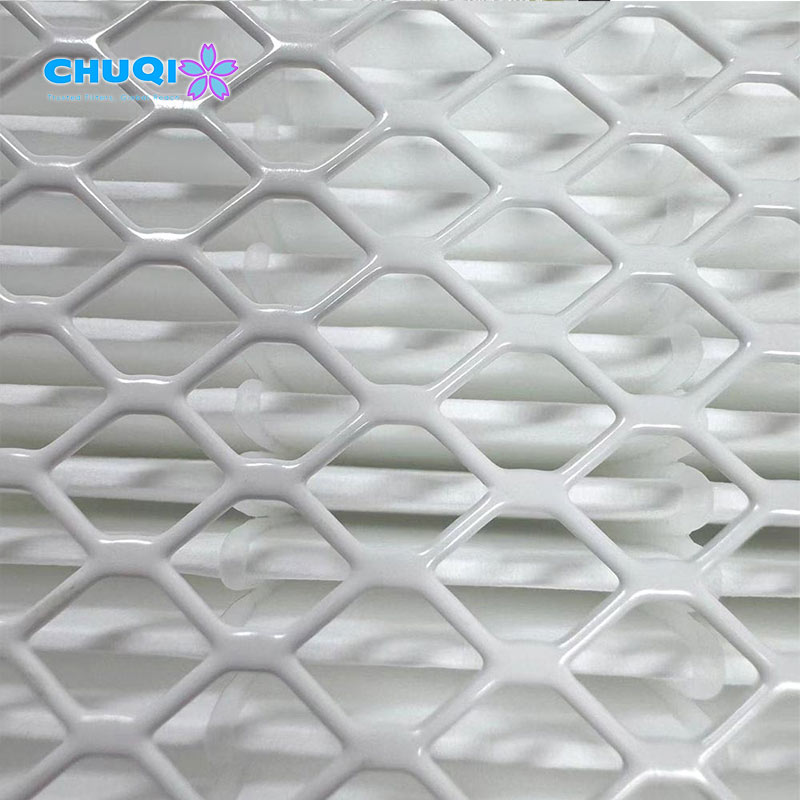
Traditional deep-pleat filters—typically constructed with corrugated aluminum foil separators—introduce severe aerodynamic penalties. The rigid, metallic baffle edges obstruct laminar flow, creating localized flow separation, turbulent eddy currents, and high air entry resistance, frequently resulting in a high clean-state pressure drop exceeding 150 Pa to 180 Pa at a standard face velocity of 0.45 m/s.
The Mini-Pleat Engineering Advantage:
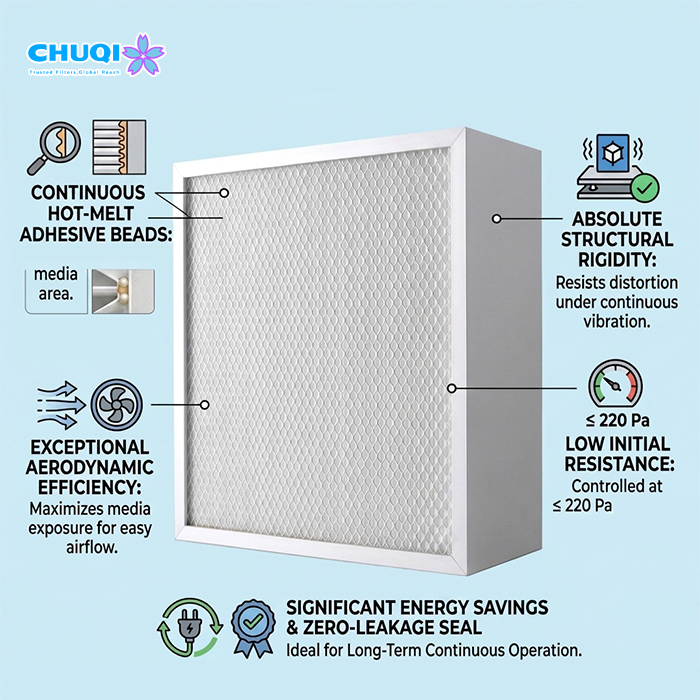
- Thermoplastic Hot-Melt Bead Spacers: Mini-pleat HEPA filters replace bulky metal foils with continuous, precision-extruded hot-melt polyurethane or polyamide glue beads. This geometric configuration maintains uniform pleat spacing while maximizing the exposed, active micro-glass fiber media surface area.
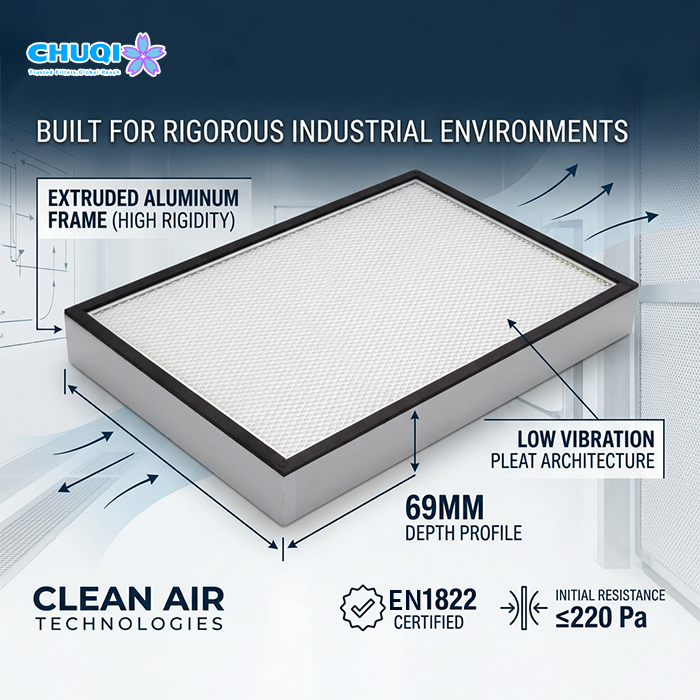
- Optimized Clean-State Resistance Curve: Due to superior internal channel laminar flow and reduced boundary-layer friction, a premium mini-pleat H13 or H14 filter typically achieves an initial clean-state pressure drop between 80 Pa and 110 Pa at nominal airflow rates.
- The Fan Power Scaling Equation: Fan power consumption scales directly with total system static head (P ∝ Q × ΔP). Reducing terminal resistance by 40 Pa to 60 Pa across a large cleanroom array equipped with hundreds of Fan Filter Units (FFUs) yields massive, quantifiable kilowatt-hour (kWh) reductions and significantly lowers annual facility amperage draw.
Slowing the Resistance Lifecycle Curve
Filter replacement frequency is not just determined by particulate loading, but by how rapidly the filter’s pressure drop reaches the maximum threshold of the blower motor (typically 250 Pa to 300 Pa).
Dust-Holding Capacity (DHC): The uniform micro-glass fiber pleat depth and spacing in mini-pleat filters allow sub-micron particulates to distribute evenly throughout the entire depth of the media, rather than blinding the surface prematurely.
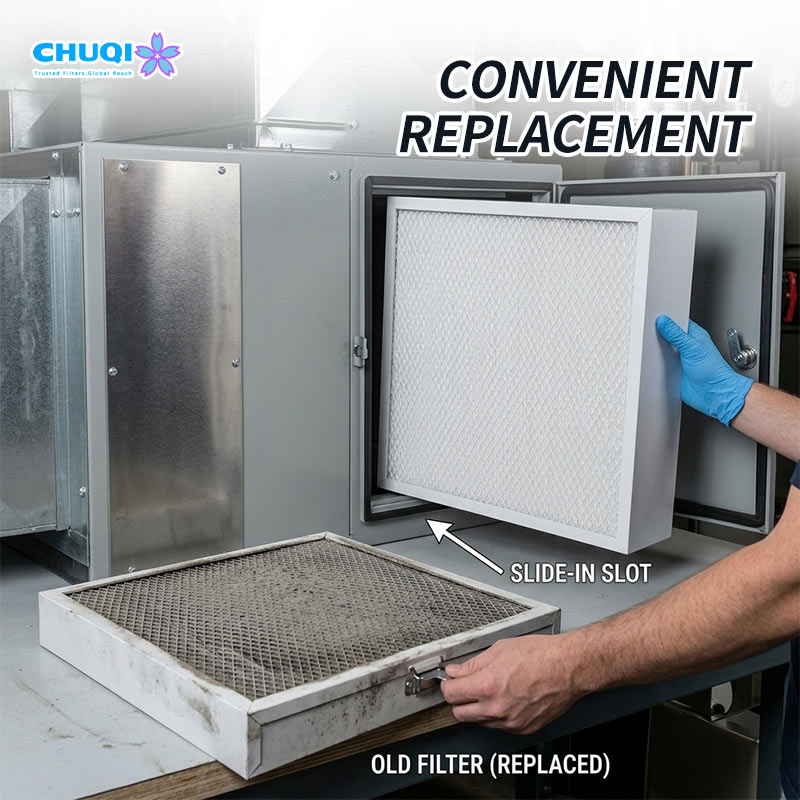
Extended Service Intervals: Slower resistance accumulation extends replacement cycles from a standard 12-month window out to 24–36 months (depending on ambient air quality and pre-filtration staging), directly cutting recurring labor and recertification costs.
Financial ROI Breakdown: CAPEX vs. OPEX Payback
When presenting budget upgrades to financial controllers or plant management, facility engineers can utilize a straightforward cost-benefit framework:
| Cost Component | Traditional Deep-Pleat Filters | Advanced Mini-Pleat HEPA Filters |
| Initial Unit Price (CAPEX) | Lower baseline unit cost | Moderately higher initial investment |
| Clean-State Resistance | High (150 Pa – 180 Pa) | Low (80 Pa – 110 Pa) |
| Annual Fan Energy Consumption | High kilowatt draw | Significantly reduced via lower static head |
| Replacement Frequency | Shorter intervals (higher labor & testing costs) | Extended intervals (fewer shutdowns) |
| Total Cost of Ownership (TCO) | High (Driven by compounding energy penalties) | Optimized (Full payback in 12–18 months) |
Mitigating Secondary Operational and Contamination Risks
Beyond direct energy savings, upgrading to rigid, high-integrity mini-pleat filters protects critical facilities against severe indirect operational and compliance risks:
Elimination of Media Fiber Shedding: Under high-velocity airflow or mechanical vibration, aging aluminum separators in traditional deep-pleat filters can fatigue, fray, or abrade the glass fiber media. Mini-pleats utilize continuous hot-melt bead stabilization, securely locking the pleat matrix and preventing micro-fiber migration into semiconductor lithography, aseptic pharmaceutical filling lines, or biotech cleanrooms.
Uniform Velocity Profile & Iso-kinetic Integrity: Uneven pressure drops across standard filters create localized air-velocity vectors (channeling), disrupting unidirectional downward laminar flow. Mini-pleat designs ensure an even, homogenous face-velocity profile across the entire filter matrix, satisfying strict ISO 14644 airflow visualization standards.
Zero-Bypass Sealing Architecture: When integrated with gel-seal channels or knife-edge framing systems, mini-pleats eliminate bypass leakage paths, ensuring absolute containment integrity and protecting high-value batches from catastrophic yield loss and regulatory audit non-compliance.
Technical Summary & Engineering Resources
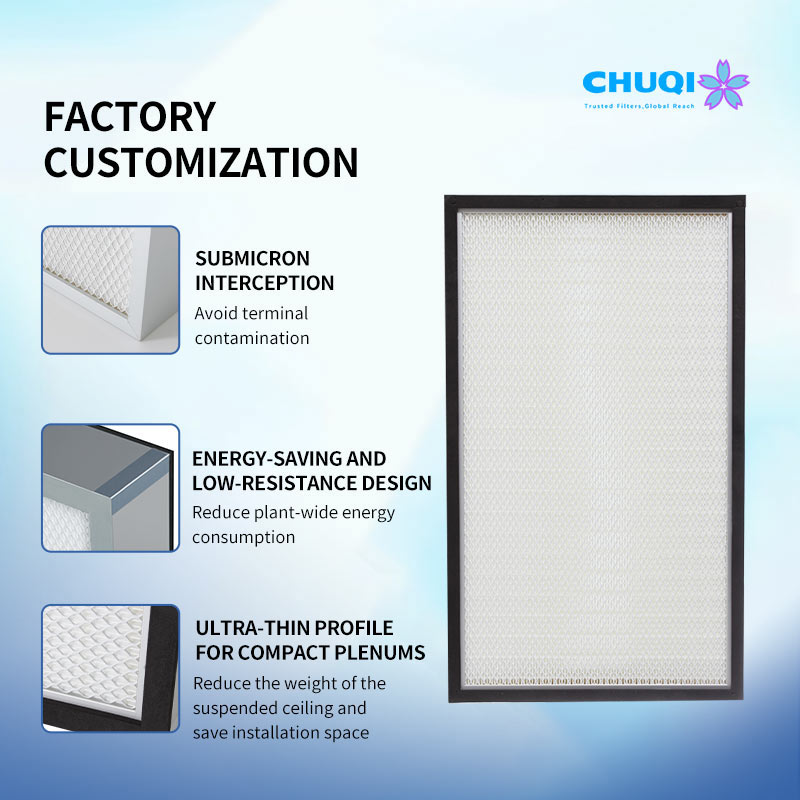
Upgrading to mini-pleat HEPA filters is a proven strategy to reduce cleanroom operational overhead by lowering static pressure, conserving EC fan energy, and extending maintenance intervals.
To explore our complete technical resources and product solutions, please review the following pathways:
Central Technical Framework: Return to our central Ultimate Engineering Guide to Mini-Pleat HEPA Filters to explore broader technical specifications and system-wide cleanroom design criteria.
Product Specifications: Visit our Mini-Pleat HEPA Filter Product Series to review specific structural configurations, custom dimensions, and performance curves for our energy-efficient filter units.
Engineering Consultation & Customization: If your facility requires a customized TCO energy-saving calculation, specialized frame materials, or bulk project pricing, you are welcome to connect with our engineering team for professional technical consultation and custom parameter alignment.