
When engineering gas-phase filtration systems for heavy industrial exhaust, automotive paint spray booths, or large-scale commercial HVAC installations, selecting the correct carbon filter architecture is essential for maintaining regulatory compliance (such as EPA and OSHA standards) while optimizing operating overhead. Although both V-bank chemical filters and standard activated carbon panel filters utilize physical adsorption to capture volatile organic compounds (VOCs), their internal geometry, active carbon mass loading, and aerodynamic pressure profiles differ substantially.
Understanding these technical distinctions enables plant engineers and B2B procurement managers to specify the most cost-effective, high-longevity solution for demanding high-airflow environments.
Structural Engineering and Active Carbon Mass Loadings
The primary divergence between V-bank and panel configurations lies in how adsorption media is distributed and contained within the frame footprint.
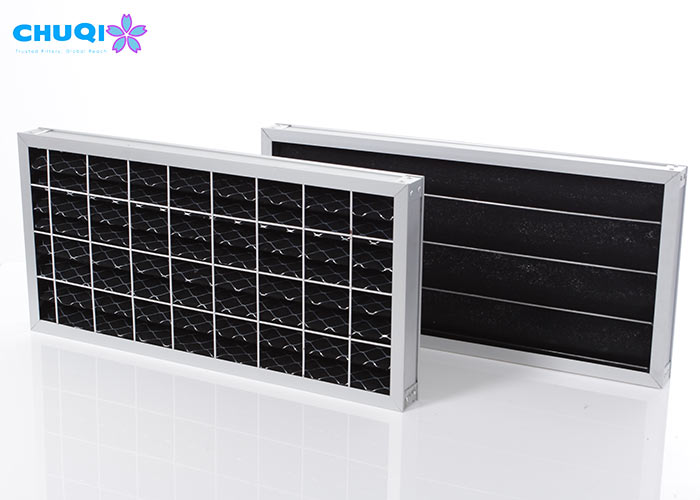
Activated Carbon Panel Filters(Shallow-Bed Design): Constructed as flat-face trays or shallow media pleats, panel filters are engineered primarily for light commercial applications. They typically house a modest carbon mass (2 kg to 5 kg per standard 24″x24″ unit), making them ideal for low-concentration odor attenuation in standard office buildings or secondary air-handling units.
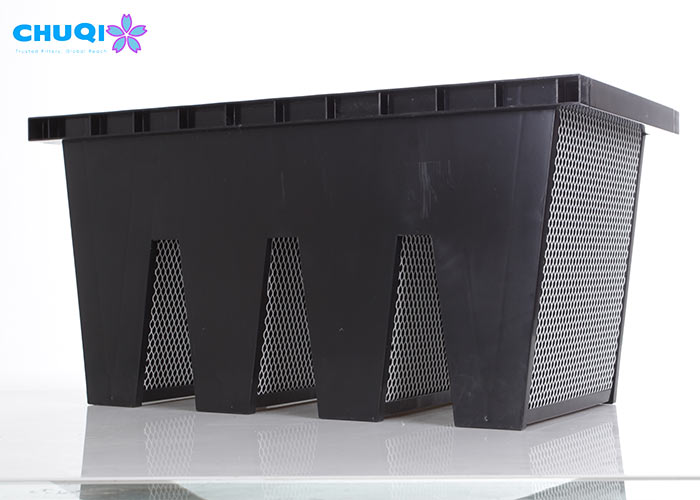
V-Bank Chemical Filters (High-Capacity Multi-Vee Architecture): V-bank systems integrate multiple independent, V-shaped mini-pleated media packs inside a rigid, high-density housing. This aerodynamic multi-vee geometry packs 3 to 4 times more active carbon mass (12 kg to 25 kg per standard unit) into the exact same spatial duct footprint.
Aerodynamics, Face Velocity, and Pressure Drop Performance
Industrial ventilation networks require continuous, high-volume air movement. Resistance to airflow directly dictates continuous fan motor energy consumption (kWh) and long-term operating expenditure.
Managing Initial Resistance: Flat panel filters frequently restrict airflow when exposed to standard industrial face velocities (>2.5 m/s), causing rapid pressure escalation and premature system blinding. V-bank modules utilize a divergent flow geometry that distributes incoming high-velocity air evenly across a massive surface area, sustaining an optimal initial pressure drop (110 Pa to 150 Pa).
Residence Time (Dwell Time) Calculations: Molecular adsorption efficiency is a direct function of contact time. V-bank systems provide a deeper, more tortuous media path, ensuring a target residence time of 0.1 s to 0.2 s. This guarantees complete mass transfer and prevents VOC breakthrough during peak emission surges.
Side-by-Side Engineering Specification Matrix
| Engineering Parameter | V-Bank Chemical Air Filters | Activated Carbon Panel Filters |
| Active Carbon Mass Load | 12 kg – 25 kg (High-capacity industrial) | 2 kg – 5 kg (Light commercial duty) |
| Rated Airflow Capacity | High (2,000 – 3,000 CFM) | Moderate (500 – 1,000 CFM) |
| Initial Pressure Drop (@ Rated Flow) | 110 Pa – 150 Pa | 80 Pa – 120 Pa |
| Target Residence / Dwell Time | 0.1 s – 0.2 s (Optimal adsorption kinetics) | <0.05 s (Shorter contact window) |
| Structural Frame Material | Rigid ABS plastic or Galvanized Steel | Lightweight cardboard or thin metal channel |
| Primary Industrial Application | Factory exhaust, paint shops, heavy HVAC | Commercial office odors & light intake filtration |
Specifying the Optimal Solution for Your Facility
For heavy industrial emissions, high chemical concentrations, or continuous high-airflow ventilation, V-bank systems deliver superior adsorption capacity, extended replacement intervals, and a lower total cost of ownership (TCO). For light commercial spaces with minimal contaminant loads, panel filters offer a space-saving alternative.
Ready to upgrade your emission control infrastructure? [Browse Our Industrial V-Bank Activated Carbon Filters Product Series] to review technical datasheets, sizing configurations, and direct factory wholesale pricing.
Seeking standard pre-filtration components? [Explore Our Air Filtration Media Rolls and Panel Filters Catalog]
For foundational insights into molecular adsorption physics, review our core engineering guide: [How Do Industrial Activated Carbon Filters and V-Bank Systems Maximize VOC Removal?].