When designing, upgrading, or maintaining commercial and industrial HVAC systems, selecting the correct combination of air filters is critical for system reliability, indoor air quality (IAQ), and energy cost control. Among the most widely specified filter classes under global standards are G-Series coarse filters (such as G4) and F-Series fine filters (such as F7).
Understanding the technical differences between G4 and F7 filters—and how they operate in a multi-stage filtration setup—helps engineers and facility managers optimize system performance and lower overall operational costs.
Introduction to G-Series Coarse Air Filters
The G-Series (G1–G4) classified under European standard EN 779 represents Coarse Air Filters (Primary Stage).
Filtration Mechanism: Relies primarily on physical impaction, interception, and mechanical straining.
Target Particulates: Designed to capture larger airborne particles (greater than 10 μm), including coarse atmospheric dust, lint, plant pollen, insects, sand, and hair.
Core Function: Functions as the primary protective barrier at the fresh air intake or return air stage. By removing large particulates early, G-series filters protect downstream supply fans, heating/cooling coils, and fine secondary filters from severe dust loading and physical damage.
Introduction to F-Series Fine Air Filters
The F-Series (F5–F9) covers Fine Air Filters (Medium to Fine Secondary Stage) under EN 779 (commonly mapped to ISO ePM2.5 and ISO ePM1 under ISO 16890).
Filtration Mechanism: Employs fine synthetic or glass fiber matrices to capture micro-particles via diffusion and fine interception.
Target Particulates: Engineered for microscopic particulates (0.4 μm to 2.5 μm), such as PM2.5, fine atmospheric dust, combustion smoke, bacteria, fungal spores, and welding fumes.
Core Function: Functions as the main filtration stage for commercial indoor air quality or as an essential protective barrier directly upstream of HEPA/ULPA terminal filters in critical cleanroom environments.
Key Differences: G4 vs. F7 Filters
| Comparison Dimension | G4 Filter (Coarse / Primary) | F7 Filter (Fine / Secondary) |
| Filter Class | Coarse Filter (EN 779: G4) | Fine Filter (EN 779: F7) |
| Target Particle Size | > 10 μm (Coarse dust, lint, sand) | 0.4 μm – 2.5 μm (Fine dust, smoke, PM2.5) |
| Average Efficiency | Gravimetric Arrestance > 90% | Spot Efficiency (0.4 μm) 80% – 90% |
| ISO 16890 Rating | ISO Coarse 60% – 90% | ISO ePM1 50%–65% / ISO ePM2.5 65%–80% |
| Initial Resistance | Low initial pressure drop (30–50 Pa) | Higher initial pressure drop (80–120 Pa) |
| Primary Media | Synthetic non-woven, wire-backed mesh | Melt-blown synthetic, sub-micron glass fiber |
| Primary Role | Fan & coil protection; primary intake | Indoor Air Quality (IAQ) & HEPA protection |
In-Depth Application Scenarios & Product Selection Guide
To achieve maximum filtration efficiency and cost performance, different filter structural formats (such as pleated panels, sub-mother frames, pocket bags, or deep-pleat V-banks) are selected based on the specific industrial environment.
A. G-Series Primary Filters: Application Scenarios & Guidelines
G-Series primary filters are built to process high airflow volumes and heavy dust concentrations at minimal pressure drop.
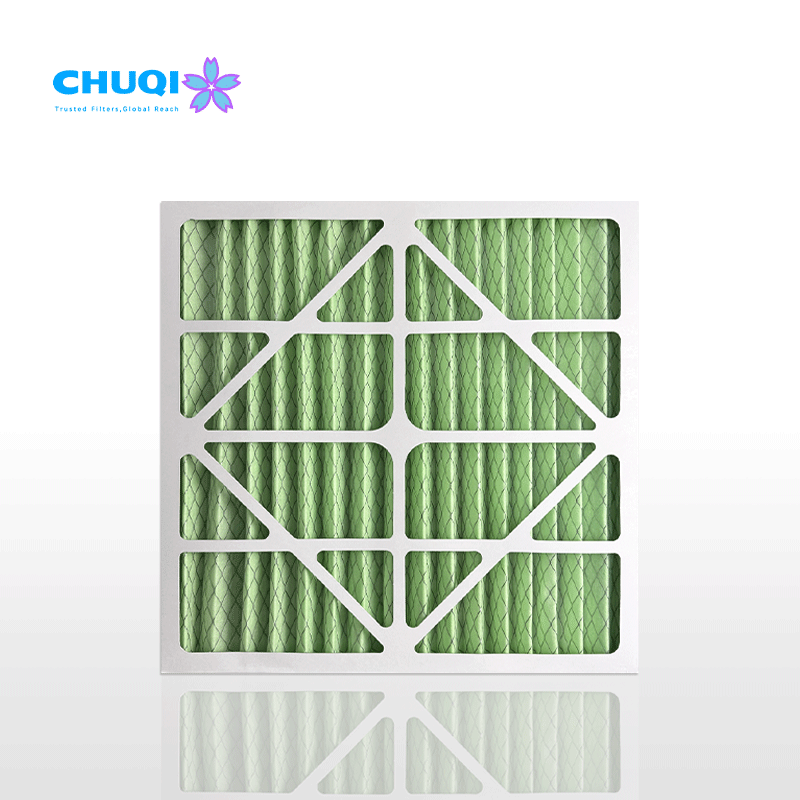
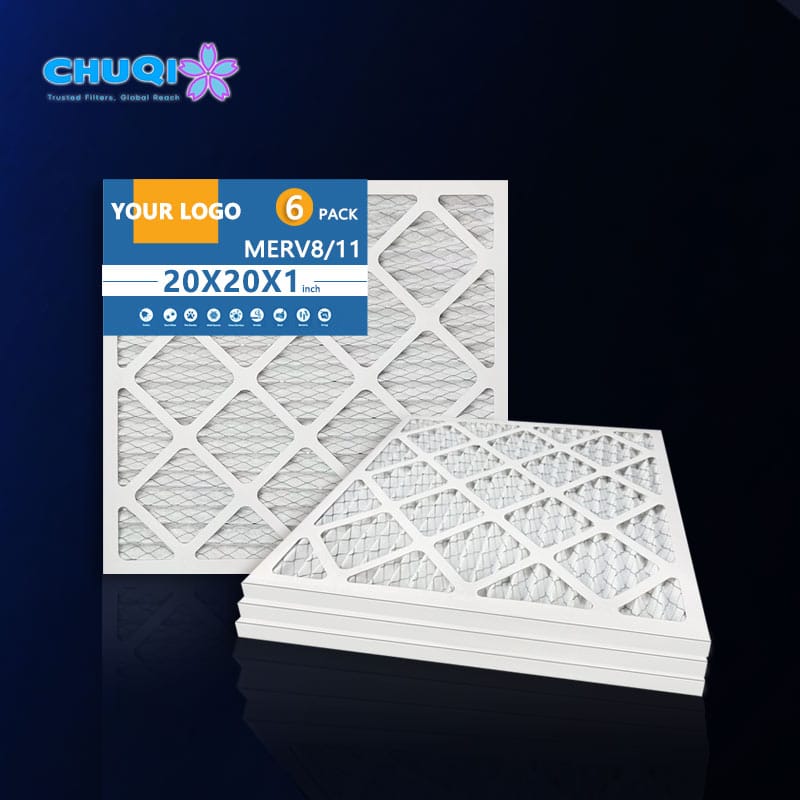
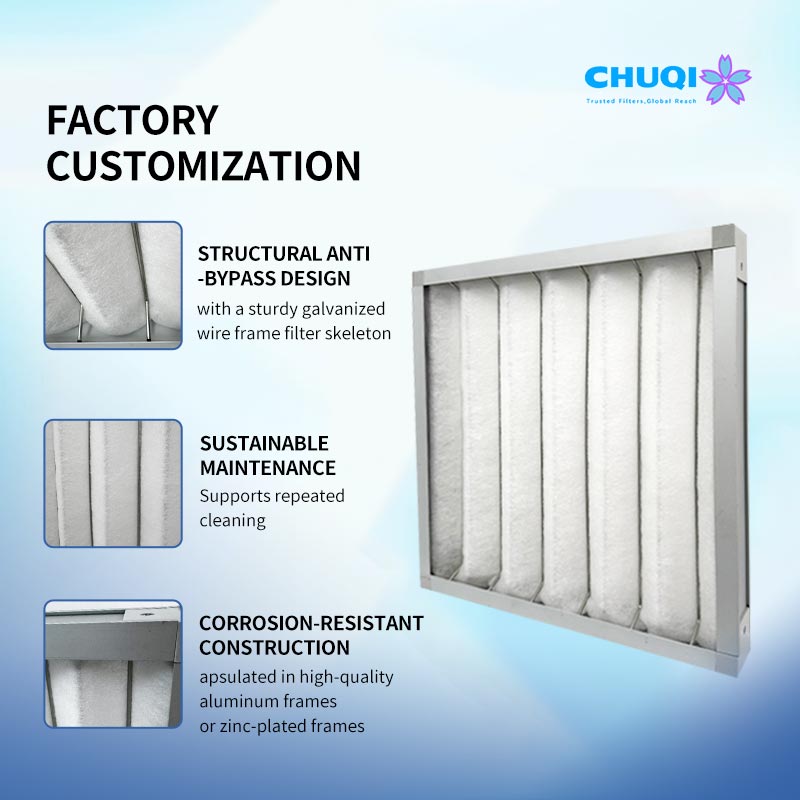
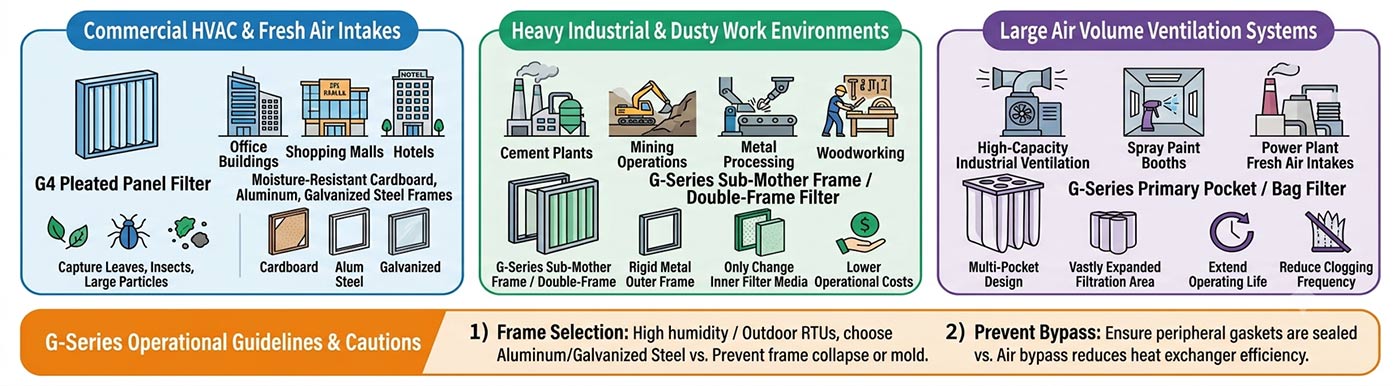
Commercial HVAC & Fresh Air Intakes (G4 Pleated Panel Filters)
Application: Office buildings, shopping malls, hotels, and general manufacturing workshops. G4 primary pleated panel filters (available in moisture-resistant beverage board, aluminum, or galvanized frames) are installed at fresh air intake louvers to capture leaves, insects, and large dust particles before air enters the air handling unit (AHU).
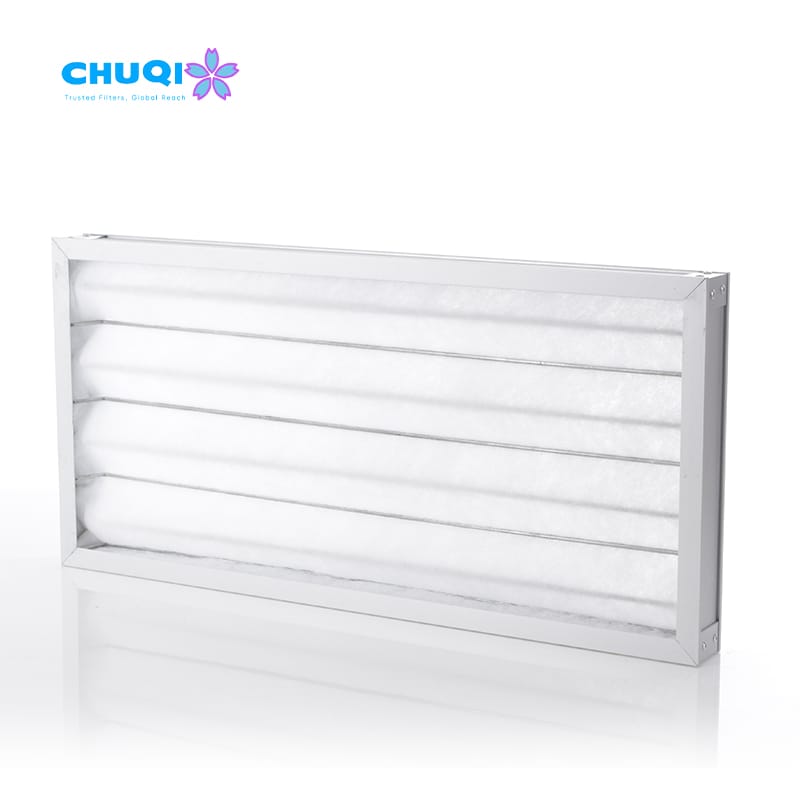
Heavy Industrial & Dusty Work Environments (G-Series Sub-Mother Frame / Double-Frame Filters)
Application: Cement plants, mining facilities, metal processing workshops, and woodworking facilities where particulate loading is extremely heavy. The rigid sub-mother outer metal frame stays permanently installed in the duct work, allowing maintenance teams to quickly swap out only the inner filter pad media, dramatically cutting operational material costs.
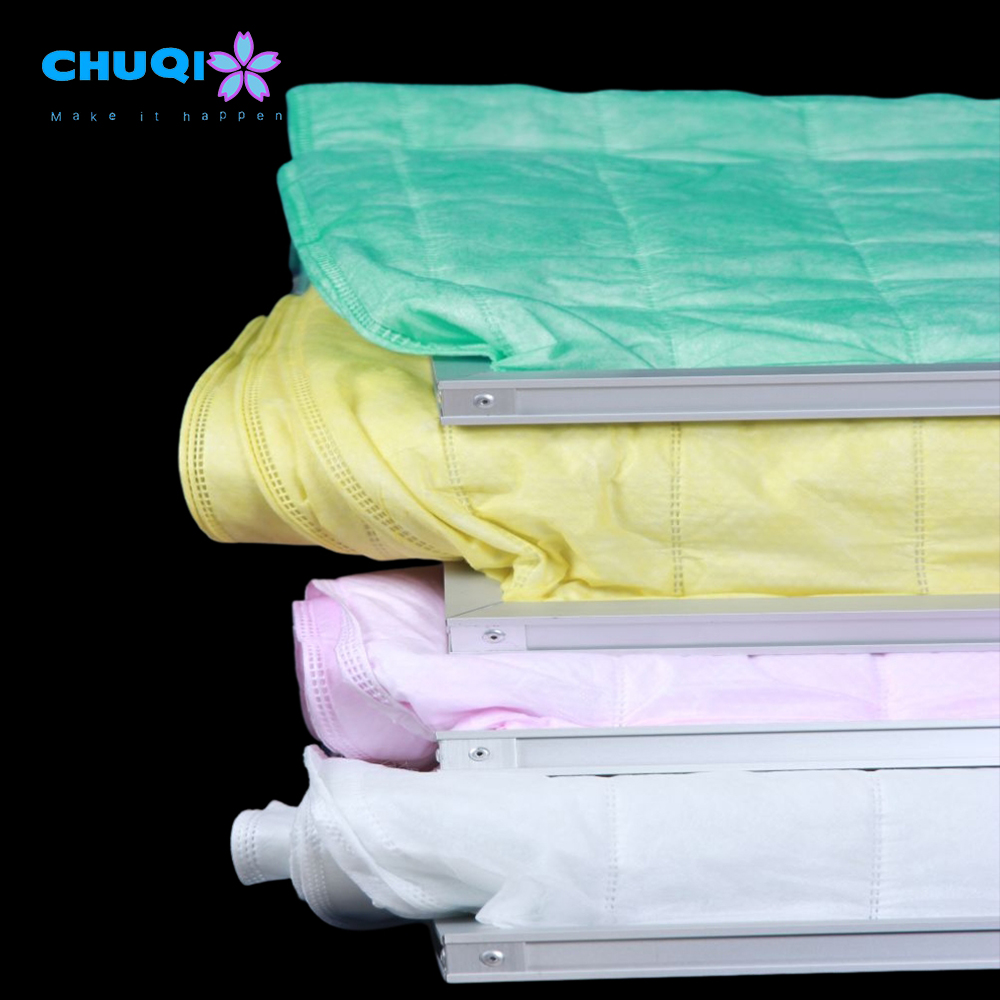
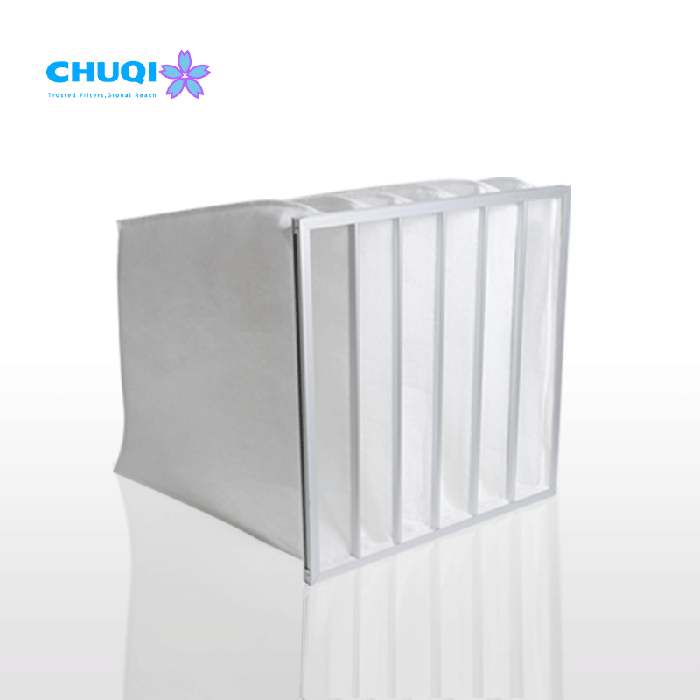
Large Air Volume Ventilation Systems (G-Series Primary Pocket / Bag Filters)
Application: High-capacity industrial ventilation, spray paint booth fresh air systems, and power generation air intakes. The multi-pocket design offers a vastly expanded filtration surface area compared to flat panels, allowing prolonged operation without frequent clogging.
G-Series Operational Guidelines & Cautions:
Frame Selection: In high-humidity climates or outdoor rooftop units (RTUs), choose aluminum or galvanized steel frames over cardboard to prevent structural collapse or mold growth.
Bypass Prevention: Ensure peripheral gaskets are properly sealed during installation. Air bypass around G-Series filters allows heavy dust to settle on cooling coils, severely compromising heat exchanger efficiency.
B. F-Series Fine Filters: Application Scenarios & Guidelines
F-Series fine filters are designed for environments requiring strict particulate control, micro-pollutant removal, and high air purity standards.
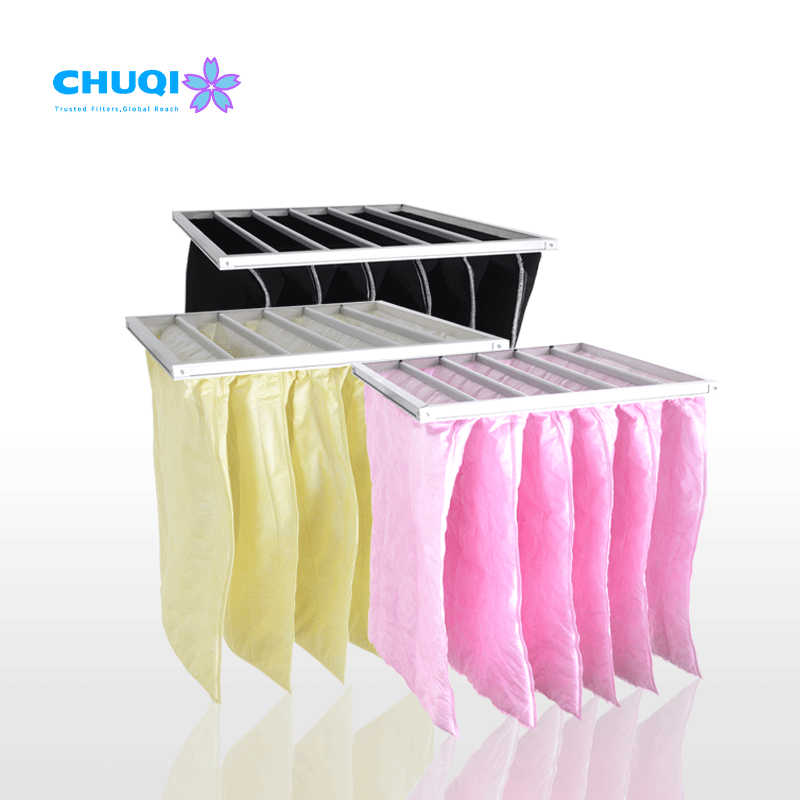
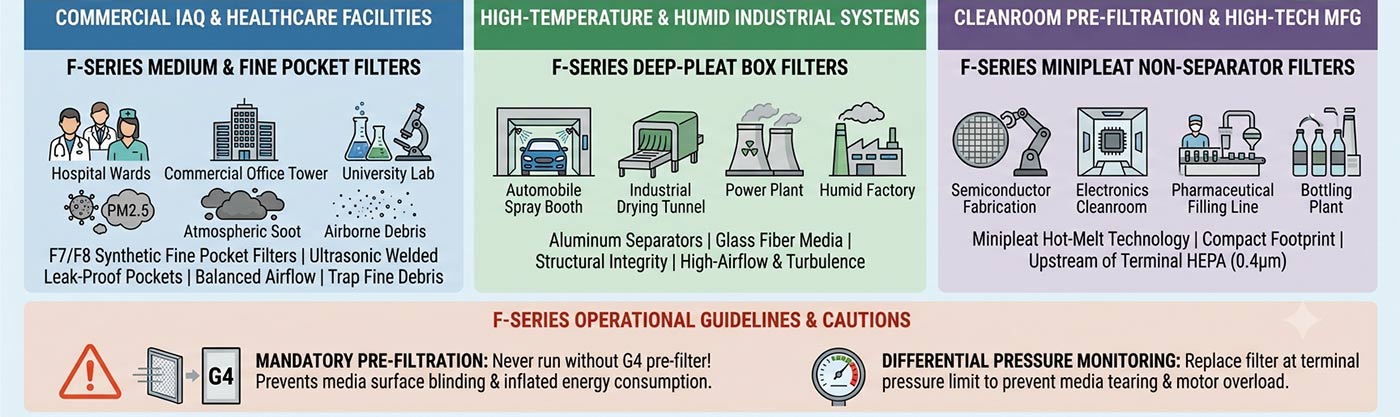
Commercial IAQ & Healthcare Facilities (F-Series Medium & Fine Pocket / Bag Filters)
Application: Hospital wards, commercial office towers, university laboratories, and public venues. F7/F8 synthetic fine pocket filters feature ultrasonic welded leak-proof pockets that ensure balanced airflow distribution while efficiently trapping PM2.5, atmospheric soot, and fine airborne debris.
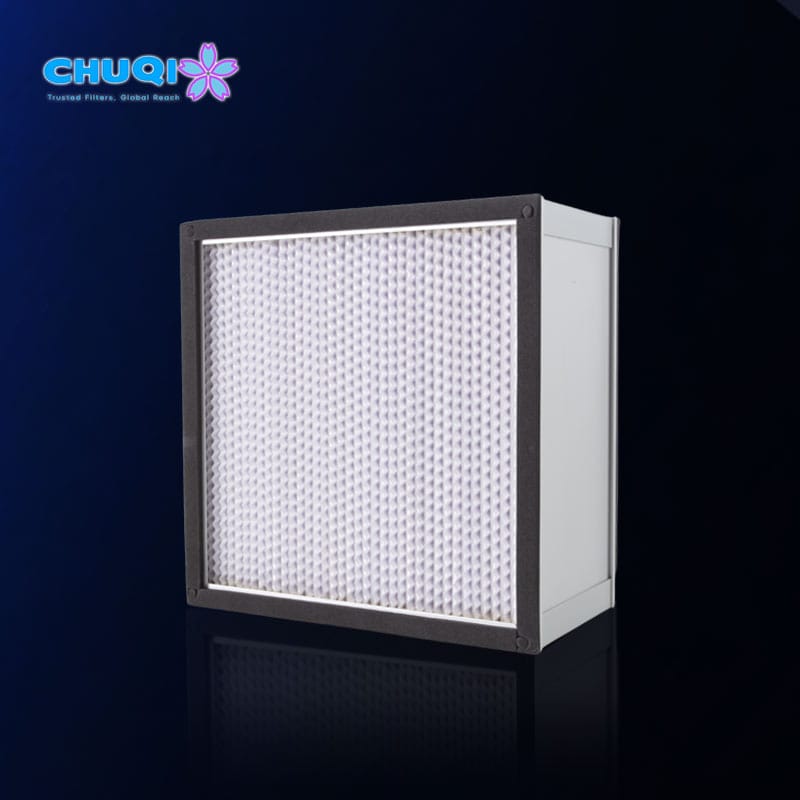
High-Temperature & High-Humidity Industrial Systems (F-Series Deep-Pleat Box Filters with Aluminum Separators)
Application: Automobile spray booths, industrial drying tunnels, power plants, and humid manufacturing environments. Corrugated aluminum separators space the glass fiber media packs uniformly, ensuring high structural integrity and stable pressure drop under high-airflow turbulence or elevated temperatures.
Cleanroom Pre-Filtration & High-Tech Manufacturing (F-Series Minipleat Non-Separator Filters)
Application: Semiconductor fabrication, electronics cleanrooms, pharmaceutical filling suites, and food/beverage bottling plants. Utilizing minipleat hot-melt technology, V-bank and header-frame non-separator filters provide an extended filter surface in a compact footprint. Positioned directly upstream of terminal HEPA filters, they capture mid-range contaminants (0.4 μm) to prevent premature fouling of expensive HEPA units.
F-Series Operational Guidelines & Cautions:
Mandatory Pre-Filtration: Never run F-Series fine filters without a G4 pre-filter. Exposing fine filter media directly to raw outdoor air causes rapid surface blinding, leading to severe pressure drops and inflated energy consumption.
Differential Pressure Monitoring: Install differential pressure gauges across F-Series filter banks. Filters must be replaced when reaching their recommended terminal pressure limit to prevent media tearing or motor overload.
International Efficiency Standards Compliance
When specifying air filters for global engineering projects, verification against current international testing standards is essential:
EN 779:2012 Standard Compliance:
G4 Class: Average arrestance Am ≥ 90% (tested with synthetic coarse dust).
F7 Class: Average efficiency Em ≥ 80% for 0.4 μm particles; minimum efficiency ME ≥ 35%.
ISO 16890 Compliance (Current Global Standard):
G4 maps to ISO Coarse 60% – 90%.
F7 maps to ISO ePM1 50%–65% or ISO ePM2.5 65%–80% (evaluating performance across particle sizes from 0.3 μm to 10 μm).
ASHRAE 52.2 Cross-Reference:
G4 corresponds roughly to MERV 7 – MERV 8.
F7 corresponds roughly to MERV 13.
Comprehensive Maintenance Cycles & Replacement Standards
Establishing a systematic preventive maintenance schedule is critical for optimizing HVAC performance. Neglecting air filter replacement leads to reduced airflow, system strain, increased fan energy consumption (which can rise by 20%–30% under clogged filters), and potential indoor air contamination.
A. Maintenance Guidelines & Replacement Indicators
| Filter Category | Inspection Frequency | Average Replacement Lifecycle | Initial Resistance | Final Recommended Resistance (Terminal ΔP) |
| G-Series Primary Filters (G1–G4 Pleated Panel, Sub-Mother, Pocket) | Monthly visual inspection | 1 to 3 Months (Up to 6 months in low-dust environments) | 30–50 Pa | 150–250 Pa |
| F-Series Fine Filters (F5–F9 Pleated Box, Pocket, V-Bank) | Bi-Monthly gauge check | 6 to 12 Months (Up to 18 months with high-grade pre-filtration) | 80–120 Pa |
B. Core Factors Influencing Filter Lifespan
Rather than relying strictly on fixed calendar dates, HVAC maintenance engineers should evaluate three key operational factors:
Differential Pressure (ΔP) Readings: The most accurate metric for filter replacement. Always change filters when the pressure drop reaches double its initial resistance or hits the manufacturer’s recommended terminal resistance (250 Pa for primary, 450 Pa for secondary).
Ambient Environmental Air Quality: Facilities located in industrial zones, near construction sites, or regions prone to seasonal dust storms or high pollen levels will require 30% to 50% shorter replacement intervals for G-Series pre-filters.
HVAC System Operating Hours: A facility running 24/7 (such as a hospital or semiconductor plant) will load filter media much faster than a standard commercial office operating 8 to 10 hours a day.
C. Best Practices for Maintenance & Cleaning
G-Series Primary Filters (Washable vs. Disposable):
Disposable Pleated Panels: Must be fully replaced when dust loading reaches capacity. Attempting to blow dust out with compressed air damages the synthetic matrix and compromises filtration efficiency.
Washable Mesh / Metal Frames: Clean with low-pressure liquid spray or mild detergent solution. Ensure media is 100% dry before reinstalling to prevent mold and bacterial growth inside the ductwork.
F-Series Fine Filters (Non-Washable):
Fine filter media (melt-blown synthetic or glass fiber) relies on delicate micro-structures and electrostatic charges. F-Series filters should never be washed, vacuumed, or blown out with compressed air. Any mechanical impact destroys the micro-fiber arrangement and creates micro-tears that cause immediate leakage.
Gasket & Housing Inspection During Swaps:
Every time a G4 or F7 filter is replaced, inspect the mounting frame perimeter, hold-down clips, and rubber seals. Damaged sealing gaskets allow untreated air to bypass the filter bank completely, nullifying the efficiency of the entire filtration system.
Get Custom Air Filtration Solutions & Factory-Direct Pricing
Looking for high-efficiency G4 primary filters, heavy-duty sub-mother frames, or EN 779 / ISO 16890 certified F7 pocket and box filters for your HVAC project or wholesale supply?
We offer custom sizes, OEM manufacturing, and strict quality control adhering to global filtration standards.
Contact Our Engineering Team Today for Custom Quotes & Technical Support