
Selecting a HEPA filter for a cleanroom is not simply a matter of choosing H13 or H14. A filter may meet the required efficiency classification but still fail to deliver the expected performance if its airflow capacity, construction, sealing arrangement or installation conditions are unsuitable.
For example, a filter with high filtration efficiency cannot compensate for insufficient airflow. Likewise, a factory-tested HEPA filter may not provide effective filtration after installation if air bypasses the filter through gaps around its frame.
A reliable cleanroom HEPA filter selection process starts with the function of the room and the design of the air-handling system. This guide explains the key decisions involved, why they matter, and how to avoid common selection mistakes.
1. Start with the Cleanroom Environment, Not Just the HEPA Grade
Before choosing a filter, understand what the cleanroom is designed to control.
Different cleanroom applications have different contamination risks, airflow requirements and operating conditions. A pharmaceutical filling area, semiconductor production room and medical device assembly area may all use HEPA filtration, but their filtration strategies are not necessarily identical.
The first distinction to understand is the difference between a cleanroom classification and a HEPA filter classification.
Cleanroom classification describes the cleanliness of the room. HEPA classification describes the filtration performance of the filter.
For example, ISO Class 5 and ISO Class 7 describe limits for airborne particle concentrations under defined classification conditions. They do not automatically specify that a particular HEPA grade must be used.
The required filter grade depends on the overall cleanroom design, including:
The cleanliness target and the particles that need to be controlled.
The number of people working in the room and their activities.
Equipment, processes and potential contamination sources.
Air supply volume and airflow distribution.
The location of terminal filters and the design of the return-air system.
This is why two cleanrooms with different ISO classifications may use similar HEPA filter grades but have different airflow arrangements and filter quantities.
Practical point: Do not select a HEPA filter based on the ISO class alone. The filter must work as part of the complete air distribution and contamination-control system.
2. H13 or H14: Does a Higher HEPA Grade Always Mean Better Performance?
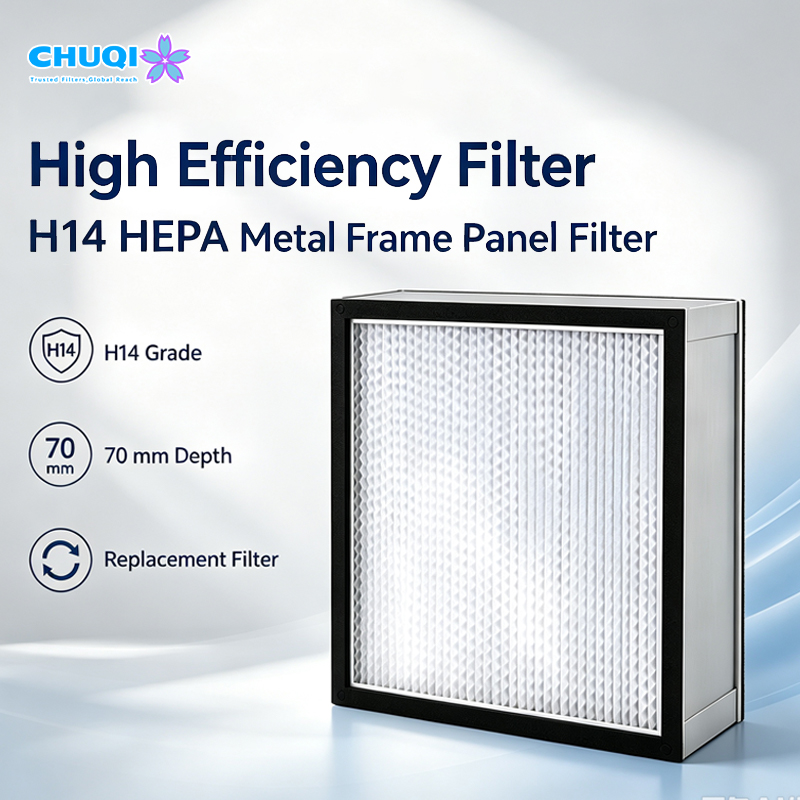
H13 and H14 are common choices for cleanroom HEPA filtration, but choosing the higher grade is not automatically the better engineering decision.
Under EN 1822, HEPA filters are classified according to their efficiency at the most penetrating particle size (MPPS).
The commonly used classification thresholds are:
| Filter Class | Integral Efficiency at MPPS | Local Efficiency at MPPS |
|---|---|---|
| H13 | ≥99.95% | ≥99.75% |
| H14 | ≥99.995% | ≥99.975% |
The integral efficiency describes the overall filter performance, while the local efficiency requirement addresses performance at the most penetrating area of the filter.
The difference between H13 and H14 is significant. However, the appropriate choice depends on the cleanroom design and the consequences of particle contamination.
For example:
An application may use H13 where the system design and cleanliness target allow it.
A more contamination-sensitive process may require H14 or another specified filtration arrangement.
A project may require different grades at different stages of the air-handling system.
A higher-efficiency filter can also have different airflow resistance depending on its media, construction and operating conditions. If the selected filter creates excessive resistance for the existing fan system, the actual air volume may fall below the design requirement.
This can affect air changes, airflow balance and the ability of the room to maintain its intended cleanliness.
The better question is not simply whether H14 is better than H13. It is whether the selected grade delivers the required filtration performance while remaining compatible with the system’s airflow design.
For a more detailed explanation of EPA, HEPA and ULPA classifications, see our guide to HEPA Filter Grades Explained.
3. Why Airflow Matters as Much as Filtration Efficiency
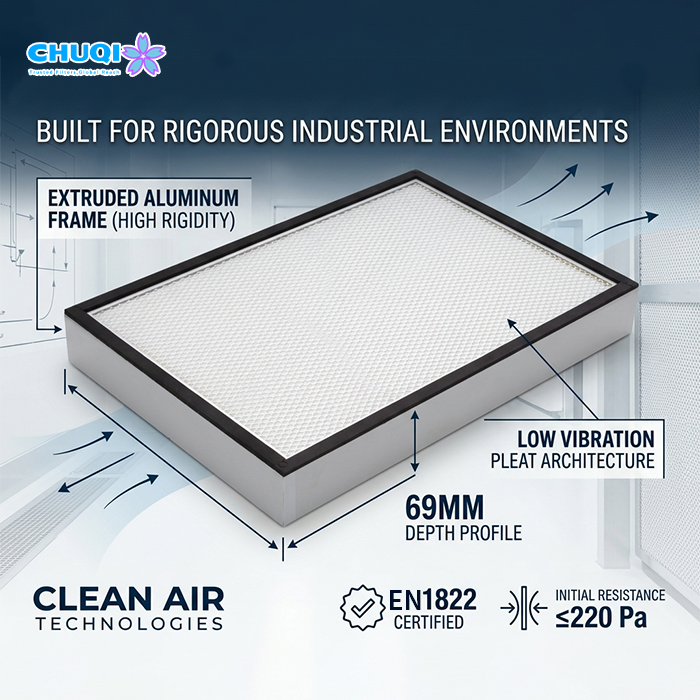
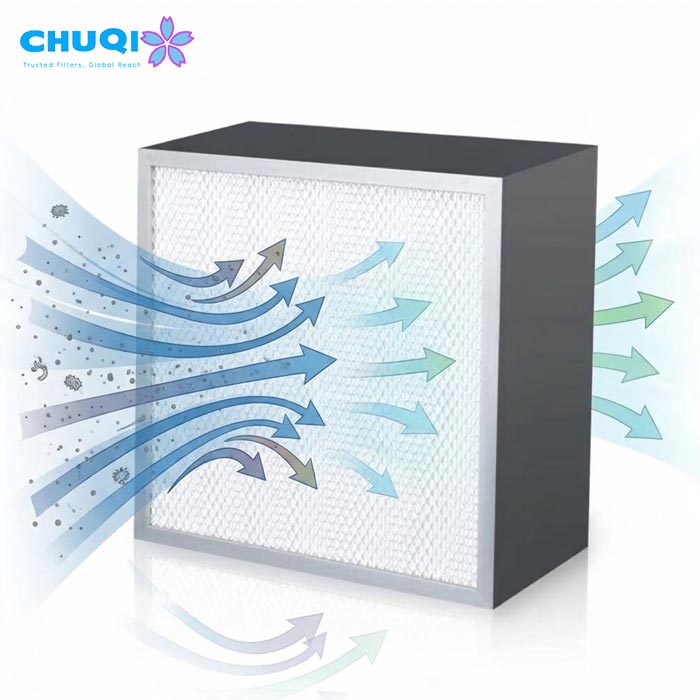
A HEPA filter must capture particles while allowing the required volume of air to pass through the system.
This is particularly important in cleanrooms, where airflow helps dilute and remove airborne contamination.
A filter with excellent particle efficiency may still be unsuitable if its airflow capacity does not match the air-handling system.
One useful starting point is face velocity.
Face velocity is calculated by dividing the airflow volume by the filter’s nominal frontal area.
Face velocity formula:
Face velocity (m/s) = Airflow (m³/h) ÷ [3600 × Filter face area (m²)]
Consider a filter measuring 610 × 610 mm with a nominal airflow of 1,000 m³/h.
The frontal area is:
0.61 × 0.61 = 0.3721 m²
The calculated face velocity is:
1,000 ÷ (3600 × 0.3721) ≈ 0.75 m/s
This is the nominal face velocity based on the filter’s frontal dimensions. It is not the actual air velocity through the filter media, which depends on the effective media area and pleat construction.
Why does this distinction matter?
Two HEPA filters with identical external dimensions can have different media areas because of differences in pleat depth, pleat count and construction. Their airflow resistance and operating characteristics may therefore differ.
When evaluating airflow, consider three related factors:
1. Rated airflow
The filter must be suitable for the air volume required by the system.
2. Initial pressure drop
A lower initial pressure drop can help reduce the resistance the fan needs to overcome, provided the filter still meets the required efficiency and structural performance.
3. Operating pressure drop
As particles accumulate, filter resistance generally increases. The fan must be capable of maintaining the required airflow as the filter loads.
A filter that works well at the beginning of its service life may become unsuitable if the system cannot maintain sufficient airflow as resistance rises.
For a closer look at airflow calculations and filter operating conditions, read our guide to HEPA Filter Airflow.
You can also learn how initial resistance, loading and airflow are related in HEPA Filter Pressure Drop.
4. Mini-Pleat, Separator or V-Bank: How Does Filter Construction Affect Selection?
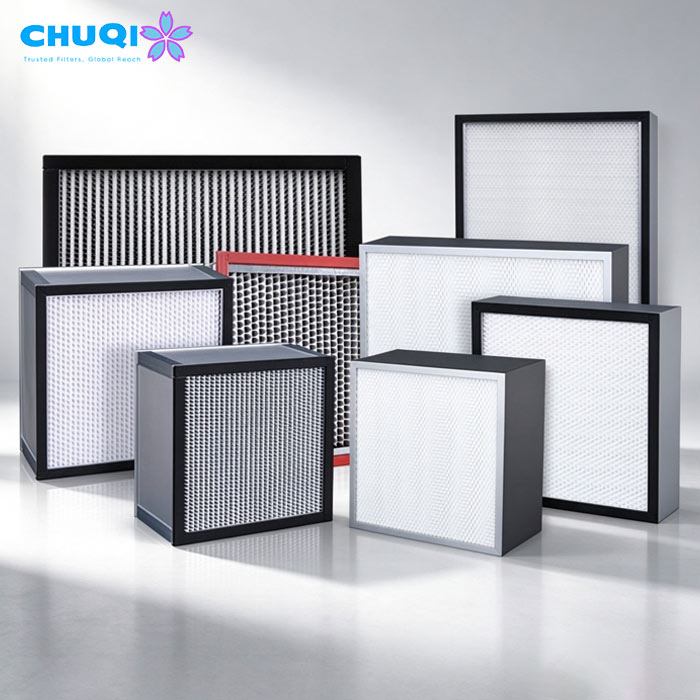
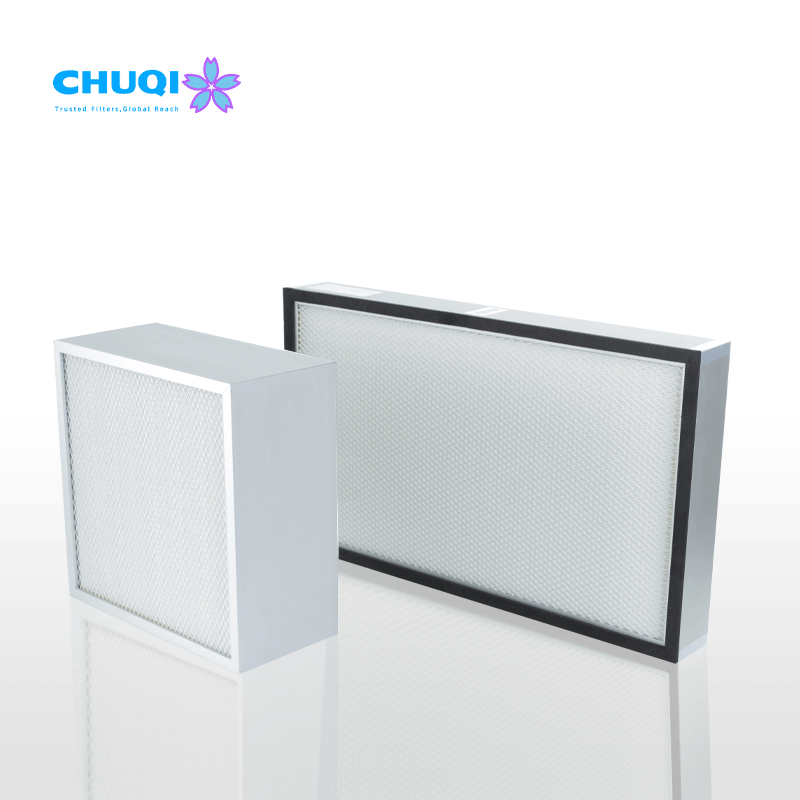
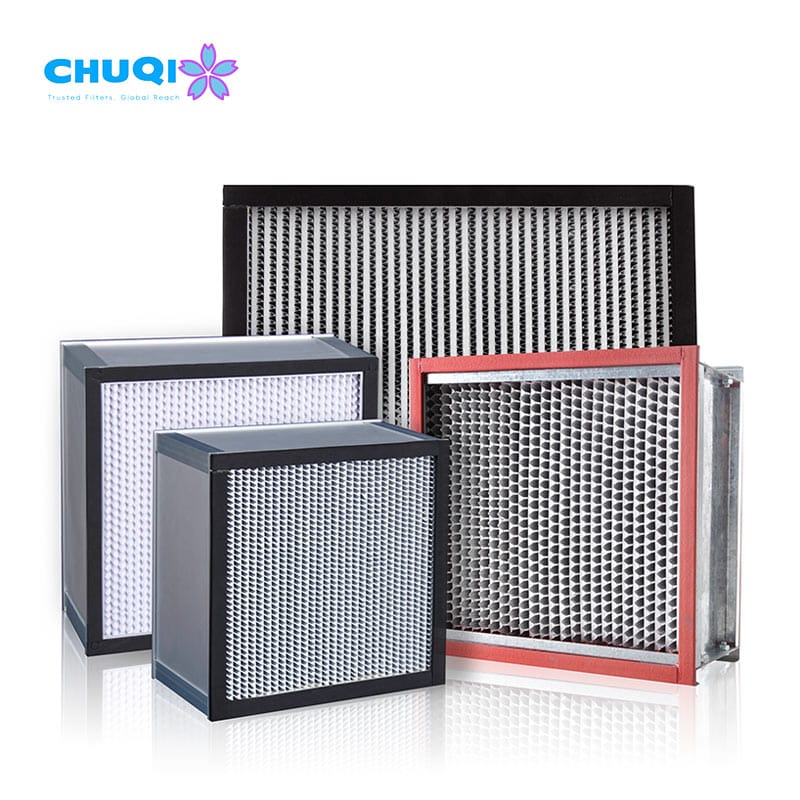
HEPA filter construction influences more than appearance. It affects media area, airflow resistance, structural support, dimensions and installation compatibility.
Three terms frequently appear when comparing HEPA filter designs: mini-pleat, separator and V-bank. However, they do not describe exactly the same type of construction.
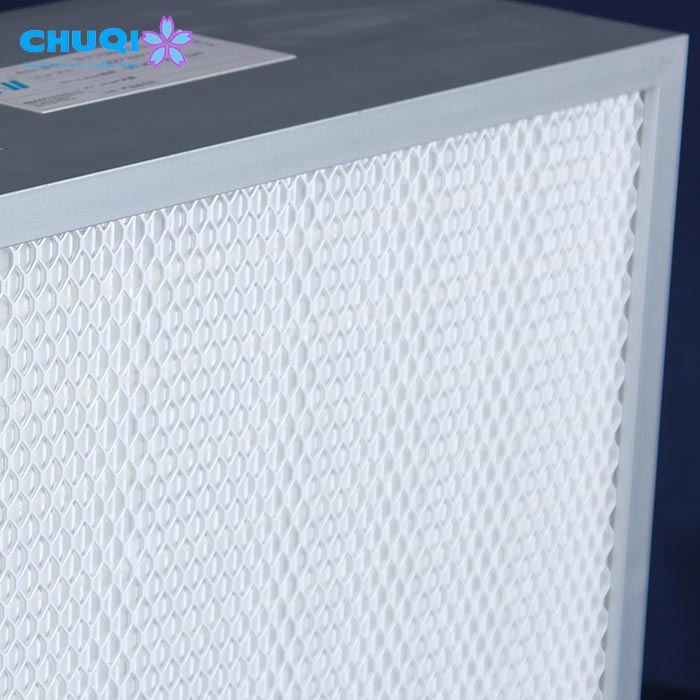
Mini-pleat filters use closely spaced, compact pleats to increase the available filtration media area within a limited frame size.
Their design can provide a large effective media area without requiring a deep filter pack.
Typical considerations include:
Compact construction for terminal filtration applications.
Pleat stability and spacing.
Media area within the available dimensions.
Compatibility with the required airflow and pressure drop.
Mini-pleat designs are commonly used in cleanroom terminal filtration and fan filter units, depending on the equipment design.
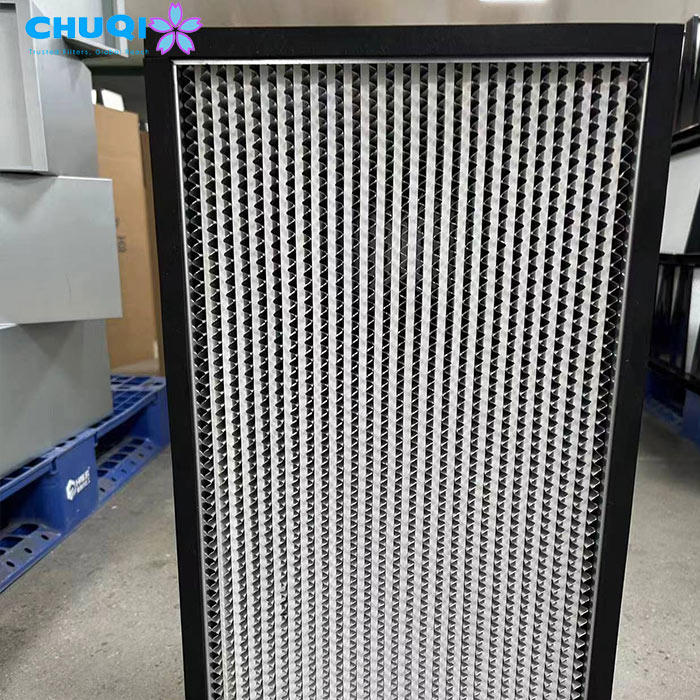
Separator-type filters use spacers between the pleats to maintain separation and support the media pack.
The separators help preserve the air passages through the filter and prevent pleats from collapsing or coming into contact under operating conditions.
Important considerations include:
Separator material and construction.
Pleat spacing and media pack stability.
Filter depth and overall dimensions.
Pressure drop and airflow capacity.
Separator construction may be suitable for applications where the filter design requires this type of media-pack support.
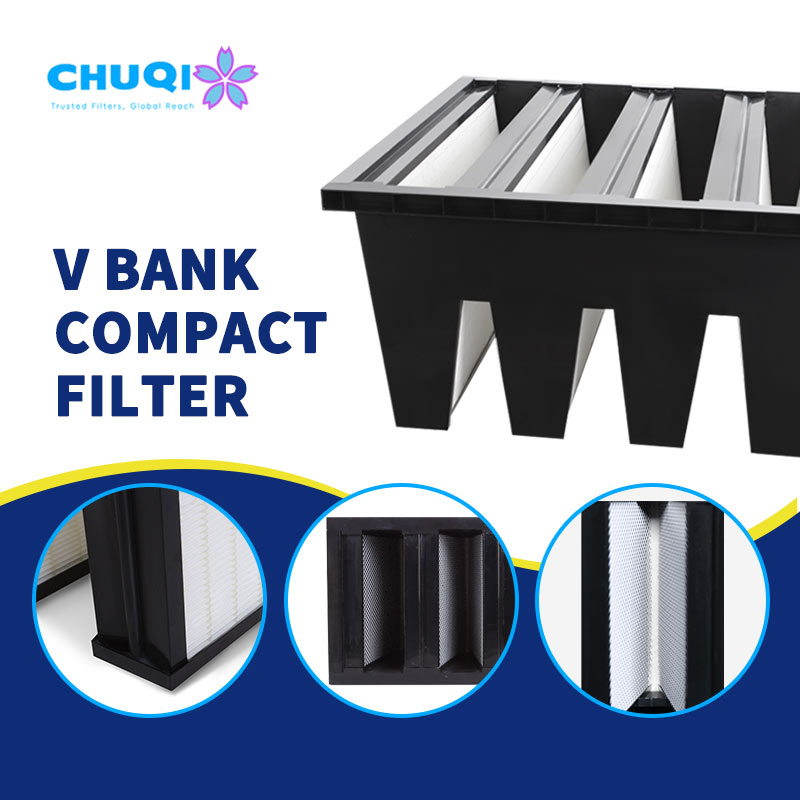
V-bank describes an overall filter arrangement in which multiple filter packs are positioned in a V-shaped configuration within a common frame.
This arrangement increases the available filtration area within a given face area and can be useful where high airflow capacity is required.
V-bank filters are often considered for larger air-handling systems and applications where equipment space and airflow requirements influence the filter layout.
They should not be treated as simply another version of a mini-pleat or separator media pack. V-bank describes the overall filter arrangement, while mini-pleat and separator refer to media-pack construction.
Which Design Should You Choose?
There is no universally best construction.
A compact terminal HEPA filter, a replacement filter for an FFU and a high-capacity air-handling filter may require different designs.
The decision should reflect the equipment’s available installation space, required airflow, pressure drop, filter depth and maintenance arrangement.
A filter with more media area is not automatically suitable if its dimensions or connection design do not fit the existing equipment.
5. Why HEPA Filter Frame Materials and Seals Matter
The filter media is responsible for capturing particles, but the frame and sealing arrangement help ensure that air passes through the media rather than around it.
This is a critical part of cleanroom filtration.
A filter can have excellent media efficiency and still perform poorly in service if its frame deforms, its gasket does not seal properly or the installation interface allows bypass leakage.
Choosing the Right Frame Material
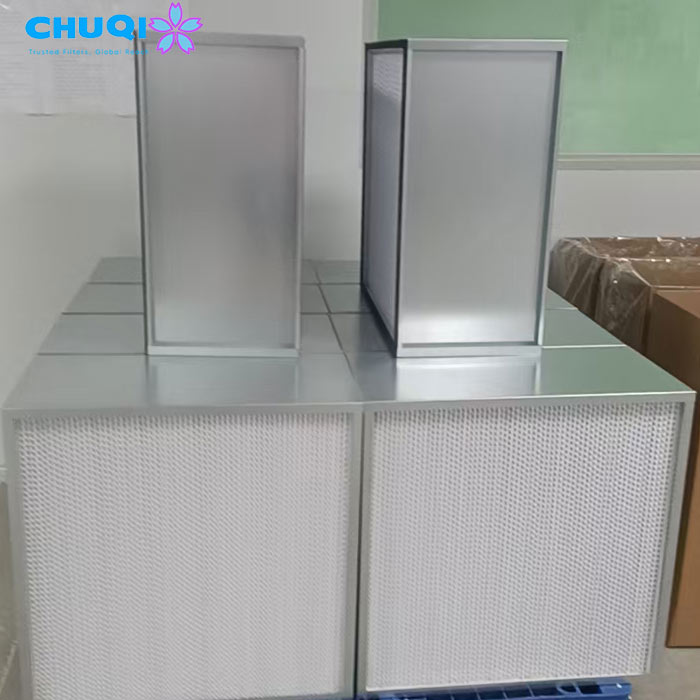
Common HEPA filter frame materials include aluminum, galvanized steel and stainless steel.
Each has different characteristics.
| Frame Material | Typical Characteristics | Common Considerations |
|---|---|---|
| Aluminum | Lightweight and corrosion-resistant in many indoor environments | Useful where low weight and handling are important |
| Galvanized steel | Rigid and widely used in industrial filter construction | Consider the operating humidity and potential coating damage |
| Stainless steel | Good corrosion resistance, depending on grade and environment | Often considered for demanding hygiene, cleaning or moisture conditions |
The correct material depends on the operating environment, cleaning procedures, equipment design and expected service conditions.
For example, a filter installed in a dry indoor cleanroom may have different frame requirements from one exposed to frequent cleaning or a humid process environment.
Frame selection should also account for filter weight, support structure and how the filter is secured in the housing.
For a more detailed comparison, see HEPA Filter Frame Materials: How to Choose the Right Frame.
Why the Sealing Arrangement Is Important
The gasket or seal creates the interface between the filter and its mounting frame.
If the seal is damaged, compressed unevenly or incompatible with the equipment, air may pass around the filter instead of through the filtration media.
Common sealing arrangements include:
Gasket seals around the filter perimeter.
Gel-seal designs used with compatible gel-seal housings.
Other equipment-specific sealing interfaces.
The correct option depends on the filter housing and installation design.
A filter should not be selected solely because its external dimensions match the opening. The sealing method and mounting interface must also be compatible.
A correctly sized filter with an unsuitable seal can still create a bypass problem.
6. Why Can a Factory-Tested HEPA Filter Still Leak After Installation?
This is one of the most important issues in cleanroom filtration.
A factory-tested HEPA filter and an installed HEPA filtration system are not the same thing.
Factory testing evaluates the filter according to the applicable test and classification requirements. Depending on the filter class and test method, this may include efficiency testing and leakage assessment.
However, once the filter is installed, the complete assembly introduces additional potential leakage points.
These may include:
Gaps between the filter frame and housing.
Damaged or unevenly compressed gaskets.
Incorrect installation or locking.
Deformation of the filter frame.
Leakage at joints or connections in the surrounding structure.
This is why installation integrity matters just as much as the filter’s factory performance.
For critical cleanroom applications, installed filter leakage testing may be required as part of the cleanroom commissioning or qualification process.
A suitable test method can help identify leakage through the filter media, around the filter perimeter or at the installation interface, depending on the test arrangement.
If leakage is detected, the cause should be investigated rather than assuming that the filter media itself is defective.
For example, a local leak around the frame may require correction of the gasket or mounting arrangement rather than replacement of the entire filter.
The key lesson: Factory classification confirms filter performance under the applicable test conditions. Installation testing helps assess whether the installed filtration system performs as intended.
7. Why Pre-Filtration Is Important in a Cleanroom HEPA System
HEPA filters are designed for high-efficiency particle removal. They are not always the most economical choice for capturing the full dust load entering an air-handling system.
This is where pre-filtration becomes important.
A typical multi-stage filtration arrangement may use:
A coarse or primary filter to capture larger airborne particles.
A medium-efficiency filter to remove a further portion of the particle load.
A HEPA filter for final high-efficiency filtration.
The purpose of pre-filtration is to reduce the particle load reaching the downstream HEPA filter.
Without suitable upstream filtration, the HEPA filter may accumulate dust more quickly, causing its pressure drop to rise and potentially shortening its service life.
For example, an air-handling system serving a facility with significant outdoor dust exposure may need an effective pre-filtration arrangement before air reaches the final HEPA stage.
However, the number of filtration stages and the grades used should be determined by the system design. Adding more filters does not automatically improve the overall system if the added resistance is not accounted for.
The goal is to balance particle removal, airflow, pressure drop, maintenance requirements and operating cost.
A well-designed filtration system protects the final HEPA stage while maintaining the airflow needed by the cleanroom.
8. A Practical Example: Selecting HEPA Filters for a Cleanroom Ceiling
Consider a cleanroom project using terminal HEPA filters installed in the ceiling.
The project requires a defined cleanliness level, a specified supply airflow and filters that fit the ceiling terminal units.
Choosing a filter based only on its grade and external dimensions would leave several important questions unanswered.
First, the selected grade must be appropriate for the contamination-control strategy. H13 or H14 should be evaluated against the design requirements rather than selected simply because one grade is higher.
Second, the filter must provide the required airflow at an acceptable pressure drop. The fan system needs sufficient capacity to overcome the resistance of the complete filtration system.
Third, the filter construction must fit the terminal unit. Frame dimensions, filter depth, gasket position and sealing interface all affect compatibility.
Finally, the installed filter should be assessed according to the project’s commissioning and leakage-testing requirements.
This example illustrates why cleanroom HEPA filter selection is a system-level decision.
The filter must perform correctly as a product, fit the equipment and maintain its intended function after installation.
9. Working with a HEPA Filter Manufacturer on Custom Cleanroom Requirements
Standard HEPA filters are suitable for many applications, but some cleanroom projects require customized dimensions, frame designs, sealing arrangements or filter constructions.
This is particularly relevant when:
Replacing filters in existing equipment with non-standard dimensions.
Matching a specific FFU or terminal housing.
Working with limited installation depth.
Adapting the filter frame or gasket to an existing mounting interface.
Developing filters for specialized industrial or cleanroom equipment.
Working with an experienced manufacturer can help identify potential compatibility issues before production.
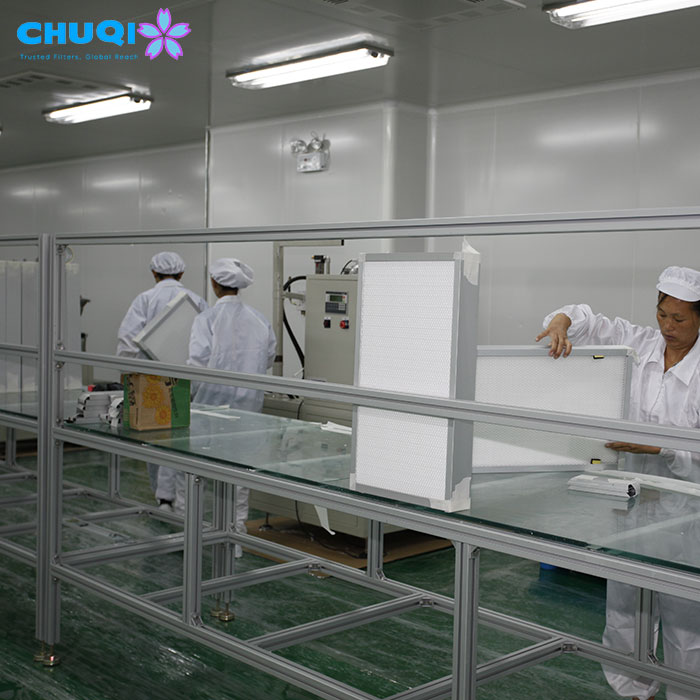
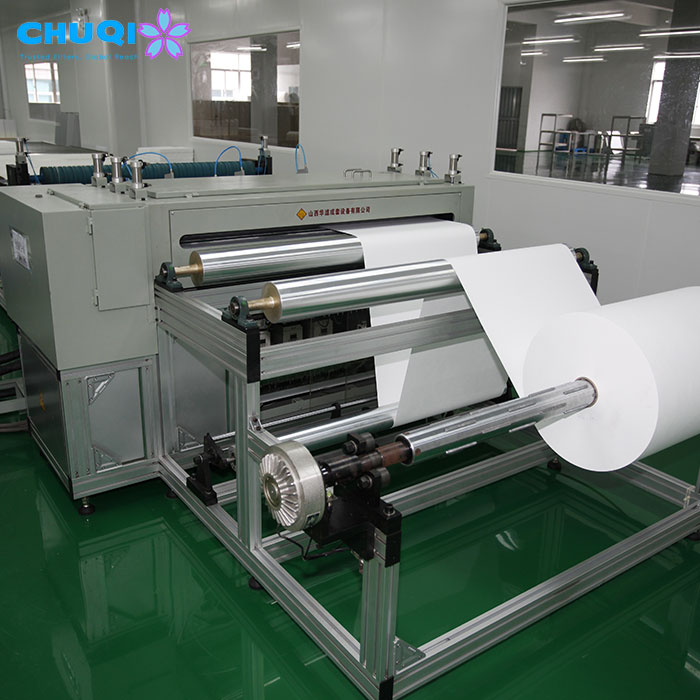
At Chuqi New Materials, we manufacture air filtration products for industrial and cleanroom applications, including HEPA filters and customized filter solutions.
Chuqi supports OEM and custom HEPA filter development based on application needs, drawings and equipment interfaces.
Our focus is not simply to supply a filter with a specified grade, but to help develop a product that is compatible with the intended equipment and operating conditions.
Explore our HEPA Air Filter Products or learn more about OEM HEPA Filter Development.
Have a specific cleanroom application or custom filter requirement? Feel free to contact our team. We’d be happy to discuss your needs and help you find a suitable solution.
Frequently Asked Questions
Q1: How do I choose between H13 and H14 HEPA filters for a cleanroom?
A: The choice depends on the cleanroom design, contamination-control requirements and filtration system. H14 has a higher efficiency classification than H13 under EN 1822, but a higher grade does not automatically mean better overall room performance. Airflow, pressure drop, sealing and installation quality must also be considered.
Q2: Does an ISO Class 5 cleanroom always require H14 filters?
A: No. ISO cleanroom classification describes airborne particle concentration, while H13 and H14 classify HEPA filter performance. The required filter grade should be determined by the cleanroom’s overall design and contamination-control strategy, not by assuming a direct one-to-one relationship between ISO class and HEPA grade.
Q3: What is the difference between mini-pleat and separator HEPA filters?
A: Mini-pleat filters use closely spaced compact pleats to increase media area within a limited frame size. Separator filters use spacers between pleats to maintain their separation and support the media pack. Their suitability depends on airflow, pressure drop, filter dimensions and equipment design.
Q4: Why is pressure drop important when selecting a HEPA filter?
A: Pressure drop represents the resistance to airflow through the filter. Excessive resistance can reduce system airflow if the fan cannot compensate for it. Initial pressure drop and the expected increase during filter loading should both be considered.
Q5: Can a HEPA filter pass factory testing but fail an installed leakage test?
A: Yes. Factory testing evaluates the filter under specified test conditions, while installed leakage testing assesses the filter and its installation in the housing. Gasket problems, frame damage, incorrect mounting or gaps around the filter can cause bypass leakage after installation.
Q6: How often should cleanroom HEPA filters be replaced?
A: There is no universal replacement interval. Replacement depends on operating hours, particle loading, pressure-drop trends, airflow performance, filter condition and the cleanroom’s maintenance requirements. Monitoring system performance is more reliable than using a fixed calendar interval alone.
Q7: Can HEPA filters be customized for existing cleanroom equipment?
A: Yes. Custom HEPA filters can be developed to match specific dimensions, frame materials, filter depths and sealing arrangements. The existing equipment interface and required operating conditions should guide the design.