
HEPA filter pressure drop is the pressure difference between the upstream and downstream sides of a filter at a defined airflow. Expressed in pascals (Pa) or inches of water gauge (in. w.g.), it indicates the resistance the filter adds to the air path under the stated operating conditions.
The key rule is simple: HEPA filter pressure drop should always be evaluated together with airflow, measurement conditions and the specific filter configuration. A pressure-drop value without its corresponding airflow is incomplete for engineering comparison.
For industrial equipment manufacturers, cleanroom ventilation projects and OEM filtration assemblies, the goal is not simply to select the filter with the lowest resistance. It is to achieve the required filtration efficiency and airflow within the available installation space, fan capability and operating limits.
This guide explains what affects HEPA filter pressure drop, how to interpret operating measurements, and what engineers and buyers should include when specifying a custom HEPA filter.
What Is HEPA Filter Pressure Drop?
HEPA filter pressure drop is the differential pressure measured across the filter under defined operating conditions. Air encounters resistance as it passes through the filter media and its supporting structure, creating a pressure difference between the inlet and outlet sides.
The differential pressure can be expressed as:
ΔP = P_upstream − P_downstream
The measurement boundary is important. A pressure reading across the HEPA filter alone is not equivalent to a reading across a complete assembly containing a prefilter, HEPA filter and housing.
Similarly, a pressure displayed by an HVAC controller or equipment monitoring system may represent duct static pressure, room pressure or another system parameter rather than the differential pressure across the HEPA filter itself.
Before interpreting a reading, confirm the pressure-tap locations, measurement method and operating conditions.
Why Must Airflow Be Specified with Pressure Drop?
For a meaningful comparison, the pressure-drop value must correspond to a defined airflow and filter configuration.
Consider these two requirements:
Initial pressure drop: 250 Pa.
Initial pressure drop: not exceeding 250 Pa at an airflow of 1,000 m³/h.
These figures are illustrative only. They are not recommended operating values, confirmed design results or Chuqi product specifications.
A HEPA filter operating at a lower airflow may exhibit lower pressure drop without being a better choice for an application requiring higher airflow. Likewise, two filters with the same efficiency classification may have different resistance characteristics because their media area, pleat geometry and construction differ.
When comparing HEPA filter specifications, use product-specific airflow and pressure-drop data measured under comparable conditions. If the application operates across a range of airflow rates, request an airflow–pressure-drop curve where available.
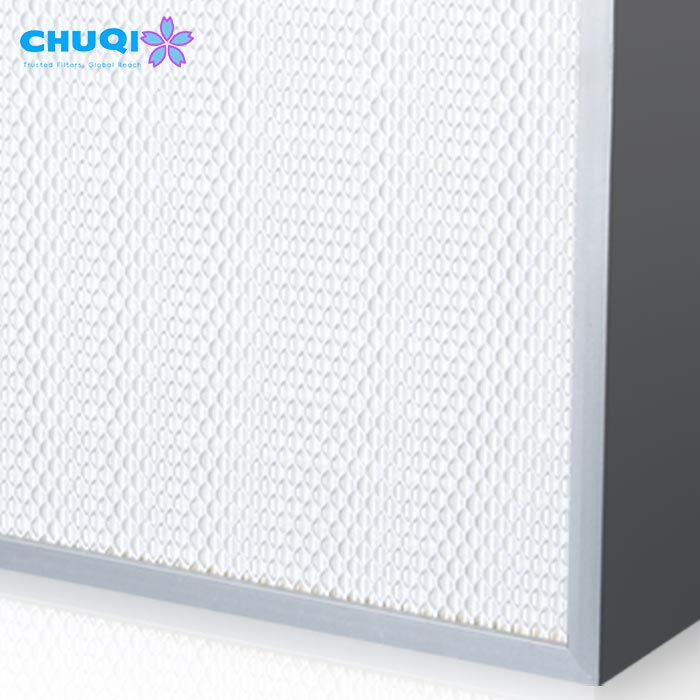
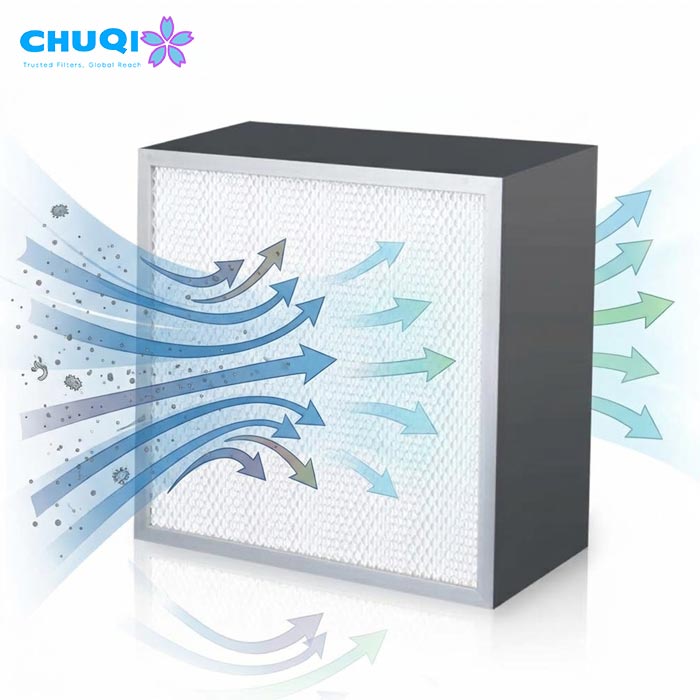
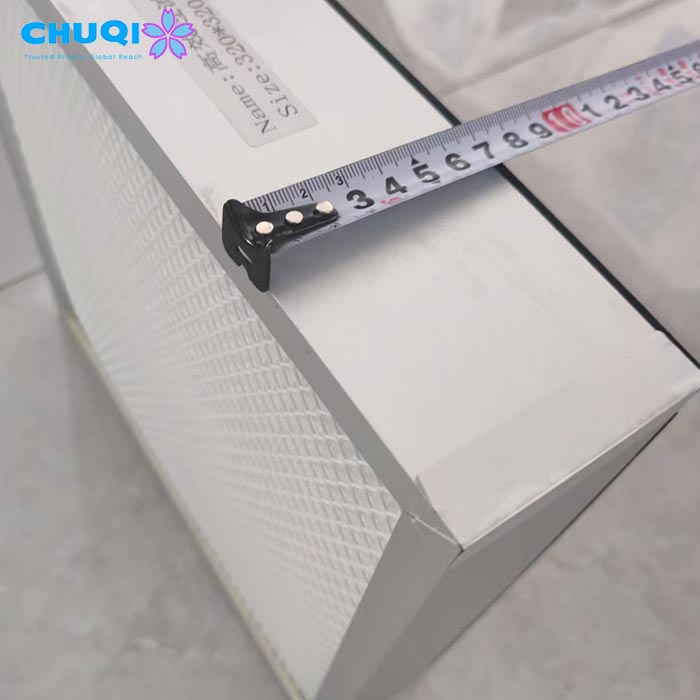
Initial Pressure Drop vs. Operating and Final Pressure Drop
Pressure-drop terminology describes different filter conditions. These terms should be distinguished when selecting filters and setting maintenance requirements.
| Term | Meaning | Engineering application |
|---|---|---|
| Initial pressure drop | Pressure drop of a new filter at a stated airflow and defined test conditions | Establishes the initial performance baseline |
| Operating pressure drop | Differential pressure measured during service | Supports monitoring of the installed filtration system |
| Recommended replacement criterion | A maintenance threshold established for the application | Helps determine when filter replacement or further assessment is required |
| Maximum allowable differential pressure | A declared limit for the specified filter and conditions | Defines an operating restriction, not necessarily the normal replacement target |
A filter manufacturer‘s recommended final pressure drop, a maximum allowable differential pressure and an equipment alarm setting are not automatically interchangeable.
For example, the equipment may be unable to maintain its required airflow before the filter reaches its declared maximum differential pressure. Conversely, a replacement criterion may be set below the product limit to protect system performance.
For this reason, maintenance criteria should be established using the applicable manufacturer documentation, equipment capability and operating requirements.
What Affects HEPA Filter Pressure Drop?
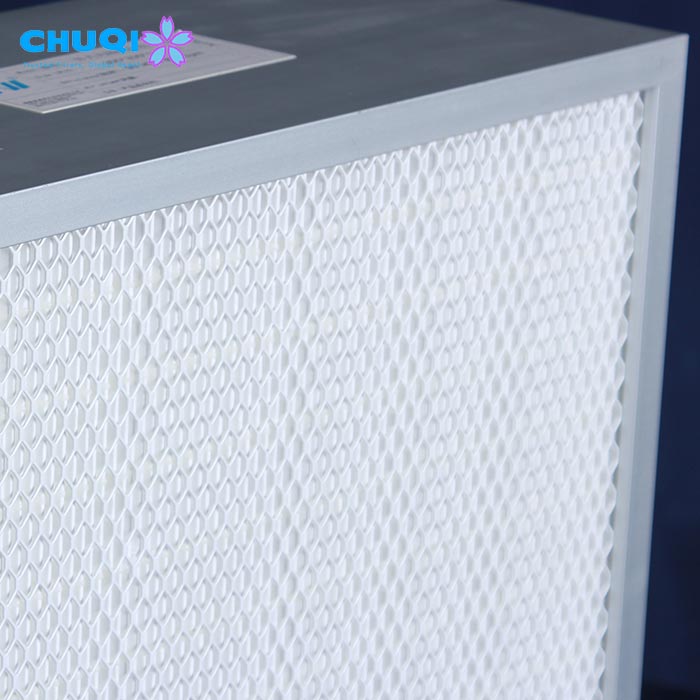
HEPA filter pressure drop is influenced by airflow, filter media, effective filtration area, pleat geometry, assembly construction and particle loading during operation.
An efficiency designation such as H13 or H14 does not, by itself, specify the pressure drop of a particular product.
1. Airflow Rate
For the same filter under otherwise comparable conditions, increasing airflow generally increases pressure drop.
This means a pressure-drop value measured at a low airflow should not be used to predict performance at a substantially higher airflow without appropriate product-specific data.
When comparing two HEPA filters, engineers should check:
Rated or specified airflow.
Initial pressure drop at that airflow.
Filter dimensions and effective media area.
The test conditions used to generate the published data.
If the equipment operates at variable airflow, request performance data covering the relevant operating range rather than relying on a single nominal value.
2. Filter Media and Effective Filtration Area
The filter media contributes to airflow resistance, but the material alone does not determine the performance of the complete filter.
Effective filtration area also matters. Increasing the usable media area can reduce the airflow carried per unit of media, potentially supporting a lower-resistance design when other conditions remain comparable.
However, a larger nominal media area does not automatically guarantee lower pressure drop. The complete construction, media properties and airflow distribution must be considered.
For technical selection, focus on the measured pressure drop of the assembled filter at the required airflow rather than making a decision based solely on the media material or nominal area.
3. Pleat Geometry and Spacing
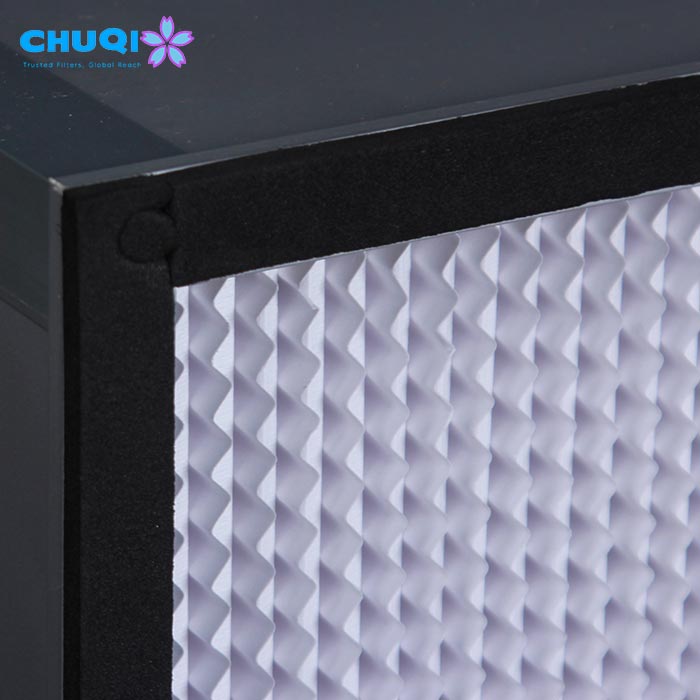
Pleat depth, spacing, shape and support structure influence how effectively the filter uses its media area.
Two HEPA filters with identical external dimensions and efficiency classifications may have different pressure-drop characteristics because their internal geometries differ.
Adding more pleats does not automatically improve airflow performance. Closely spaced pleats, restricted channels or media contact can limit the benefit of additional media area.
For a custom HEPA filter, evaluate the complete design, including usable filtration area, pleat configuration, internal airflow paths and assembly constraints.
4. Filter Frame and Assembly Construction
The frame, seals, supports and internal structure form part of the complete filter assembly. Their design can influence airflow distribution, installation compatibility and overall system resistance.
When evaluating custom HEPA filter options, specify the required dimensions, frame arrangement, sealing method and installation orientation where relevant.
Pressure-drop comparisons should use clearly defined measurement boundaries so that resistance attributed to the filter is not confused with losses from the housing, ductwork or adjacent components.
5. Particle Loading and Operating Conditions
As particles accumulate on the filter, its resistance may change. The rate of change depends on the incoming particle load, particle characteristics, airflow, upstream filtration and operating environment.
Initial pressure drop alone cannot reliably predict filter service life.
Two identical filters can develop different pressure-drop trends when installed in different systems. Changes in process conditions, contamination levels or upstream filter performance can alter the amount of material reaching the HEPA stage.
Condensation, unusual exposure or an abnormal process event may also affect filter condition. A sudden pressure change should therefore be investigated rather than automatically attributed to normal dust loading.
How Does HEPA Filter Pressure Drop Change During Operation?
The relationship between pressure drop and airflow depends partly on how the equipment controls its fan and maintains system performance.
Constant-Airflow Systems
In a system that actively maintains airflow, increasing filter resistance may appear as a rising differential pressure while the fan compensates.
Maintaining airflow against greater resistance generally requires additional air-moving effort. The actual electrical energy impact depends on the fan, motor, controls and overall system efficiency.
A lower-resistance HEPA filter may therefore support energy-performance objectives, but the size of any saving must be evaluated against the specific system operating conditions.
Compensation also has limits. The fan may eventually be unable to maintain the required airflow within its available pressure capability.
Systems with Variable Airflow
Where airflow is not actively maintained, increasing filter resistance may cause airflow to decrease.
The measured pressure drop then reflects both the changing filter condition and the changing operating point. A relatively small pressure increase does not necessarily mean that the filter remains lightly loaded.
Record airflow or a sufficiently defined equipment operating state alongside differential pressure. Measurements taken at different fan speeds or damper positions should not be compared as if the operating conditions were identical.
Sudden Pressure-Drop Changes
A sudden increase or decrease in pressure drop is a reason to investigate, not a diagnosis on its own.
Potential factors include:
Changes in fan speed, damper position or airflow.
Incorrectly connected, blocked or damaged pressure tubing.
Instrument or measurement problems.
Changes in the measurement boundary.
Unusual contamination or exposure conditions.
Changes in filter installation or assembly condition.
An unexpectedly low reading does not automatically prove that the filter is performing better. An unusually high reading does not, by itself, establish that the HEPA media is blocked.
First verify the measurement setup and operating conditions. Then assess the filter and equipment using the applicable inspection and maintenance procedures.
How to Measure HEPA Filter Pressure Drop
A useful pressure-drop measurement requires a defined measurement boundary, a suitable instrument and known operating conditions.
The objective is to obtain a value that can be compared with the product specification or a previous baseline.
Measure Across the Correct Filter Stage
Pressure taps should span the component whose resistance is being evaluated.
If the measurement covers both a prefilter and a HEPA filter, the result represents the combined pressure drop across those components rather than the HEPA filter alone.
This distinction matters during troubleshooting. A loaded prefilter may increase the measured pressure difference across a multi-stage assembly even when the HEPA stage has not experienced a comparable change.
Follow the approved measurement arrangement for the equipment and identify the components included in each reading.
Verify the Instrument and Pressure Connections
Before drawing conclusions from an unexpected reading, confirm that the instrument range, connections and pressure tubing are appropriate and functioning correctly.
A blocked, disconnected or incorrectly connected pressure line can produce a misleading value. Instrument checks should follow the applicable equipment and maintenance procedures.
This verification is particularly important before using pressure measurements to justify filter replacement, approve a design change or compare supplier performance.
Establish a Baseline
A new-filter baseline measured under confirmed conditions provides a reference for future monitoring.
Later measurements are most informative when airflow, measurement locations and relevant operating settings are comparable. If any of these conditions change, record the change before interpreting the difference.
Pressure-drop monitoring does not verify HEPA filtration efficiency or confirm that an installed assembly is free from leakage. Those questions require the relevant performance testing and, where applicable, installation integrity testing.
Does Lower Pressure Drop Always Mean a Better HEPA Filter?
No. Lower pressure drop is beneficial only when the filter also meets the required efficiency, airflow, installation and operating requirements.
A lower value measured at a lower airflow does not establish better performance at the required operating point. Nor does it demonstrate equivalence between filters with different efficiency classifications, dimensions or construction.
H13 and H14 identify different filtration requirements under the applicable classification system, but neither designation specifies one universal pressure-drop value.
Similarly, a low installed pressure reading cannot independently confirm filtration efficiency or rule out installation leakage.
The appropriate comparison is between complete filter solutions evaluated at the required operating conditions, with performance data and measurement boundaries clearly defined.
For the broader selection process, see How to Choose the Right Industrial HEPA Filter: Efficiency & Airflow Guide.
Frequently Asked Questions About HEPA Filter Pressure Drop
What Is a Normal Pressure Drop for a HEPA Filter?
There is no single normal pressure-drop value for every HEPA filter. Initial pressure drop depends on the specific filter design, airflow and stated test conditions. Use the relevant product data and equipment requirements rather than applying a generic value from another installation.
At What Pressure Drop Should a HEPA Filter Be Replaced?
Use the approved maintenance criterion for the filter and equipment. Replacement decisions may need to consider required airflow, fan capability, operating conditions and the applicable product limits. A filter’s maximum allowable differential pressure should not automatically be treated as its replacement threshold.
Can Pressure Drop Confirm That a HEPA Filter Is Working Correctly?
No. Pressure drop indicates airflow resistance under the measurement conditions. It does not independently establish filtration efficiency or confirm that the installed assembly is free from leakage. Use the relevant performance and integrity verification procedures when these characteristics must be confirmed.
Does a Higher HEPA Filter Efficiency Mean a Higher Pressure Drop?
Not necessarily. Efficiency classification alone does not determine the pressure drop of a specific product. Resistance also depends on media properties, usable filtration area, pleat geometry, airflow and assembly design. Compare product-specific data at the required airflow.
Can HEPA Filter Pressure Drop Be Reduced in a Custom Design?
Potentially, depending on the application and design constraints. Options may include changes to usable filtration area, pleat geometry or other construction details. Any proposed change must still meet the required efficiency, dimensions, installation and operating requirements.
Need Help Defining Your HEPA Filter Pressure-Drop Requirements?
If you are developing a new filtration assembly or reviewing an existing filter, Chuqi can help discuss the airflow, installation dimensions and technical requirements for a custom industrial HEPA filter.
Start with the information already available, such as an equipment reference, existing filter model, drawing or required operating airflow. You do not need to finalize every parameter before starting the discussion.
Our team can help identify which specifications are available, which design details require confirmation, and what information is needed before a proposed configuration can be reviewed. You can also explore our Product Catalog to view our standard offerings and technical specifications.