
E12, H13, H14 and U15 are common labels in high-efficiency air filtration, but they do not represent the same filter category.
Under the EN 1822 classification system, high-efficiency air filters are divided into three groups: EPA (E10–E12), HEPA (H13–H14) and ULPA (U15–U17). Each class has defined filtration efficiency and particle penetration limits based on the most penetrating particle size (MPPS).
Understanding these HEPA filter grades helps engineers, equipment manufacturers, facility managers and industrial filter buyers compare technical specifications more accurately.
This guide explains the classification system, compares efficiency thresholds, clarifies common labeling differences and identifies the other specifications needed when selecting an industrial HEPA filter.
For a broader introduction to filtration mechanisms, efficiency and filter types, see our guide to HEPA filter working principles, efficiency and types.
EPA, HEPA and ULPA: What Is the Difference?
EPA, HEPA and ULPA are three distinct groups within the EN 1822 classification framework. The letter identifies the group, while the number identifies the specific filter class.
| Filter Group | Classes | General Classification |
|---|---|---|
| EPA | E10, E11, E12 | Efficient Particulate Air filters |
| HEPA | H13, H14 | High-Efficiency Particulate Air filters |
| ULPA | U15, U16, U17 | Ultra-Low Penetration Air filters |
The classes become progressively more demanding in terms of permitted particle penetration.
EPA filters are not HEPA classes under EN 1822. E12, for example, belongs to the EPA group, whereas H13 and H14 belong to the HEPA group.
This distinction matters when comparing product catalogues, reviewing equipment specifications or checking whether a proposed filter meets a defined filtration requirement.
It is also important to distinguish the European EN 1822 classification from other filtration standards and commercial descriptions. Similar-looking efficiency percentages do not automatically establish equivalence between different test methods.
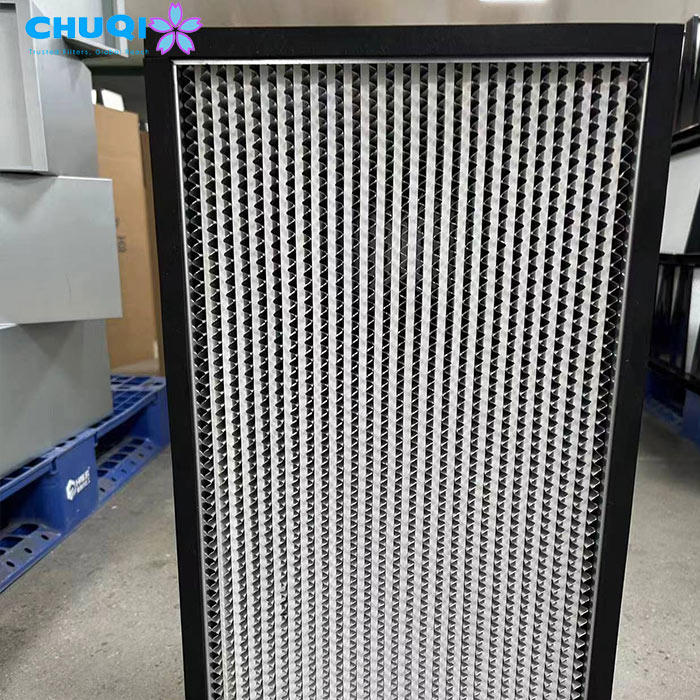
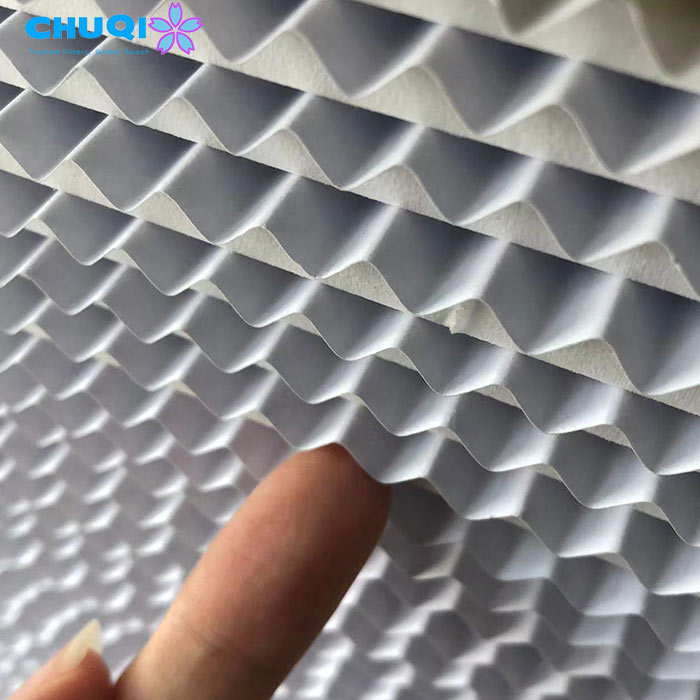
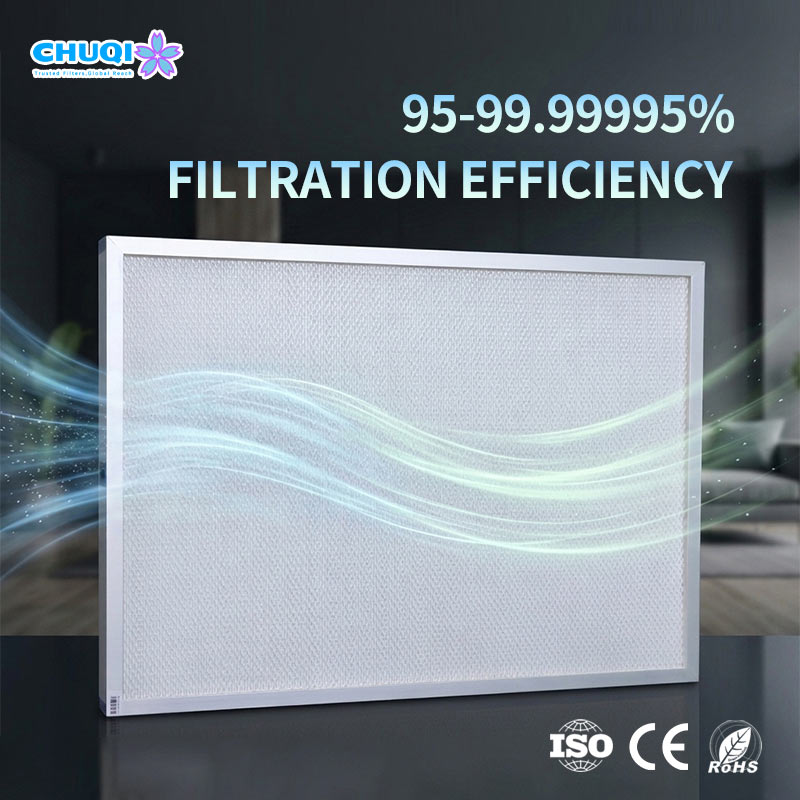
EPA Filter Grades: E10 to E12
EPA filters occupy the E10–E12 range under EN 1822.
These filters are sometimes discussed alongside HEPA filters because both belong to the wider field of high-efficiency particulate filtration. However, E12 is an EPA class in this system, not another name for H13.
The distinction is based on the classification requirements rather than simply whether a product is marketed as a high-efficiency filter.
EPA is also a filtration-group designation in this context, not a reference to certification by the United States Environmental Protection Agency.
When reviewing a product description, check the stated classification system and supporting test documentation rather than relying on the terminology alone.
HEPA Filter Grades: H13 and H14
H13 and H14 are the two HEPA classes in the EN 1822 classification system.
The distinction matters because HEPA filter does not describe one single efficiency level. Two products can both be classified as HEPA while having different permitted particle penetration.
For H13 and H14, the classification considers overall efficiency and local performance requirements. These measures help distinguish the performance of the complete filter rather than relying only on a single efficiency percentage.
For a more detailed comparison of their efficiency thresholds, airflow considerations and selection factors, read our guide to H13 vs. H14 HEPA filters.
ULPA Filter Grades: U15 to U17
ULPA classes extend beyond H14, with progressively more stringent permitted particle penetration limits.
U15, U16 and U17 are distinct classes within the ULPA group. They should not be treated as interchangeable labels.
Whether the additional filtration performance is necessary depends on the application’s contamination-control requirements, operating conditions and system design.
For industrial equipment manufacturers, cleanroom contractors and other technical buyers, the key question is not simply which class has the highest number, but which classification is appropriate for the intended application.
HEPA Filter Grades Chart: E10 to U17
The following table summarizes the overall and local efficiency requirements associated with the EN 1822-1:2019 classification system.
| Group | Class | Minimum Overall Efficiency at MPPS | Maximum Overall Penetration | Minimum Local Efficiency | Maximum Local Penetration |
|---|---|---|---|---|---|
| EPA | E10 | 85% | 15% | — | — |
| EPA | E11 | 95% | 5% | — | — |
| EPA | E12 | 99.5% | 0.5% | — | — |
| HEPA | H13 | 99.95% | 0.05% | 99.75% | 0.25% |
| HEPA | H14 | 99.995% | 0.005% | 99.975% | 0.025% |
| ULPA | U15 | 99.9995% | 0.0005% | 99.9975% | 0.0025% |
| ULPA | U16 | 99.99995% | 0.00005% | 99.99975% | 0.00025% |
| ULPA | U17 | 99.999995% | 0.000005% | 99.9999% | 0.0001% |
Note: These values are classification thresholds, not measured results for a particular filter. Local efficiency requirements apply to the relevant H and U classes. The applicable standard edition, test method and filter-specific documentation should be considered when evaluating a product.
The table shows why a filter classification should be understood as a set of performance requirements rather than a single efficiency percentage.
For H13 and higher classes, overall efficiency alone does not describe the complete classification. Local performance and the applicable leakage-testing requirements are also important.

What Do HEPA Filter Efficiency Ratings Mean?
Filter efficiency describes the proportion of particles removed under specified test conditions. Penetration describes the proportion that passes through the filter.
The two values are complementary:
Efficiency (%) = 100% − Penetration (%)
For example, the overall classification thresholds for H13 and H14 are:
H13: at least 99.95% overall efficiency, with no more than 0.05% overall penetration.
H14: at least 99.995% overall efficiency, with no more than 0.005% overall penetration.
At these classification limits, H14 permits one-tenth the overall particle penetration of H13 under the relevant test conditions.
A Simple Example: H13 vs. H14
Imagine an illustrative upstream quantity of 100,000 particles on the relevant measurement basis.
At 0.05% penetration, 50 particles would pass through. At 0.005% penetration, 5 would pass through.
This example illustrates the difference between the two penetration limits. It is not a prediction of actual airborne particle concentrations in a cleanroom, factory or HVAC system.
The distinction is particularly useful when comparing classes whose efficiency percentages all appear close to 100%.
However, a higher filter class does not automatically mean a better system outcome. The selected class must match the application’s filtration requirements and work with the intended airflow, pressure drop and installation arrangement.
What Is MPPS in HEPA Filter Testing?
MPPS stands for Most Penetrating Particle Size. It is the particle size at which a filter exhibits its lowest filtration efficiency under the relevant test conditions.
At the MPPS, penetration is at its highest. EN 1822 uses this principle as part of its classification framework for EPA, HEPA and ULPA filters.
Is MPPS the Smallest Particle a HEPA Filter Can Capture?
No. MPPS is not a minimum particle-capture size.
Air filtration involves several mechanisms, including interception, inertial impaction and diffusion. Their relative contributions change with particle size and operating conditions.
Very small particles can be captured effectively through diffusion. Consequently, filtration efficiency does not simply decrease as particle size becomes smaller.
MPPS is also not automatically 0.3 μm for every filter. The actual MPPS depends on factors such as filter media and the relevant test conditions.
When comparing efficiency claims, check the stated particle-size basis and test method rather than assuming that all percentages refer to a fixed particle diameter.
For further background on filtration mechanisms, efficiency ratings and testing standards, see our guide to HEPA filter working principles, efficiency and types.
Why HEPA Filter Labels Can Be Confusing
Product catalogues do not always use the same terminology or provide the same level of technical detail. Understanding the wording helps prevent incorrect comparisons.
“H12 HEPA”
Under the EN 1822 classification described in this guide, E12 is an EPA class, while H13 and H14 are HEPA classes.
If a catalogue describes a product as “H12 HEPA,” check which classification system, historical terminology or commercial convention the supplier is using.
Do not assume that the label is directly equivalent to E12, H13 or another class without reviewing the supporting technical information.
“99.97% at 0.3 Microns”
This description gives an efficiency percentage and a fixed particle-size basis.
It should not automatically be translated into H13 or H14. EN 1822 classes are based on performance at MPPS and include defined classification and testing requirements.
Two filters may display high efficiency percentages while being evaluated using different particle sizes, test procedures or reporting conventions.
The efficiency value and its test basis must be considered together.
“HEPA-Grade” or “HEPA-Type”
These expressions do not, by themselves, identify a specific class in the E10–U17 table.
They may be used to describe a product’s general filtration positioning, but they provide less classification detail than a clearly stated class supported by applicable test documentation.
For engineering applications, check the actual performance declaration and the standard used to establish it.
“H14 Filter Media”
Filter media performance and finished-filter performance are not interchangeable.
A complete filter assembly also includes the media pack, frame, sealant, joints and other construction details. Leakage or bypass around the media can affect the performance of the assembled unit.
For this reason, a media efficiency claim alone should not be treated as proof that the finished filter meets the same classification.
When evaluating an assembled HEPA filter, review the applicable product-level test information.
Why Two H14 HEPA Filters Can Have Different Performance
The filter class describes filtration performance under a defined classification framework. It does not specify every feature required for installation or operation.
Two H14 filters can have different dimensions, media areas, airflow ratings, pressure drops and sealing arrangements. These differences can make them suitable for different equipment, even when their nominal classes are identical.
1. Airflow and Pressure Drop
Airflow and pressure drop are closely related to filter dimensions, media area, construction and operating conditions.
A filter with a particular H14 classification does not automatically deliver the airflow required by a specific fan or ventilation system.
When reviewing a data sheet, check the rated or specified airflow alongside the corresponding initial pressure drop. Also consider the system’s allowable resistance and maintenance requirements.
For a closer look at operating airflow, see our guide to HEPA filter airflow and face velocity. You can also read about HEPA filter pressure drop to understand how filter resistance affects system selection.
2. Dimensions and Housing Connections
A filtration class does not define the filter’s external dimensions or installation interface.
Relevant construction details may include:
Length, width and overall depth
Frame material and structural design
Gasket location and sealing arrangement
Gel-seal or other housing-interface requirements
Mounting direction and installation clearances
Two filters with the same nominal dimensions may still be unsuitable substitutes if their sealing or mounting arrangements differ.
For replacement applications, confirm compatibility with the existing housing rather than relying on the grade and external dimensions alone.
3. Finished-Filter Integrity and Test Documentation
For H13, H14 and ULPA filters, local performance and the applicable leakage-testing requirements are important parts of the classification framework.
Review the relevant test documentation to establish what was tested, which standard was applied and which performance results are reported.
A catalogue description introduces the product and its declared characteristics. A filter-specific test report provides more detailed evidence for the tested unit and conditions covered by that report.
These documents serve different purposes and should not be treated as interchangeable.
4. Filter Class vs. Cleanroom Classification
A filter class is not the same as a cleanroom classification.
An H14 filter may contribute to contamination control, but the performance of a cleanroom also depends on factors such as airflow distribution, installed filter integrity, leakage, room operation and airborne particle concentration.
The filter is one component of the system. Selecting the appropriate grade is important, but it does not independently establish the cleanliness level of the finished installation.
How to Read an Industrial HEPA Filter Specification
Consider this illustrative product description:
H14 / EN 1822 / 610 × 610 × 292 mm / specified airflow and initial pressure drop
Each item answers a different question:
| Specification | What It Tells You |
|---|---|
| H14 | The declared filtration class |
| EN 1822 | The classification framework |
| 610 × 610 × 292 mm | The stated external dimensions |
| Airflow | The specified operating air volume |
| Initial pressure drop | The filter’s resistance at the stated airflow and test conditions |
| Test documentation | The performance evidence available for the product |
This is a more useful starting point than the class alone, but the description may still be incomplete for a particular application.
Depending on the equipment and installation, engineers may also need to confirm the sealing interface, frame material, operating temperature, humidity, chemical exposure, available installation space and documentation requirements.
For a practical checklist, see our HEPA filter specifications guide for engineers and buyers.
Does a Higher HEPA Filter Grade Always Mean a Better Choice?
A higher class imposes more stringent filtration requirements within the EN 1822 classification system. Whether it is the right choice depends on the application.
If a process requires H14 performance, an E12 filter is not an equivalent substitute simply because it fits the housing.
Conversely, selecting ULPA solely because it has a higher efficiency figure does not establish that the additional filtration is necessary or beneficial for the system.
A suitable selection should consider:
Required filtration class and contamination-control objectives
Operating airflow and allowable pressure drop
Housing dimensions and sealing requirements
Operating environment and filter construction
Applicable test records and compliance requirements
Maintenance needs and total operating considerations
The objective is to meet the required filtration performance without overlooking airflow, compatibility or system-level requirements.
Before selecting a configuration, review the HEPA filter specifications checklist and compare the relevant operating conditions.
Frequently Asked Questions About HEPA Filter Grades
Q1. What are the HEPA filter grades under EN 1822?
A: Under EN 1822, the HEPA group includes H13 and H14. EPA classes are E10, E11 and E12, while ULPA classes are U15, U16 and U17. All three groups belong to the wider high-efficiency air-filter classification system.
Q2. Is E12 a HEPA filter class?
A: No. E12 belongs to the EPA group under EN 1822. H13 and H14 are the HEPA classes in this classification system.
Q3. What is the difference between H13 and H14?
A: H13 requires at least 99.95% overall efficiency at MPPS, while H14 requires at least 99.995%. Their maximum overall penetration limits are 0.05% and 0.005%, respectively. H13 and H14 also have separate local efficiency requirements. For more details, see our H13 vs. H14 HEPA filter comparison.
Q4. What do U15, U16 and U17 mean?
A: U15, U16 and U17 are ULPA classes under EN 1822. They have progressively more stringent overall efficiency and particle penetration limits. The appropriate class depends on the application’s requirements.
Q5. Is 99.97% efficiency at 0.3 μm the same as H13?
A: Not automatically. The 99.97% figure refers to a stated efficiency at a fixed particle size, whereas H13 is a classification under EN 1822 based on MPPS and its associated testing requirements. The two descriptions should not be assumed equivalent without reviewing the test basis.
Q6. Does a higher HEPA filter grade always provide better performance?
A: A higher class has stricter filtration requirements, but it does not automatically make the filter the best choice for every system. Airflow, pressure drop, sealing, dimensions and the intended application must also be considered.
Q7. What information is needed to select an industrial HEPA filter?
A: Start with the required filter class, dimensions, operating airflow, allowable pressure drop and housing connection. Depending on the application, operating temperature, humidity, chemical exposure and testing documentation may also need to be considered. Our HEPA filter specifications checklist provides a useful starting point.
Need Help Evaluating an Industrial HEPA Filter?
Understanding HEPA filter grades is the first step. The next is checking whether the proposed filter configuration suits the equipment and operating conditions.
For industrial equipment manufacturers, HVAC engineering teams, cleanroom contractors and filter distributors, an existing filter reference, equipment drawing or operating airflow can provide a useful starting point.
Explore Chuqi’s industrial HEPA filters and custom manufacturing solutions to learn about available filter configurations and customization options.
If you are evaluating a replacement filter or developing a custom filtration assembly, our team can help review the available technical information and identify which specifications need further clarification.