
In industrial maintenance and commercial HVAC contracting, margin erosion rarely stems from raw material expenses alone. Far more often, it originates from structural and aerodynamic failures on the plant floor or inside the air handling unit (AHU) where panel filters are deployed.
Many procurement teams evaluate panel filters—whether standard flat pads, high-capacity pleated panel filters, or reusable skeleton frame panel filters—solely by unit price on a spreadsheet. When sourcing through intermediary trading companies or basic assembly shops that lack foundational process control, these engineering oversights manifest rapidly during field operations:
Bypass Leakage via Tolerance Drift: A deviation of just two millimeters in die-cutting dimensions causes the metal, beverage board, or plastic panel filter frame to distort under static pressure, allowing uncleaned air to bypass the filtration media entirely.
Fiber Shedding (Media Migration): Inferior, loosely thermal-bonded synthetic or fiberglass media sheds particulates when face velocities fluctuate between 2.5 m/s and 3.0 m/s, contaminating downstream equipment and sensitive cleanrooms.
Unpredictable Resistance Spikes: Wild batch-to-batch variations in initial pressure drop (Pa) force building management systems (BMS) to ramp up fan speeds prematurely, driving up annual energy consumption for facility operators.
Mitigating these operational risks requires a shift from superficial vendor comparison to a rigorous technical audit of panel filter manufacturing capabilities—beginning right at the source of the raw media (learn more about our foundational production standards in our main HVAC Filtration Hub).
The Industrial Advantage of True Vertical Integration for Panel Filters
The primary vulnerability of standard panel filter supply chains is a lack of upstream control. Most suppliers operating in the market are assembly-only operations. They purchase pre-cut media rolls from third-party mills, leaving them entirely exposed to raw material price volatility, allocation shortages, and inconsistent fiber formulations.
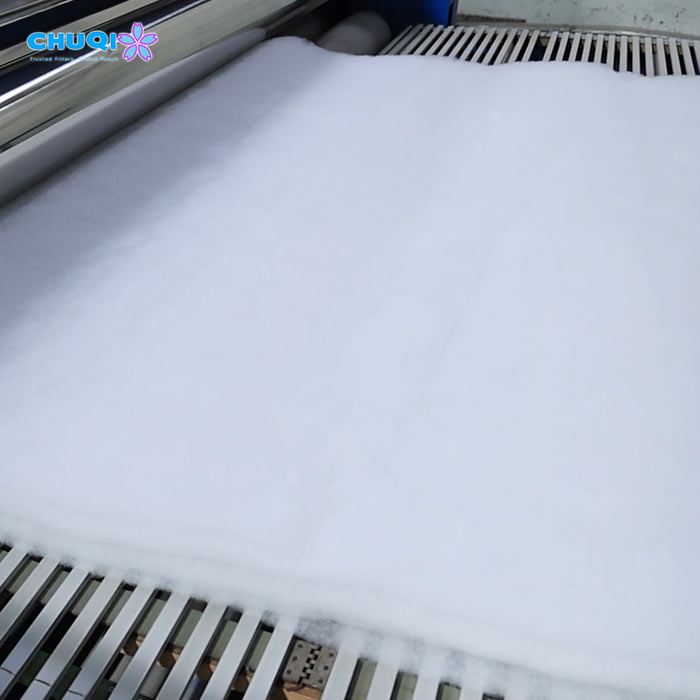
A fully vertically integrated manufacturing model changes this dynamic by consolidating the entire production sequence under one roof—from raw synthetic fiber extrusion, needle-punching, and carbon impregnation straight through to final panel filter frame assembly and wire-grid lamination.
Controlling the upstream media mill delivers distinct operational and economic advantages for panel filter buyers:
Upstream Cost Stability: Eliminating intermediary mill markups shields procurement budgets from volatile spot-market price swings.
Customized Media Matrix Engineering: Rather than forcing applications into generic catalog items, internal engineering teams can formulate custom progressive-density PET blends, activated carbon flat panels, or specific glass fiber matrices tailored to exact dust-holding capacity (DHC) and arrestance targets.
Absolute Batch Consistency: Direct control over fiber extrusion ensures that bulk production runs of flat, pleated, and skeleton panel filters perform identically to initial laboratory qualification samples.
Four Essential Engineering Benchmarks for Auditing Panel Filter Manufacturers
When qualifying a manufacturing partner for bulk procurement or OEM projects, professional engineering teams must look beyond general business certificates and evaluate suppliers against four rigorous technical benchmarks specific to panel filter construction:
1. Media Matrix Integrity & Pleat Geometry Stability
The Technical Risk in the Field: In high-velocity commercial and industrial HVAC systems, inferior pleated panel filters suffer from “pleat flutter” or structural collapse. When low-density synthetic media lacks sufficient internal stiffness, dust loading creates localized air turbulence, causing the pleats to bunch together, severely reducing the Effective Filtration Area (EFA) and triggering abrupt static pressure spikes.
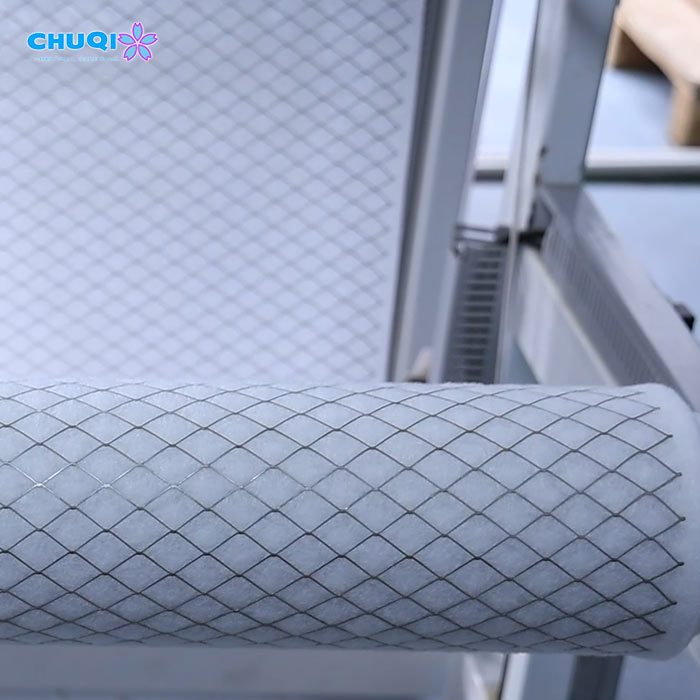
The Source Factory Standard: A reliable manufacturer utilizes automated, synchronized mechanical pleating integrated with high-tensile expanded metal backing (typically galvanized steel or aluminum mesh) tightly laminated on the air-leaving side. This locks the pleat pitch and depth into a rigid geometric matrix, preventing media deformation and ensuring uniform airflow resistance across the entire face of the panel filter under continuous high dust loads.
2. Frame Structural Rigidity & Miter-Joint Air Bypass Sealing
The Technical Risk in the Field: Even the highest-efficiency filter media is rendered useless if the frame fails. Inaccurate folding or weak adhesive distribution leaves micro-gaps at the corners. Under the static pressure of an operating air handler, sub-millimeter gaps at these mitered joints create air bypass leakage, allowing uncleaned air to stream straight past the filtration envelope and resulting in failed on-site particle counter audits.
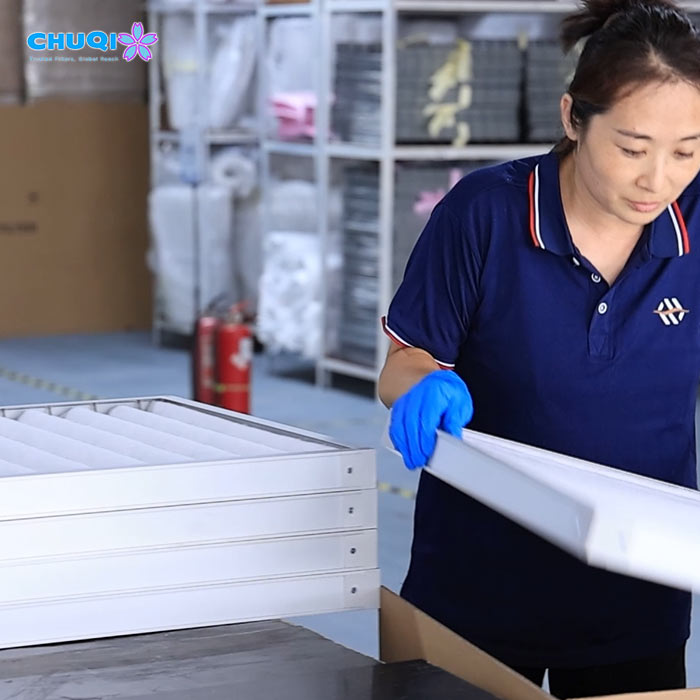
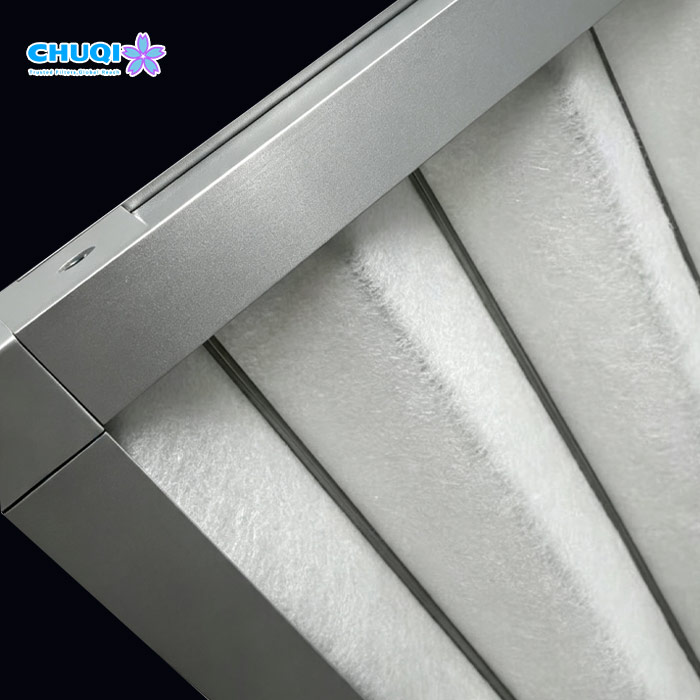
The Source Factory Standard: Whether utilizing heavy-duty galvanized steel, extruded aluminum, or moisture-resistant beverage board frames, structural integrity is non-negotiable. Precision die-cutting coupled with meticulous corner-folding and industrial-grade structural adhesives ensures absolute dimensional accuracy, 100% frame rigidity, and zero bypass under rated operating pressure.
3. Progressive-Density Media Cohesion & Fiber Migration Control
The Technical Risk in the Field: Low-tier assemblers source cheap, uniform-density synthetic or fiberglass mats that lack proper thermal bonding. Under fluctuating face velocities (2.5 m/s to 3.0 m/s), these poorly bonded fibers shed and migrate downstream—a phenomenon known as media migration. This directly contaminates cleanroom environments, fouls downstream heating/cooling coils, or prematurely blinds secondary bag and HEPA filters.
The Source Factory Standard: Because we control the upstream extrusion and needle-punching process, our panel filters feature a progressive-density gradient structure. The matrix transitions from coarse, loosely packed fibers on the air-entering side (to trap large particulates) to fine, densely packed fibers on the air-leaving side (to capture fine dust). This maximizes Dust-Holding Capacity (DHC) while completely eliminating fiber shedding under turbulent flow.
4. Aerodynamic Verification & Batch-to-Batch Resistance Consistency
The Technical Risk in the Field: Many suppliers treat aerodynamic performance as a black box, shipping goods without verifying initial pressure drop (Pa) or arrestance curves. When batch resistance varies wildly, building management systems (BMS) are forced to constantly readjust fan speeds, leading to unpredictable energy consumption spikes and premature blower motor wear for facility operators.
The Source Factory Standard: A mature manufacturer operates an internal aerodynamic testing rig to verify initial pressure drop at standard airflow rates and monitors particle arrestance curves for every production run. This ensures that every bulk delivery of flat, pleated, or skeleton panel filters matches strict ISO 16890 and ASHRAE specifications, delivering predictable, low-energy performance across the entire lifespan of the HVAC installation.


Custom Supply Frameworks Built for Diverse B2B Channels
Different commercial channels operate under distinct operational pressures. A mature panel filter manufacturing partner structures fulfillment models around those specific requirements:
For HVAC Contractors & Facility Integrators: Older commercial structures rarely conform to catalog dimensions. In-house integration of media extrusion and frame fabrication allows for rapid prototyping and short-run custom sizing of panel filters, ensuring project installation schedules never slip. Frame materials match specific environmental exposures—from rugged galvanized steel for industrial boiler rooms to rust-free extruded aluminum or marine-grade stainless steel for high-humidity and cleanroom facilities.
For Regional Wholesalers & Distributors: Direct-mill pricing keeps local distribution networks competitive against sudden spot-market surges. Large internal buffer reserves of raw synthetic fiber and metal mesh prevent stockouts during peak spring and autumn HVAC replacement seasons.
For Amazon & Cross-Border E-Commerce Brand Owners: Private-label panel filter portfolios can be scaled or high-margin, eco-friendly washable skeleton panel filters tested without locking up working capital in excessive minimum order quantities (MOQs). Brand equity is protected with custom master cartons, tailored box labeling, and private-label inner packaging executed directly on the production line. Direct-dispatch capabilities handle precise FNSKU barcode labeling and container shipping to global Amazon FBA fulfillment networks, eliminating domestic port-handling friction.
Verify Through Engineering Data
Navigating the global panel filter market requires looking past polished marketing materials and low initial quotations. By auditing suppliers against verifiable engineering benchmarks—from raw media formulation and automated production precision to rigorous aerodynamic testing protocols—you protect your projects, your profit margins, and your market reputation from structural failure.
Explore our full range of engineered filtration solutions over at our main HVAC Filtration Hub.
Evaluate Our Panel Filter Manufacturing Capabilities Directly
If you are currently reviewing supply options for custom panel filters, high-capacity pleats, or reusable skeleton frames, skip the sales pitch and review the engineering specifications.