
Premature AHU pressure spikes, unexpected thermal bag collapses, and runaway fan energy bills are rarely random failures—they are the direct result of treating synthetic pre-filter media and non-woven composite bag filters as interchangeable specifications. For HVAC chief engineers and cleanroom technical directors, avoiding these costly operational bottlenecks requires evaluating exact material physics: weighing the 130°C extreme thermal resilience of synthetic media against the color-coded colorimetric precision of non-woven medium-efficiency bag filters.
Mastering these distinctions protects your downstream assets, stabilizes static pressure, and slashes total lifecycle operating costs (TCO). To build a comprehensive filtration architecture across your facility, understanding these material boundaries is just the starting point; you can explore the complete system layout in our Ultimate Guide to Pocket Air Filters.
Material Architecture & Efficiency Split
The fundamental performance divergence between the two media types dictates their precise mechanical deployment:
Non-Woven Composite Media (Medium Efficiency F5 – F8):
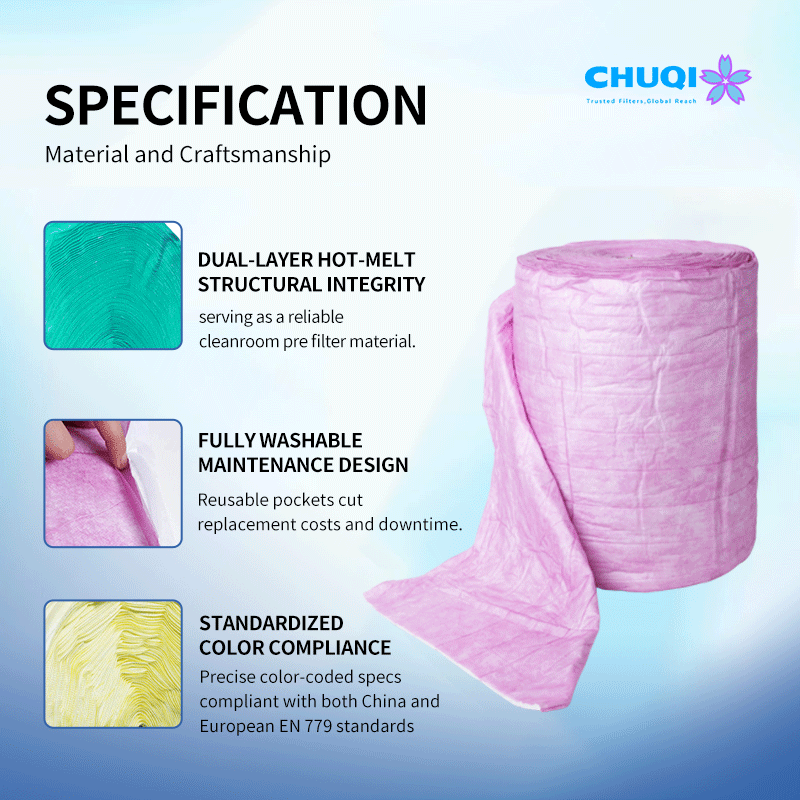
Material & Color Grading: Engineered from advanced non-woven fabrics where media color directly indicates fine efficiency classes: F5 (White / Light Yellow, 45%), F6 (Green / Orange, 65%), F7 (Pink / Purple, 85%), and F8 (Yellow, 95%) under colorimetric test standards. When evaluating these capture rates against global benchmarks, referencing standardized test protocols is essential, as detailed in our ISO 16890 Pocket Filter Efficiency & Standards Guide.
Aerodynamic & Pressure Profile: Designed for multi-pocket configurations (5 to 8 pockets) with initial resistances ranging tightly from 50 Pa (F5 at 1000–1300 m³/h) up to 65 Pa (F8 at 1200–1600 m³/h), effectively capturing sub-micron aerosols while maintaining stable airflow.
Synthetic Pre-Filter Media (Primary G3 – G4):
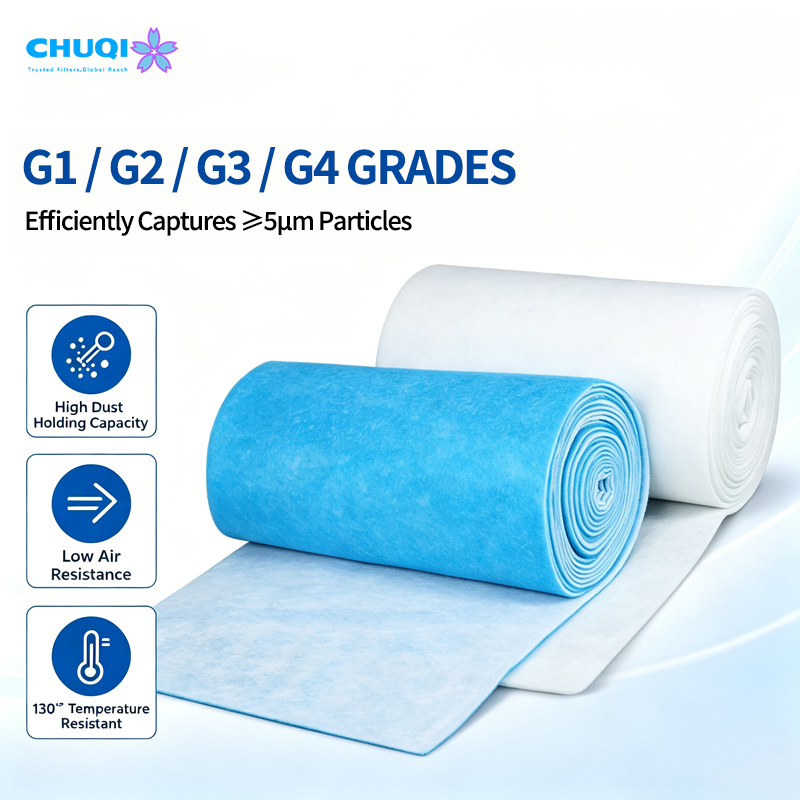
Material & Color Grading: Formulated from needle-punched pre-filter media (air intake cotton / green-and-white / blue-and-white synthetic mats) maintaining a uniform White clean surface profile.
Efficiency & Resistance Profile: Targets coarse arrestance with G3 efficiency (25–35%) and G4 efficiency (35–45%). Engineered with a standardized initial resistance of 70 Pa across heavy-duty airflow rates (ranging from 1500 m³/h up to 4500 m³/h for 595x595x600mm units).
Thermal Thermodynamics & Operating Limits
Industrial applications impose strict physical boundaries on media survivability:
The 130°C Synthetic Advantage: Synthetic pre-filter media is engineered with high-temperature polymer structures certified to withstand continuous operating temperatures and humidity levels up to 130°C and 130% RH (extreme thermal processing and heavy industrial exhaust protection).
Standard Non-Woven Thresholds: Non-woven composite bag filters are optimized for standard commercial and cleanroom HVAC environments, operating reliably up to 80°C and 80% RH. Exceeding 80°C risks binder softening and structural pocket distortion under high system turbulence.
Proper material matching in these thermal zones directly impacts your long-term operational budget, a financial strategy we analyze extensively in our breakdown on How to Reduce HVAC Filter Replacement Costs & LCC.
Application-Specific Advantages: Choosing the Right Material for Your Operating Environment
To assist engineering and procurement teams in making foolproof selections, each media type exhibits distinct operational advantages tailored to specific industrial sectors:
When to Specify Synthetic Media (G3–G4):
Target Applications: Heavy industrial ventilation, automotive and industrial spray booth intake plenums, high-temperature manufacturing drying lines, and harsh coastal or high-humidity mechanical rooms.
Core Engineering Advantages: The primary advantage lies in its absolute 130°C thermal endurance and 100% hydrophobic synthetic structure. It prevents thermal collapse and moisture rotting in environments where standard pre-filters fail, ensuring robust frontline defense for heavy dust loads.
When to Specify Non-Woven Composite Media (F5–F8):
Target Applications: Commercial office skyscrapers, hospital surgical suite AHUs, data center ventilation, and pharmaceutical or electronics cleanroom secondary stages.
Core Engineering Advantages: The primary advantage is its progressive gradient-density capture and color-coded efficiency precision (F5–F8). It delivers stable sub-micron aerosol capture while maintaining ultra-low initial pressure drops (50–65 Pa), making it the ultimate solution for optimizing indoor air quality and lowering central fan energy consumption.
Engineering Comparison Matrix
| Technical Parameter | Non-Woven Composite Pocket Filter | Synthetic High-Temp Pocket Filter |
| Efficiency Spectrum | Medium Efficiency: F5 to F8 (45% to 95%) | Primary Coarse: G3 to G4 (25% to 45%) |
| Visual Color Indicator | Color-coded by grade (White, Green, Pink, Yellow) | Clean uniform White synthetic finish |
| Initial Pressure Drop | 50 Pa to 65 Pa (optimized low initial resistance) | Stable 70 Pa across high-volume airflow rates |
| Max Thermal & Humidity Limit | 80°C / 80% RH | 130°C / 130% extreme thermal tolerance |
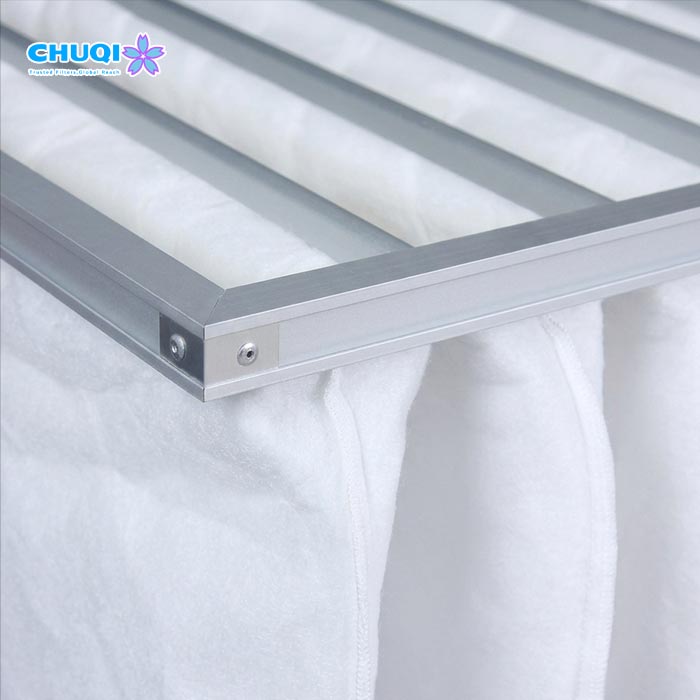
| Gasket & Frame Integrity | EVA gasket with aluminum/galvanized frame | EVA gasket with rigid alloy frame & needle-punched media |
Specifying the Right Media for Your System
Selecting between synthetic and non-woven media goes beyond simple catalog choices; it dictates whether your AHU system will suffer from premature thermal breakdown or maintain optimal energy efficiency. To understand why pocket configurations outperform traditional flat panels in high-airflow scenarios, read our B2B Pocket Air Filter Selection Guide.
Furthermore, once your engineering specifications are locked in, partnering with a fully verified source factory is vital to ensure batch-to-batch consistency. You can review our rigorous manufacturing audit criteria in the Reliable Pocket Filter Supplier Sourcing Guide.
Source Factory Direct: Custom Synthetic & Non-Woven Solutions
Our vertically integrated facilities control the entire production process—from pocket filter media manufacturing to finished pocket air filters. Whether you require high-temperature 130°C synthetic pre-filters or color-graded F5–F8 non-woven bag filters, we deliver precision engineering tailored to your specifications.
Complete Vertical Integration: In-house quality control spanning from pocket filter media manufacturing to finished pocket air filters.
Specialized Thermal Ratings: Synthetic media engineered for extreme industrial operations up to 130°C.
Custom Engineering: Flexible pocket counts (5 to 8 pockets), non-standard dimensions, and rigorous laboratory sample support.