
For facility managers, maintenance directors, and industrial plant owners, central HVAC and air handling unit (AHU) maintenance budgets are under constant scrutiny. When evaluating filtration options, many procurement teams fall into the trap of looking solely at the initial purchase price of individual filters.
However, experienced HVAC engineers know that the true financial impact of an air filtration system lies in its Life Cycle Cost (LCC)—a combination of filter replacement frequency, labor overhead, and, most importantly, fan energy consumption.
If your facility is struggling with high power bills, frequent maintenance shutdowns, and premature filter clogging, upgrading to high-performance pocket air filters (bag filters) is the single most effective engineering strategy to slash operational expenses. Here is how specialized pocket air filters systematically reduce your HVAC replacement costs and optimize your facility’s LCC.
The True HVAC Filtration Cost Breakdown: Why Cheap Panel Filters Cost More
To effectively reduce filtration costs, facility directors must examine where their operational budget actually goes across a standard commercial HVAC lifecycle:
Initial Filter Purchase Price: ~5% to 10%
Maintenance & Replacement Labor Overhead: ~10% to 15%
Fan Electricity Consumption (Energy): ~75% to 80%
Many facilities attempt short-term savings by purchasing cheap flat panel filters or low-grade synthetic bag filters. These inferior units clog rapidly, causing system static pressure to skyrocket. To maintain nominal airflow through a choked filter, your AHU blowers must overwork against higher resistance, consuming massive amounts of kilowatt-hours and driving up your monthly power bills.
Maximizing Dust Holding Capacity (DHC) with Multi-Pocket Geometry
The labor cost of replacing filters—especially in large commercial complexes, airports, or manufacturing plants—is a massive financial burden. The structural design of bag air filters, however, delivers immediate economic advantages.
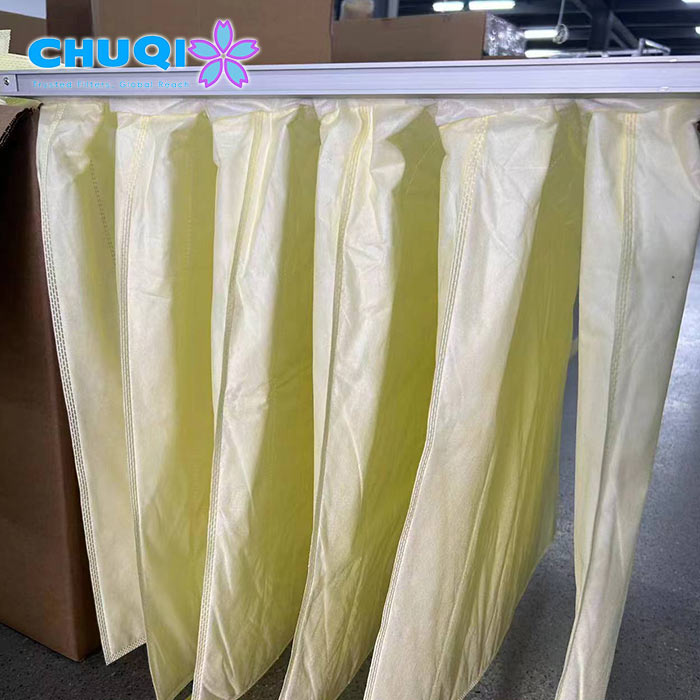
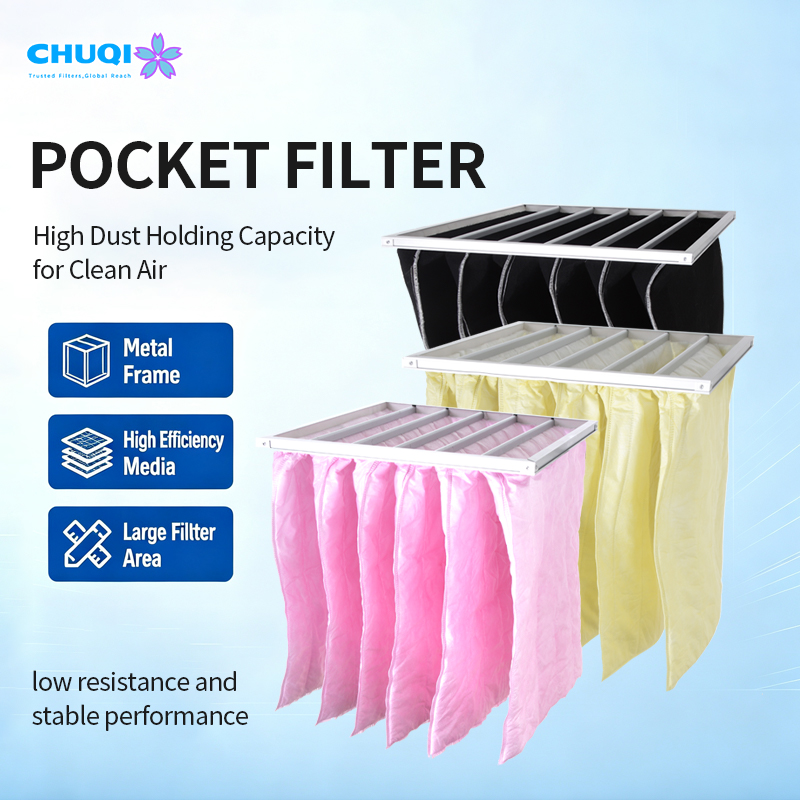
300% to 500% Increase in Surface Area: Unlike panel filters, which are constrained by the face dimensions of the air handling unit, bag filters feature a deep, aerodynamically designed multi-pocket structure. This allows the effective filtration surface area to grow exponentially, providing more attachment space for incoming particulate matter.
Extended Replacement Cycles: High-quality bag filters utilize progressive density synthetic media to capture coarse dust upstream and fine particles deep within the fiber matrix. This maximizes Dust Holding Capacity (DHC), allowing bag filters to operate reliably for longer periods (typically 6 to 12 months) and drastically reducing your annual replacement labor costs.
Fundamental Design: To understand the core mechanism behind why this bag structure outperforms other filter types, check out our guide, Why Choose Bag Air Filters? An HVAC Engineering and Procurement Guide.

Slashing Energy Bills with Low Initial and Operating Resistance
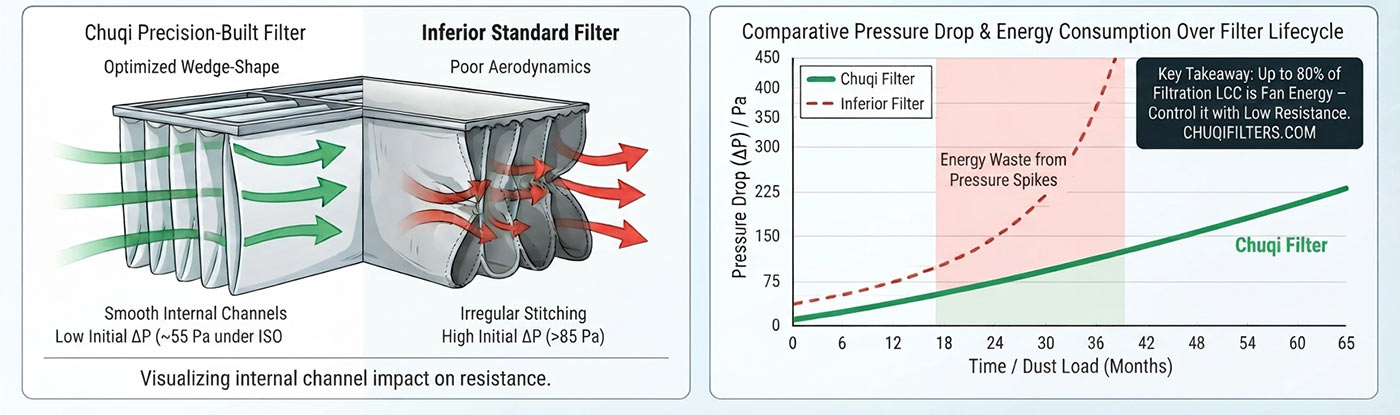
Because fan electricity accounts for up to 80% of your filtration LCC, controlling your system’s pressure drop curve is the ultimate key to cutting energy waste.
Ultra-Low Initial Resistance: Premium pocket air filters engineered with optimized wedge-shaped pockets and smooth internal channels ensure a remarkably low initial pressure drop (e.g., ~50–65 Pa under ISO 16890 / EN 779 standards), allowing air to glide through the media effortlessly.
Flattening the Resistance Curve: Poorly manufactured filters experience sharp, exponential pressure surges the moment they capture a moderate amount of dust. In contrast, precision-built pocket filters provide a gradual, predictable pressure increase over time, saving thousands of kilowatt-hours in fan energy over an operating cycle.
Protecting Your Investment: Preventing the "Masking Effect"
One of the most insidious hidden costs in HVAC maintenance is premature filter failure caused by structural collapse. In poorly made bag filters, the “masking effect” occurs when high air velocity forces adjacent pockets to balloon, touch, and stick together. When pockets touch, active surface area is instantly cut in half, triggering a sudden pressure spike that chokes the AHU and forces premature filter replacement.
Ultrasonic Sealing & Internal Spacers: Top-tier pocket filters protect your operating budget by utilizing ultrasonic thermal welding and internal airflow guide ribs. These features ensure that every single pocket inflates fully and uniformly under high airflows (withstanding operating pressures up to 450–600 Pa), maintaining stable, low-resistance performance throughout its entire service life.
Material Choices: To see how media composition affects durability and energy curves, read our comparison on Synthetic vs. Non-Woven Pocket Filters: The Definitive Engineering & Media Selection Guide.
Strategic Sourcing: Buying Direct to Maximize Bulk ROI
Beyond selecting the right filter design, your procurement channel directly dictates your bottom line.
Eliminating Middlemen: Sourcing pocket air filters directly from an established source factory allows you to bypass multi-tier distributor markups, securing factory-direct wholesale pricing for bulk facility replacements.
CBM & Logistics Optimization: Because standard air filters are bulky, international freight can eat into your cost savings. Partnering with a manufacturer that offers compressed, CBM-optimized packaging ensures your shipping and warehousing expenses stay remarkably low.
Procurement Blueprint: Ready to streamline your supply chain? Read our step-by-step practical companion guide on How to Choose a Reliable Pocket Filter Supplier: A B2B Sourcing & Factory Audit Guide.
Stop Overpaying on HVAC Energy Bills & Frequent Filter Maintenance
✅ Upgrade to Multi-Pocket Designs: Maximize DHC and extend replacement intervals from months to a full year.
✅ Insist on Low Pressure Drop: Choose precision-engineered pocket filters to minimize AHU fan energy consumption.
✅ Verify Anti-Masking Craftsmanship: Ensure ultrasonic sealing and internal spacers prevent pocket collapse.
✅ Source Direct from Manufacturers: Secure wholesale pricing and optimized freight packaging to maximize your procurement ROI.
