In high-precision automotive coating lines, aerospace manufacturing, and industrial finishing rooms, achieving a flawless, mirror-like finish requires more than advanced paint chemistry and precise thermal control. It depends fundamentally on aerodynamic air management. As conditioned air enters the paint shop, the ceiling diffusion media acts as the terminal flow-conditioning plane, dictating whether the air descends as a uniform laminar piston or breaks down into turbulent eddies.
When aerodynamic turbulence occurs, microscopic airborne particulates and overspray are whipped around the enclosure, settling directly onto wet automotive clearcoats or industrial finishes to cause costly defects like fisheyes, pinholes, and orange peel.
This technical engineering analysis examines the fluid dynamics of paint spray booths, the structural mechanics of progressive density filter media, and why multi-layered fiber gradients are indispensable for achieving true laminar airflow and maximum dust holding capacity (DHC).
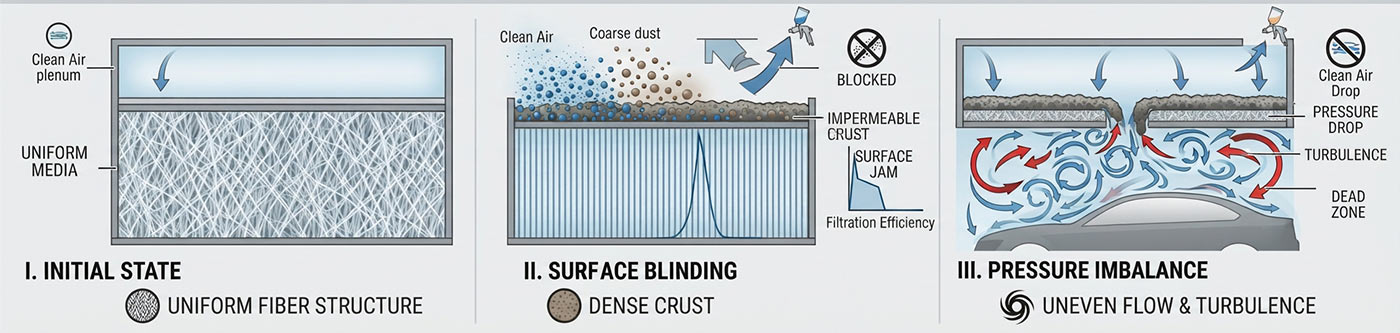
1. Fluid Dynamics: Why Uniform-Density Filters Fail in Spray Booths
Standard or low-tier ceiling filters are frequently manufactured with a uniform, homogeneous density from top to bottom. While seemingly straightforward, this uniform structure introduces severe aerodynamic and filtration flaws:
Accelerated Surface Blinding: Because every layer shares an identical pore size and packing density, incoming paint mist and coarse atmospheric dust jam exclusively onto the top micro-layer, forming a dense crust that chokes air permeability within weeks.
Pressure Imbalances and Dead Zones: Inconsistent air resistance across a flat-density filter generates localized pressure differentials, producing micro-currents and turbulent eddies that disrupt the critical vertical downward airflow.
2. The Anatomy of a Progressive Density Structure
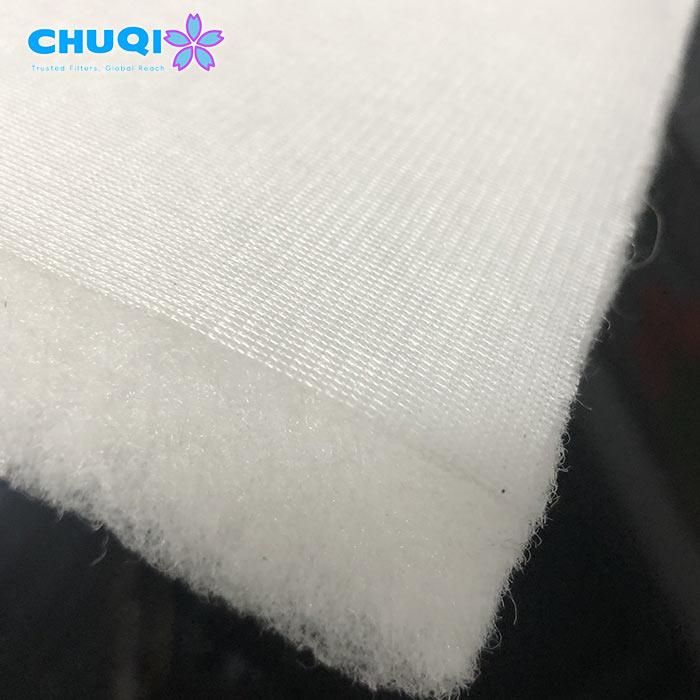
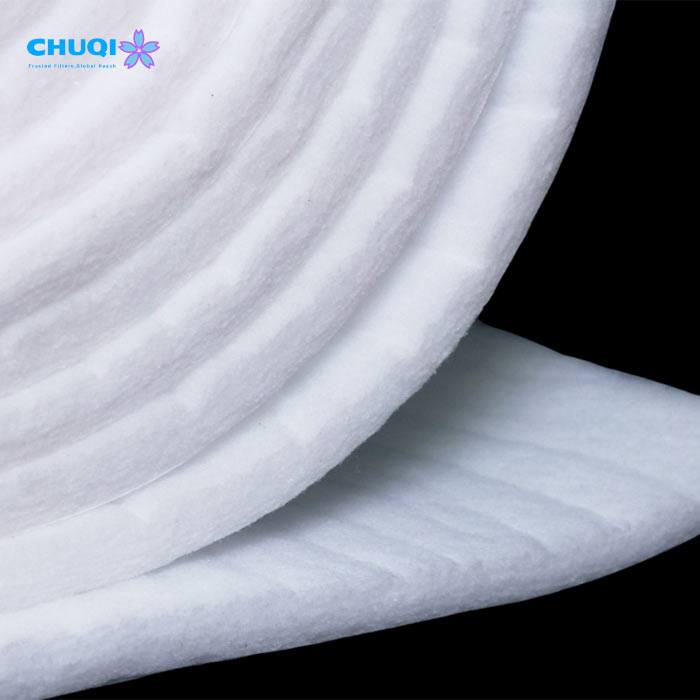
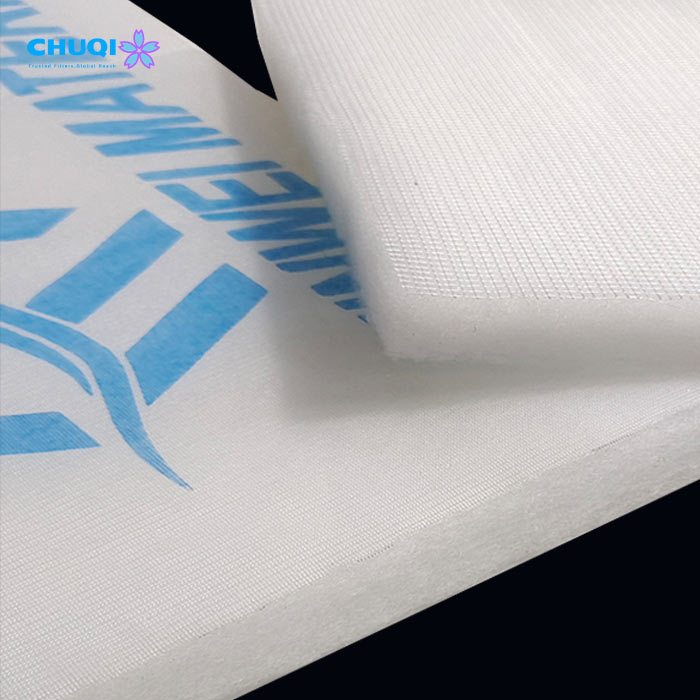
High-performance ceiling diffusion media is engineered with a continuous, multi-stage density gradient spanning its entire 3-dimensional cross-section, ensuring optimal particle capture at every stratum:
| Layer Level | Fiber Denier & Structure | Aerodynamic & Filtration Function |
| Air-Entering Side (Top Layer) | Coarser synthetic fibers, open loft structure, low packing density | Bulk Mass Capture: Traps larger atmospheric particulates and heavy paint mist; prevents premature surface blinding. |
| Middle Transition Zone | Moderately fine fibers with progressive density increments | Deep Interception: Captures mid-sized particulate matter while smoothing out localized air pressure differentials. |
| Air-Leaving Side (Bottom Layer) | Ultra-fine multi-filament fibers, high thermal-bonding density | Precision Sealing & Laminar Control: Captures sub-micron particles and stabilizes air into a smooth, piston-like downward stream. |
3. Engineering Benefits of Progressive Fiber Gradients
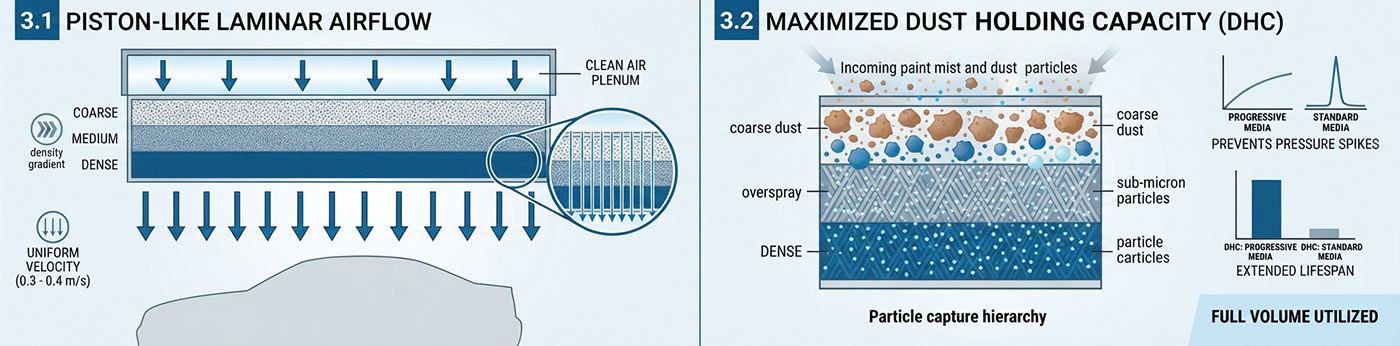
3.1 Achieving Piston-Like Laminar Airflow
The primary aerodynamic function of a ceiling diffusion filter is to establish a uniform downward velocity (typically maintained between 0.3 m/s and 0.4 m/s). The progressive density gradient acts as an internal air straightener, ensuring even static pressure distribution across the entire ceiling plenum. This yields a stable, vertical laminar flow that sweeps overspray cleanly toward floor exhaust grilles without cross-contamination.
3.2 Maximized Dust Holding Capacity (DHC) and Extended Lifespan
Because larger contaminants are trapped in the coarse top layers while smaller sub-micron particles penetrate deep into the dense inner strata, the entire volume of the media is fully utilized. This progressive loading mechanism prevents sudden pressure spikes, extends changeout intervals, and drastically reduces unplanned maintenance shutdowns.
4. Operational and Economic Value for Plant Engineering Teams
Integrating a certified progressive density ceiling filter into your spray booth maintenance regime delivers measurable operational and financial advantages:
Elimination of Air Eddies: Prevents random air currents from redepositing loose dust onto freshly coated horizontal and vertical surfaces, slashing annual paint rework rates.
Optimized Blower Efficiency: Maintains a predictable, stable pressure drop curve, reducing unnecessary energy strain on air handling unit (AHU) fan motors.
Reduced Total Cost of Ownership (TCO): Lowers overall filtration expenditure through extended service intervals, reduced downtime, and maximized production yields.
5. Conclusion: Demand Engineered Density Gradients
When specifying paint spray booth ceiling diffusion media, reject flat, uniform-density alternatives. Insist on true progressive density structures backed by certified performance standards to guarantee stable laminar airflow, superior dust retention, and pristine coating yields.
Engineering Resource Center & Next Steps
Return to Core Knowledge Base: -> Back to What Makes the Best Paint Spray Booth Ceiling Diffusion Filter?
Airflow Diagnostics: Experiencing uneven static pressure or turbulent eddies across your booth plenum? Let our senior aerodynamic engineers evaluate your setup.
Product Specifications: -> Review Technical Parameters of Our Progressive Density Ceiling Filter Series
Laboratory Evaluation: -> Request Custom-Cut Sample Rolls & Certified Airflow Testing Reports for Your Plant