
Spray booth intake filters and exhaust filters both help control airborne contamination, but they do different jobs. Intake filters help keep dust out of the spray area, while exhaust filters capture paint overspray before it enters the downstream exhaust system. Choosing the wrong media for either stage can affect paint finish quality, airflow and filter replacement frequency.
The difference matters because clean incoming air and effective overspray capture require different filtration properties. A material that works well for dry airborne dust may not have the structure or paint-holding capacity needed to collect wet paint droplets.
This guide explains how spray booth intake and exhaust filters work, how ceiling filters differ from intake pre-filters, and what to consider when selecting replacement media.
1. Spray Booth Intake Filters vs. Exhaust Filters: Key Differences
| Feature | Intake Filters | Exhaust Filters |
|---|---|---|
| Main purpose | Reduce dust and particles entering the booth | Capture paint overspray leaving the spray area |
| Typical contaminants | Ambient dust, lint, pollen and other airborne particles | Airborne paint droplets and overspray |
| Typical location | Fresh-air intake, air handling unit or supply-air section | Floor pit, exhaust wall or exhaust filtration section, depending on booth design |
| Common media formats | Rolls, pads, panels or other pre-filter formats | Fiberglass or synthetic paint arrestor media, often supplied in rolls or pads |
| Main selection considerations | Particle capture, airflow resistance, media strength and fit | Overspray capture, paint-holding capacity, airflow resistance and booth compatibility |
| Common warning signs | Dust contamination, restricted supply airflow or damaged media | Paint breakthrough, rapid loading, increased resistance or reduced exhaust airflow |
The exact arrangement depends on the spray booth design. A downdraft booth may use ceiling supply filters and floor exhaust filters, while a crossdraft booth may use intake filters at one end and exhaust filters at the opposite end.
For a broader explanation of the complete system, see our paint booth filter system design and installation guide.
2. Where Do Intake and Exhaust Filters Sit in the Airflow Path?
To select the right filter, first identify where the air enters and leaves the booth.
In a typical dry-filter spray booth, the airflow path may look like this:
Fresh air → Intake pre-filter → Ceiling filter, where fitted → Spray area → Exhaust paint arrestor → Downstream exhaust system
Not every booth uses all these stages, and their order or location can vary by design.
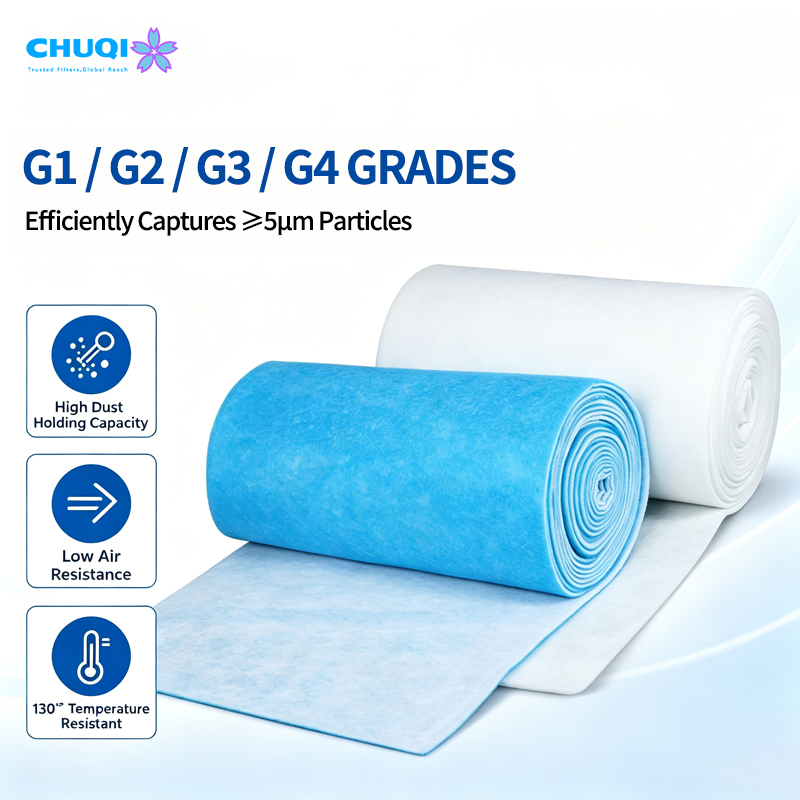
Intake pre-filters: The first stage of incoming-air filtration
An intake pre-filter captures a portion of the dust and other particles carried by incoming air before they reach downstream filtration equipment. This helps reduce the contaminant load on later filter stages.
The filter’s suitability depends on the dust load, required airflow, available installation space and the filtration arrangement. A pre-filter that becomes heavily loaded can restrict incoming airflow, so its resistance and replacement condition should be monitored.
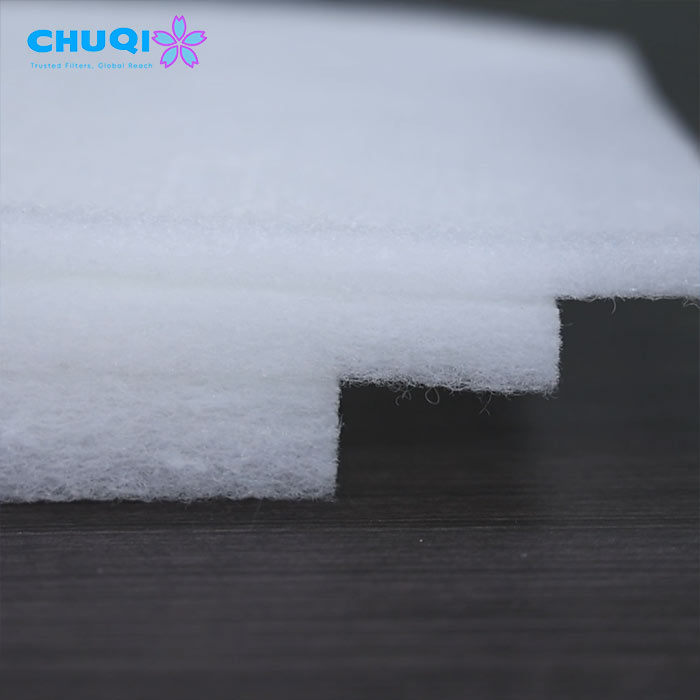
Explore Chuqi’s intake filter media for applications that require pre-filtration media in roll or pad formats.
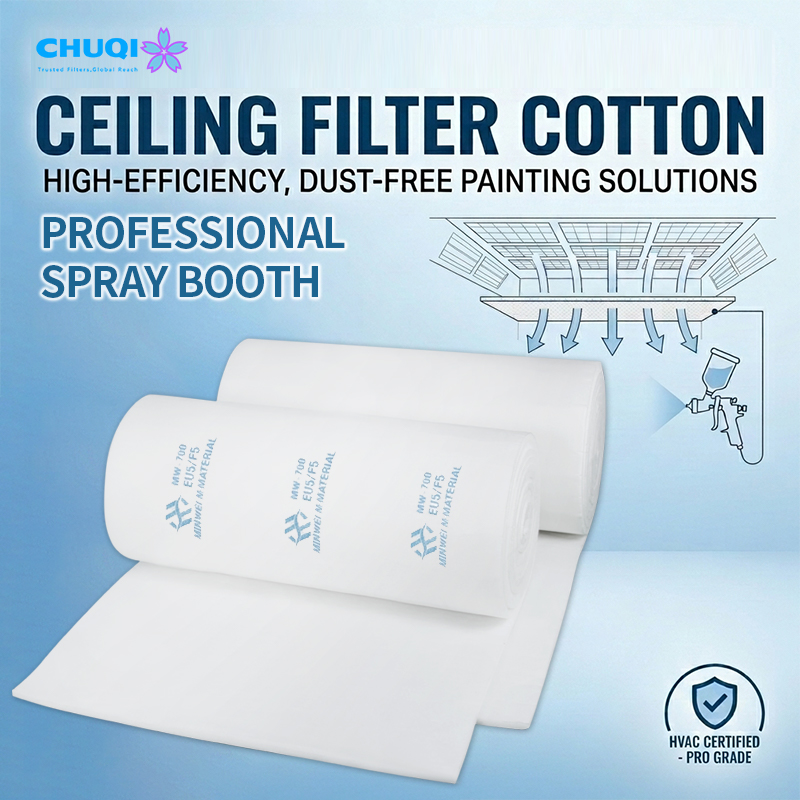
Ceiling filters: Final supply-air filtration in many spray booths
In many spray booths, ceiling filters sit above the working area. They help capture finer airborne particles that pass through upstream filtration and support a more uniform distribution of supply air.
This role differs from that of a basic intake pre-filter. Ceiling media must be suitable for the booth’s supply-air conditions, installation system and required airflow distribution.
See our spray booth ceiling filter media page for the product used in this stage.
Exhaust filters: Capturing paint overspray
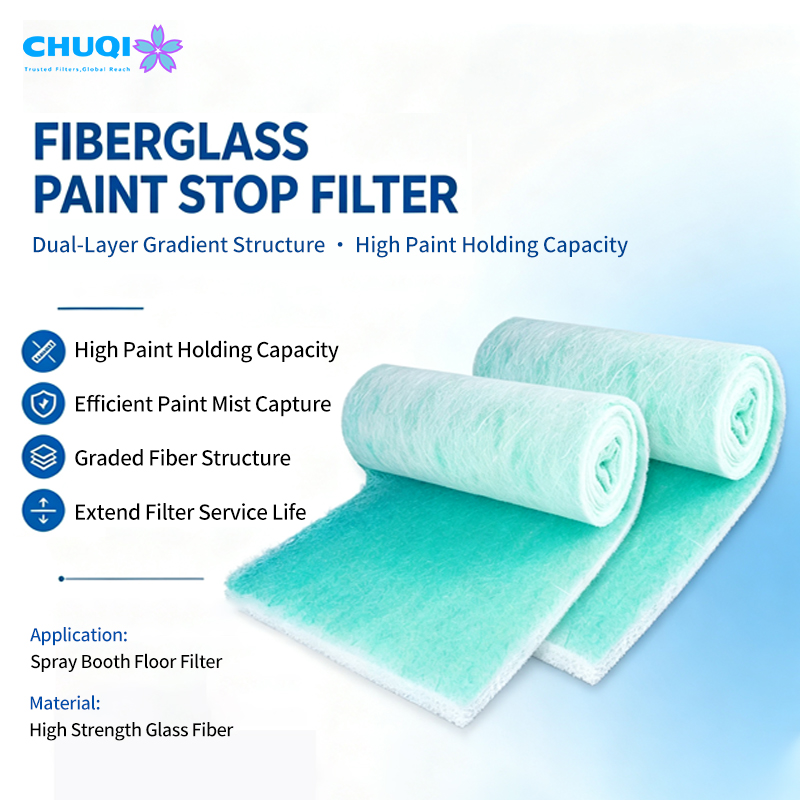
Exhaust filters handle air leaving the spray area. In dry-filter booths, paint arrestor media is designed to capture airborne paint droplets before they accumulate in exhaust ducts and downstream equipment.
Fiberglass paint arrestor media is commonly used for this purpose. Its open structure and depth can help retain overspray within the media rather than allowing all the paint to collect immediately on the surface.
Explore fiberglass filter media for paint arrestor applications.
3. Why Intake Filters and Exhaust Filters Are Not Always Interchangeable
Two filter materials may look similar, have similar thicknesses or come in rolls of the same width. That does not mean they are suitable for the same application.
The important difference is the type of contaminant each material is expected to handle.
Intake filtration focuses on airborne dust
Incoming-air media is selected to reduce dust entering the booth while allowing the system to deliver the required airflow. Relevant factors include particle capture, initial resistance, dust-loading behavior, media integrity and how the material fits into its filter frame.
For example, a pre-filter roll selected for coarse ambient dust may not provide the same fine-particle control expected from a ceiling filtration stage.
Exhaust filtration focuses on paint overspray
Paint arrestor media must handle droplets of liquid coating and the residue left as captured paint accumulates. The material therefore needs to be suitable for the booth’s overspray load and exhaust conditions.
A general-purpose intake filter may load differently when exposed to paint overspray. It should not be substituted for specified paint arrestor media simply because the dimensions appear to match.
Similar thickness does not mean similar performance
Filter thickness alone cannot establish suitability. Fiber arrangement, density distribution, media structure and the intended contaminant all influence how a filter behaves.
Likewise, a low initial pressure drop does not automatically mean a material is the best choice. The filter must continue to perform under the actual dust or overspray load.
Practical rule: Select intake media for the incoming-air filtration stage and paint arrestor media for the exhaust overspray stage. Confirm suitability for the actual booth design rather than choosing by appearance alone.
4. Intake Pre-Filters vs. Ceiling Filters: What Is the Difference?
These two filter types both handle incoming air, but they are not necessarily used in the same location or perform the same role.
An intake pre-filter is generally installed upstream to capture part of the incoming dust load. A ceiling filter, where fitted, provides filtration at the supply-air side of the spray area and helps distribute air across the booth.
Consider a booth that draws outdoor air through a pre-filter before sending it to the ceiling plenum. If the pre-filter is damaged or overloaded, more dust may reach downstream components or the supply airflow may fall. If the ceiling filter is unsuitable, incorrectly installed or loaded with dust, the booth may experience uneven air distribution or increased contamination risk.
Replacing one stage with the other does not automatically solve these problems because the two stages occupy different positions in the system.
For more detail on how ceiling filters and floor paint arrestors differ in function and maintenance, read Ceiling Diffusion Filters vs. Floor Paint Arrestor Pads.
5. How Filter Loading Affects Spray Booth Airflow
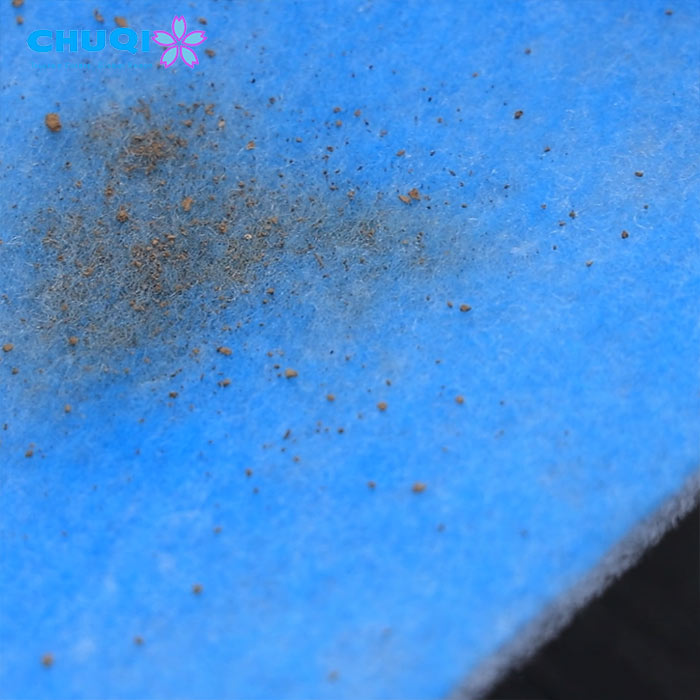
As filters capture dust or paint overspray, the accumulated material generally increases resistance to airflow. The rate of change depends on the media, contaminant load, operating conditions and system design.
The effects can differ between the intake and exhaust sides.
Loaded intake filters: Increasing resistance can reduce the amount of fresh air delivered by the supply system if the fan and controls cannot compensate.
Loaded ceiling filters: Higher resistance can affect supply airflow and the distribution of air over the spray area.
Loaded exhaust filters: Increasing resistance can reduce exhaust airflow and affect the removal of overspray from the booth.
These symptoms are not proof that a filter alone is responsible. Fan performance, dampers, blocked grilles, leaking seals and other system conditions can also influence airflow.
What should operators monitor?
Use the booth manufacturer’s maintenance instructions and the system’s monitoring equipment. Where differential pressure is measured across a filter bank, compare readings with the specified limits and the baseline recorded for clean filters.
Also pay attention to changes in booth airflow, visible paint mist, dust contamination and the physical condition of the media.
There is no single replacement interval that suits every booth. A high-volume production line using coatings that generate substantial overspray may load exhaust media much faster than a low-volume operation.

6. Common Spray Booth Filter Problems and What They May Indicate
| Observed problem | Possible causes to investigate |
|---|---|
| Dust nibs or particles on the painted surface | Contaminated incoming air, loaded or damaged supply filters, air bypass around filter edges, or dust introduced inside the booth |
| Paint overspray appearing downstream of the exhaust filter | Incorrect or damaged arrestor media, poor installation, excessive loading or a mismatch between the media and application |
| Airflow decreases after filter replacement | Incorrect media specification, unsuitable dimensions, installation problems, blocked passages or a system issue |
| Paint mist remains suspended in the working area | Reduced exhaust airflow, supply/exhaust imbalance, unsuitable operating conditions or loaded filters |
| One area of the booth has noticeably different airflow | Uneven filter loading, gaps around filter panels, blocked sections or air-distribution problems |
These are diagnostic starting points rather than definitive conclusions. Check the full airflow path and installation before assuming that changing the filter material alone will resolve the issue.
For example, if dust appears on finished parts shortly after a filter change, inspect the filter orientation, seals and surrounding booth cleanliness as well as the media itself. If overspray passes through the exhaust stage, check whether the installed material is intended for paint arrestment and whether it is correctly fitted.
7. Do Spray Booth Exhaust Filters Remove VOC Vapors?
Not necessarily. Ordinary fiberglass or synthetic paint arrestor media is intended primarily to capture paint droplets and particulate overspray. It should not be assumed to remove gaseous volatile organic compounds (VOCs).
VOC control depends on the coating, booth design, applicable requirements and any separate treatment system specified for the application. Depending on the system, additional vapor-control technology may be required.
Do not treat a paint arrestor filter as a substitute for appropriate ventilation or a dedicated gas-phase treatment system.
8. How to Choose the Right Spray Booth Filter Media
Start with the stage where the filter will be installed, then evaluate the conditions that determine how it must perform.
Consider:
Whether the material is used as an upstream pre-filter or another supply-air filtration stage.
The type and amount of airborne dust entering the system.
Required airflow and acceptable pressure drop.
Available roll width, pad dimensions and installation method.
How the media will be inspected and replaced during routine maintenance.
Consider:
Whether the media is designed for spray booth supply-air applications.
Required air distribution and filtration performance.
Filter-frame dimensions and sealing arrangements.
The operating airflow and pressure-drop limits of the booth.
The condition of upstream pre-filters, where installed.
For exhaust paint arrestor media
Consider:
The coating process and expected overspray load.
The media’s suitability for capturing and retaining paint droplets.
Airflow resistance as paint accumulates.
The dimensions and layout of the floor pit or exhaust filter bank.
The manufacturer’s replacement and maintenance guidance.
For all three stages, compare products according to their intended use and available technical information. A material that performs well in one booth may not be appropriate for another with a different airflow arrangement or coating process.
9. Explore Spray Booth Filter Media from Chuqi
We manufactures air filtration media for industrial and spray booth applications, including intake pre-filter media, ceiling filter media and fiberglass paint arrestor media.
If you are reviewing replacement materials or developing a filtration specification for a spray booth, start with the filter’s actual position in the airflow path and the operating conditions it needs to handle.
Explore the relevant product pages:
If you are unsure which media type matches your application, share the booth configuration or details of the filter currently in use. The Chuqi team can help you review suitable options for your requirements.
Frequently Asked Questions
Q1. What is the difference between spray booth intake filters and exhaust filters?
A: Intake filters help reduce dust and other airborne particles entering the spray booth. Exhaust filters capture paint overspray as air leaves the working area. They handle different contaminants and should be selected for their respective filtration stages.
Q2. Can intake filter media be used as paint arrestor media?
A: Not automatically. Intake media is generally selected for incoming-air dust filtration, while paint arrestor media is designed to capture paint overspray. Confirm that the material is suitable for the exhaust application before using it as a substitute.
Q3. Are spray booth ceiling filters the same as intake pre-filters?
A: No. An intake pre-filter is commonly used upstream to reduce the dust load on downstream equipment. A ceiling filter, where fitted, filters supply air closer to the spray area and helps support more uniform air distribution.
Q4. Do spray booth filters affect airflow when they become dirty?
A: Yes. Dust and paint accumulation generally increase filter resistance. Depending on the fan and system controls, this can reduce supply or exhaust airflow. Monitor filter condition and differential pressure according to the booth manufacturer’s guidance.
Q5. How often should spray booth intake and exhaust filters be replaced?
A: There is no universal replacement interval. The appropriate timing depends on operating hours, ambient dust, paint consumption, overspray loading, media type and the booth’s specified pressure-drop limits. Follow the manufacturer’s instructions and monitor actual filter condition.
Q6. Do fiberglass paint arrestor filters remove VOC vapors?
A: Standard fiberglass paint arrestor media is designed primarily for particulate overspray, not gaseous VOC removal. Where vapor treatment is required, the booth may need a separate control system suited to the application and applicable requirements.