
Selecting a dependable spray booth ceiling filter manufacturer directly impacts paint finish quality, production yield, and long-term operating costs in industrial automotive and commercial refinishing operations. High-efficiency ceiling diffusion filters (such as F-560, V600, and CC-600G media) provide uniform laminar airflow, trap airborne micro-particles down to 5–10 microns, and prevent costly rework caused by paint defects like dust nibs, fish eyes, and craters.
This sourcing guide outlines the technical evaluation criteria, raw material specifications, and manufacturing quality standards required to source premium spray booth ceiling media directly from verified B2B direct factories.
Key Takeaways for B2B Procurement Buyers
Progressive Density Structure: Multi-layered synthetic media prevents surface face-loading, maximizes dust-holding capacity (DHC), and extends filter service life.
Full-Tackification is Critical: 100% full-depth adhesive gel impregnation locks in fine dust particles, preventing re-entrainment caused by vibration or air pressure surges.
Fiber Migration Resistance: Reinforced downstream backing mesh (polyester scrim or woven glass fiber) prevents loose synthetic fibers from shedding into the fresh paint zone.
International Fire Safety Compliance: Verified flame retardancy certifications, including DIN 53438 Class F1 and UL 900 Class 2, are mandatory for hazardous spray cabin environments.
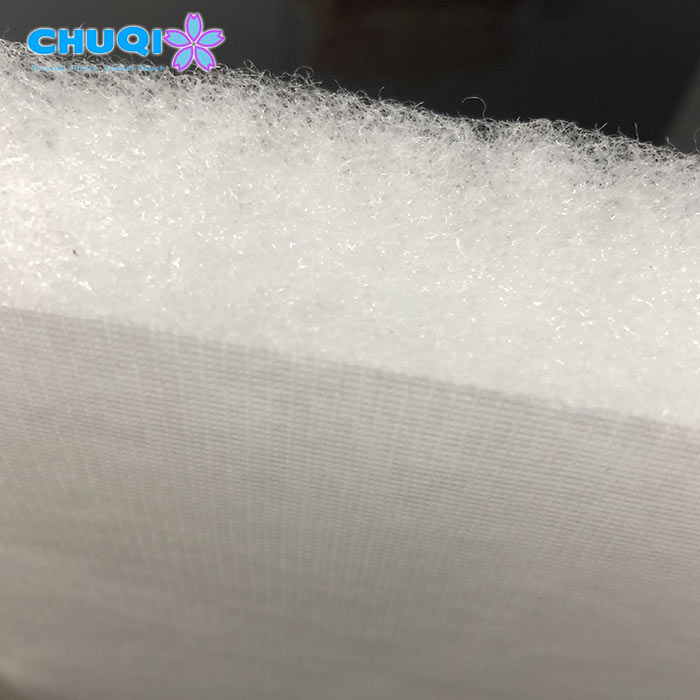
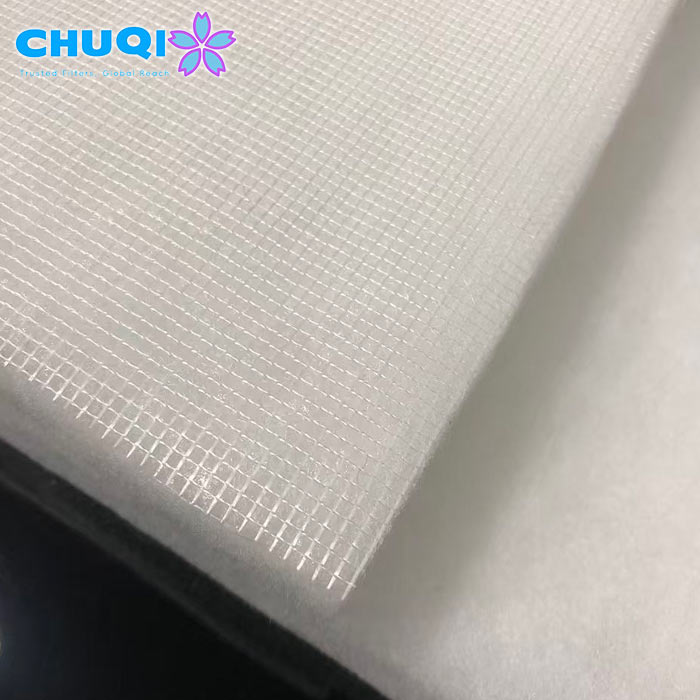
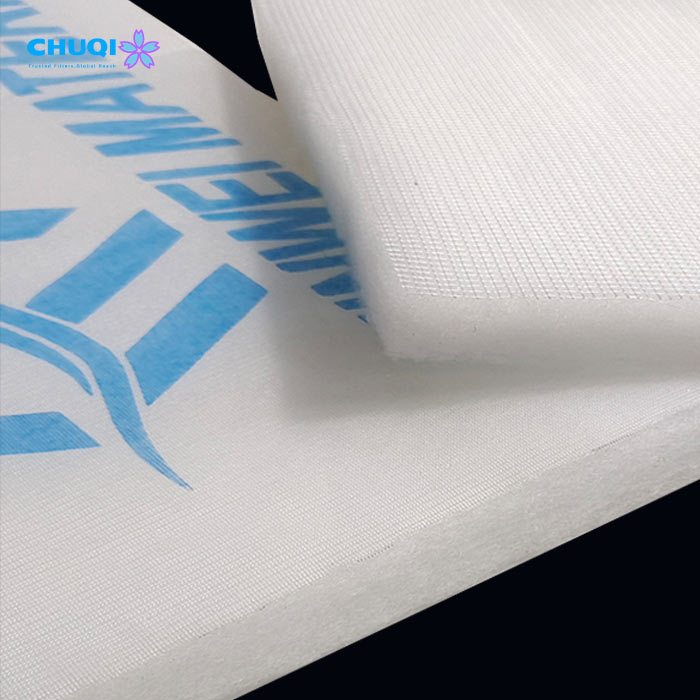
When auditing a potential spray booth ceiling filter manufacturer, evaluate their raw material processing capabilities against these essential structural benchmarks:
1. Progressive Density Construction
Standard ceiling filters feature a uniform density, causing rapid clogging on the air-inlet face (face-loading) and sharp pressure drops. Qualified manufacturers utilize a progressive density fiber matrix:
Air-Inlet Side: Coarse synthetic fibers trap larger airborne dust and overspray particles.
Core & Outlet Side: Progressively finer, thermally bonded polyester fibers capture micro-contaminants deeper within the media matrix.
2. Adhesive Impregnation Method Comparison
| Treatment Type | Performance Profile | Suitable B2B Application |
| Fully Tackified / Gel-Impregnated | Adhesive binder thoroughly saturates the fiber network; micro-particles stick on contact and cannot migrate downstream. | High-precision automotive OEMs, refinish booths, aerospace coating lines. |
| Surface-Tackified Only | Adhesive spray is applied only to the air-leaving face; particle re-entrainment occurs once internal layers fill up. | Standard commercial metal fabrication, basic equipment enclosure venting. |
| Dry Media (No Adhesive) | Relies purely on mechanical impaction; high risk of fiber shedding and particle release during pressure surges. | General coarse pre-filtration; strictly unsuitable for spray booth ceilings. |
3. Downstream Reinforcement & Laminar Flow Stabilization
To eliminate fiber migration onto fresh clearcoats, professional manufacturers reinforce the air-leaving side:
Polyester Scrim / Woven Mesh Backing: Provides structural stability against continuous air velocities ranging from 0.25 m/s to 0.5 m/s.
Thermally Glazed Surface Finish: Heat-sealed outer fibers ensure zero fiber shedding under high-volume airflow.
Airflow Pathway Structure:
Air Inlet (Coarse Fibers) ──► Deep Filtration (Fine Fibers + Gel Tackifier) ──► Outlet Face (Smooth Scrim Backing)

Factory Audit Checklist: Quality Control & Manufacturing Standards
To build a secure supply chain, B2B importers, distributors, and booth OEMs should verify candidate factories using the following audit criteria:
Certified Third-Party Testing Standards
Request original third-party laboratory test reports rather than self-declared datasheets:
ISO 16890 / EN 779: Verifies filtration efficiency (typically rated ePM10 50%–80% under ISO 16890, or M5 / F5 / F6 under EN 779:2012).
DIN 53438 (F1/K1): Ensures fire behavior compliance for hazardous paint booth environments containing volatile organic compounds (VOCs).
UL 900 Class 2: Standard flammability compliance required across North American industrial markets.
Production Consistency & Material Tolerances
Virgin Bico-Polyester Fiber: Uses high-grade virgin synthetic fibers rather than recycled off-cuts to ensure uniform thermal bonding strength.
Tight Grammage Tolerances: Maintains media weight (e.g., 600 g/m² ±5%) and thickness (20mm to 22mm) across master roll production batches.
Automated Gel Application: Precise adhesive dipping systems deliver uniform tack distribution without dry spots or wet oversaturation.


B2B Supply Chain Capabilities: Customization & OEM Support
A capable manufacturing partner offers versatile export solutions tailored to commercial distribution networks:
Custom Roll Dimensions & Precision Die-Cutting: Master roll sizes (1m x 20m, 2m x 20m) and custom pre-cut pad sets engineered for leading spray booth brands (such as Blowtherm, USI Italia, and Global Finishing Solutions).
Private Label OEM Branding: Custom printing for distributor logos, part numbers, and airflow direction arrows directly on the backing mesh.
Moisture-Proof Export Packaging: Heavy-duty polyethylene film wrapping and compressed roll packaging protect media from moisture absorption, mold, and physical deformation during ocean freight transit.
Frequently Asked Questions
Q1: How do I verify if a spray booth ceiling filter manufacturer is a direct factory or a trading company?
A1: To verify a direct source factory, request an official factory audit video, live raw material batch tracking, and third-party ISO 9001 certificates. Direct manufacturers also offer broad custom roll sizing (such as 1.6m–2.2m master roll widths) and custom OEM brand printing on the media backing mesh, which trading companies rarely supply directly.
Q2: What key testing certifications should I request when sourcing ceiling media globally?
A2: Always request original third-party lab test reports verifying three critical standards: ISO 16890 / EN 779 for particle filtration efficiency (M5 / F5 / V500 / V600 grades), DIN 53438 Class F1 or UL 900 for fire retardancy, and moisture-resistance certificates up to 100% RH for waterborne paint compatibility.
Q3: How do I prevent fiber migration and paint defects caused by low-quality ceiling filters?
A3: Ensure your supplier provides fully tackified (gel-impregnated) progressive density media with a reinforced high-density polyester scrim backing. The gel binder traps fine dust permanently, while the downstream mesh reinforcement prevents synthetic fibers from shedding onto fresh clearcoats under high airflow speeds (0.25–0.5 m/s).
Q4: What is the minimum order quantity (MOQ) and lead time for custom OEM spray booth filter rolls?
A4: Reliable direct manufacturers typically maintain flexible MOQs ranging from 20 to 50 standard master rolls (e.g., 2m x 20m) for custom branding, logo printing, or specialized die-cut pad sizes. Production lead times for standard container orders usually range between 7 to 15 business days.