
A complete HEPA filter specification defines more than an efficiency class and a set of dimensions. It connects filtration performance with the required airflow, allowable pressure drop, installation interface, operating environment and verification requirements.
For example, “H14, 610 × 610 mm” identifies part of a filter requirement, but it does not establish whether the filter will fit the housing, deliver the required airflow or meet the project’s acceptance criteria.
For HVAC engineers, equipment manufacturers, cleanroom contractors and industrial buyers, the objective is to establish a specification that allows the proposed filter to be evaluated against clearly defined technical requirements.
This guide explains how to define the essential HEPA filter specifications, compare technical data sheets and identify missing information before approving a new or replacement industrial HEPA filter.
What Are the Most Important HEPA Filter Specifications?
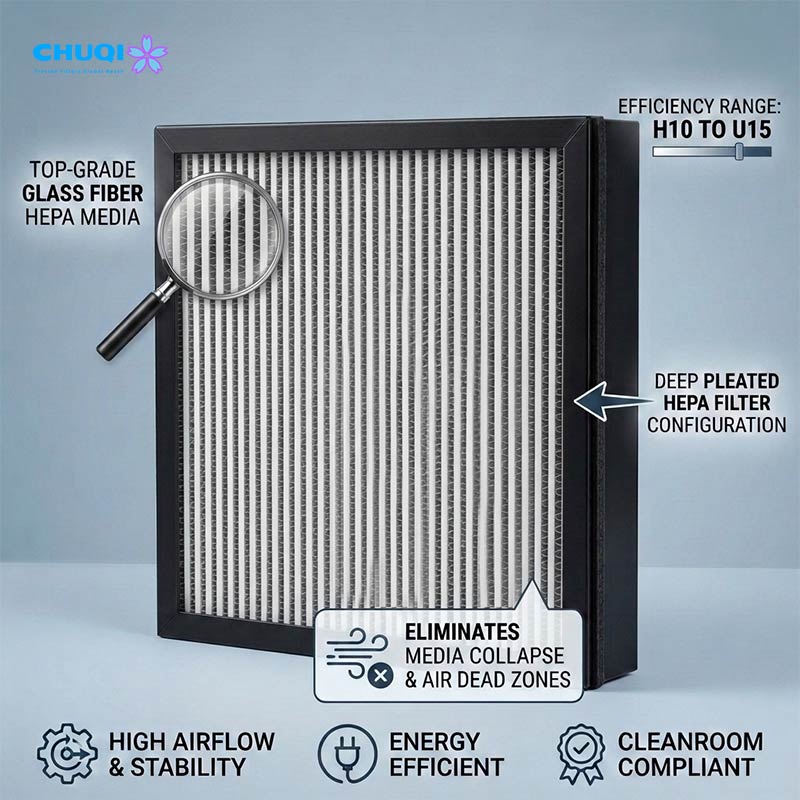
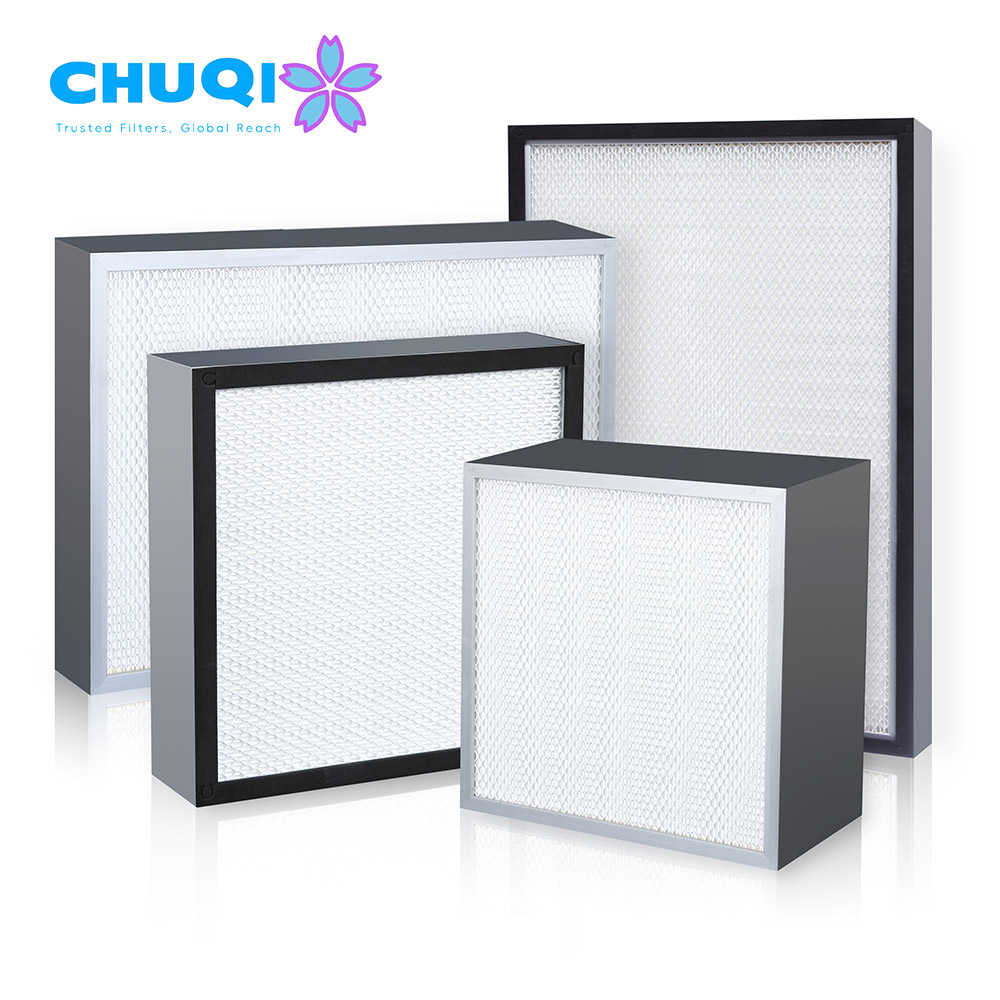
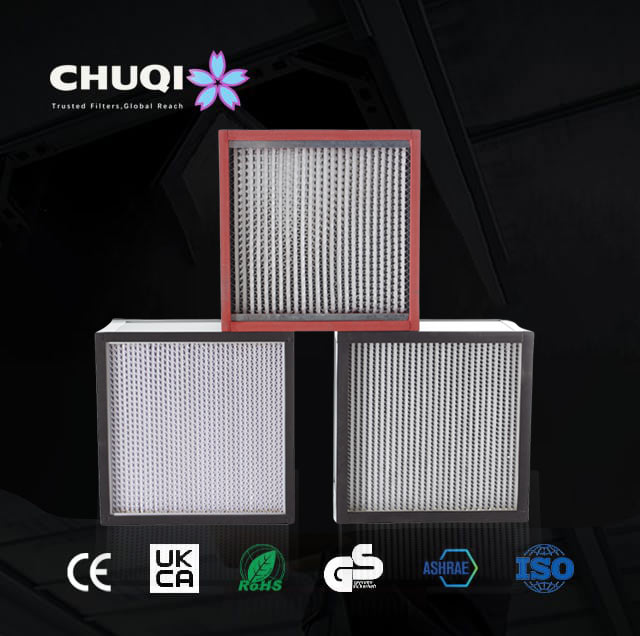
The most important HEPA filter specifications include the required efficiency class and test standard, operating airflow, pressure drop at the specified airflow, external dimensions and tolerances, sealing arrangement, construction materials, operating conditions and test documentation.
These requirements should be evaluated together. An efficiency rating and nominal dimensions alone do not establish whether a filter is suitable for the intended equipment or installation.
What Should a HEPA Filter Specification Include?
A specification should identify the required product, define its operating conditions and establish how its suitability will be verified.
The information required varies by application. A replacement filter for an existing housing may need an approved dimensional drawing and seal configuration. A new OEM project may begin with an airflow target, available installation space and performance requirements.
In both cases, missing information should be identified and resolved rather than silently assumed.
Specification Area | What Needs to Be Defined | Why It Matters |
|---|---|---|
Filtration performance | Required class, applicable standard and test basis | Establishes how efficiency requirements are interpreted |
Operating performance | Required airflow and allowable pressure drop at that airflow | Connects filter performance to system requirements |
Dimensions and installation | Width, height, depth, tolerances, mounting interface and airflow direction | Establishes physical compatibility |
Sealing | Gasket or gel-seal arrangement, location and mating surface | Defines the filter-to-housing interface |
Materials and environment | Frame, media, sealant, gasket and operating conditions | Identifies material compatibility requirements |
Verification | Test reports, product identification and acceptance criteria | Defines how the supplied filter will be evaluated |
Manufacturer data sheets commonly separate efficiency class, airflow, initial pressure drop, frame material, gasket, sealant and operating limits. These parameters describe different aspects of a finished filter and should be reviewed together.
For procurement, a useful starting point is to establish which requirements are mandatory, which can be adjusted during engineering review and which remain subject to confirmation.
How to Specify HEPA Filter Efficiency and Test Standards
An efficiency percentage needs a defined test basis. A specification should identify the required filter class and applicable standard rather than relying on an isolated percentage.
Under EN 1822, HEPA filter classes H13 and H14 are associated with performance evaluation at the most penetrating particle size (MPPS). Their minimum overall efficiencies are:
EN 1822 Filter Class | Minimum Overall Efficiency at MPPS |
|---|---|
H13 | 99.95% |
H14 | 99.995% |
These figures describe minimum overall efficiency requirements, not every aspect of filter acceptance. The applicable classification requirements also address local performance, where required by the class and test procedure.
A statement such as “99.97% at 0.3 microns” should not automatically be treated as equivalent to an H13 or H14 classification. The standard, particle-size basis, test method and scope of the result must be understood before different specifications can be compared.
Why the Particle-Size Basis Matters
MPPS is the particle size at which a filter is most penetrating under the specified test conditions. It should not be assumed to be a fixed 0.3-micron value for every HEPA filter.
This distinction matters when suppliers use different efficiency descriptions. Two efficiency percentages are not necessarily comparable if they refer to different particle sizes, test methods or operating conditions.
A clearer specification identifies the required classification standard and class, then defines any additional project-specific testing and documentation requirements.
For a detailed comparison of the two common classes, see our related guide: H13 vs. H14 HEPA Filters: Efficiency, Airflow and Selection.
Media Efficiency vs. Finished-Filter Performance
A media test result describes the material sample that was tested. It does not, by itself, establish the performance of the finished filter assembly.
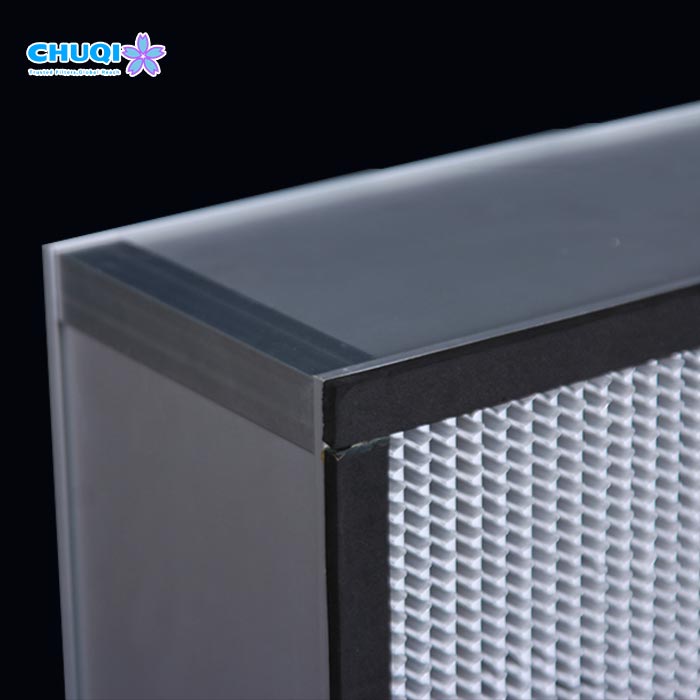
The completed filter includes the media, frame, sealant and other construction details. Depending on the design, leakage can also be associated with the media pack, frame joints or sealing interface.
Where the project requires finished-filter classification or integrity verification, the supporting evidence should address the assembled filter and the agreed test scope—not only the filter media.
If the required class has not been established, it is better to mark it as pending technical confirmation than to select a grade simply to make the specification appear complete.
For projects referencing EN 1822 or ISO 29463, confirm the applicable standard, edition, classification requirements and documentation before procurement.
How to Specify HEPA Filter Airflow and Pressure Drop
Airflow and pressure drop must be evaluated together. A pressure-drop value is incomplete unless its corresponding airflow is stated. Similarly, a required airflow does not fully describe the operating requirement unless the acceptable resistance is understood.
Required Airflow vs. Rated Airflow
Required airflow is the volume of air the application needs to pass through the filter. Rated airflow is the flow associated with a product’s declared performance conditions.
For a custom industrial HEPA filter, the application requirement should guide the design review. A catalogue rating should not be assumed suitable without checking the proposed filter’s operating data.
Manufacturer data sheets commonly present airflow and initial pressure drop as paired values.
If the customer knows only the equipment’s total airflow, the flow through each filter still needs to be established. Where several filters are installed, the system arrangement and airflow distribution determine how the total flow relates to an individual filter.
Dividing total system airflow by the number of filters is appropriate only when the assumed distribution is valid.
Specify Pressure Drop at a Defined Airflow
Consider these two descriptions:
1. Initial pressure drop: 250 Pa.
2. Initial pressure drop not exceeding 250 Pa at 1,000 m³/h.
The second statement is more useful because it defines both the resistance limit and the airflow at which it applies.
When comparing proposed HEPA filters, check whether the pressure-drop figures refer to the same airflow and comparable configurations. Otherwise, a lower published resistance may simply reflect a different test condition.
Initial Pressure Drop vs. Final Pressure Drop
Initial pressure drop describes the resistance of a new filter at the stated airflow. Final pressure drop refers to a separately defined operating or maintenance threshold, depending on the manufacturer’s documentation and project requirements.
A recommended replacement threshold and a maximum allowable pressure limit are not automatically interchangeable.
For example, a manufacturer may specify a recommended final pressure drop separately from a maximum final pressure drop. The replacement criterion should remain compatible with the filter’s declared limits and the equipment’s ability to maintain the required operating conditions.
There is no universal replacement pressure that applies to every HEPA filter design or application.
How to Calculate Face Velocity
Where face velocity is part of the requirement, the reference area used in the calculation must be identified.
For airflow expressed in cubic metres per hour:
v = Q / (3600 × A)
Where:
v = average velocity in m/s
Q = airflow in m³/h
A = stated reference area in m²
External frame area, open face area, and unfolded filter-media area are different quantities. Using one in place of another can produce a misleading comparison.
For this reason, the specification should identify the area basis whenever velocity is used to evaluate filter performance.
How to Confirm HEPA Filter Dimensions and Installation
Nominal size is useful for identifying a filter family, but it should not replace an approved dimensional drawing when fit is critical.
A dimension written as “610 × 610 × 292” remains open to interpretation if the units, dimension order and installation orientation are not identified.
The specification should establish width, height and depth, together with the tolerances relevant to the installation.
Housing Interface and Installation Orientation
External dimensions are only part of mechanical compatibility.
A flange, supporting edge, mounting feature or recessed installation can determine how the filter sits inside the equipment. A replacement with similar overall dimensions may still be unsuitable if the interface differs.
For an existing housing, the important reference is the actual connection between the filter and equipment. A front-facing photograph alone may not show the mounting arrangement, sealing surface or available depth.
An existing drawing, equipment reference or clearly identified measurements can help resolve these details before approval.
Gasket, Gel Seal and Dimensional Tolerances
“With gasket” is not always a complete sealing requirement.
The gasket location, contact surface and mounting arrangement need to match the housing. A gel-seal interface likewise needs to be considered as part of the filter-and-housing connection, not simply as a material option.
Installed integrity involves the complete assembly, including potential leakage at the frame and seal—not only the filter media.
The dimensional drawing should show the sealing location, installation orientation and relevant mounting features clearly enough to prevent different interpretations by the buyer and manufacturer.
There is no universal dimensional tolerance suitable for every custom HEPA filter. Acceptable variation depends on the frame construction, housing clearance, sealing arrangement and assembly requirements.
For replacement projects, distinguish nominal dimensions from measured dimensions so that an uncertain reference is not mistakenly treated as an approved manufacturing drawing.
How to Select HEPA Filter Materials for Operating Conditions
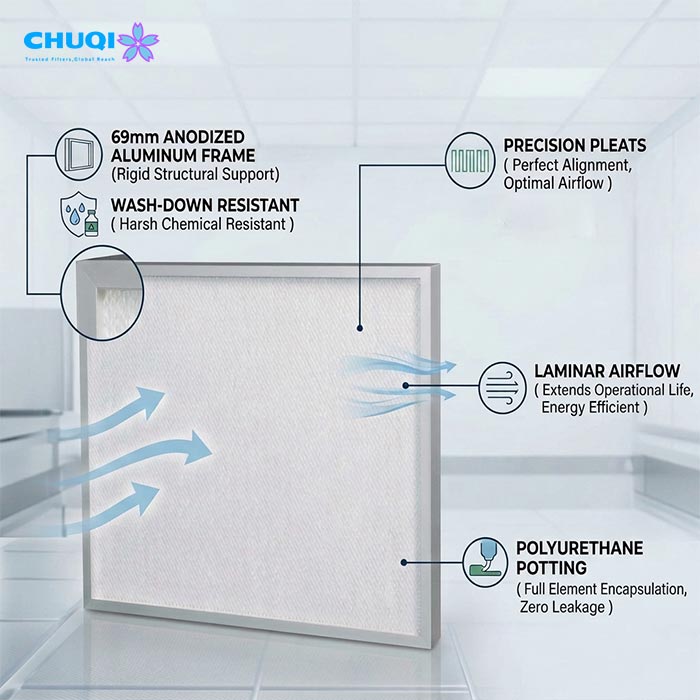
rame material is only one part of filter construction. The media, separators or spacers, sealant and gasket also need to be evaluated against the intended operating environment.
A temperature rating for one component should not automatically be applied to the complete assembly. Product documentation should establish the operating limits of the finished filter under the relevant conditions.
Temperature, Humidity and Chemical Exposure
“High-temperature use” is not a sufficiently precise operating description.
The normal operating temperature, any short-term excursions and the duration of exposure can all be relevant to the design review. If the process includes heating or defined temperature cycles, those conditions should be made available for evaluation.
A metal frame does not, by itself, demonstrate that the media, sealant and gasket are suitable for the same temperature.
Similarly, “humid environment” can describe several different situations. High relative humidity, condensation, direct liquid contact and exposure to cleaning chemicals should not be treated as equivalent conditions.
Where these factors are relevant, describe the actual exposure so material compatibility can be reviewed against the application.
When Can a HEPA Filter Be Specified as Washable?
Washability should be treated as a product-specific capability.
Unless a filter has been designed and validated for a defined cleaning process, washing should not be assumed to preserve its efficiency, structural condition or integrity.
If cleaning or reuse is part of the intended operation, specify the cleaning method and required performance after cleaning during the design discussion. Do not assume that a conventional HEPA filter can be washed and returned to service without validation.
What If Your HEPA Filter Specifications Are Incomplete?
You do not need to have every parameter finalized before starting a technical discussion.
An existing filter reference, equipment drawing or description of the application can help establish what is known and what still needs to be confirmed.
If the original documentation is unavailable, photographs and measurements may provide a useful starting point. However, they should not be treated as proof of the required efficiency class, operating performance or final installation dimensions.
For example, an old filter can help identify its physical arrangement, but it may not reveal the airflow for which the equipment was designed. A readable product label may identify a class or model, but additional documentation may still be needed to establish the correct replacement specification.
The objective is to resolve missing information before the design is approved—not to fill gaps with assumptions.
When a requirement is pending, identifying who will confirm it helps keep the project moving without presenting uncertain information as final.
Need a Fully Customized HEPA Filter? Work Directly with the Manufacturer.
Whether you are developing a new filtration system or replacing an existing filter, Chuqi is a direct manufacturer offering customized industrial HEPA filters to meet your specific application requirements.
From filter dimensions and frame construction to sealing configurations and airflow requirements, we work with you to develop a suitable filter configuration for your equipment and operating conditions. Share your drawings, existing filter samples, model numbers or available technical specifications, and our team will help review your requirements and identify any details that need confirmation.
As a source manufacturer, we offer flexible customization to support different equipment designs and project requirements. You do not need to finalize every parameter before contacting us. Start with the information you have, and let our team help you define the next steps.
Explore Our HEPA Filter Products
Browse our [HEPA Filter Product Range] to explore available product configurations and identify options for your application.
Need a solution tailored to your project? Contact Chuqi directly for custom HEPA filter consultation and a quotation.