
In industrial air handling systems, high filter pressure drop, limited airflow capacity, and restricted installation space can increase operating costs and make HEPA filter selection more challenging.
V-Bank and Box-Type HEPA filters offer different structural solutions. But which design is better for airflow capacity, pressure drop, and fan energy efficiency? This guide compares their key differences to help engineers, equipment manufacturers, and buyers choose the right configuration for their applications.
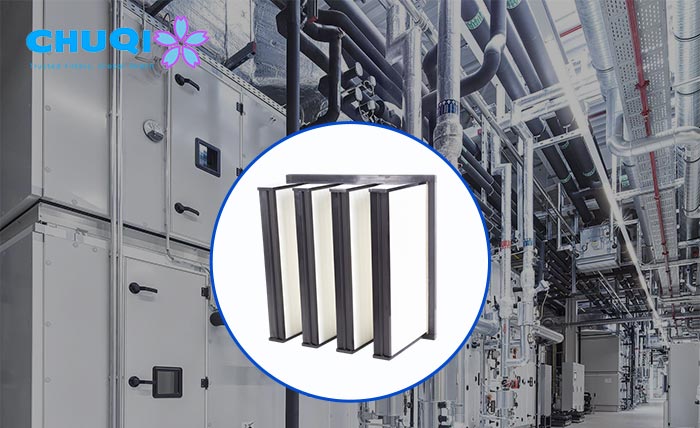

Understanding V-Bank and Box-Type HEPA Filter Designs
What Is a V-Bank HEPA Filter?
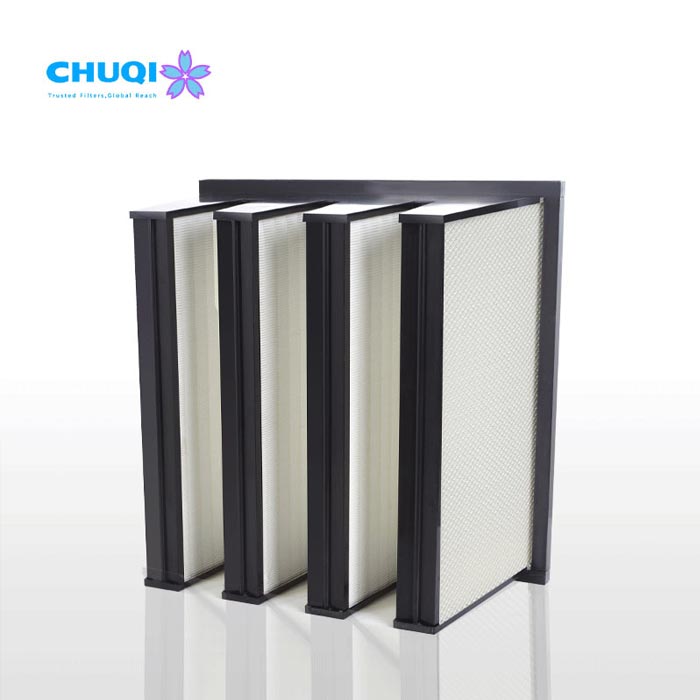
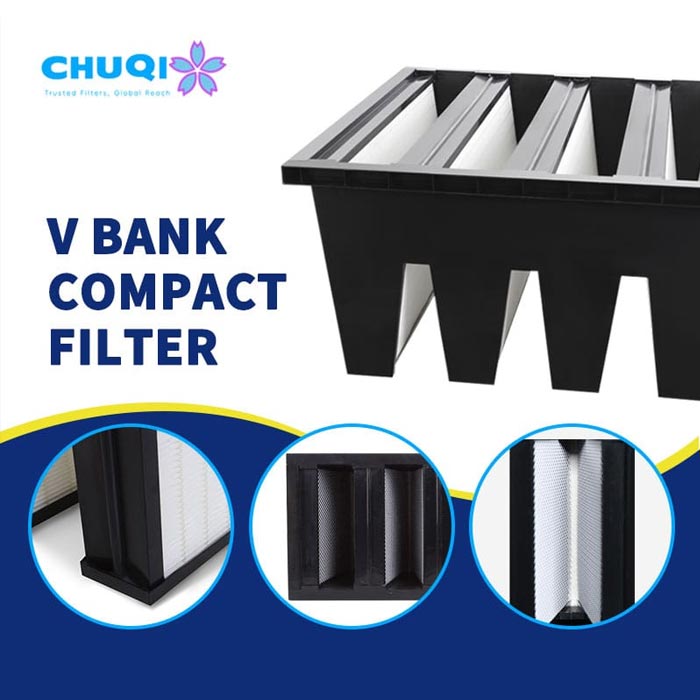
A V-Bank HEPA filter consists of multiple pleated filter media packs arranged at an angle to form a V-shaped structure.
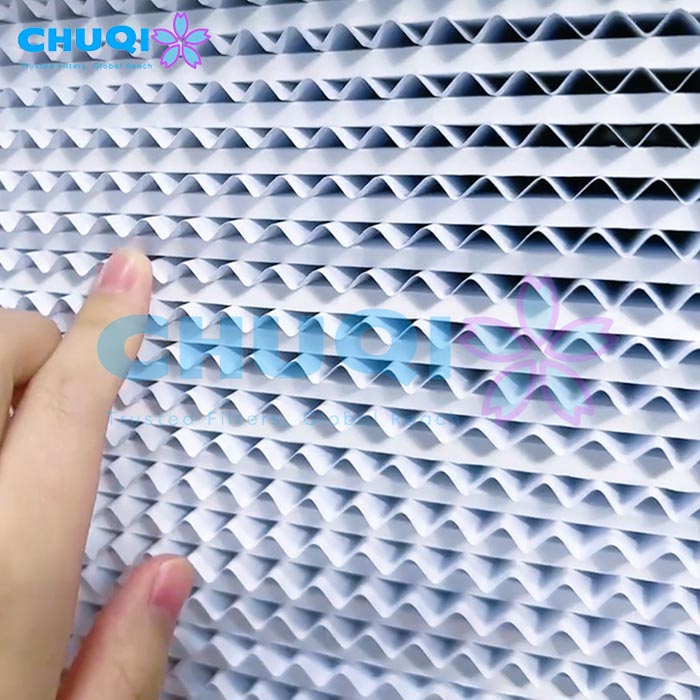
Instead of relying on a single conventional media pack, the design distributes the filtration media across several sections. This arrangement can increase the effective filtration area within a given frontal dimension.
Depending on the design, V-Bank filters may be considered for systems where airflow capacity and installation space are important considerations.
However, the V-shaped arrangement alone does not determine filtration efficiency or pressure drop. Media resistance, pleat spacing, internal airflow passages, and filter construction remain important.
Explore Chuqi’s V-Bank Air Filter range for available configurations and product specifications.
What Is a Box-Type HEPA Filter?
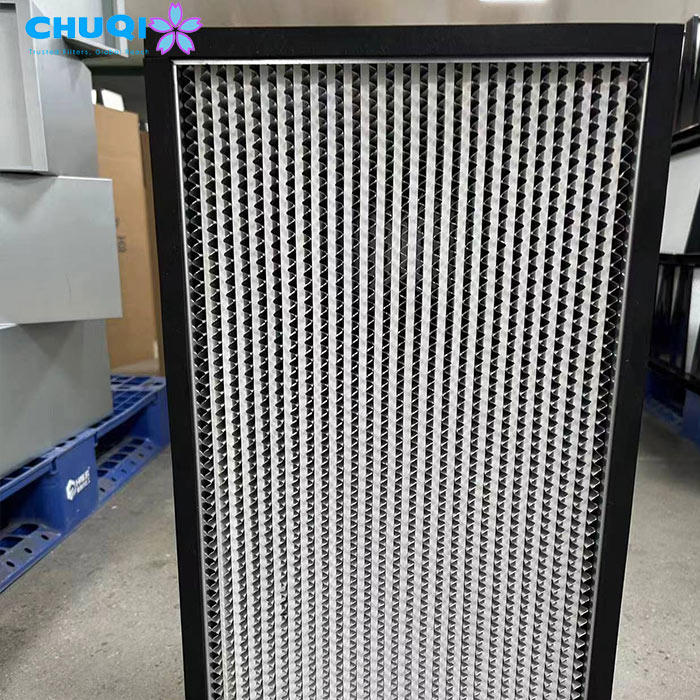
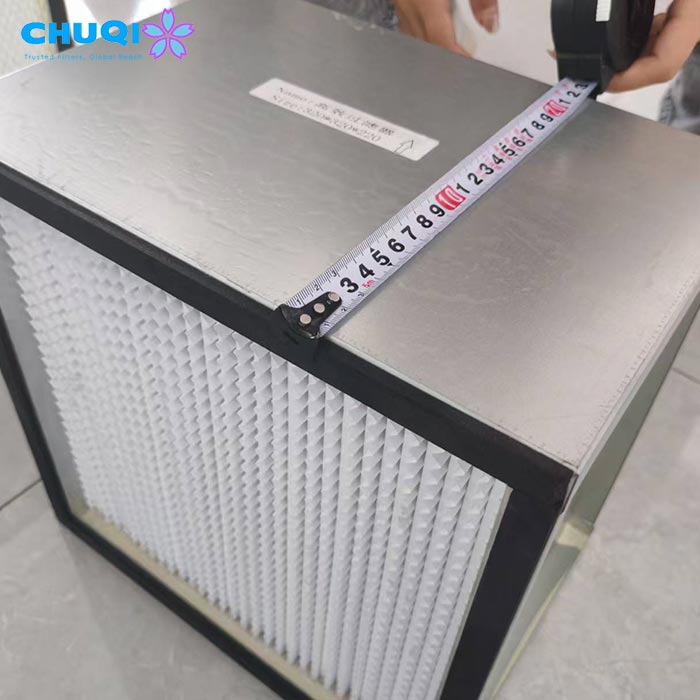
A Box-Type HEPA filter features a rectangular outer frame or housing containing a pleated filter media pack.
Its conventional rectangular shape makes it suitable for many air handling systems and equipment designed around standard filter mounting arrangements.
Box-Type filters can use different media pack constructions, pleat configurations, frame materials, and sealing designs. Their actual performance therefore varies according to the specific filter construction rather than the box-shaped housing alone.
For an overview of different HEPA filter configurations, visit Chuqi’s Industrial HEPA Filter Product Range.
V-Bank vs. Box-Type HEPA Filters: Key Structural Differences
The main difference between these two filter designs is how the media packs are arranged inside the available housing space.
| Comparison Factor | V-Bank HEPA Filter | Box-Type HEPA Filter |
|---|---|---|
| Media arrangement | Multiple angled media packs | Pleated media pack inside a rectangular housing |
| Structural layout | V-shaped configuration | Conventional rectangular configuration |
| Effective media area | Can accommodate a relatively large media area within a compact frontal space | Depends on filter dimensions and pleat configuration |
| Airflow passages | Air passes through multiple angled media sections | Air passes through the pleated media pack |
| Installation requirements | Requires a compatible V-Bank housing or mounting arrangement | Requires a compatible rectangular housing or mounting arrangement |
| Main design consideration | Media area and airflow capacity within limited frontal space | Equipment compatibility and available installation dimensions |
These differences influence how each filter uses the available space, but they do not establish a universal performance ranking.
For a meaningful comparison, evaluate both filters at the same required airflow and filtration efficiency, using comparable test conditions.
A filter with a larger effective media area may offer a design advantage, but it must also maintain suitable airflow passages, media stability, and sealing performance.
How Filter Structure Influences HEPA Filter Airflow Capacity
Airflow capacity is one of the most important factors when comparing V-Bank and Box-Type HEPA filters.
The internal structure determines how the media area is distributed within the housing and how air moves through the filter.
Effective Filter Media Area
The effective media area is the actual filtration surface available for air to pass through, rather than the frontal area of the filter.
A V-Bank configuration can arrange multiple media packs within a relatively compact frontal dimension. Depending on the design, this may provide more effective filtration area than a conventional Box-Type filter with similar frontal dimensions.
When the same airflow is distributed across a larger effective media area, the airflow load per unit of media area can be reduced.
This can help improve the filter’s airflow characteristics, provided that the media resistance and internal flow passages are appropriately designed.
However, a larger media area does not automatically guarantee higher rated airflow or lower pressure drop.
The result also depends on:
Filter media permeability and resistance
Pleat depth, spacing, and geometry
Number and arrangement of media packs
Internal airflow passages
Filter dimensions and installation depth
Airflow distribution across the media
Box-Type HEPA filters can also achieve substantial effective media areas through suitable pleat designs and dimensions. Their performance should therefore be evaluated using actual rated airflow and pressure drop data.
Airflow Distribution Through the Filter
Airflow distribution is another important consideration.
If air is not distributed evenly across the filter media, some sections may experience higher local airflow velocity than others. This can contribute to uneven loading and unnecessary resistance.
For a V-Bank filter, sufficient space between media packs is important for maintaining effective airflow passages.
For a Box-Type filter, the pleat arrangement and available internal space influence how evenly air passes through the media pack.
In both designs, good airflow distribution depends on the complete filter construction and its compatibility with the surrounding housing.
For a deeper explanation of rated airflow, face velocity, and their relationship to filter performance, read our guide to HEPA Filter Airflow: Rated Flow and Face Velocity.
HEPA Filter Pressure Drop and Fan Energy Consumption
Filter pressure drop is the resistance created as air passes through the filter.
In an air handling system, the fan must overcome this resistance along with the pressure losses from other system components.
If a filter creates higher resistance at the required operating airflow, the fan may need to use more power to maintain the same airflow, depending on the fan curve and control strategy.
This makes pressure drop an important factor when comparing V-Bank and Box-Type HEPA filters.
How Does Filter Pressure Drop Affect Fan Power?
A simplified relationship for estimating the additional electrical power associated with filter pressure drop is:
Additional Fan Power (W) = Airflow Rate (m³/s) x Pressure Drop Difference (Pa) / Overall Fan-System Efficiency
Where:
Airflow Rate is the operating airflow in cubic meters per second.
Pressure Drop Difference is the difference in filter resistance at the same airflow.
Overall Fan-System Efficiency accounts for the efficiency of the fan and relevant motor or drive components.
For example, consider an air handling system operating at 10,000 m³/h.
Assume that one filter configuration creates 50 Pa more pressure drop than another at the same airflow, and the overall fan-system efficiency is 65%.
First, convert the airflow:
10,000 m³/h = 2.78 m³/s
Then estimate the additional power:
2.78 x 50 / 0.65 = approximately 214 W
If the system operates for 8,000 hours per year, the estimated additional energy consumption is:
0.214 kW x 8,000 hours = approximately 1,709 kWh per year.
This is an illustrative calculation, not a guaranteed energy-saving figure. Actual electricity consumption depends on fan performance, motor and drive efficiency, system resistance, airflow control, and operating conditions.
The calculation also assumes that the pressure drop difference remains constant at the operating airflow.
Does a V-Bank HEPA Filter Always Have Lower Pressure Drop?
No. A V-Bank HEPA filter does not automatically have lower pressure drop than a Box-Type HEPA filter.
Its structural arrangement may provide more effective media area within a limited frontal space. However, the final pressure drop is also influenced by:
Filter media resistance
Rated airflow
Pleat geometry and spacing
Internal airflow passages
Filtration efficiency
Filter construction and sealing
A well-designed Box-Type HEPA filter may perform better than a poorly matched V-Bank filter under certain operating conditions.
For an accurate comparison, use pressure drop data measured at the same airflow and under comparable test conditions. Also consider how resistance changes during filter operation rather than relying only on initial pressure drop.
Read more in our guide: HEPA Filter Pressure Drop: What Affects It and How to Specify It.
Which HEPA Filter Design Is Suitable for Different Applications?
The right filter configuration depends on equipment design, airflow demand, installation space, and operating conditions.
When to Consider V-Bank HEPA Filters
V-Bank HEPA filters are worth considering when:
The air handling system requires substantial airflow within a limited frontal space.
The equipment is designed to accommodate a V-shaped filter configuration.
Increasing effective media area is an important design objective.
Pressure drop and fan energy consumption are important operating considerations.
The available housing dimensions support the required V-Bank installation depth.
They may be suitable for selected industrial air handling units, high-capacity HVAC systems, and other applications where the equipment is designed around this configuration.
When to Consider Box-Type HEPA Filters
Box-Type HEPA filters may be a practical choice when:
The existing housing is designed for rectangular filters.
The equipment has sufficient installation depth.
A conventional rectangular mounting arrangement is required.
Replacement compatibility is an important consideration.
The required airflow and pressure drop can be achieved within the available filter dimensions.
They are commonly considered for cleanroom air supply systems, pharmaceutical facilities, and industrial filtration equipment.
Application Requirements Matter More Than the Filter Name
A cleanroom, for example, does not automatically require a V-Bank or Box-Type filter.
The appropriate design depends on the air handling unit configuration, required airflow, filtration efficiency, available installation space, and the position of the HEPA filter within the overall system.
For equipment manufacturers and system integrators, filter selection should start with the system’s airflow and installation requirements rather than assuming that one structure is suitable for every application.
For more information, see How to Size a HEPA Filter for an Industrial Air System.
Engineering Factors to Consider Before Selecting a HEPA Filter
Before choosing between V-Bank and Box-Type HEPA filters, engineers and purchasing teams should evaluate the following factors.
Required Filtration Efficiency
The required HEPA grade should match the application’s particle filtration target and relevant testing standards.
For example, H13 and H14 filters are commonly specified for applications requiring high-efficiency particle filtration.
However, filtration efficiency alone does not determine the most suitable filter structure. Airflow, pressure drop, sealing, and installation requirements must also be considered.
Rated Airflow and Initial Pressure Drop
Compare rated airflow and initial pressure drop at the same operating conditions.
Two filters should not be considered equivalent simply because they have the same external dimensions or filtration grade.
A useful comparison should include:
Rated airflow
Initial pressure drop at the rated airflow
Filter efficiency grade
Filter dimensions and depth
Applicable test conditions
Available Installation Space
Check the available frontal dimensions, installation depth, housing configuration, and maintenance clearance.
A V-Bank filter may require a different housing arrangement from a conventional Box-Type filter. Replacing one structure with another is not always a direct fit.
Sealing and Mounting Design
Air leakage around the filter can undermine the performance of the entire filtration system.
The frame, gasket, gel seal, knife-edge interface, or other mounting arrangement should match the equipment design and required sealing performance.
Operating Conditions and Maintenance
Operating airflow, dust loading, humidity, temperature, and maintenance accessibility can influence filter service life and replacement requirements.
A filter with suitable initial pressure drop should also be evaluated in terms of its operating performance over time.
For a broader overview of HEPA filter selection factors, refer to HEPA Filter Specifications: A Checklist for Engineers and Buyers.
Custom HEPA Filter Manufacturing for Different Airflow Requirements
Standard filter configurations may not always match the installation dimensions or operating conditions of industrial equipment.
For equipment manufacturers, filtration system integrators, and distributors, customized HEPA filters can help address differences in housing dimensions, airflow requirements, and mounting interfaces.
Chuqi manufactures air filtration media in its own factory and also supplies finished air filters for different industrial filtration applications.
Depending on the product design and application, customization may involve:
Filter dimensions and installation depth
Filter media selection
Pleat configuration and structural arrangement
Frame materials and construction
Gasket and sealing arrangements
Rated airflow and pressure drop targets
OEM packaging and supply requirements
The key is to match the filter construction to the actual equipment and operating conditions rather than changing the filter structure based on appearance alone.
For projects requiring V-Bank configurations, explore our V-Bank HEPA Filter product page.
You can also browse the complete Industrial HEPA Filter Product Range to explore different HEPA filter designs.
Frequently Asked Questions About V-Bank and Box-Type HEPA Filters
What is the main difference between V-Bank and Box-Type HEPA filters?
The main difference is the arrangement of the filter media. V-Bank HEPA filters use multiple angled media packs arranged in a V-shaped configuration, while Box-Type HEPA filters use a pleated media pack inside a rectangular housing.
Do V-Bank HEPA filters provide higher airflow capacity?
A V-Bank design can accommodate a relatively large effective media area within a compact frontal space, which may support higher airflow capacity. Actual performance depends on media resistance, pleat geometry, airflow distribution, and filter dimensions.
Are V-Bank HEPA filters more energy-efficient than Box-Type HEPA filters?
Not necessarily. Energy consumption depends on filter pressure drop at the operating airflow, fan-system efficiency, and system control strategy. A V-Bank filter may offer an energy advantage when its specific design achieves lower resistance under the required operating conditions.
Can a Box-Type HEPA filter be replaced with a V-Bank HEPA filter?
Not always. The replacement must be compatible with the equipment’s housing dimensions, installation depth, support structure, sealing interface, and airflow requirements. A different mounting arrangement may be necessary.
Which HEPA filter is better for cleanroom applications?
Both V-Bank and Box-Type HEPA filters can be used in cleanroom-related systems. The appropriate choice depends on the air handling unit design, required airflow, filtration efficiency, available space, and installation configuration.
What information is needed for a customized V-Bank or Box-Type HEPA filter?
Useful information includes the required HEPA grade, filter dimensions, installation depth, rated airflow, pressure drop target, frame material, sealing design, and equipment or housing drawings. These details help determine a suitable filter configuration.