
A HEPA filter is designed to capture extremely fine airborne particles. But in an industrial air filtration system, the air entering the filter may contain much more than fine particles. It can also carry dust, fibers, lint, and other contaminants in relatively large quantities.
What happens when all of this dust reaches the HEPA filter directly?
The filter has to handle both the fine particles it is designed to capture and a substantial amount of incoming dust that could have been removed earlier. As dust accumulates, airflow resistance increases. The filter may need to be replaced sooner, and the entire system can become more difficult and expensive to operate.
This is why pre-filtration is important in a HEPA filtration system. Primary pre-filters and medium-efficiency filters capture particles before the air reaches the HEPA stage, reducing its dust load and helping the system maintain more stable airflow.
Let’s look at what happens without pre-filtration, how upstream filters protect HEPA filters, and why different filtration stages work better together.
1. What Happens When a HEPA Filter Works Without a Pre-Filter?
Imagine an air handling system drawing dusty air continuously from a factory, workshop, or outdoor environment.
Without an upstream pre-filter, much of the incoming dust travels directly toward the HEPA filter. The HEPA media must capture the fine particles as well as a portion of the larger particles and dust that could otherwise have been removed by an earlier filtration stage.
This creates several practical problems.
1.1 Dust Builds Up on the HEPA Filter More Quickly
Every time air passes through a HEPA filter, particles are captured by its fine fiber structure.
As more dust accumulates, the available airflow paths within the media change. The filter becomes increasingly resistant to airflow.
This does not necessarily mean the filter immediately stops working. However, it means the HEPA filter is using more of its dust-loading capacity to handle contaminants that could have been captured upstream.
For systems with a continuous supply of dusty air, this can make the HEPA filter reach its replacement condition sooner.
1.2 Pressure Drop Increases and Airflow May Become Unstable
As dust accumulates, the pressure drop across the HEPA filter generally increases.
The fan must overcome this additional resistance to maintain the required airflow. Depending on the fan capacity and control system, one of two things may happen:
The fan consumes more energy to maintain the required airflow.
The system cannot compensate sufficiently, and airflow begins to decrease.
For cleanroom ventilation, industrial air handling, and other applications with defined airflow requirements, reduced airflow can affect how consistently the system supplies clean air.
In some applications, it may also make it harder to maintain the required room cleanliness or ventilation balance.
For a more detailed explanation, see our guide to HEPA Filter Pressure Drop.
1.3 Filter Replacement and Maintenance Become More Frequent
When the HEPA filter receives a heavy particle load, it may reach its final operating resistance earlier.
This means more frequent filter inspections and potentially earlier replacement. Maintenance teams may also need to spend more time investigating airflow or pressure-drop problems.
The cost is not limited to the price of a replacement HEPA filter. It can also include labor, system downtime, energy consumption, and disruption to normal operations.
The important point is that a HEPA filter is an expensive final filtration stage. Using it to capture large amounts of dust that could have been removed by lower-stage filters is often an inefficient way to operate a filtration system.
2. How Does a Pre-Filter Protect a HEPA Filter?
A pre-filter works as the first line of defense in an air filtration system.
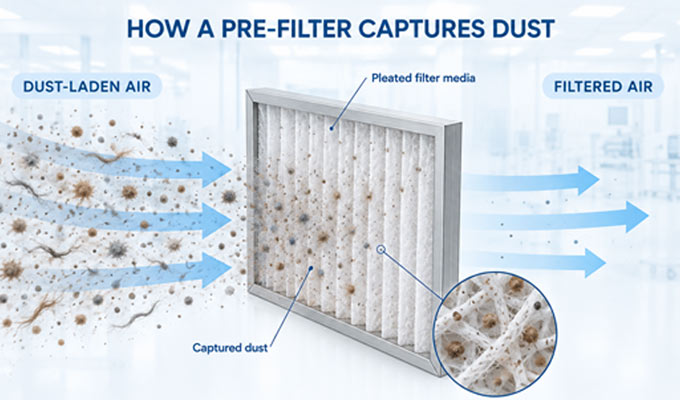
Instead of sending all incoming particles directly to the HEPA filter, the system removes a portion of the dust before the air reaches the final stage.
For example, consider an industrial air handling system that draws in air containing coarse dust, fibers, and finer airborne particles.
The primary filter captures a substantial portion of the larger contaminants. A medium-efficiency filter then removes additional particles that pass through the first stage. By the time the air reaches the HEPA filter, much of the particle load has already been removed.
This is the basic principle of staged air filtration:
Capture larger particles first, remove additional particles in the middle stage, and use the HEPA filter for final high-efficiency filtration.
Why Does This Make Such a Difference?
Think of the HEPA filter as the final cleaning stage rather than the filter responsible for handling every type of airborne contaminant.
If the air entering the HEPA filter contains a high concentration of dust, the filter must capture that additional material while also performing its fine-particle filtration function.
When upstream filters remove much of this dust first:
Less dust reaches the HEPA filter.
Dust accumulation on the HEPA media can be reduced.
The HEPA filter may take longer to reach its replacement condition.
Pressure-drop increases across the final stage may be slower.
The system has a better chance of maintaining its required airflow over time.
Pre-filtration does not eliminate HEPA loading or guarantee a particular service life. Its value is that it reduces the amount of particulate matter reaching the final filter.
3. With vs. Without Pre-Filtration: What Is the Difference?
The difference becomes clearer when comparing how the two systems operate over time.
| Operating Factor | Without Pre-Filtration | With Suitable Pre-Filtration |
|---|---|---|
| Incoming dust | More dust reaches the HEPA stage directly | Upstream filters capture a portion of the incoming dust |
| HEPA dust loading | HEPA handles a greater particle load | HEPA receives air with a reduced particle load |
| Pressure drop | HEPA resistance may increase more quickly | Dust loading on the HEPA stage may be reduced |
| Airflow management | Fan may need to overcome rising resistance earlier | Upstream filtration helps manage the resistance across stages |
| Maintenance | HEPA inspection and replacement may be needed sooner | Lower-stage filters take on part of the dust load and can be serviced separately |
| Operating cost | Potentially higher HEPA replacement and maintenance costs | Better distribution of filtration work may improve operating economy |
The main advantage is not that pre-filtration makes the HEPA filter last forever. It is that each filter performs a more appropriate role.
A relatively economical primary filter can capture coarse dust. A medium-efficiency filter removes additional particles. The HEPA filter then focuses on the final high-efficiency filtration task.
This is a more practical way to manage the filtration workload than relying on the HEPA filter to handle the entire incoming particle load.
4. Why Do HEPA Systems Use Primary and Medium-Efficiency Filters?
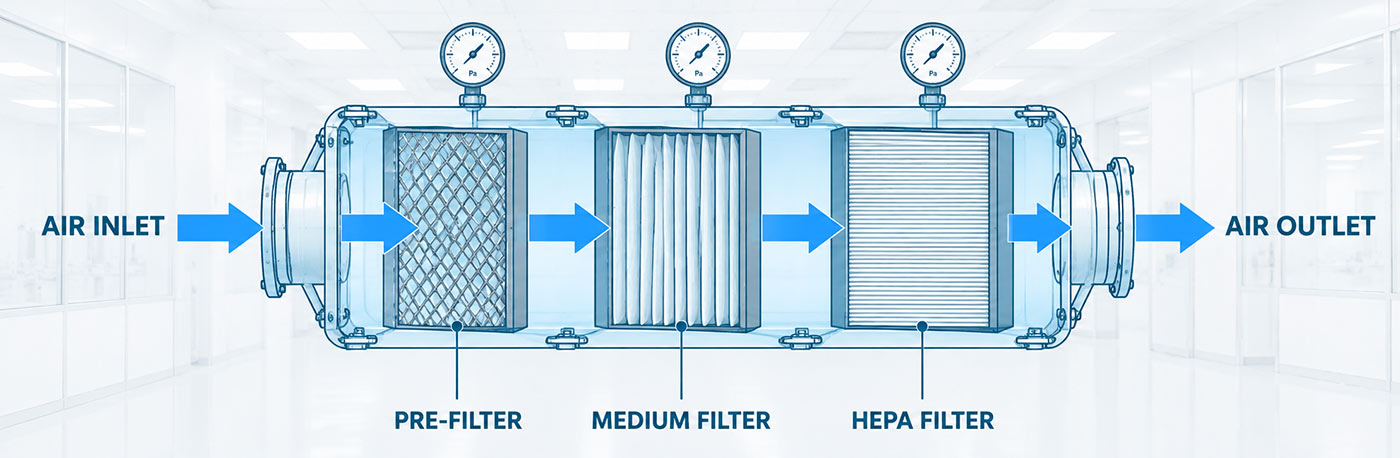
A common multi-stage filtration arrangement is:
Incoming Air → Primary Pre-Filter → Medium-Efficiency Filter → HEPA Filter → Filtered Air
Each stage captures a different portion of the incoming particle load.
Primary Pre-Filter: Removing Coarse Dust First
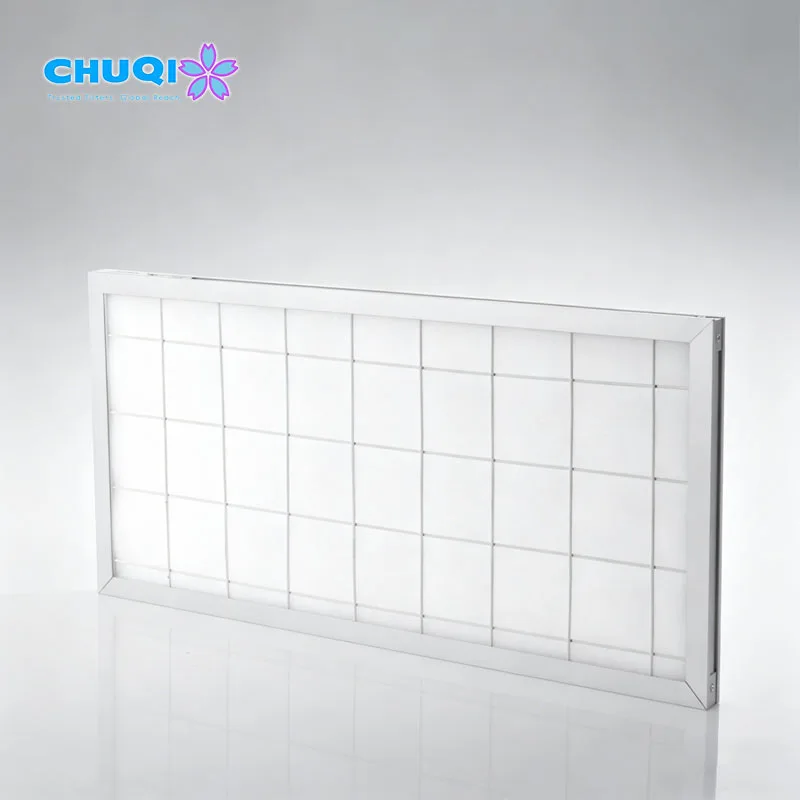
The primary pre-filter is the first filtration stage.
It is designed to capture larger airborne particles such as coarse dust, fibers, lint, and other contaminants.
This is particularly useful in environments where the incoming air contains visible dust or where the air intake is exposed to outdoor and industrial contaminants.
By removing much of this coarse material early, the primary filter reduces the dust burden on the downstream medium-efficiency and HEPA filters.
Medium-Efficiency Filter: Capturing Additional Particles
Not all airborne particles are captured by the primary filter.
Smaller particles can continue through the first stage, so a medium-efficiency filter is often installed before the HEPA filter.
Its role is to capture an additional portion of the remaining particles and reduce the concentration reaching the final stage.
This intermediate filtration stage is particularly valuable in systems where the incoming air has a significant particle load or where greater protection of the HEPA stage is required.
HEPA Filter: Final High-Efficiency Particle Removal
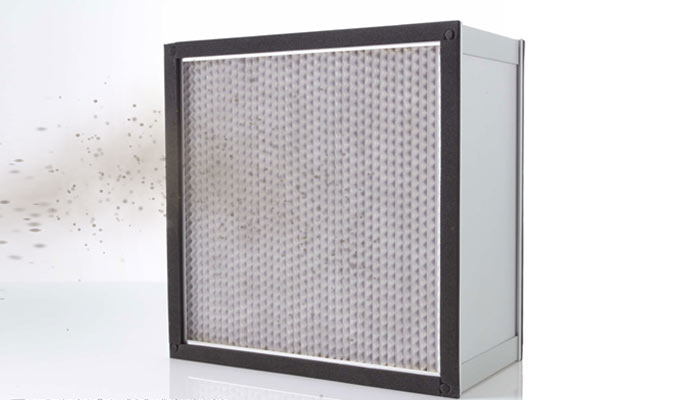
After passing through the upstream filters, the air reaches the HEPA filter.
The HEPA filter provides the final high-efficiency particle removal required by the application. It is commonly used in cleanrooms, pharmaceutical manufacturing, laboratories, hospitals, and other environments where fine airborne particle control is important.
Its job is not simply to collect as much dust as possible. It is to deliver the required final filtration performance under the system’s operating conditions.
For a closer look at HEPA efficiency classifications, read our guide to HEPA Filter Grades: EPA, HEPA and ULPA.
Note: Not every HEPA system requires exactly three filtration stages. The number and efficiency of upstream filters depend on incoming air quality, required cleanliness, airflow, equipment design, and operating conditions.


5. Does a Higher-Efficiency Pre-Filter Always Provide Better Protection?
Not necessarily.
It may seem logical to use the highest-efficiency filter possible before a HEPA filter. However, a higher filtration efficiency does not automatically mean better overall system performance.
A suitable pre-filter needs to capture relevant particles without creating excessive resistance or introducing unnecessary operating costs.
Three factors are particularly important.
Particle Capture Efficiency
The pre-filter should be effective against the types and sizes of particles commonly found in the incoming air.
For example, a primary filter in a dusty industrial environment needs to handle the coarse dust load effectively. A medium-efficiency filter can then capture additional particles that pass through the primary stage.
The objective is to distribute particle removal across the filtration stages, not simply maximize the efficiency rating of every filter.
Initial Pressure Drop
Every filter creates some resistance to airflow.
A filter with higher initial pressure drop requires the fan to overcome greater resistance from the beginning. If the resistance is not compatible with the system design, airflow or energy consumption may be affected.
This is why filtration efficiency should always be considered together with pressure drop at the intended airflow.
Dust-Holding and Loading Behavior
Two filters may have similar initial pressure drops but behave differently after collecting dust.
One filter may maintain relatively stable airflow as dust accumulates, while another may experience a faster increase in resistance.
This difference can influence how often the filter needs to be replaced and how much maintenance the system requires.
A suitable pre-filtration arrangement therefore needs to balance particle capture, airflow resistance, and dust-loading behavior.
Protecting the HEPA Filter Starts Before the HEPA Stage
A HEPA filter plays a critical role in high-efficiency air filtration, but its performance over time is closely connected to the filters installed upstream.
Without suitable pre-filtration, more incoming dust reaches the HEPA filter directly. This can accelerate dust loading, increase pressure drop, create greater demands on the fan, and lead to more frequent filter maintenance or replacement.
By using primary and medium-efficiency filters to remove particles progressively, a filtration system can distribute the workload more effectively. The HEPA filter can then focus on its most important function: final high-efficiency particle removal.
Chuqi New Materials manufactures primary pre-filters, medium-efficiency filters, HEPA filters, and related air filtration media for industrial and HVAC applications. As a source manufacturer, Chuqi supports customized filtration solutions for different equipment designs and operating requirements.
Explore our HEPA Air Filter Products to learn more about our filtration options, or contact our team to discuss an air filtration solution for your application.
Frequently Asked Questions About HEPA Pre-Filtration
Q1. Can a HEPA filter operate without a pre-filter?
A HEPA filter can operate without an upstream pre-filter in some applications, but this does not mean it is always an efficient system design.
When incoming air contains substantial dust or coarse particles, the HEPA filter may accumulate contaminants more quickly. An appropriate pre-filter can remove part of this load before it reaches the final stage.
Q2. Does a pre-filter make a HEPA filter last longer?
Effective pre-filtration can reduce the amount of dust reaching the HEPA filter and may slow its loading.
However, actual service life depends on incoming air quality, airflow, operating hours, filter characteristics, and system conditions. There is no universal service-life extension that applies to every installation.
Q3. Is a primary filter enough to protect a HEPA filter?
It depends on the incoming air quality and the system’s filtration requirements.
A primary filter mainly captures larger particles. If substantial smaller particles remain in the airflow, a medium-efficiency filter may provide additional protection before the HEPA stage.
Q4. How can I tell if my HEPA filter is loading too quickly?
A rapid increase in HEPA pressure drop can indicate that the filter is accumulating dust, but it does not identify the cause on its own.
Compare pressure-drop trends across the primary, medium-efficiency, and HEPA stages at similar airflow conditions. Also consider changes in incoming air quality, airflow, filter installation, and possible damage or leakage.
Q5. Can a pre-filter remove odors and VOCs?
Standard particulate pre-filters and medium-efficiency filters are designed to capture airborne particles, not gaseous contaminants.
If the application involves odors, VOCs, or other gaseous pollutants, a suitable gas-phase filtration stage, such as activated carbon filtration, may be needed in addition to particulate filtration.