
Quick Answer: Under ISO 16890, legacy EN 779 classes map to modern particulate efficiency standards as follows: F5 → ISO Coarse ~60%; F6 → ISO ePM10 50–65%; F7 → ISO ePM1 55–70%; F8 → ISO ePM1 70–85%. These are industry benchmarks designed to replace legacy testing models. Always verify certified independent laboratory test reports (ISO 16890 Parts 1–4) before global B2B procurement.
When specifying or procuring pocket air filters (bag filters) for commercial and industrial Air Handling Units (AHUs), engineering teams require precise technical transparency. While the legacy EN 779 standard (classifying bag filters from F5 to F8) served the industry for decades, the global transition to ISO 16890 has fundamentally transformed how pocket filter efficiency is measured and specified.
For B2B procurement managers and facility directors, understanding how to map ISO ePM ratings to legacy F5 through F8 pocket filters—while evaluating critical factory performance parameters like initial pressure drop and airflow capacity—is vital to ensuring indoor air quality (IAQ) compliance without inflating energy overhead.
Here is an authoritative engineering guide to navigating ISO 16890 specifically for high-performance pocket air filters, backed by rigorous factory manufacturing specifications.
Why ISO 16890 Matters for Pocket Filters
The Limitations of Legacy EN 779 Pocket Filters: The old standard evaluated bag filters based on a single particle size (0.4 μm using DEHS droplets), which failed to represent how multi-pocket filters capture real-world atmospheric pollutants across the full size range.
The Precision of ISO 16890 for Bag Filters: Aligned with WHO air-quality guidelines, ISO 16890 evaluates pocket air filters based on capture efficiency across three health-related particulate size fractions: ISO ePM1 (particles ≤ 1 μm — viruses, combustion aerosols), ISO ePM2.5 (≤ 2.5 μm — fine dust), and ISO ePM10 (≤ 10 μm — pollen and coarse dust), plus a gravimetric ISO Coarse class.
- Worst-Case Rating Logic: Unlike EN 779, which reported average efficiency, ISO 16890 classifies filters by their minimum efficiency after electrostatic conditioning — giving engineers a guaranteed performance floor, not a marketing average.
How ISO 16890 Testing Works (Parts 1–4)
| Part | Scope | What It Tells You |
|---|---|---|
| ISO 16890-1 | Classification system, performance testing, marking | How ePM1/ePM2.5/ePM10/ISO Coarse classes are assigned and labeled |
| ISO 16890-2 | Measurement of fractional efficiency (0.3–10 μm) and airflow resistance | Efficiency curves across 12 particle-size channels using KCl solid particles — not liquid droplets |
| ISO 16890-3 | Measurement of gravimetric efficiency (dust-holding capacity) | Basis for the ISO Coarse class, tested with synthetic loading dust |
| ISO 16890-4 | Conditioning method to determine minimum fractional efficiency | The filter is discharged (electrostatic charge removed, e.g., IPA vapor treatment) so the rating reflects worst-case real-world behavior |
Mapping Legacy EN 779 (F5–F8) to Modern ISO 16890 Pocket Filters
When evaluating retrofits or reviewing legacy blueprints, technical buyers rely on established performance equivalents paired with certified factory testing data:
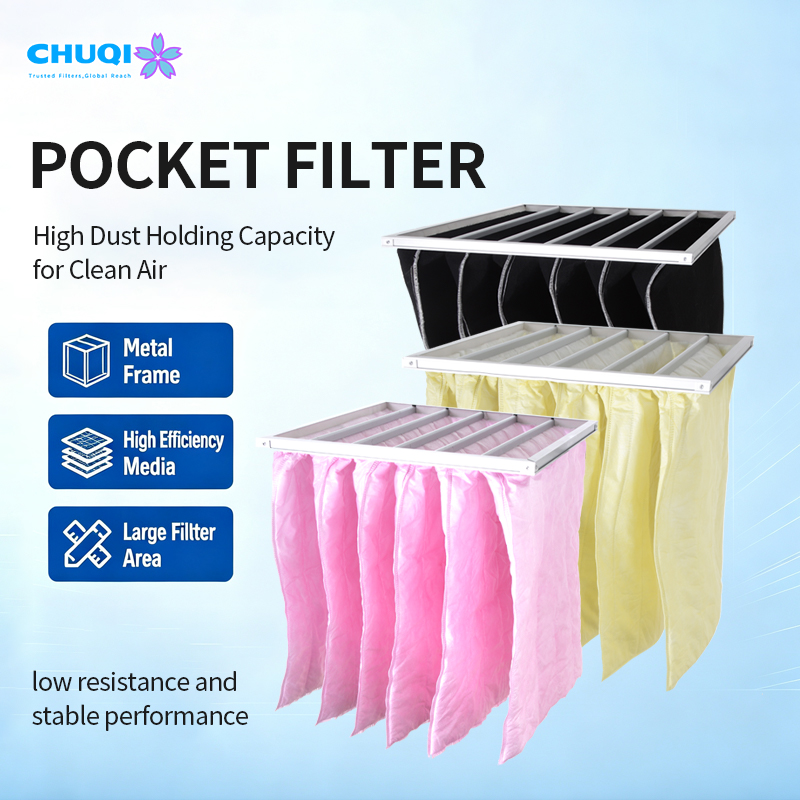
Legacy F5 Pocket Filters (ISO Coarse ~60% / ePM10 < 50%): Designed with white or light-yellow non-woven synthetic media, engineered for heavy industrial pre-filtration and basic AHU ventilation.
Legacy F6 Pocket Filters (ISO ePM10 50–65%): Featuring green or orange identification trims, utilized in commercial office complexes, educational institutions, and public retail spaces.
Legacy F7 Pocket Filters (ISO ePM1 55–70%): The commercial industry benchmark (pink color code) deployed in airports, premium office buildings, and hotels to capture fine combustion particles and urban smog.
Legacy F8 Pocket Filters (ISO ePM1 70–85%): High-efficiency yellow-trim pocket filters specified for critical environments including hospital secondary AHU stages, pharmaceutical cleanrooms, and data centers.
Engineering Baseline: Pressure Drop, Airflow, and Operating Conditions
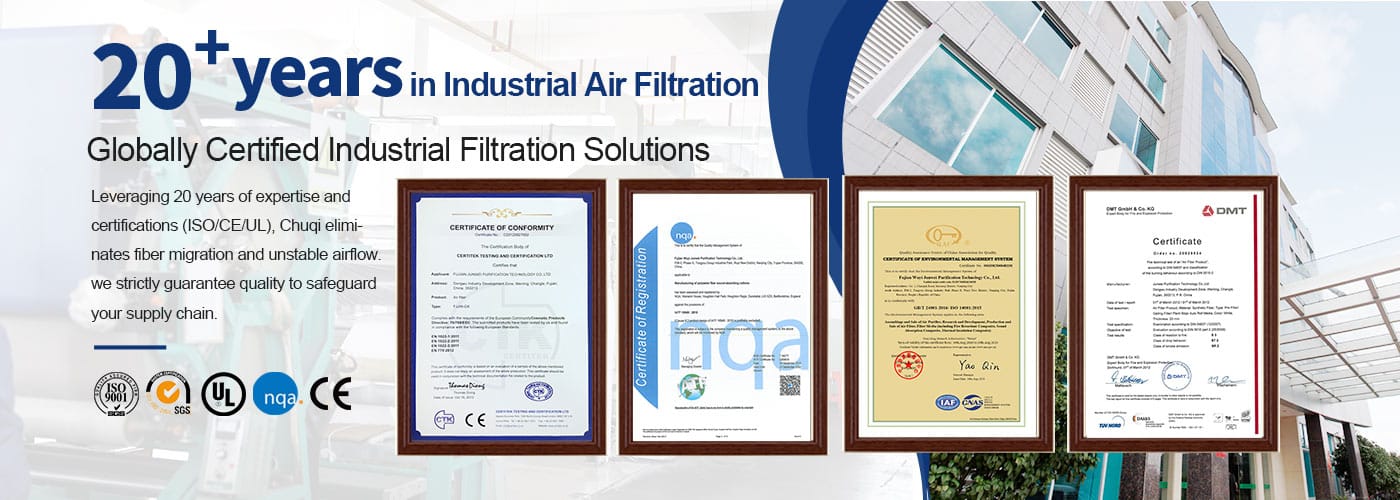
High-performance pocket filters engineered to strict international standards (ISO 9001), ensuring predictable pressure drop behavior and extended operational lifespans in demanding commercial and industrial Air Handling Units (AHUs).
Initial & Recommended Final Pressure Drop (ISO 16890 / EN 779 Verified):
F5 (ISO Coarse ~60%): Initial ~50 Pa | Final limit: 250 – 300 Pa
F6 (ISO ePM10 50-65%): Initial ~55 Pa | Final limit: 250 – 300 Pa
F7 (ISO ePM1 55-70%): Initial ~60 Pa | Final limit: 350 – 400 Pa
F8 (ISO ePM1 70-85%): Initial ~65 Pa | Final limit: 400 – 450 Pa
Standard Airflow & Dimension Capacity:
Rated Air Volume: 2,600 to 3,200 m3/h per standard 595 x 595 mm (24×24 in) module at 8 pockets.
Customization: Pocket counts (3 to 10) and face depths (300 to 750 mm) engineered to exact AHU footprints.
Media & Aerodynamic Construction:
Progressive Density Media: Multi-layer synthetic composite matrix with a density gradient for maximum Dust-Holding Capacity (DHC).
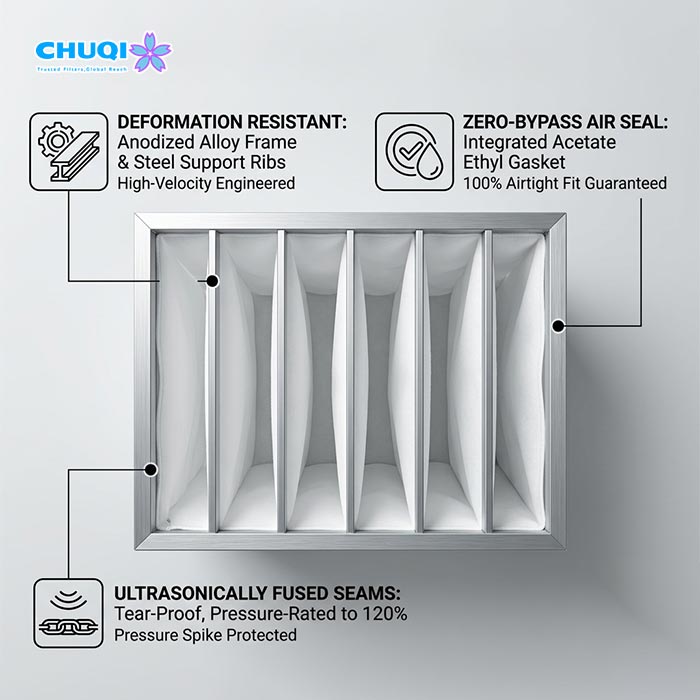
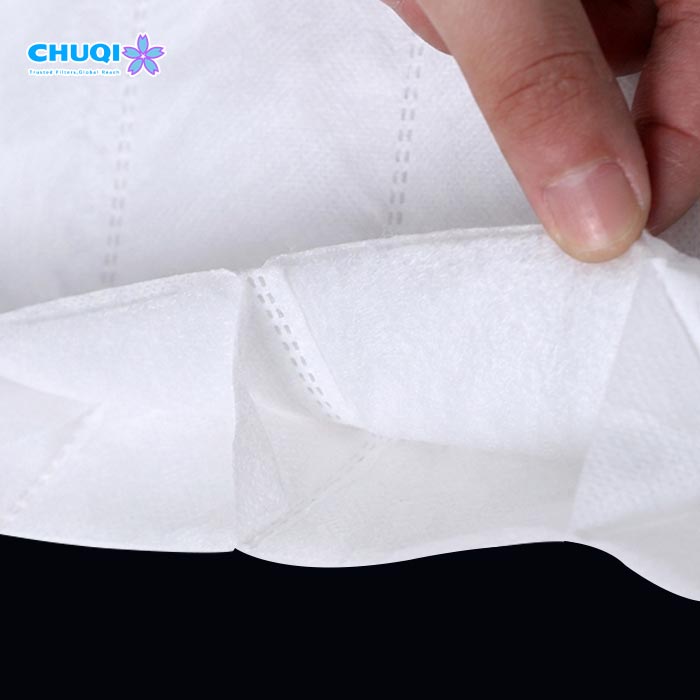
Seam Integrity: Ultrasonically welded thermal seams with internal aerodynamic spacers to prevent pocket ballooning and ensure 100% effective media utilization.
Structural & Environmental Tolerances:
Frames: Rigid extruded aluminum alloy or galvanized steel header frames (20 mm / 25 mm).
Gaskets: Seamless polyurethane (PU) or closed-cell EVA gaskets preventing bypass leakage.
Limits: Continuous operating temperature up to 80°C (176°F) and 98% RH relative humidity.
Certifications: Complies with UL 900 (Class 2) and DIN 53438 (F1) flammability standards.
| Legacy Class | ISO 16890 Equivalent | Media Color Code | Initial Resistance (ΔP) | Rated Airflow (595×595 mm, 8 Pockets) | Primary Facility Application |
| F5 | ISO Coarse ~60% | White / Light Yellow | ~50 Pa | 2,600 to 3,200 m3/h | Heavy industry pre-filtration, basic AHU ventilation |
| F6 | ISO ePM10 50-65% | Green / Orange | ~55 Pa | 2,600 to 3,200 m3/h | Commercial offices, schools, shopping complexes |
| F7 | ISO ePM1 55-70% | Pink | ~60 Pa | 2,600 to 3,200 m3/h | Airports, premium commercial buildings, hotels |
| F8 | ISO ePM1 70-85% | Yellow / Light Yellow | ~65 Pa | 2,600 to 3,200 m3/h | Hospitals, data centers, precision laboratories |
Need Certified ISO 16890 Pocket Filters Built to Exact Factory Specifications?
Before placing volume orders, it is vital to evaluate manufacturing capabilities, quality control protocols, and material traceability. To learn more about what to look for when partnering with a manufacturer, read our in-depth guide on How to Choose a Reliable Pocket Filter Supplier: A B2B Sourcing & Factory Audit Guide.
Verified Laboratory Performance: Precise initial pressure drops (50 Pa – 65 Pa) backed by advanced composite non-woven media technology.
Custom Engineering & Dimensions: Flexible face dimensions (e.g., 495 mm or 595 mm) and customized pocket counts (3 to 10 pockets) designed to retrofit any AHU layout.
Global B2B Logistics: Factory-direct wholesale pricing, robust CBM-optimized packaging, and reliable lead times for international distributors, contractors, and mechanical engineering firms.
Contact our engineering sales team today to request certified ISO 16890 test reports, technical datasheets, or custom pocket filter samples.