
When engineering, retrofitting, or maintaining a commercial or industrial Air Handling Unit (AHU), system designers, facility managers, and B2B procurement directors face a critical technical choice: Which industrial air filtration technology delivers the optimal balance of aerodynamic efficiency, Indoor Air Quality (IAQ) compliance, and Total Cost of Ownership (TCO)?
While the market offers various configurations—ranging from standard flat panel filters to rigid box and V-Bank filters—pocket air filters (globally recognized and searched as bag filters) remain the undisputed industry standard and workhorse for secondary and primary medium-to-high efficiency stages in global HVAC infrastructure.
As a leading B2B source factory and direct manufacturer specializing in air filtration with over 20 years of export experience, Chuqi has engineered this definitive technical guide to help procurement professionals and HVAC engineers understand why pocket air filters are systematically specified for high-performance systems.
The Aerodynamic Advantage: Exponential Surface Area Expansion
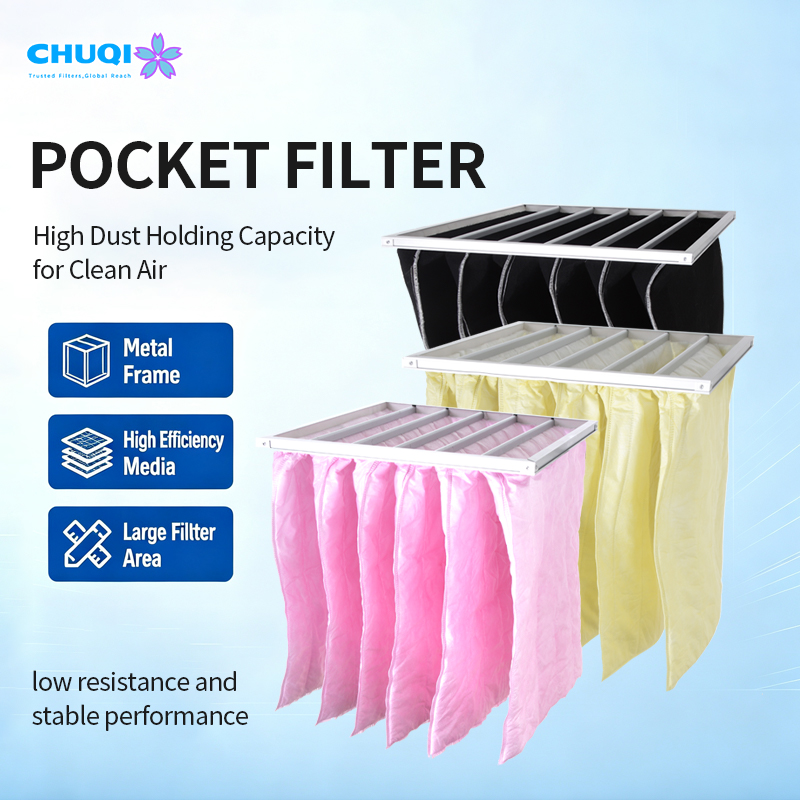
The fundamental engineering principle that sets pocket air filters apart is their multi-bag geometry, which transforms limited face area into massive filtration capacity.
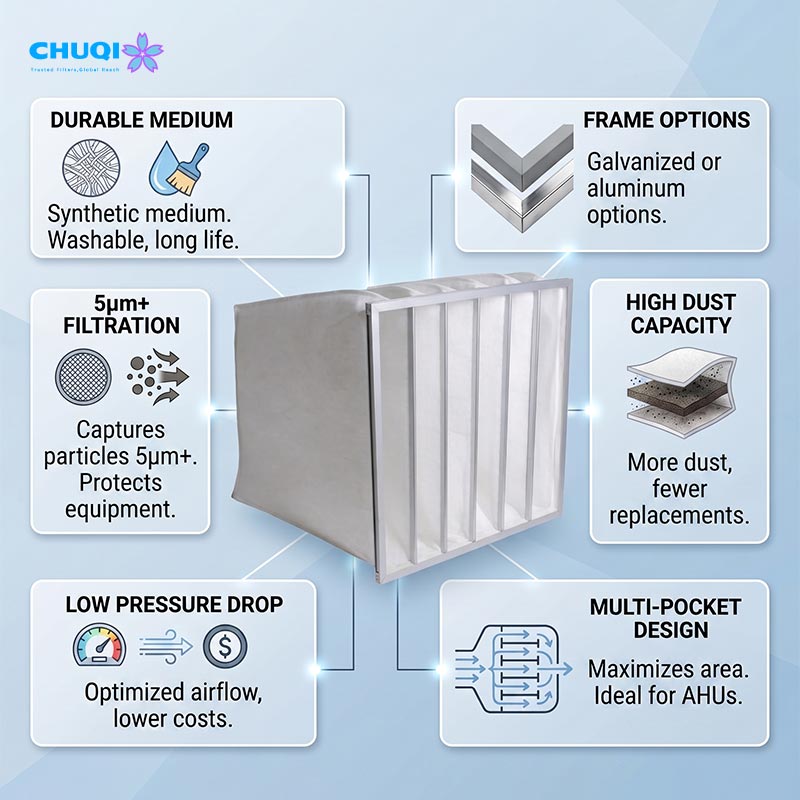
Surface Area Multiplier: Unlike flat panel or shallow pleated filters constrained by the AHU face dimensions, pocket filters extend deep into the air stream. A standard multi-pocket design expands the effective filtration surface area by 300% to 500% compared to a flat filter of identical face size.
Radical Reduction in Face Velocity: By dramatically increasing the surface area, the actual velocity of air passing through the filter media (face velocity) drops significantly. Lower media velocity enhances particulate capture efficiency via interception and diffusion, preventing particles from being forced through the fiber matrix by high air momentum.
Aerodynamic Stabilization: Optimized wedge-shaped pocket geometries minimize turbulence and eddy currents at the inlet collar, preventing localized pressure hotspots.
Superior Dust Holding Capacity (DHC) & Extended Service Intervals
For facility managers, filter replacement labor and system downtime represent substantial hidden expenses. Pocket air filters excel in high-particulate environments due to advanced media construction.
Progressive Density Matrix: Premium synthetic filter media is manufactured with a multi-layer gradient structure. Coarser fibers on the upstream side trap large particles (such as lint and pollen), while finer fibers on the downstream side capture micro-particulates. This ensures the entire depth of the filter media is utilized, maximizing Dust Holding Capacity (DHC).
Extended Maintenance Cycles: Because DHC is vastly superior to shallow-media alternatives, pocket filters maintain stable airflow over extended operational hours, drastically reducing the frequency of emergency changeouts and associated labor overhead.
Total Cost of Ownership (TCO) & Life Cycle Cost (LCC) Optimization
A common procurement misstep is evaluating air filters strictly on unit purchase price. In a commercial HVAC system, fan electricity consumption accounts for roughly 70% to 80% of a filter’s total Life Cycle Cost (LCC).
Low Initial Pressure Drop: High-quality pocket filters engineered with optimized wedge-shaped pockets and smooth internal channels ensure a remarkably low initial pressure drop (typically ranging from 45 Pa to 90 Pa depending on efficiency grade and face velocity).
Mitigating Fan Energy Spikes: As filters load with dust, pressure drop rises. Poorly designed filters experience sharp, exponential pressure spikes, forcing AHU fans to overwork and consume excess kilowatt-hours. Premium pocket filters provide a gradual, predictable pressure curve, saving thousands of dollars in energy costs over a standard 6-to-12-month operational cycle.
Cost Analysis: To calculate your exact operational savings, explore our dedicated breakdown on How to Reduce HVAC Filter Replacement Costs and Lower LCC.
Engineering Reliability: Preventing the "Masking Effect" and Structural Failures
In inferior bag filters, structural flaws can lead to catastrophic operational failures. The most notorious is the “masking effect”—where high static air pressure causes adjacent pockets to swell, balloon, and press flat against one another. This seals off vital surface area, causing immediate pressure spikes and filter collapse.
To guarantee structural integrity, tier-one manufacturers implement rigorous engineering controls:
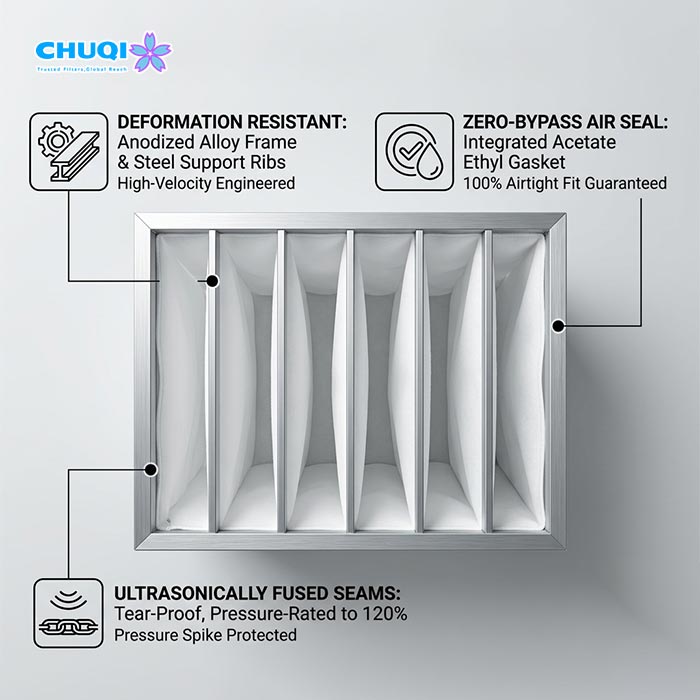
Ultrasonic Thermal Welding: Eliminates weak stitched seams, ensuring hermetic, leak-free pocket bonding that withstands high turbulent airflows and prevents bypass leaks.
Internal Airflow Guide Ribs & Spacers: Integrated stitching or physical spacer channels inside each pocket maintain uniform, independent inflation across all operating conditions, preventing pocket-to-pocket contact and ensuring 100% active filtration area.
Rigid Galvanized or ABS Header Frames: Heavy-gauge metal or high-impact plastic headers ensure a secure, vibration-free seal within standard front-access or side-access holding frames.
Pocket Filters vs. Rigid Box & V-Bank Alternatives
When projects demand ISO ePM1, ePM2.5, or ISO ePM10 efficiency (legacy F7, F8, or F9 grades), engineers often debate between pocket filters and rigid V-Bank filters.
| Performance Metric | Pocket Air Filters (Bag Filters) | Rigid V-Bank Filters |
| Initial Pressure Drop | Low to Moderate (Optimized airflow) | Moderate to High (Dense pleat packs) |
| Dust Holding Capacity (DHC) | Extremely High (Deep 3D pocket volume) | High (Dependent on media area) |
| Shipping & Logistics (CBM) | Excellent (Flexible, compressible pockets) | Bulky (Rigid plastic/metal frames) |
| Unit Purchase Cost | Highly Cost-Effective | Premium / Higher Initial Cost |
| Primary Deployment | Commercial AHUs, Cleanroom Pre-filtration | Heavy Industrial Exhaust, High Moisture |
Performance-to-Cost Ratio: While V-Bank filters excel in ultra-heavy-duty or high-moisture industrial exhaust streams, they come with a significantly higher price tag and rigid footprint. Pocket filters deliver equivalent or superior medium-efficiency performance at a highly cost-effective price point.
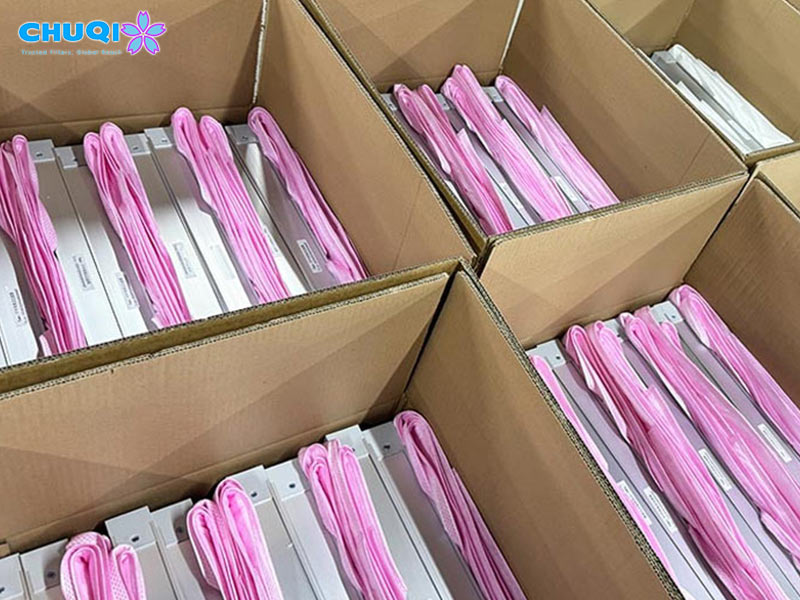
Logistics & CBM Efficiency: Rigid box frames are bulky and consume excessive shipping volume. In contrast, flexible pocket filters can be packed compactly or precision-nested for international transport, drastically reducing container freight (CBM) expenses for global distributors and wholesalers.
Selecting the correct filtration stage is critical to meeting international indoor air quality standards (such as ASHRAE 52.2, ISO 16890, and EN 1822). HVAC system designers, facility engineers, and procurement directors can confidently specify high-performance pocket air filters across these key operational environments:
Commercial Office Towers & Airports (Central AHUs): Ideal for continuous, high-volume HVAC operations. Operating as primary or secondary stages (ISO ePM1 50% to 70% / legacy F7–F8), they capture urban particulate matter and pollen while maintaining low fan energy consumption during peak occupancy.
Healthcare & Cleanroom Pre-Filtration: Serving as essential pre-filters in hospital operating theaters, pharmaceutical cleanrooms, and biosafety labs, they arrest micro-particulates to protect downstream HEPA/ULPA filters, drastically extending their lifespan and ensuring ISO Class 5–8 compliance.
Industrial Processing & Paint Spray Booths: Deployed in automotive paint pre-treatment, electronics manufacturing, and food processing where strict particulate control is mandatory. Chuqi’s synthetic media delivers fiber-shed-free performance and high Dust Holding Capacity (DHC) under heavy contaminant loads.
Transit Hubs & High-Occupancy Infrastructure: Engineered for underground metro stations, railway terminals, and shopping malls facing massive organic dust and textile fiber loads. Multi-pocket surface expansion handles high face velocities without catastrophic pressure spikes.
LEED & Net-Zero Energy Facilities: Specified for projects driven by strict Life Cycle Cost (LCC) optimization. Because fan electricity accounts for 70% to 80% of filter LCC, low initial resistance and slow pressure curves deliver substantial annual energy savings.
Engineering a New HVAC Project or Optimizing Your Supply Chain?
Do not let suboptimal filtration compromise your system efficiency or inflate operational energy costs. Partner with Chuqi, a trusted B2B manufacturer with over 20 years of expertise in industrial air filtration.
 Rigorously Tested Performance: Low initial pressure drop and certified ISO 16890 / EN779 / UL900 compliance.
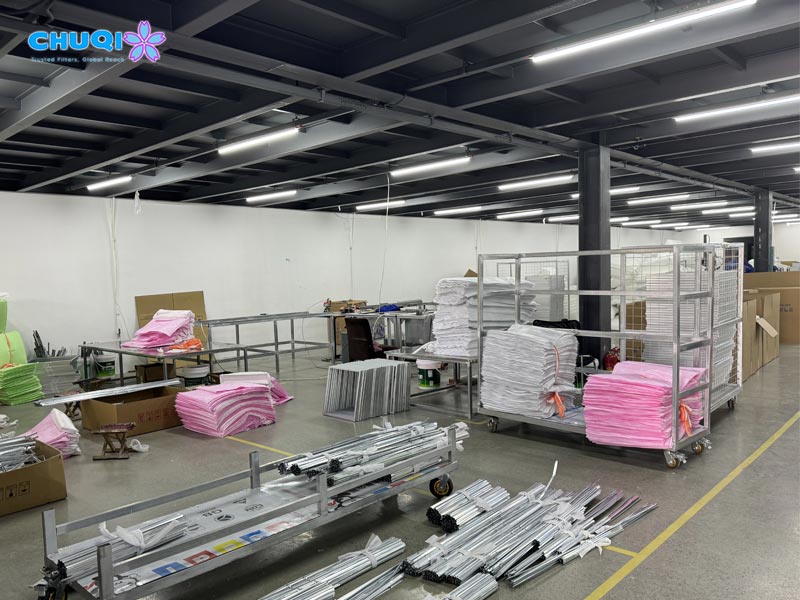
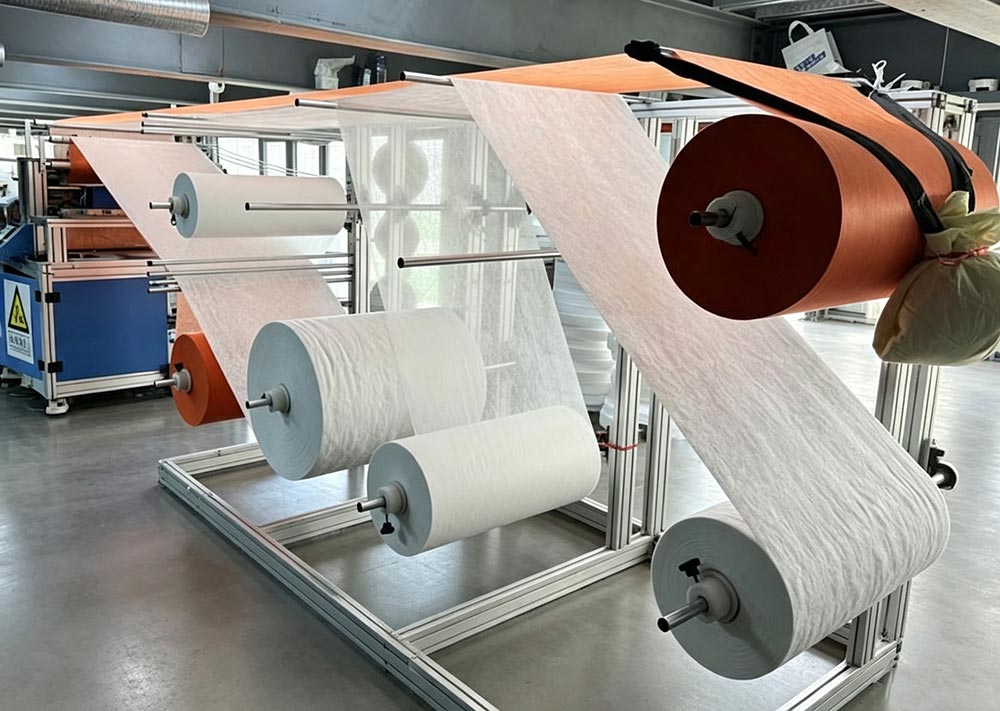
- Precision Manufacturing: Advanced ultrasonic welding and anti-masking design to eliminate failure risks.
- Custom OEM/ODM Solutions & CBM-Optimized Packaging for global distributors.
 Rigorously Tested Performance: Low initial pressure drop and certified ISO 16890 / EN779 / UL900 compliance.
 Contact Our Engineering Team Today for Technical Datasheets & Custom Quotations or Explore Our Complete Pocket Air Filter Series to request your product sample kit.