
In commercial buildings, cleanrooms, and industrial manufacturing facilities, Air Handling Units (AHUs) run continuously to maintain strict Indoor Air Quality (IAQ) and process air standards. While facility managers frequently focus on fan motor ratings or chiller efficiency, the choice of commercial pleated air filters plays an oversized role in determining operational expenditure (OpEx), energy consumption, and equipment longevity.
Procurement teams and facility engineers face recurring operational pain points:
Rapid dust clogging and high initial differential pressure (ΔP) in traditional flat-panel air filters, driving up electricity bills.
Pleat collapse and media tearing under high airflow velocities, leading to air bypass and catastrophic downstream contamination.
Fiber shedding from low-quality filter media, contaminating cleanroom air ducts and lowering manufacturing yields.
High shipping costs and disposal challenges associated with heavy metal-framed units in countries with strict carbon-reduction and solid waste policies.
Excessive lead times for non-standard custom filter sizes from regional distributors.
Partnering directly with an experienced pleated air filter manufacturer solves these engineering and supply chain challenges—slashing fan energy loads while extending the lifespan of high-value secondary and terminal HEPA filters by 1.5 to 2 times.
Unlike traditional flat panel air filters or fiber pads that clog quickly due to limited surface exposure, a commercial pleated air filter utilizes an extended V-pleat geometric topology. This architecture multiplies the active filtration surface area by 3 to 5 times within a compact depth profile (21 mm to 96 mm).
Media Composition: Non-Shedding Polycotton & Synthetic Blends
The core filter media utilizes high-density synthetic nonwoven media blended with polyester fibers (Polycotton, available in white or blue).
Zero Fiber Shedding: Thermally bonded continuous filament construction prevents lint release, fiber breakage, or blow-through, making it ideal for cleanrooms and paint spray booths.
High Dust Holding Capacity (DHC): The gradient fiber structure depth-loads particulate matter, capturing both coarse debris (>5um) and fine sub-micron particulates without premature surface blinding.
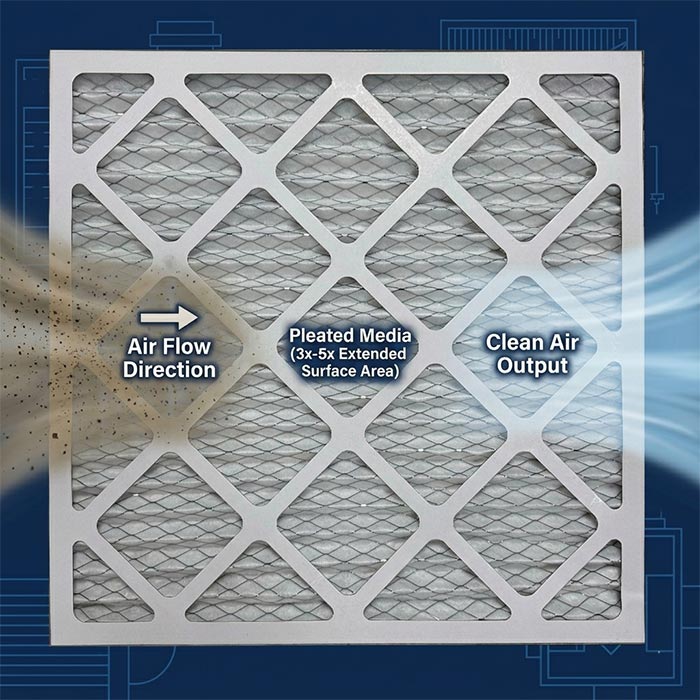
Frame Architecture: Disposable Cardboard Air Filter Frames vs. Rigid Metal
Choosing the right frame material balances structural integrity, operating environment, and freight costs:
Disposable Cardboard Air Filter Frames:
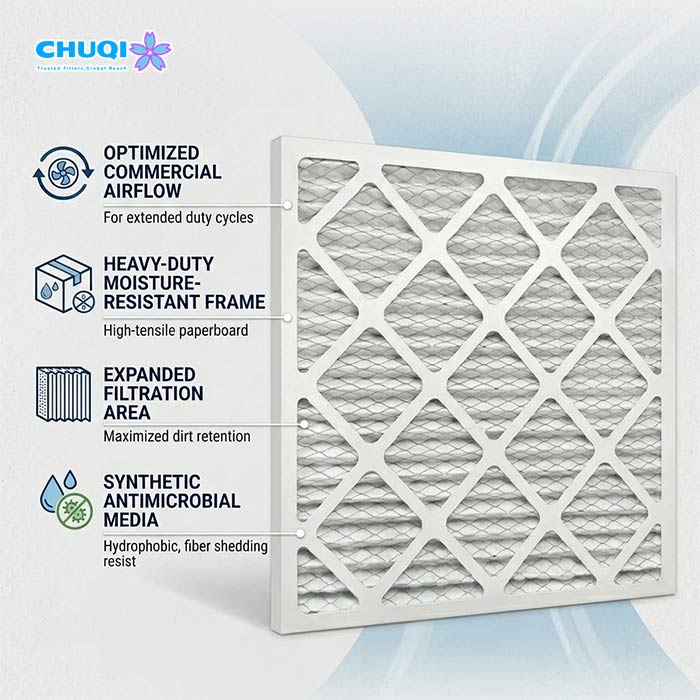
Moisture-Resistant Sizing: Engineered from heavy-duty beverage board treated with moisture-resistant agents. Suitable for up to 80% relative humidity (RH).
Logistics & Freight Efficiency: Extremely lightweight design reduces international air and ocean freight costs by 30% to 50% compared to metal frames.
Incinerable & Eco-Friendly: Fully incinerable for effortless solid-waste disposal, fully complying with European and North American environmental audit regulations.
Extruded Aluminum & Galvanized Steel Frames:
100% RH Resistance: Ideal for high-humidity HVAC casing sections, wet scrubbers, or tropical climate installations where cardboard might soften.
Heavy-Duty Rigidity: High side-wall resistance eliminates frame warping, twisting, or air bypass under turbulent air velocity profiles up to 80°C.
Structural Face Net & Edge Sealing
Anti-Collapse Support Grid: The air-leaving side (or dual sides) features a painted steel grid or aluminum wire mesh backing. This locks pleat spacing into an optimal geometric ratio, preventing pleats from bending or pressing together under differential pressure up to 300 Pa.
Universal Adhesive Bond: The filter media perimeter is fully potted into the internal frame walls with high-tack universal glue. This continuous seal completely eliminates air bypass leakage.
Comparison: Pleated Filters vs. Alternative Configurations
To optimize HVAC system performance and lower long-term operating costs, engineering teams must evaluate structural footprint, static pressure, and replacement frequency across different filter designs.
Comparative Analysis Matrix
| Feature / Parameter | Flat Glass / Synthetic Pad Filter | Commercial Pleated Air Filter | Extended-Surface Pocket / Bag Filter |
| Effective Surface Area | 1x (Equal to face area) | 3x – 5x (Extended V-Pleat) | 8x – 12x (Deep pocket structure) |
| AHU Housing Depth | 10 mm – 25 mm | 21 mm – 96 mm (Ultra-Compact) | 300 mm – 600 mm (Requires deep tracks) |
| Dust Holding Capacity (DHC) | Low (Fast surface loading) | High (Uniform depth loading) | Very High |
| Initial Pressure Drop | Moderate | Very Low (As low as 35 Pa) | Moderate (0.25″–0.35″ w.g.) |
| Risk of Air Bypass | High (Loose frame fit) | Zero (Perimeter glue sealed) | Low (Frame gasket sealed) |
| 100% RH Performance | Prone to sagging / collapsing | Rigid metal / treated frame available | Varies by pocket synthetic media |
| Downstream Protection | Poor (Passes coarse particulates) | Protects Medium & HEPA stages | High protection for final stages |
Engineering Trade-Offs
Pleated Panel Filters vs. Flat Pad Filters:
Flat panel filters clog rapidly due to their limited surface area. In contrast, cardboard panel filter options utilize structured pleats to spread particulate capture over a significantly wider area, dramatically reducing fan energy consumption.
Pleated Panel Filters vs. Deep Pocket / Bag Filters:
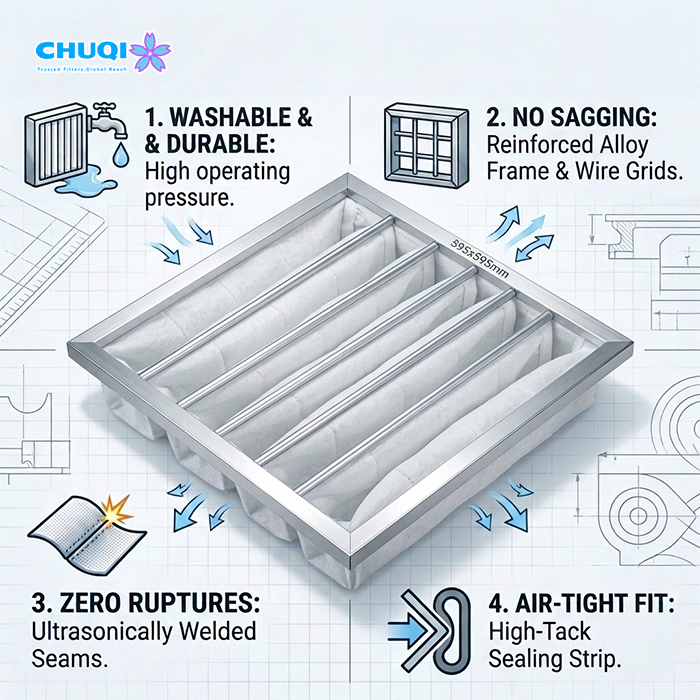
While pocket filters offer large surface areas, their deep track requirements (300 mm to 600 mm) make them impossible to install in compact existing AHUs. A compact pleated pre filter G3 or G4 (21 mm to 96 mm depth) delivers high airflow and efficiency within tight mechanical casing constraints.
Core Industry Application Scenarios
Commercial HVAC & Facility Management: Primary pre-filtration in office towers, shopping malls, hotel central air conditioning, and hospital general ventilation units.
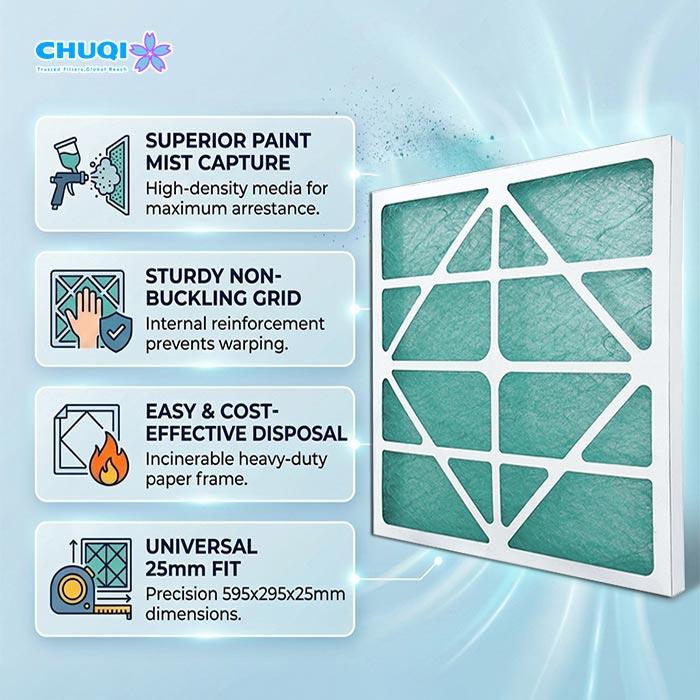
Automotive & Industrial Paint Spray Booths: Ceiling intake pre-filtration and paint arrestor air distribution grids, capturing paint overspray mist while ensuring laminar airflow over spray zones.
Cleanroom Air Handling Units (Semiconductor, Pharma GMP, Food & Beverage): First-stage protection for Fan Filter Units (FFUs), cleanroom air showers, laminar flow workstations, and sterile filling lines.
Heavy Machinery & Turbine Air Intakes: Protective intake filtration for air compressors, gas turbines, and diesel generator sets, guarding high-speed rotating components from particulate erosion.
Solving ToB Pain Points: Operational Impact & Financial ROI
Slashing HVAC Fan Energy Costs
Airflow resistance directly dictates fan motor power draw. Starting at an exceptionally low initial resistance of 35 Pa, commercial pleated air filters allow supply fans to maintain design air changes without excessive energy drag—delivering immediate power cost reductions across 24/7 facilities.
Doubling the Lifespan of Downstream HEPA & Secondary Filters
Secondary medium filters (like F7 filters and pocket filters) and terminal HEPA filters in cleanrooms are costly to replace. Deploying a high-capacity pleated pre filter G3 or G4 intercepts up to 90% of coarse dust before it reaches sensitive downstream stages, extending terminal filter operational lifespans by 1.5 to 2 times.
Eliminating Cleanroom & Coating Defects
In automotive paint spray booths and semiconductor cleanrooms, airborne fibers cause paint craters and product rejection. Synthetic polycotton media features bonded non-shedding fibers that keep process air 100% free of fiber contamination.
OEM/ODM Customization & Rapid Sample Matching
Retrofitting older AHU units frequently requires custom non-standard frame dimensions. As a direct source cardboard panel filter factory and supplier with 20+ years of industrial filtration experience, our facility provides 100% precise sample replication and rapid production turns for any non-standard dimension without high MOQ barriers.
Maintenance Protocols & Filter Replacement Frequencies
To maintain system energy efficiency and avoid fan motor overload, facility maintenance teams should monitor differential pressure across filter banks using inclined manometers or digital Magnehelic gauges.
1. Differential Pressure (Delta P) Monitoring & Thresholds
System status should be continuously monitored using inclined manometers, digital Magnehelic gauges, or automated building management system (BMS) differential pressure transmitters.
Baseline Logging: Record the initial clean differential pressure (Initial Delta P) immediately after a fresh filter installation.
Terminal Pressure Drop Change Out: Replace filter elements when they reach the designated final recommended differential pressure (Final Delta P) or the maximum allowable pressure drop threshold specified by the HVAC system design.
2. Standard Filter Replacement Schedule & Technical Guidelines
| Filter Classification | ISO 16890 / EN 779 Rating | Typical Initial Delta P | Recommended Final Delta P | Replacement Frequency | Primary Application & Maintenance Notes |
| G3 / G4 Pleated Pre-Filters | Coarse 50% – 60% | 30 – 60 Pa | 150 – 200 Pa | 1 to 3 Months | Serves as the primary barrier against coarse dust and heavy particulates. Frequency varies heavily based on ambient outdoor air quality and seasonal dust loading. |
| F5 / F6 Medium Pleated Filters | ePM10 50% – 70% | 50 – 80 Pa | 200 – 250 Pa | 3 to 6 Months | Captures intermediate particulate matter. Regular inspection helps maintain system airflow while protecting fine secondary filtration stages. |
| F7 / F8 / F9 Fine Pleated Filters | ePM1 50% – 85%+ | 70 – 120 Pa | 250 – 300 Pa | 6 to 12 Months | Protects critical indoor environments against fine respirable particles. Replacement timing should prioritize pressure drop readings over calendar time. |
Note: Actual replacement intervals depend on specific operational parameters, including total operating hours per day, process dust concentration, humidity levels, and upstream pre-filtration efficiency.
Why Partner with Chuqi New Materials?
Zibo Chuqi New Material Technology Co., Ltd. (Chuqi) is a premier direct pleated air filter manufacturer with over 20 years of expertise in industrial air filtration. We offer fully integrated manufacturing capabilities—producing our own raw filter media through to final complete filter assembly.
Integrated Supply Chain: Total quality control from raw synthetic fibers to completed framed units, providing superior cost-efficiency and performance consistency.
Global Compliance: Certified manufacturing meeting international EN779, ISO 16890, and ASHRAE test standards.
Flexible Customization: Fast sample matching and custom non-standard dimension production for legacy AHU retrofits.
Competitive Factory Direct Pricing: Eliminating trading intermediaries to maximize distributor margins and contractor tender competitiveness.
Looking for a reliable cardboard panel filter supplier, or custom HVAC pre-filter factory?
Contact our engineering team today for technical specs, factory-direct quotes, or custom sample requests!