When industrial plant engineers and global procurement managers draft technical specifications for automotive spray booth maintenance, a pervasive rule of thumb often dictates purchasing decisions: “Heavier must mean better.” Consequently, purchase requisitions routinely mandate 600gsm (grams per square meter) ceiling diffusion media, reflexively dismissing 500gsm alternatives as cost-cutting compromises that sacrifice quality.
However, in high-end automotive manufacturing, aerospace finishing, and precision industrial coating environments, raw mass weight (GSM) does not inherently dictate filtration excellence. Selecting an improperly matched grammage can trigger premature static pressure spikes, disrupt uniform airflow dynamics, and inflate operational energy expenditures.
This engineering analysis rigorously compares 600gsm and 500gsm paint booth ceiling filters across fiber packing density, initial pressure drop, dust-holding capacity (DHC), and long-term economic value, providing the data needed for an optimal procurement decision.
What Does GSM Actually Measure in Non-Woven Filter Media?
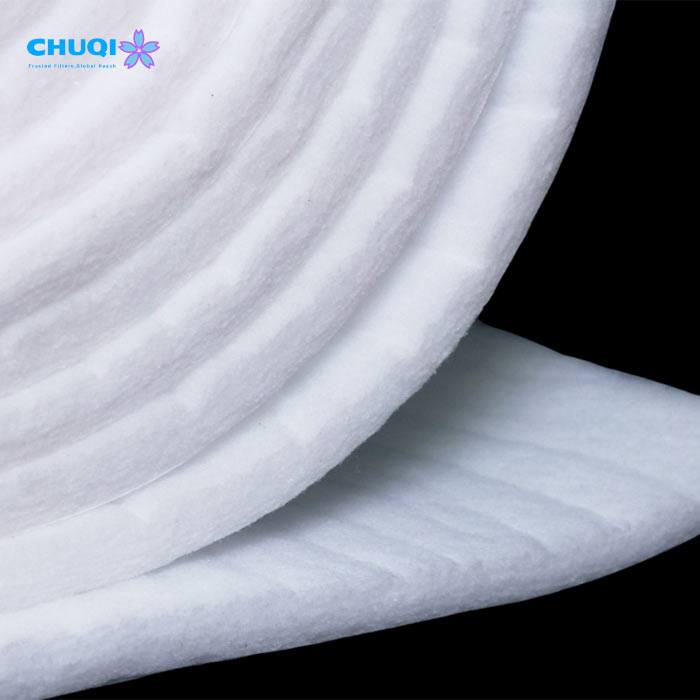
Grammage (GSM) measures the total mass of synthetic polyester fibers per square meter within a non-woven media matrix. While a higher GSM indicates a heavier physical load of raw material, how those synthetic fibers are engineered and distributed determines real-world filtration performance.
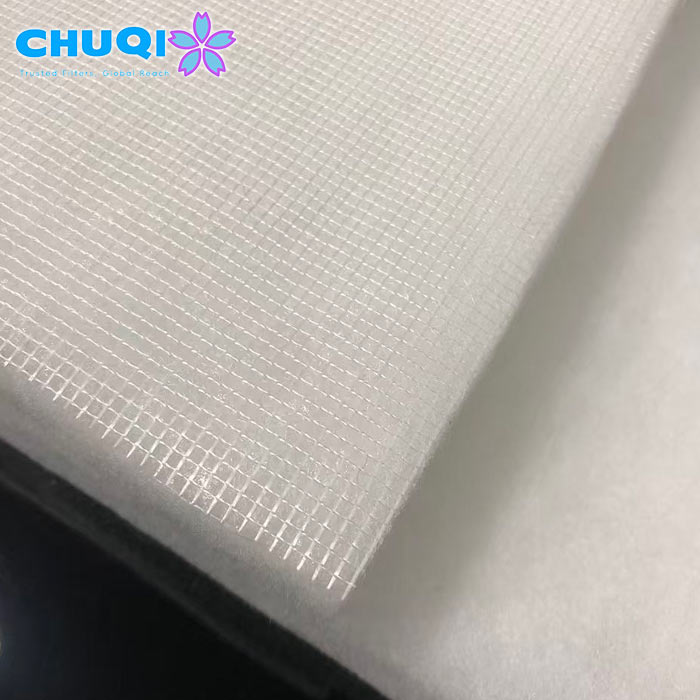
Ceiling diffusion media relies primarily on depth filtration mechanics, multi-layered packing density gradients, and permanent adhesive impregnation, rather than simple surface sieving. Consequently, two distinct filter rolls with identical GSM can exhibit radically different operating efficiencies depending on:
Fiber Denier (Fineness): Utilizing ultra-fine multi-filament synthetic fibers creates a dense, tortuous interception path for sub-micron paint mist while maintaining optimized material weight.
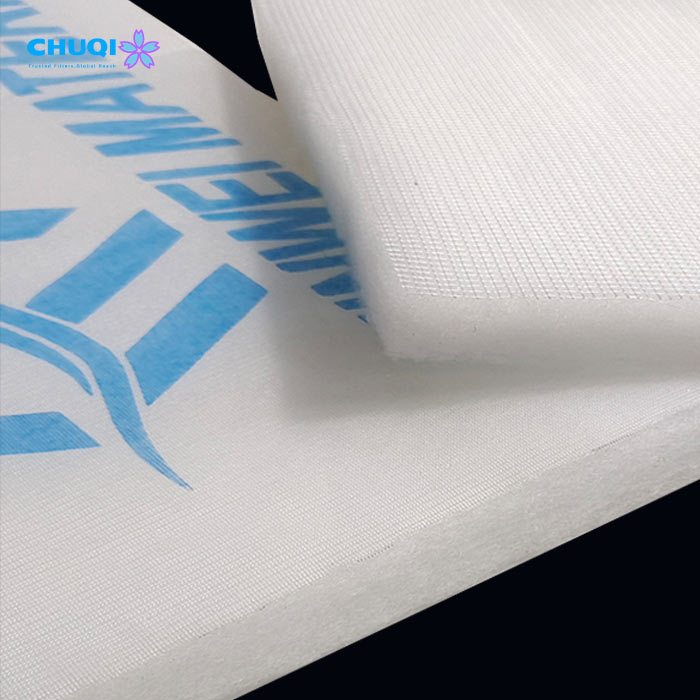
Needle-Punching and Thermal Bonding Structure: How securely the fiber matrix is consolidated dictates mechanical stability and tensile strength under high-velocity continuous airflow.
Direct Technical Comparison: 600gsm vs. 500gsm Ceiling Filters
| Technical Parameter | MW-500G (500gsm Optimized Media) | MW-600 (600gsm Heavyweight Media) |
|---|---|---|
| Thickness | 22±2 mm | 25±2 mm (Increased loft for deeper matrix entrapment) |
| Max. Airflow | 880 m³/h | 910 m³/h |
| Initial Resistance | 28 Pa (Lower initial static pressure) | 35 Pa (Higher initial resistance load) |
| Final Resistance | 450 Pa | 450 Pa |
| Initial Efficiency | 95.00% | 99.80% (Near-absolute initial capture) |
| Nominal Velocity | 0.28 m/s | 0.26 m/s |
| Dust Holding Capacity (DHC) | 400 g/m² | 477 g/m² (Maximum mass accumulation capacity) |
| Max. Working Temp. | 130°C | 130°C |
| Filtering Grade | F5 | F5 |
| Flame Resistance | DIN 53438 F1 / UL 900 Class 2 | DIN 53438 F1 / UL 900 Class 2 |
Dissecting the Three Core Decision Factors
3.1 Airflow Resistance, Pressure Drop, and Energy Consumption
The primary function of a ceiling diffusion filter is not merely trapping particles, but maintaining a stable, downward laminar airflow (the piston effect) across the entire cross-section of the spray booth.
As shown in the laboratory data, upgrading from 500gsm to 600gsm increases the initial resistance from 28 Pa to 35 Pa (both sharing a maximum final resistance threshold of 450 Pa).
An improperly engineered heavier filter can impose unnecessary static resistance on air handlers, driving up electrical energy consumption.
In contrast, the engineered MW-500G achieves certified F5 performance with an optimized initial resistance of 28 Pa and a nominal test velocity of 0.28 m/s, whereas the MW-600 scales initial capture efficiency up to a remarkable 99.80% for ultra-sensitive clear coat operations.
3.2 Dust Holding Capacity (DHC) and Real-World Service Life
Many specifiers select 600gsm under the assumption that it yields a longer operational lifespan.
Total mass capacity scales from 400 g/m² (MW-500G) up to 477 g/m² (MW-600), supported by an increase in physical thickness from 22±2 mm to 25±2 mm.
However, actual filter longevity depends heavily on full-depth adhesive impregnation rather than weight alone. A well-structured 500gsm media with full-depth impregnation matches practical service efficiency for standard automotive lines, while the 600gsm tier is built for heavy-duty, continuous particulate loads.
3.3 Freight Logistics and Supply Chain Cost Efficiency
For international distributors and large-scale plant operators, shipping logistics heavily impact total cost of ownership (TCO).
MW-600 rolls consume slightly more container space and carry a higher freight weight penalty per square meter due to their increased physical thickness (25 mm vs 22 mm).
Engineered 500gsm media provides equivalent or superior micro-particle arrestance while optimizing roll dimensions, allowing for efficient vacuum-compressed packaging that slashes international freight and warehousing costs.

Industry Standards: Why Certified Compliance Trumps Weight
Regardless of whether your engineering team specifies MW-500G or MW-600, never rely on grammage as a standalone quality metric. Always evaluate filters against recognized international standards:
EN 779 Standard: Certifying F5 classification across both variants, guaranteeing high-performance synthetic dust arrestance.
ISO 16890 Standard: The modern global benchmark assessing fractional particulate efficiency (ePM10 or ePM2.5) to ensure sub-micron pigment particles are captured before reaching the workspace.
Thermal & Fire Safety Consistency: Both models maintain an identical maximum working temperature of 130°C and strictly adhere to DIN 53438 F1 and UL 900 Class 2 self-extinguishing fire safety standards.
Always insist on certified third-party laboratory test reports (such as SGS or equivalent accredited institutions) verifying initial resistance, recommended final pressure drop, and dust holding capacity.
Which One Should You Choose?
When selecting between 500gsm and 600gsm ceiling diffusion media, the decision should be driven by your booth’s operational parameters rather than industry myths:
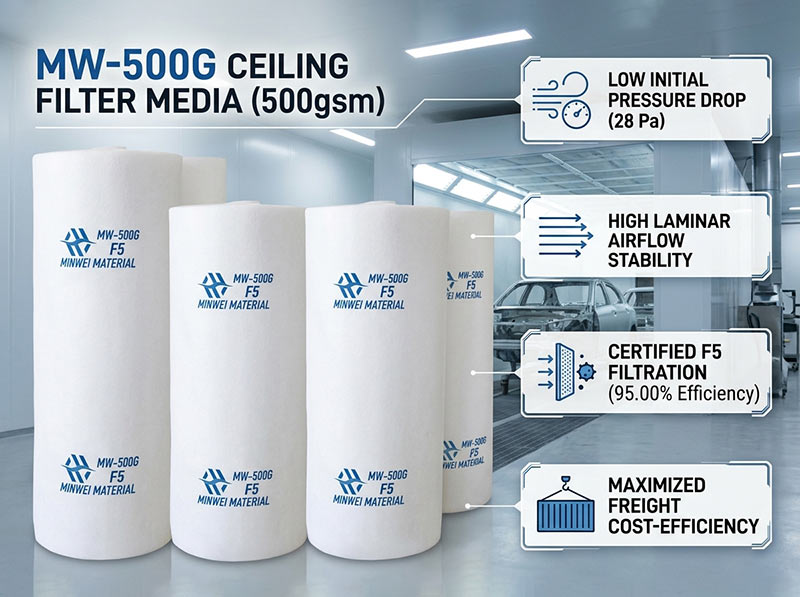
Specify 500gsm (MW-500G) if: Your operation requires an optimal balance of lower initial pressure drop (28 Pa), high laminar airflow stability, certified F5 filtration (95.00% initial efficiency), and maximized freight cost-efficiency across standard-to-advanced industrial coating lines. You can learn more about its specifications on our MW-500G Ceiling Filter Product Page.
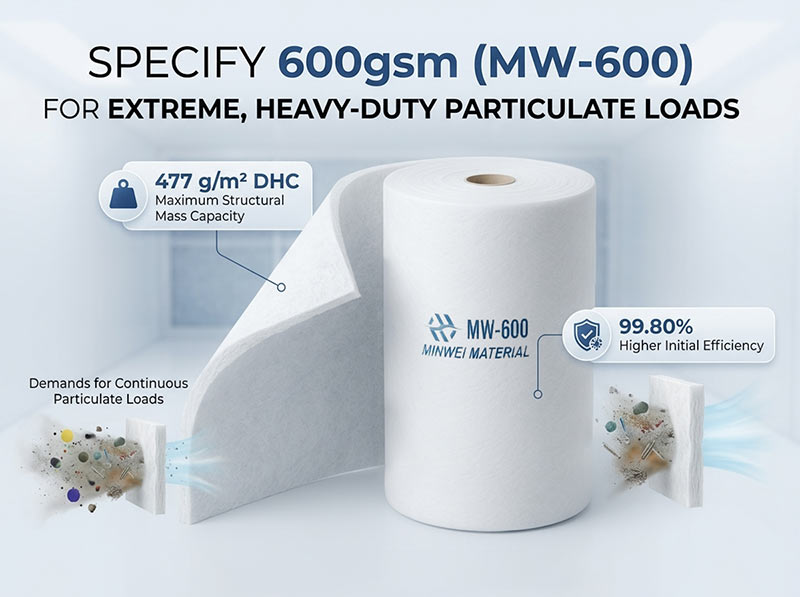
Specify 600gsm (MW-600) if: Your specific spray booth operates under extreme, heavy-duty continuous particulate loads that demand maximum structural mass capacity (477 g/m² DHC) and higher initial efficiency (99.80%). Explore our heavy-duty solutions on the MW-600 Ceiling Diffusion Media Page.
Strategic Navigation & Actionable Next Steps
[Return to What Makes the Best Paint Spray Booth Ceiling Diffusion Filter?]
Looking for specific roll dimensions, custom widths, or tailored GSM specifications?
 [Explore Our Complete Ceiling Diffusion Filter Product Series & Datasheets]