In high-precision automotive coating lines, aerospace manufacturing, and industrial finishing rooms, surface contamination translates directly into scrapped parts and financial loss. When microscopic dust inclusions or foreign particles breach the final filtration barrier, the result is costly surface defects such as fisheyes, pinholes, and orange peel, forcing expensive manual sanding and repainting.
While facility engineers meticulously check airflow velocities and temperature controls, a critical point of failure often hides within the ceiling diffusion media itself: substandard adhesive technology. Traditional filter manufacturing relies on superficial, surface-only glue application. Under continuous high-velocity airflow, this superficial adhesive strips away, causing catastrophic fiber shedding and premature surface blinding.
This engineering analysis explores the mechanics of dust holding capacity (DHC), the critical difference between surface-coated and full-depth tackifier impregnation, and how advanced adhesive engineering protects your coating quality.
1. Understanding Dust Holding Capacity (DHC) in Filtration Media
Dust Holding Capacity (DHC) measures the total mass of particulate matter a filter media can retain before its operating pressure drop reaches a predetermined terminal limit.
The Flawed Surface Model: In low-tier filters, the adhesive or tacky agent is only sprayed onto the air-entering surface. Particles are trapped exclusively on the top skin layer. This creates a dense crust (surface blinding) that causes static pressure to skyrocket within weeks, starving the booth of air while leaving the internal fiber layers completely unutilized.
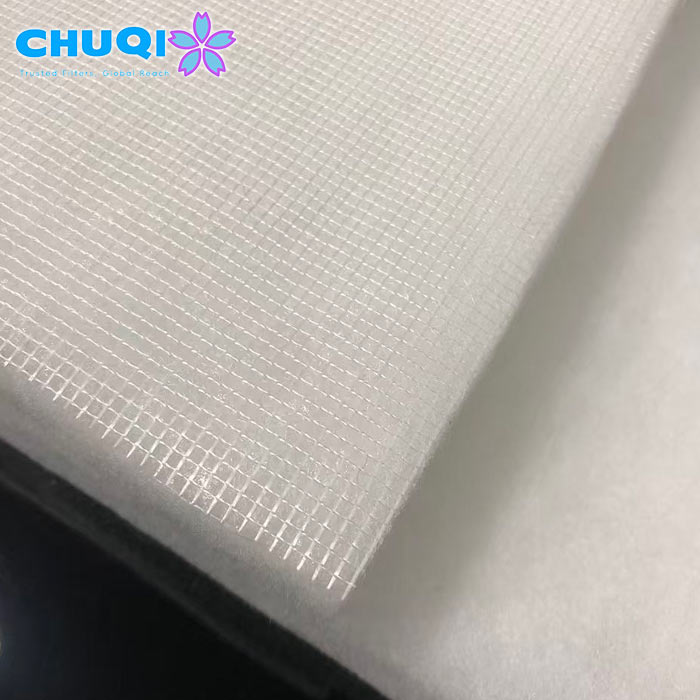
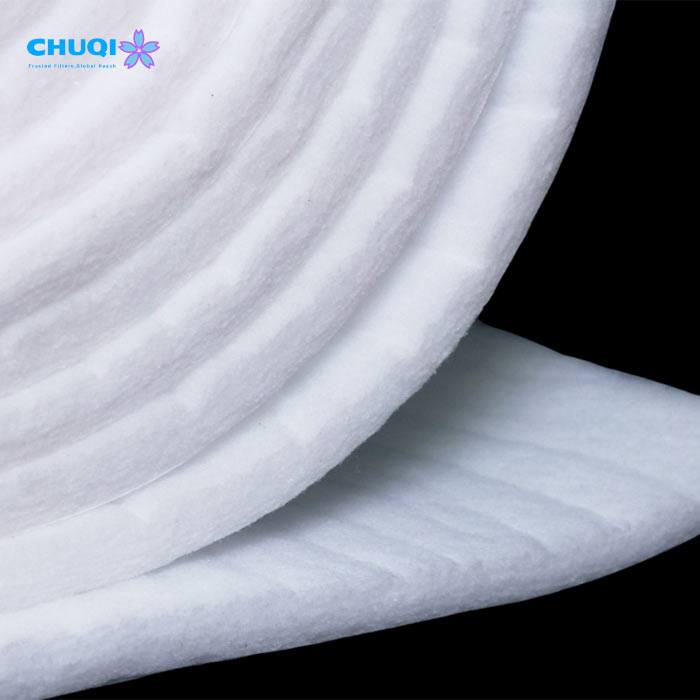
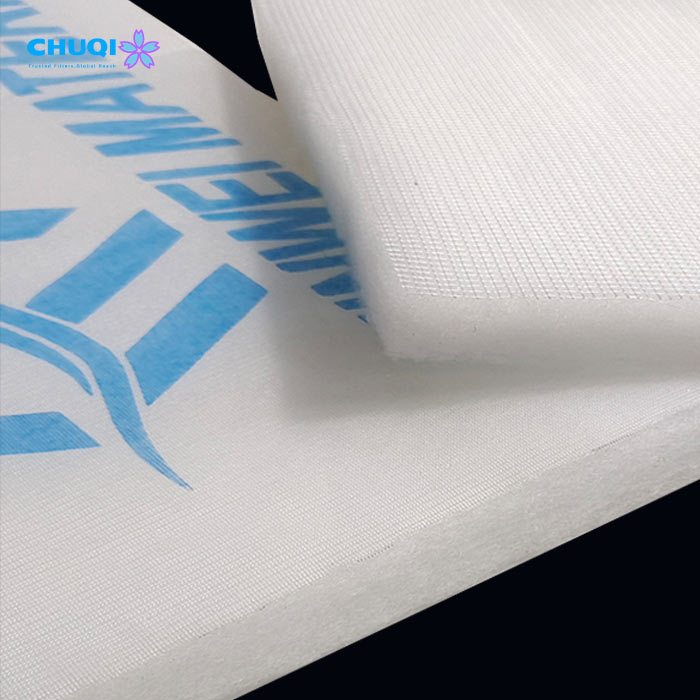
The Deep-Matrix Model: A superior ceiling filter utilizes its entire 3-dimensional thickness. By distributing calibrated tacky agents throughout the entire media depth, particles are progressively captured across the multi-layered fiber web, maximizing both service life and dust retention.
2. Full-Depth Impregnation vs. Surface Coating: Technical Comparison
| Performance Characteristic | Surface-Coated Filter Media | Full-Depth Impregnated Media (Advanced) |
| Adhesive Distribution | Confined to the top micro-layer (Skin level) | Evenly locked throughout the entire 3D synthetic matrix |
| Fiber Retention (Tensile Stability) | High risk of shedding under high air velocity (>= 0.5 m/s) | Zero fiber migration; synthetic filaments are permanently bonded |
| Dust Utilization | Blinds prematurely at the surface; internal fibers wasted | Progressive depth loading; utilizes full media thickness |
| Operational Lifespan | Short-lived; requires frequent, costly unplanned replacements | Extended service life; stable pressure drop curve over time |


3. The Engineering Mechanics of Full-Depth Tackification
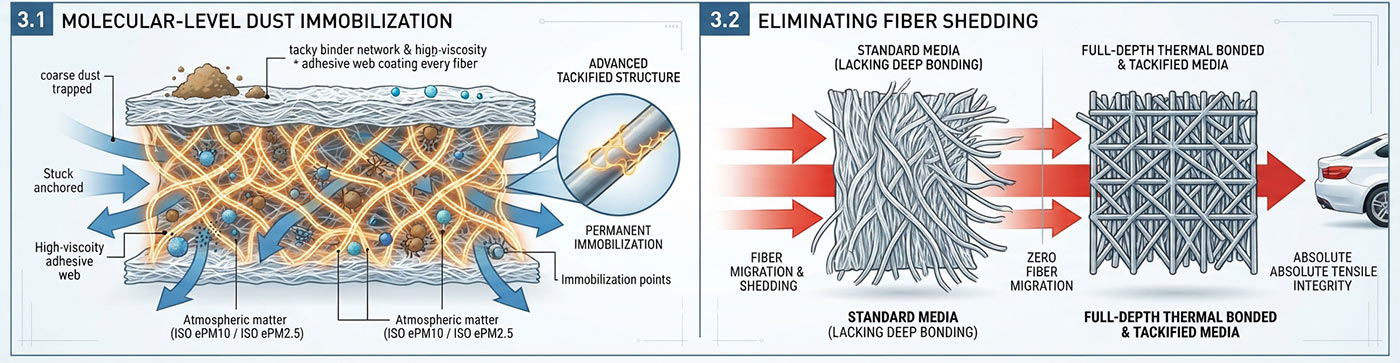
3.1 Molecular-Level Dust Immobilization
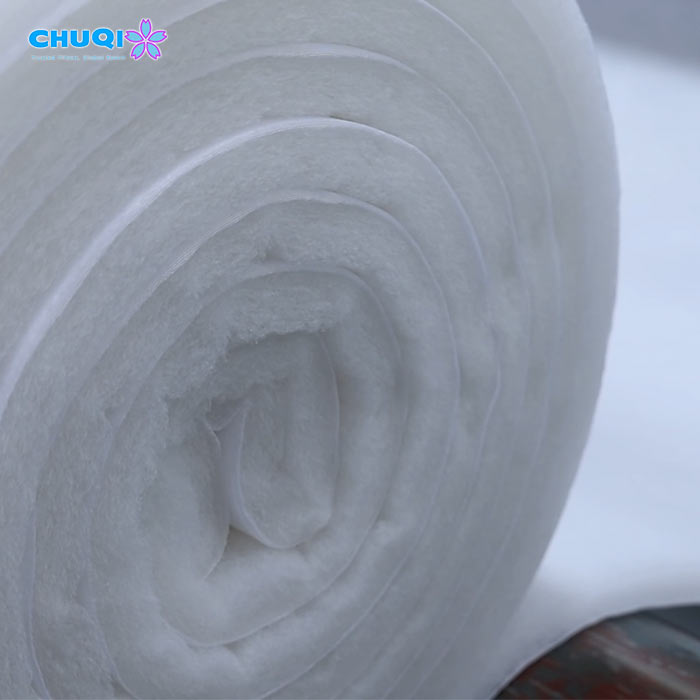
High-performance ceiling filters are infused with specialized non-migratory, high-viscosity tacky binders. Unlike liquid oils that can vaporize or migrate under heat, advanced macromolecular impregnating agents remain chemically stable. When sub-micron paint mist and atmospheric particulate matter (ISO ePM10 / ISO ePM2.5) penetrate the media, they encounter a continuous web of adhesive contact points, ensuring that trapped particles are permanently immobilized and cannot be dislodged by mechanical vibration or air pulsations.
3.2 Eliminating Fiber Shedding and Filament Migration
Under continuous operation, spray booth air handling units generate significant aerodynamic stress. If synthetic fibers lack deep bonding, loose micro-filaments break away and travel downstream into the workspace, landing directly on freshly applied liquid coatings. Full-depth thermal bonding combined with integrated tackification guarantees absolute tensile integrity, ensuring zero fiber migration over thousands of hours of operation.
4. Operational and Economic Impact for Facility Managers
Choosing a ceiling filter engineered with full-depth impregnation delivers measurable long-term value:
Maximized Uptime: Prevents sudden pressure spikes and extends changeout intervals, reducing scheduled maintenance shutdowns.
Defect Reduction: Eliminates paint rework caused by filter-derived fiber shedding and particle breakthrough.
Total Cost of Ownership (TCO): Although engineered media requires precision manufacturing, its extended lifespan and defect-free yield significantly lower annual filtration operating costs.
5. Conclusion: Demand True Depth Engineering
When selecting paint spray booth ceiling diffusion media, do not settle for superficial surface tack. Insist on filters manufactured with full-depth impregnation technology, verified by rigorous standard testing to ensure absolute particle retention, stable laminar airflow, and flawless coating finishes.
Strategic Navigation & Actionable Next Steps
Return to What Makes the Best Paint Spray Booth Ceiling Diffusion Filter?
Looking to experience advanced dust holding technology firsthand?
Explore Our Complete High-Efficiency Ceiling Diffusion Filter Series
Request Free Sample Rolls with Full-Depth Impregnation for Lab Testing