
Reticulated foam is one of the most widely used materials for the first stage of air filtration. It sits at the intake of air handling units, fan coil units, electronics enclosures, server and telecom cabinets, machinery housings and compressors, where it captures coarse dust, lint and fibers before they reach fans, coils, heat sinks or finer filters.
It looks simple: an open, net-like foam that can be cut to almost any shape. Using it well, however, means understanding a handful of technical questions. What PPI does and does not mean. How it differs from ordinary sponge. How thickness and air velocity affect resistance. How it should be fitted and maintained. And how to judge a supplier’s evidence.
This guide gives an overview of reticulated foam filter media for air pre-filtration and answers the key questions briefly. Each topic links to a dedicated article that covers it in depth.
Key Takeaways
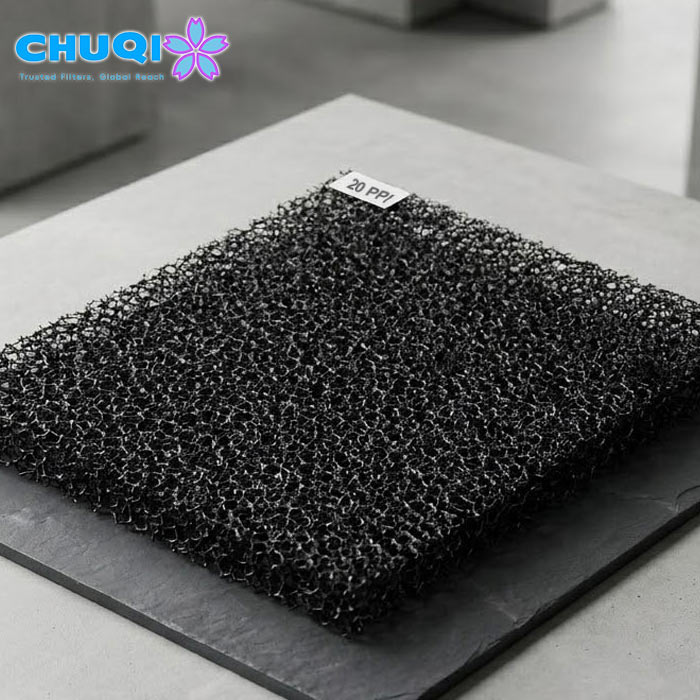
Reticulated foam is polyurethane foam whose cell membranes have been removed, leaving an open three-dimensional network of struts through which air can pass easily.
It is used mainly as a pre-filter: a low-resistance, washable first stage that takes the coarse dust load and protects what lies downstream.
It captures dust through its depth, not only at the surface, and its behavior depends on PPI, thickness, air velocity and loading together.
PPI describes cell fineness, not quality or a micron rating. A complete specification also needs material, thickness, supply format, dimensions and tolerances.
Installation decides real-world results. Gaps around a filter can let a large share of the air bypass the media.
Supplier claims need evidence: identified materials, defined test conditions, approved samples and consistent documentation.
Guide Contents
| Topic | Question it answers | Article |
|---|---|---|
| Specifications | What do PPI, density, thickness, sheets, rolls, drawings and tolerances actually define? | Reticulated Filter Foam Specifications: PPI, Thickness, Sheets and Rolls |
| Material and structure | How does reticulated foam differ from regular sponge, and how are materials identified? | Reticulated Filter Foam vs Regular Sponge: What Is the Difference? |
| Dust capture and airflow | How does it capture dust, why is PPI not a micron rating, and how do thickness and velocity affect pressure drop? | How Reticulated Filter Foam Captures Dust: Airflow, Thickness and Pressure Drop |
| Applications and installation | Where is it used, and how is it placed, retained, sealed, cleaned and replaced? | Reticulated Foam Air Pre-Filters: Equipment Applications and Installation |
| Choosing a manufacturer | How do you verify a supplier’s production scope, technical evidence, samples and quotations? | How to Evaluate a Reticulated Filter Foam Manufacturer |
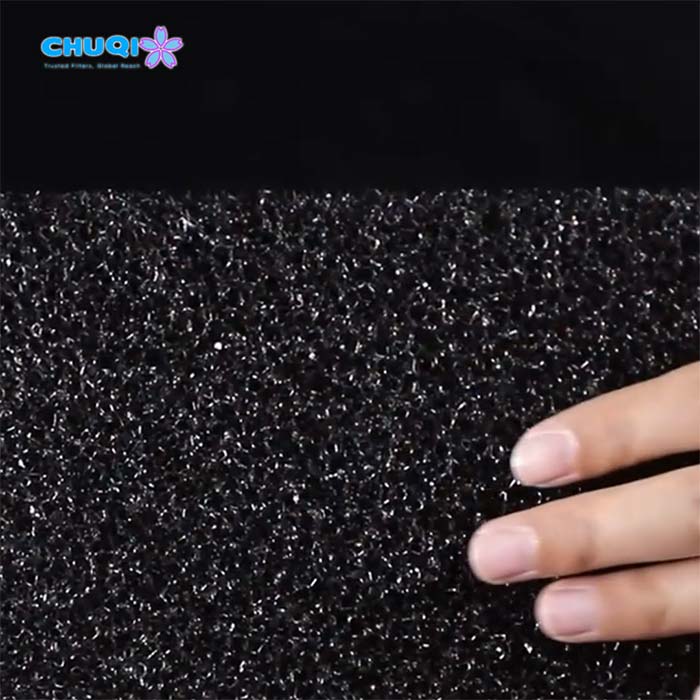
Short answer: Reticulated foam filter media is flexible polyurethane foam that has gone through a reticulation process to remove the thin membranes between its cells. What remains is a three-dimensional skeleton of struts with open, interconnected cells. It is graded by nominal pore count (PPI) and supplied as sheets, rolls or cut parts for use as a filter medium.
How It Is Made
Reticulated foam starts as conventional flexible polyurethane foam. In that state, many cells are still separated by thin membranes, or “windows.” A second process step removes them:
Thermal reticulation: a controlled hydrogen–oxygen flame front passes through the foam inside a pressure vessel and melts the membranes.
Chemical reticulation: the foam passes through a caustic bath that dissolves the membranes.u
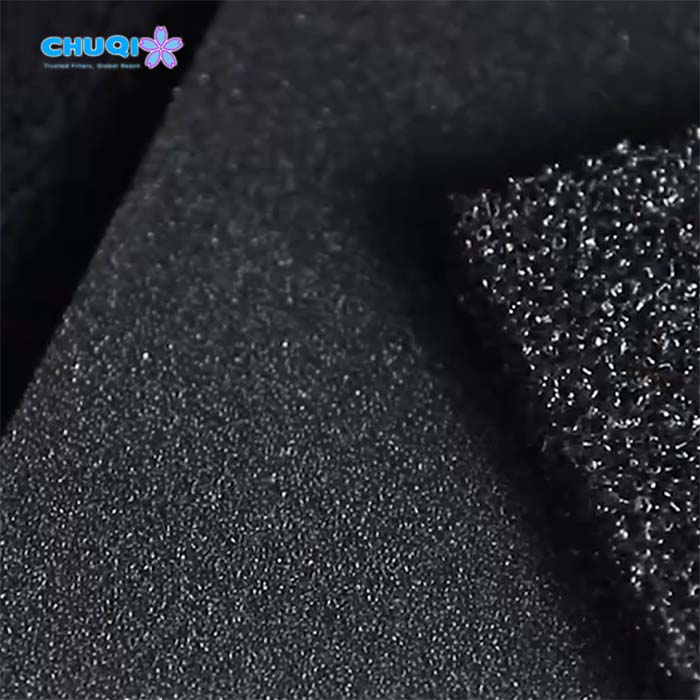
Both leave the struts intact, producing a windowless, open network. This is the property that separates filter foam from an ordinary sponge, even though the two may share the same base polymer. The structure, the process and how to recognize reticulated foam are explained in Reticulated Filter Foam vs Regular Sponge: What Is the Difference?.
Base Materials
Reticulated filter foam is made from either polyester-based or polyether-based polyurethane. The two are different materials. Polyether types generally resist hydrolysis better, while polyester types generally offer higher tensile and tear strength and better resistance to many organic solvents.wtburnett+1 They often look alike, so the base material should be stated on the specification rather than judged by eye.
Pore Count (PPI)
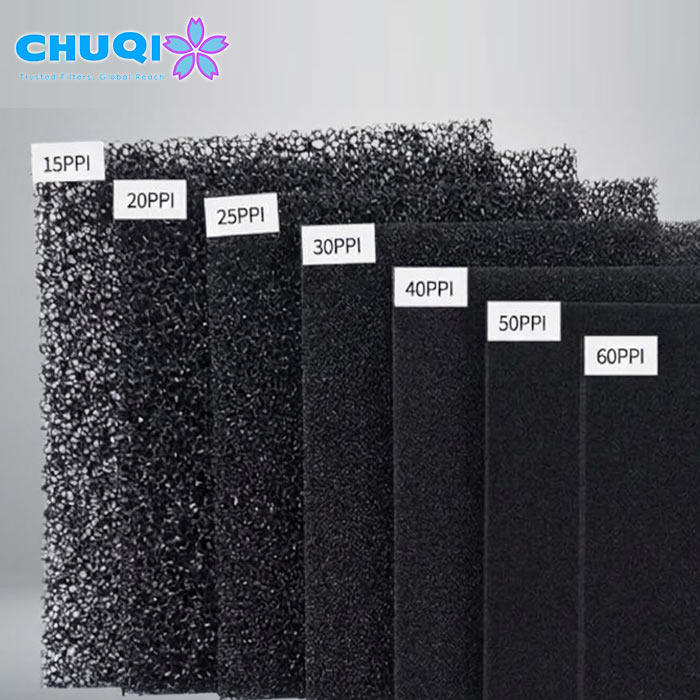
Reticulated foam is graded by PPI, the nominal number of pores counted along one linear inch.A lower PPI, such as 10, has a coarse, open structure. A higher PPI, such as 60, has a fine, dense one. PPI describes structure only. It does not set the foam’s weight, thickness, quality or filtration rating on its own. What PPI means in a specification is covered in Reticulated Filter Foam Specifications: PPI, Thickness, Sheets and Rolls.
2. What Does a Foam Pre-Filter Do in an Air System?
Short answer: A foam pre-filter is the first stage the incoming air meets. It captures coarse dust, lint and fibers at low resistance, so that fans, coils, heat sinks and finer filters downstream stay cleaner for longer. In some small systems it is the only filter. In others it protects a more efficient, more expensive stage behind it.
The Role of Pre-Filtration
In multi-stage filtration, each stage handles a different part of the dust load. The pre-filter takes the largest particles and the bulk of the mass, which:
Slows the loading of finer filters downstream.
Keeps coarse dust off fans, coils and heat exchangers.
Allows a washable, reusable first stage in front of disposable elements.
Equipment makers use open-cell foam as the intake filter where low pressure drop matters more than high-efficiency capture, for example in small fan coil units, packaged terminal air conditioners and electronics cooling circuits with limited fan pressure.
How It Captures Dust, in Brief
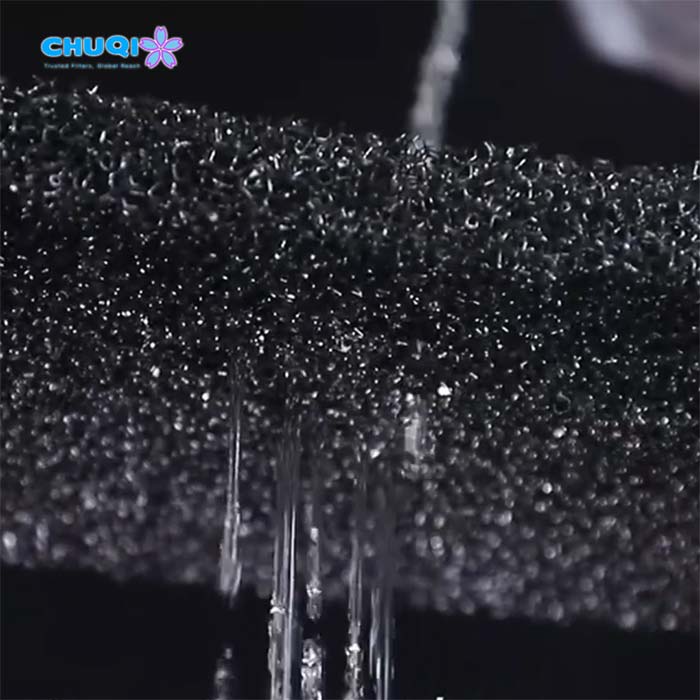
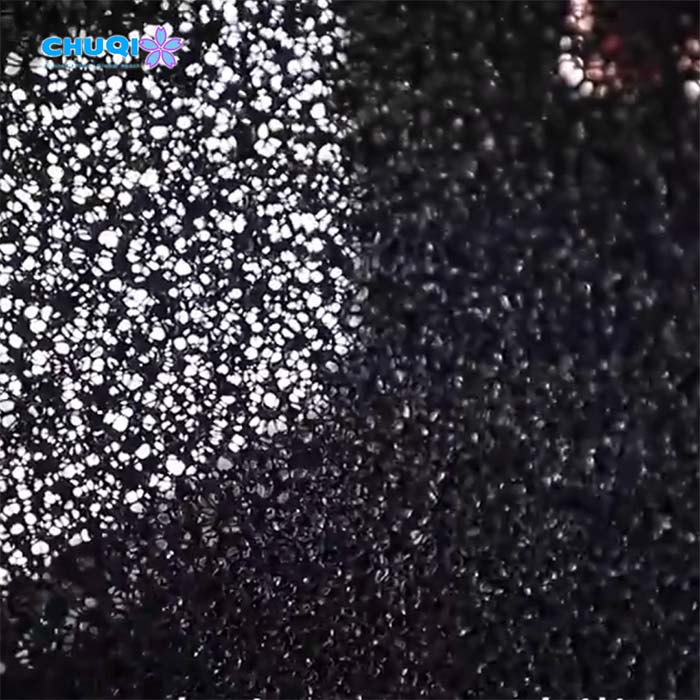
Air passing through the foam follows a winding path around the struts. Particles are captured by several mechanisms at once, including straining, inertial impaction, interception and diffusion. This happens throughout the depth of the foam, not just at its face.acat.or+1 As a result, capture depends on particle size, air velocity, thickness and how much dust is already held, not on PPI alone. These mechanisms, and what they mean for pressure drop and data comparison, are explained in How Reticulated Filter Foam Captures Dust: Airflow, Thickness and Pressure Drop.
Where It Sits Among Filter Classes
Complete filters made with foam media are typically tested and classified in the coarse range. Examples are the ISO Coarse group under ISO 16890, which is based on arrestance with a standard test dust,and the lower MERV values under ANSI/ASHRAE 52.2.Foam pre-filters complement fine and high-efficiency filters; they do not replace them.
3. Where Is Reticulated Foam Used for Air Pre-Filtration?
Short answer: Reticulated foam pre-filters are used in HVAC air handling units, rooftop ventilation units and fan coil units; in split and packaged air conditioners; in electrical enclosures, control panels and UPS units; in server racks, telecom cabinets and power distribution units; and in machinery housings, compressors, blowers and intake grilles.
| Sector | Typical equipment | Typical role of the foam |
|---|---|---|
| HVAC and ventilation | AHUs, rooftop units, fan coil units, split and packaged AC | Washable pre-filter ahead of coils and finer filters |
| Electronics and data | Control panels, UPS units, server racks, telecom cabinets, PDUs | Dust protection at fan and vent intakes |
| Industrial equipment | Machinery enclosures, compressors, blowers | Intake protection for motors and internal components |
| Outdoor equipment | Outdoor enclosures and cabinets | Pre-filter behind louvers or hoods |
In each case, the same questions come up: where the foam sits in the airflow, how much depth and face area are available, how the pad is held and sealed, and how it will be cleaned or replaced. These are covered in Reticulated Foam Air Pre-Filters: Equipment Applications and Installation.
4. When Is Reticulated Foam the Right Choice?
Short answer: Reticulated foam is a strong choice when an application needs a low-resistance, washable, easily shaped first stage for coarse dust. It is not the right choice when the application requires fine-particle or high-efficiency filtration on its own, or when the operating environment is incompatible with the foam’s base material.
Strengths and Limitations
| Strengths | Limitations |
|---|---|
| Open structure with low airflow resistance at coarse capture levels | Not a substitute for fine or high-efficiency filters |
| Washable and reusable when cleaned correctly | Needs regular cleaning or replacement as dust accumulates |
| Can be cut, die-cut and shaped to fit non-standard frames | Results depend on correct fit and sealing; gaps cause bypass |
| Available across a range of PPI grades and thicknesses | Performance depends on the full configuration, not PPI alone |
| Polyester and polyether options for different conditions | Base material must suit humidity, temperature and chemical exposure |
Questions to Answer Before Selecting
What dust load does the pre-filter need to handle, and what does it protect?
How much pressure drop can the fan system accept, both clean and loaded?
How much depth and face area are available?
What are the operating conditions: humidity, temperature, oils or chemicals?
How will the pad be held, sealed and maintained?
Will it be supplied as material for cutting or as finished parts?
The answers point to a material, a PPI and thickness range, a supply format and an installation method. Each of those is covered in one of the dedicated articles in this guide.
5. Key Technical Questions, Answered Briefly
The questions below are the ones buyers and engineers ask most often. Each answer is a summary; the linked article covers the topic in full.
Specifications
Does a higher PPI mean better or heavier foam? No. PPI describes cell fineness. Weight depends on apparent density and volume, and quality is judged against the agreed specification.
Are 30 PPI foams at 5 mm and 20 mm interchangeable? No. They share a pore-count grade, but they differ in volume, mass and the installation depth they need.
What does a complete specification include? Material, nominal PPI, thickness, supply format, dimensions or drawing, and applicable tolerances.
Read more: Reticulated Filter Foam Specifications: PPI, Thickness, Sheets and Rolls
Material and Structure
Is open-cell foam the same as reticulated foam? No. Conventional open-cell foam still has membranes across many cell faces. Reticulated foam has had them removed.
Can polyester and polyether foam be told apart by eye? Usually not. Rely on documentation or infrared spectroscopy (FTIR).
Read more: Reticulated Filter Foam vs Regular Sponge: What Is the Difference?
Dust Capture and Airflow
Does 30 PPI foam have a micron rating? Not on its own. A credible precision claim states an efficiency, a particle size and a test method with defined conditions.
What raises pressure drop? A finer PPI, greater thickness and, above all, higher air velocity. Resistance rises faster than linearly with velocity.
Read more: How Reticulated Filter Foam Captures Dust: Airflow, Thickness and Pressure Drop
Installation and Maintenance
Where should the foam go? On the intake side, upstream of what it protects, with all incoming air passing through it.
How is a foam pre-filter cleaned? Remove loose dust, wash in lukewarm water with mild detergent from the clean side, squeeze rather than wring, and dry fully without heat.
Read more: Reticulated Foam Air Pre-Filters: Equipment Applications and Installation
Choosing a Manufacturer
What evidence should a supplier provide? Identified materials, specifications tied to defined conditions, approved samples and documents that match what is delivered.
Read more: How to Evaluate a Reticulated Filter Foam Manufacturer
6. Our Reticulated Filter Foam Range
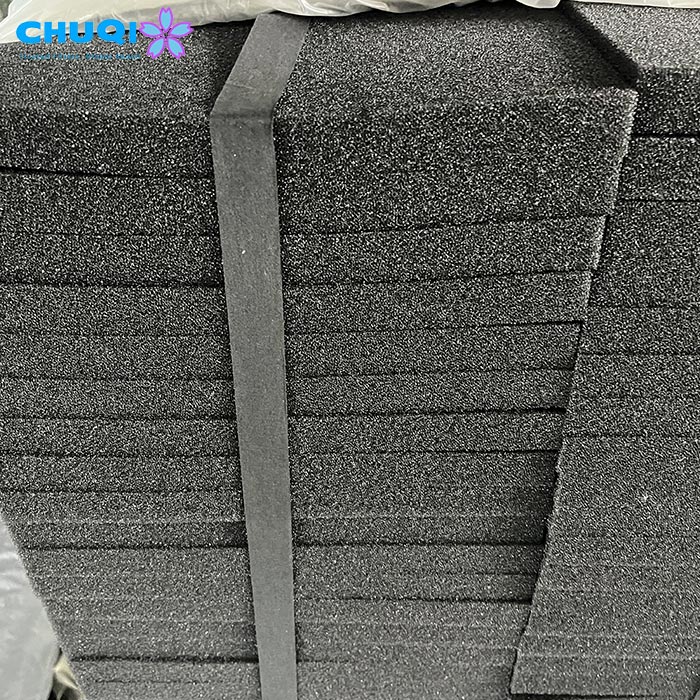
Our PPI-666 reticulated filter foam is produced for air pre-filtration and related uses. Our product literature lists:
| Item | Listed information |
|---|---|
| Material options | Polyester-based and polyether-based reticulated polyurethane foam |
| Nominal pore count | 10–60 PPI |
| Thickness range | 3–50 mm |
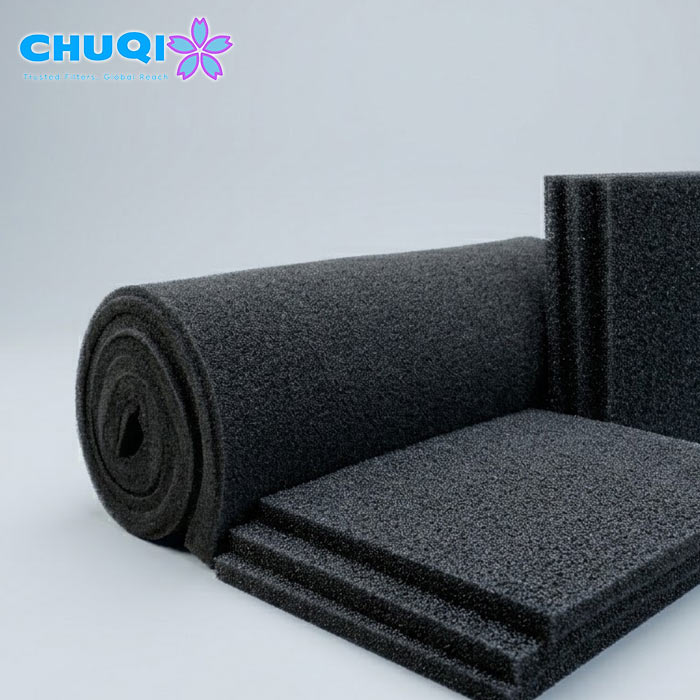
| Sheet format | 1 × 2 m |
| Whole rolls | Width, length and thickness agreed per project |
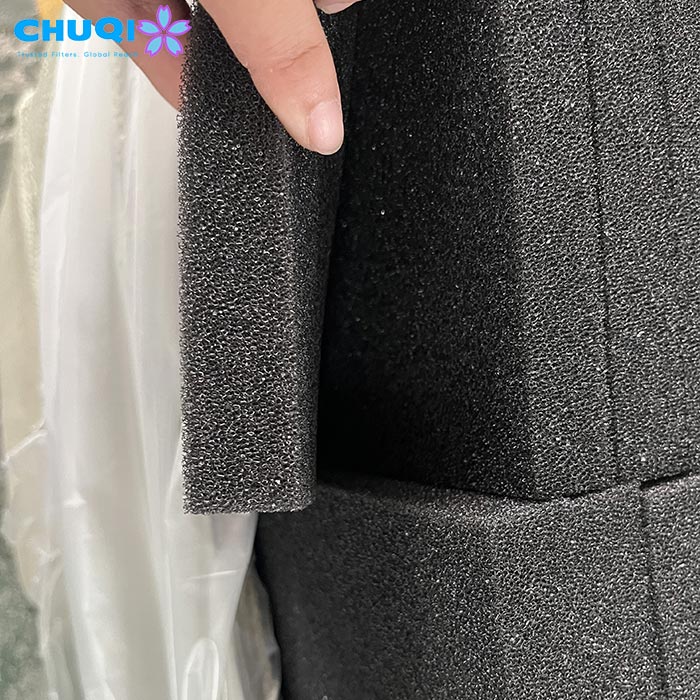
| Cut and die-cut parts | To customer dimensions or drawings |
| Nominal apparent density | 23 kg/m³ |
| Color | Custom options |
The combination of material, PPI, thickness and supply format available for a given order is confirmed at quotation. For full product details, see the product page.
View Available Filter Foam Specifications
If you already have an application in mind, send us the equipment type, the available space, your airflow and any drawings or samples. We will help you work out which material, PPI and thickness are worth evaluating.