
A product description such as “30 PPI black filter foam” identifies a pore-count grade and a color. It does not define the material, apparent density, thickness, finished dimensions, supply format or acceptable tolerances.
When those details are left open, problems tend to show up late in the process. Two samples carry the same PPI but weigh differently. A replacement pad matches on length and width but not on thickness. A die-cut part matches the outside size, but its holes miss the fixing points.
This guide answers the six specification questions that buyers, design engineers and purchasing teams ask most often about reticulated filter foam. It ends with a template for describing a requirement completely.
For an overview of what reticulated filter foam is, where it is used and the technical questions it raises, see Reticulated Foam Filter Media: A Guide to Air Pre-Filtration.
Key Takeaways
PPI (pores per inch) is the nominal number of pores counted along one linear inch. A higher PPI means a finer cell structure. It is not a quality grade and does not indicate a heavier material.
Weight depends on apparent density and volume, not on PPI. Mass = apparent density × length × width × thickness.
Thickness is a separate specification. At the same length and width, 30 PPI foam at 20 mm has four times the volume and calculated mass of 30 PPI foam at 5 mm.
Sheets and rolls suit different processing methods. The number of usable parts depends on the cutting layout, not on the format name.
Length and width define only the outer boundary of a part. Holes, notches and corner profiles each need a size and a position, measured from a stated reference.
Every tolerance should state which characteristic it controls. For flexible foam, the measurement condition should also be agreed.
1. What Is the Difference Between 10 PPI and 60 PPI Filter Foam?
Short answer: PPI stands for pores per inch, the nominal number of pores counted along one linear inch of foam. 10 PPI foam has fewer, larger cells and a coarse, open structure. 60 PPI foam has more, smaller cells and a fine, dense structure. PPI describes cell structure only. It is not a quality rating and does not by itself indicate weight, thickness or filtration efficiency.
How PPI Is Counted
In the reticulated foam industry, PPI is the number of pores counted along a one-inch line, usually under magnification.store.astm+1 It is a linear count, not a count per square inch. The figure is nominal, because the cells in any foam vary in size.
Where metric values are needed, divide PPI by 2.54 to get pores per centimeter. Dividing 25.4 mm by the PPI value gives the average linear pitch, which is the average distance taken up by one pore along the counting line:
| Nominal PPI | Pores per cm (≈) | Average linear pitch (25.4 mm ÷ PPI) |
|---|---|---|
| 10 PPI | 3.9 | ≈ 2.5 mm |
| 20 PPI | 7.9 | ≈ 1.3 mm |
| 30 PPI | 11.8 | ≈ 0.85 mm |
| 45 PPI | 17.7 | ≈ 0.56 mm |
| 60 PPI | 23.6 | ≈ 0.42 mm |
These values are for conversion and visual orientation only. Average pitch is not the diameter of each opening, and this table is not a list of stocked grades.
What Changes Between 10, 30 and 60 PPI
When comparable foams are viewed at the same scale:
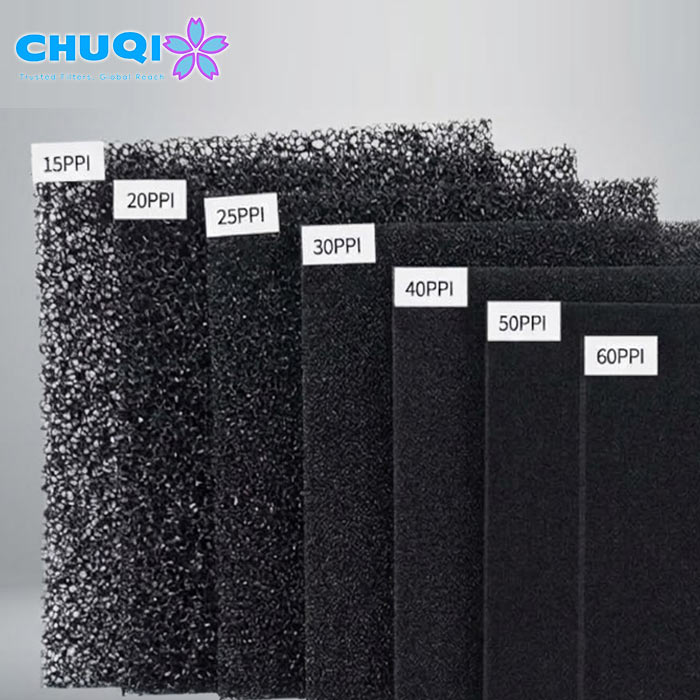
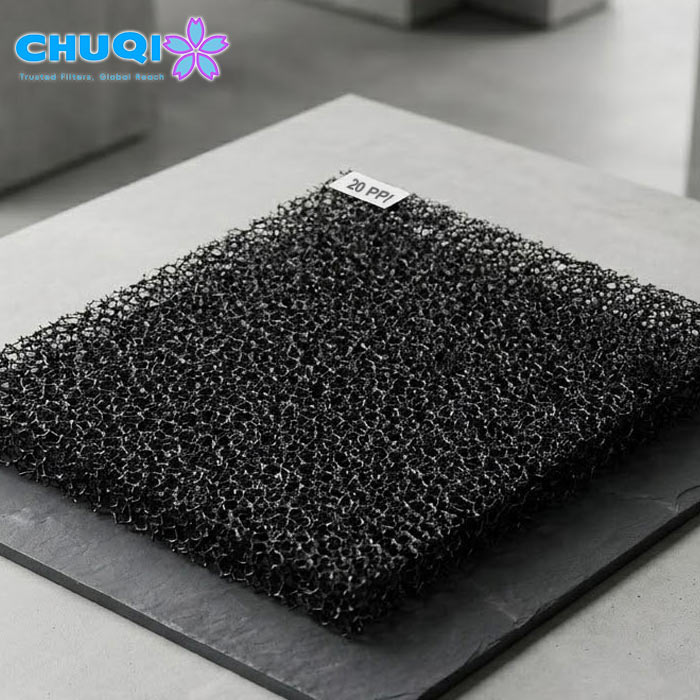
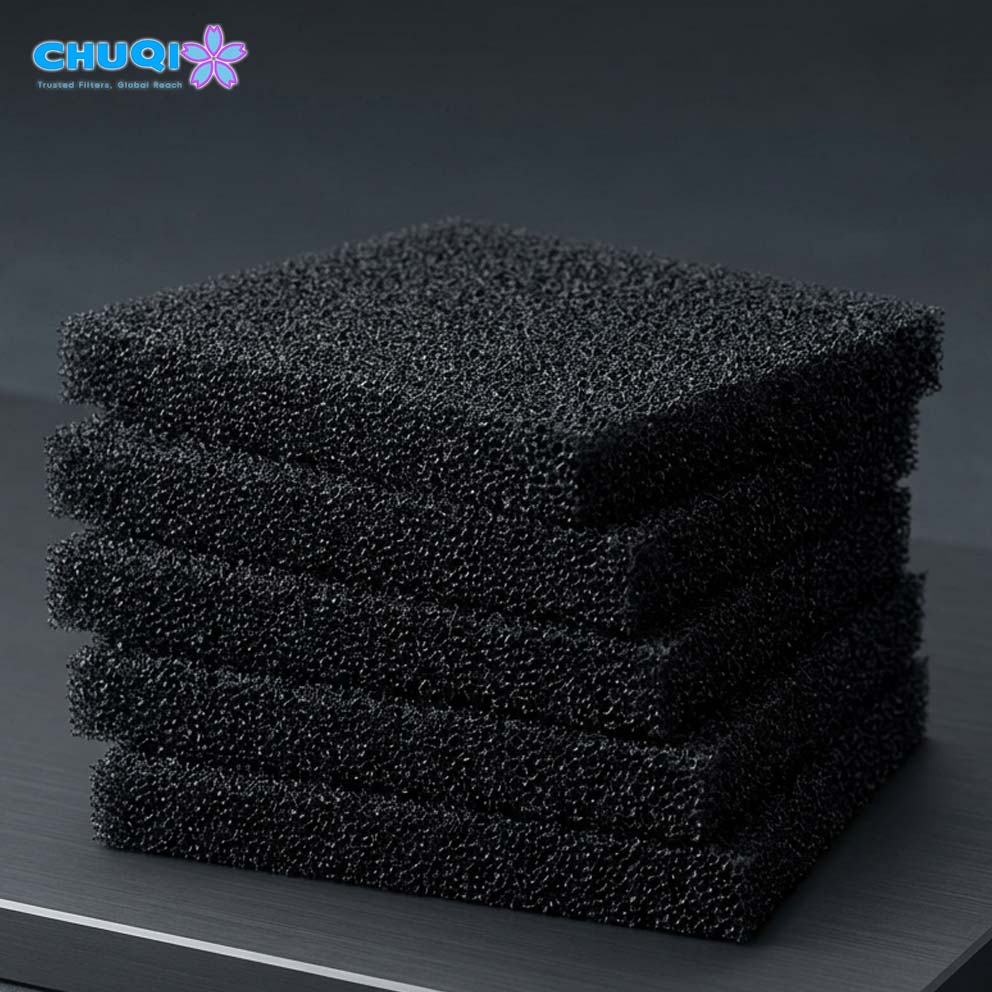
10 PPI shows a coarse, open network. The cells are large enough to see clearly without magnification, and the openings are wide.
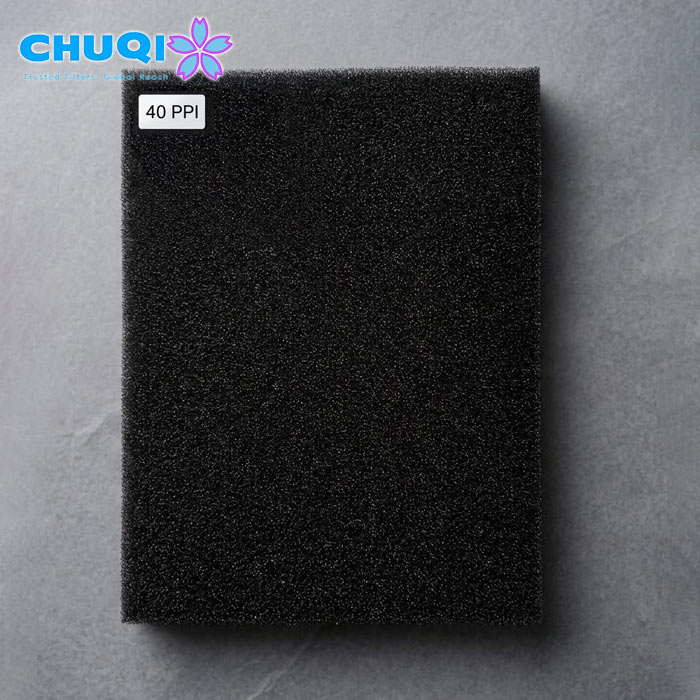
30 PPI shows a visibly finer network. The individual cells can still be seen, but they are noticeably smaller.
60 PPI shows a dense, fine network. Close inspection or magnification is needed to see individual cells.
Moving up the scale, more cells fit into the same inch and each cell is smaller. Pore count does not tell you how much solid material the foam contains or how thick the supplied piece is.
Why PPI Belongs Under “Pore Count,” Not “Hole Diameter”
The openings on a cut surface of reticulated foam are sections through an interconnected three-dimensional network, not uniform round holes.On a specification sheet, a PPI value should therefore appear under “Nominal PPI” or “Pore Count.” A sheet that lists “Hole Diameter: 30 PPI” mixes a count with a size and invites misreading. For more on how this open-cell structure differs from ordinary sponge, see reticulated filter foam vs. ordinary sponge.
Why a Higher PPI Is Not a Higher Grade
PPI classifies structure, not quality. 60 PPI is not a premium version of 10 PPI, and 10 PPI is not an economy version of 60 PPI. They are different structures for different configurations. Quality is judged against the agreed material, dimensions and tolerances. The right PPI depends on the equipment, the available space and the operating requirements. How PPI relates to dust capture and airflow is covered in how reticulated foam captures dust.
Our range: Our PPI-666 filter foam is listed with a nominal pore count of 10–60 PPI. The material, thickness and supply format available for each grade are confirmed when you order.If you have specific technical questions or custom requirements, please Contact Our Technical Experts on WhatsApp for quick consultation.
2. Does Higher PPI Mean Heavier Foam?
Short answer: No. PPI describes how fine the cells are. Weight depends on apparent density and volume. Two pieces of the same size and the same apparent density have the same calculated mass whatever their PPI. Two pieces with the same PPI can weigh different amounts if their density or dimensions differ.
Four Terms That Should Not Be Interchanged
| Term | What it describes | Unit |
|---|---|---|
| Nominal PPI | Pores counted along one linear inch; cell fineness | PPI |
| Apparent density | Mass per unit of overall volume, including the void space | kg/m³ |
| Porosity | Share of the overall volume that is void space | % |
| Total mass | Quantity of foam actually supplied | kg |
Apparent density is calculated from the measured mass and volume of a specimen, using methods such as ISO 845.It is a separate property from pore count, and neither can be worked out from the other.
The Calculation
For any rectangular sheet, pad or roll:
Mass = Apparent density × Length × Width × Thickness
Keep the units consistent: density in kg/m³ and all dimensions in meters.
Comparing Two Pieces of the Same Size
If length, width and thickness are identical, the volume is identical. Which piece is heavier then depends only on apparent density.
Same density, different PPI: same calculated mass.
Same PPI, different density: different mass.
Comparing Two Rolls
A roll can be heavier simply because it is wider, longer or thicker. To compare net foam mass, you need all four values: apparent density, thickness, roll width and roll length. A heavier roll may just contain more foam. It is not evidence of a denser or higher-PPI material.
3. Why Are 30 PPI Foam at 5 mm and 20 mm Different Specifications?
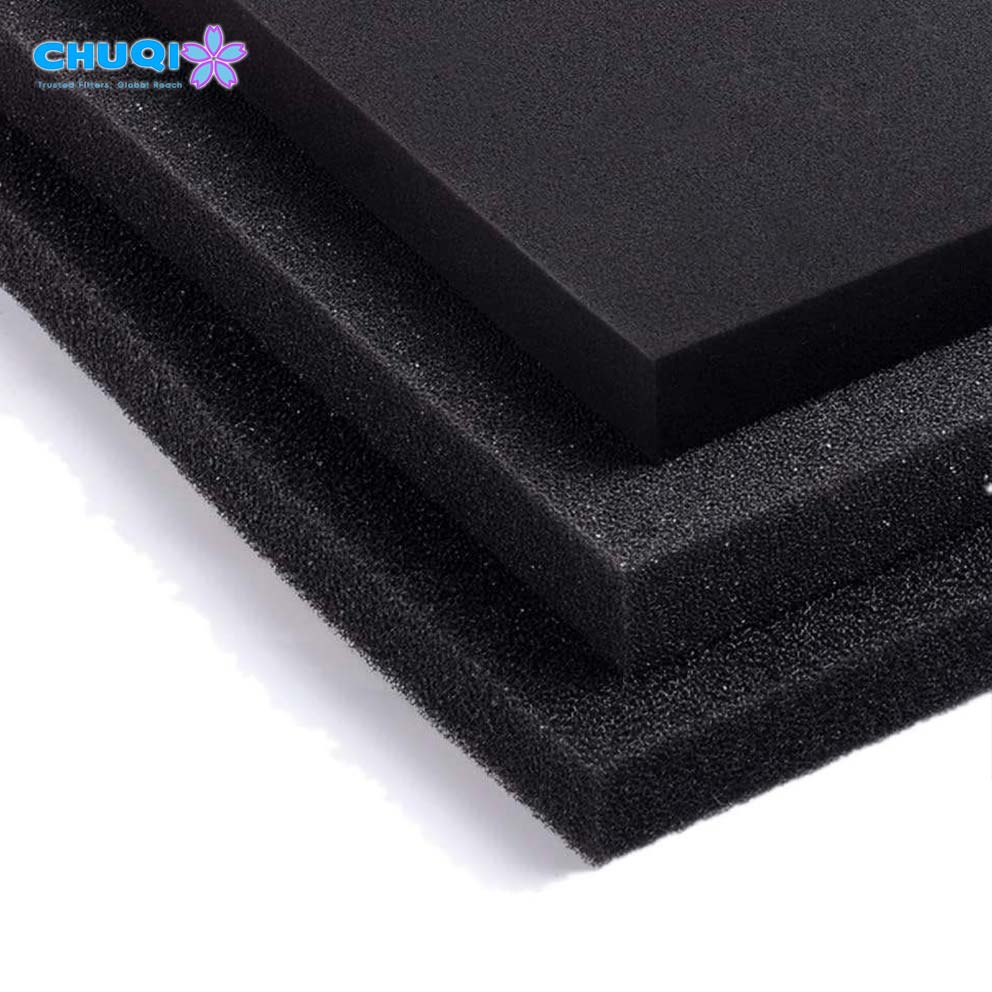
Short answer: They share a pore-count grade but not a product configuration. At the same length and width, the 20 mm piece has four times the volume of the 5 mm piece. At equal density it also has four times the calculated mass. It needs four times the installation depth, so neither can be assumed to replace the other.
What Is the Same, and What Is Not
| Characteristic | 30 PPI × 5 mm | 30 PPI × 20 mm |
|---|---|---|
| Nominal PPI | 30 | 30 |
| Thickness | 5 mm | 20 mm |
| Volume (same length and width) | 1× | 4× |
| Calculated mass (same density) | 1× | 4× |
| Installation depth taken up | 5 mm | 20 mm |
| Same product specification? | No | No |
Why Matching PPI Does Not Make Two Pads Interchangeable
Thickness sets how much depth the foam occupies. A frame or slot designed for a 5 mm pad cannot be assumed to accept a 20 mm pad, even if PPI, length and width all match. A thinner pad that fits inside the same frame is not automatically an equivalent replacement either. How to check installation depth, retention and sealing before changing thickness is covered in installing reticulated foam pre-filters.
Thickness also changes the filter configuration. Airflow resistance and dust-holding data measured at one thickness should not be transferred to another. That relationship is covered in dust capture and airflow performance.
Specify Supplied Thickness
The thickness on a quotation or drawing should describe the material as supplied, under a stated measurement condition (see Section 6). If the application also requires a particular installed condition, state that as a separate requirement. Do not fold it into the supplied thickness.
Our range: Our product literature lists thicknesses from 3 to 50 mm. The thicknesses available for a given material, PPI and supply format are confirmed when you order.
4. Sheets or Whole Rolls: What Is the Practical Difference?
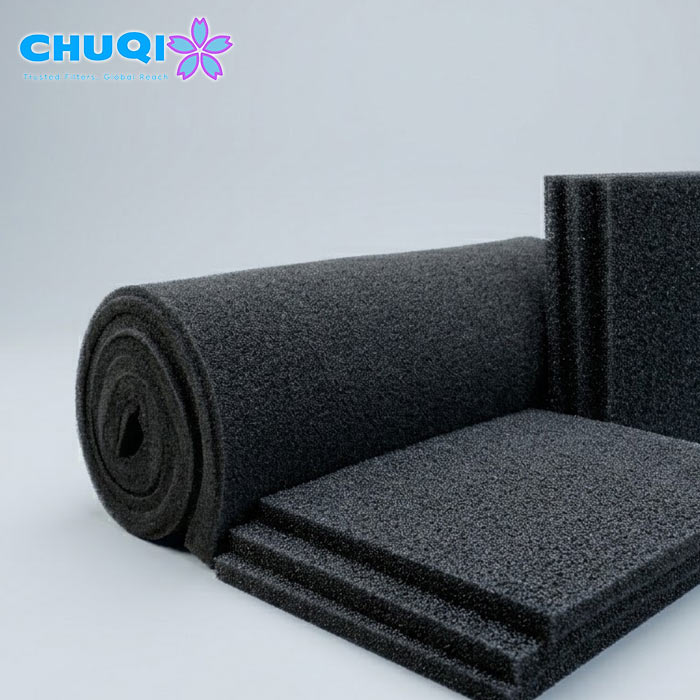
Short answer: Sheets are flat panels of fixed length and width, suited to processes that handle and cut material one panel at a time. Rolls are continuous lengths of a set width, suited to processes built around unwinding and feeding material. Neither format is automatically cheaper or less wasteful. The cutting layout, equipment and handling decide which one fits.
What Each Format Requires You to Specify
| Aspect | Sheets | Whole rolls |
|---|---|---|
| Form supplied | Flat panels | Continuous wound length |
| Dimensions to state | Thickness, length, width | Thickness, roll width, roll length |
| Quantity unit | Number of sheets | Number of rolls |
| Main processing question | How parts nest within the panel | How material unwinds, feeds and is cut |
| Usually considered when | Material is handled and cut panel by panel | Equipment is set up for unwound material |
For rolls, also confirm whether a minimum continuous length is needed, whether joints are permitted and how they are marked, and how rolls are cored, packed and identified. “One whole roll” is not a complete quantity until width, length and thickness are agreed.
Why Sheet Size Alone Does Not Tell You Part Yield
The number of parts you can cut from a sheet depends on part size, orientation, the spacing your cutting process needs and any edge trim. Take a 1,000 × 2,000 mm sheet and a 200 × 300 mm part:
| Layout | Calculation | Parts per sheet |
|---|---|---|
| Area only, no spacing | 2.0 m² ÷ 0.06 m² | 30 (theoretical) |
| 200 mm across the 1,000 mm width, 5 mm spacing | 4 across × 6 along | 24 |
| 300 mm across the 1,000 mm width, 5 mm spacing | 3 across × 9 along | 27 |
The same part on the same sheet gives 24 or 27 pieces depending on orientation, and 30 only in theory. Edge trim would reduce these numbers further. The spacing value here is illustrative; use the value your cutting process actually needs. The same logic applies to rolls: the number of parts that fit across the roll width sets the yield per meter.
Because of this, compare formats on the basis of your actual layout and the full quotation, not price per sheet against price per roll.
If you need parts ready for assembly rather than material to cut yourself, custom-cut or die-cut supply moves the cutting step to the supplier.
Our range: Our product literature lists a 1 × 2 m sheet format. This is a listed format, not a maximum size. Whole rolls are available, with width, length and thickness agreed for each project. Cutting and die-cutting are available to customer requirements.
5. Why Are Length and Width Not Enough for Some Custom Parts?
Short answer: Length and width define only the outer boundary of a part. Two pads can have the same outside size and thickness but holes, notches or corner profiles of different sizes or in different places. A complete drawing defines both the size and the position of every feature, each measured from a stated reference edge or centerline.
Same Outline, Different Part
Take two 400 × 300 × 10 mm pads, each with a 20 mm diameter hole:
Pad A: the hole center is 200 mm from the left edge and 150 mm from the bottom edge, which puts it at the center.
Pad B: the hole center is 80 mm from the left edge and 150 mm from the bottom edge.
Both pads match on length, width, thickness and hole diameter. If the hole must line up with a fixing stud, sensor or drain point, only one of them will fit. Diameter defines the size of the hole. The distances from the reference edges define where it is. The drawing needs both.
Notches and cutouts work the same way. Their width and depth set their size, but their position has to be dimensioned separately.
What a Foam Part Drawing Should Include
| Drawing element | What it defines |
|---|---|
| Overall dimensions | Outer boundary of the part |
| Thickness | Material depth (see Section 3) |
| Hole and cutout sizes | Size of each feature |
| Hole and cutout positions | Location of each feature |
| Reference edges or centerlines | Where position dimensions are measured from |
| Corner radii (if required) | Profile where corners are not square |
| Applicable tolerances | Allowed variation for each characteristic (see Section 6) |
| Drawing number and revision | Exactly which version is being quoted, sampled and produced |
A plain rectangular pad may need only three dimensions. A shaped insert needs enough information that nobody has to interpret an unscaled sketch or a photograph.
Quotation, sample approval and production should all refer to the same identified revision. When the geometry changes, issue a new revision number. “Use the latest drawing” is not a reliable instruction once several versions have been exchanged.
Our range: Our product literature states that the foam can be cut and die-cut to customer requirements. The proposed shape and dimensions are confirmed against the drawing you submit.
Review the listed PPI range, thicknesses and supply formats on our product page:
View Available Filter Foam Specifications
If you have a drawing or a non-standard requirement, send us whatever you already know about the material, your dimensions or drawing with its revision number, the quantity you need, and any points still undecided. We will review the requirement and work out a complete specification with you.