
Quick Summary (Key Takeaways):
Primary Role: Intake pre-filters (G2–G4 / MERV 5–8) capture coarse dust, insects, and debris before air reaches HVAC heating/cooling coils and secondary HEPA/bag filters.
Core Metrics: B2B buyers must evaluate initial pressure drop (Initial ΔP ≤ 40 Pa), gradual density depth loading, zero fiber shedding, and fire compliance (DIN 53438 F1 / UL 900).
Rolls vs. Finished Filters: Raw roll media offers lower shipping costs and custom cut flexibility, while factory-finished pleated panel filters eliminate field labor and air bypass risks.
What is an HVAC Intake Pre-Filter and Why is It Critical?
An HVAC intake pre-filter (also known as a pre-filter media pad or air intake filter roll) is the initial filtration layer installed at fresh air intakes, air handling units (AHUs), and return air vents. Rated typically between EN779 G2–G4, ISO 16890 Coarse, or ASHRAE MERV 5–8, its main technical function is to intercept high-volume coarse particulates (>10 microns) from the incoming airstream.
By stopping heavy particulate loading at the air intake, a high-quality pre-filter prevents fan coil fouling, maintains thermal exchange efficiency, and extends the service lifespan of downstream medium-to-high efficiency filters (such as pocket filters and final HEPA units) by 30% to 50%.
Where and How Pre-Filter Media is Deployed Across HVAC Infrastructure
To prevent system-wide fouling and optimize fan power consumption, intake pre-filter media is deployed across four primary nodes in commercial and industrial HVAC loops:
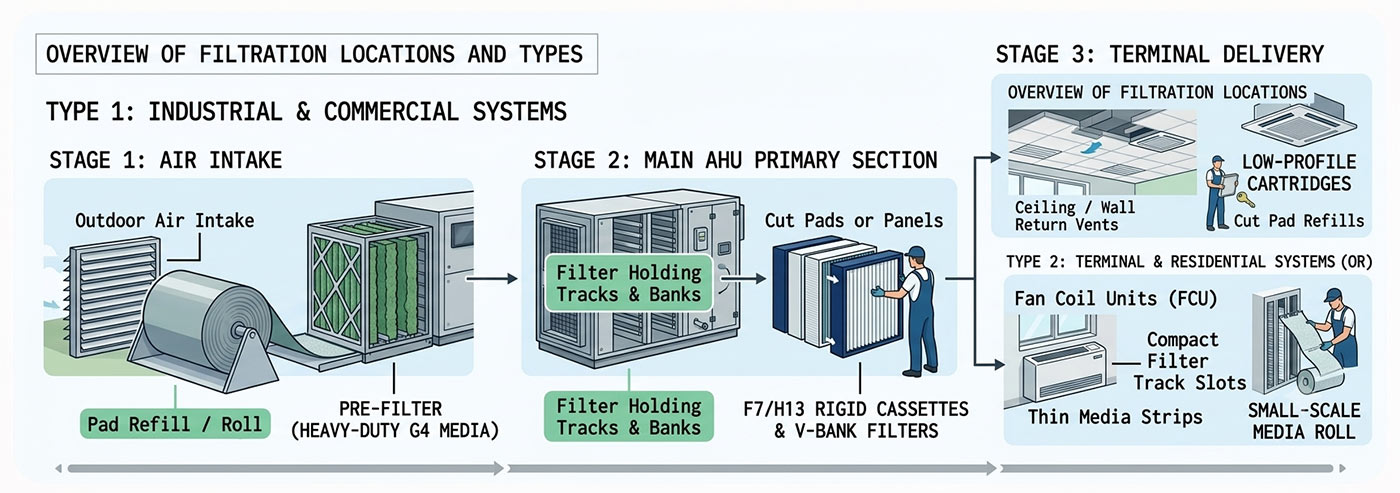
Fresh Outdoor Air Intake Louvers (Weather Louvers & Primary Grids)
Application & Placement: Installed directly behind exterior metal louvers or inside fresh-air plenum chambers where raw outdoor air enters the building.
Operating Conditions: Exposed to extreme ambient weather, outdoor humidity, rain droplets, high wind velocities, and heavy environmental debris (leaves, insects, airborne seeds, and coarse fugitive dust).
Engineering Purpose: Serves as the primary barrier preventing large organic debris from entering and decomposing inside the air mixing box. Media used here requires high moisture/water resistance, robust tensile strength, and open-density G2/G3 (MERV 5–6) profiling to handle high volumetric airflow without causing severe pressure drops during stormy or wet conditions.
AHU Mixing Chambers & Primary Filter Banks (Centralized Air Handlers)
Application & Placement: Fitted into standard slide-in holding tracks (24″ × 24″ or 12″ × 24″ modules) located inside large Air Handling Units (AHUs), positioned upstream of heating/cooling coils and secondary pocket/bag filters.
Operating Conditions: High face velocities (1.5 m/s to 2.5 m/s) handling mixed air streams (fresh outdoor air combined with recirculated indoor air).
Engineering Purpose: Intercepts fine-to-medium ambient atmospheric dust before it can coat delicate heat-exchanger fins (cooling coils) or blind secondary medium/high-efficiency filters. Utilizing progressive-density G4 (MERV 8) media here traps up to 90% of coarse particulate mass in depth, preventing coil fouling—which causes severe heat-transfer loss—and extending the service lifespan of expensive downstream bag or HEPA filters by 30% to 50%.
Return Air Vents & Extraction Grilles (Commercial Recirculation)
Application & Placement: Mounted directly behind ceiling-integrated or wall-mounted return air registers in office spaces, hotels, shopping malls, and industrial production floors.
Operating Conditions: Continuous, low-to-medium velocity air extraction laden with indoor contaminants.
Engineering Purpose: Designed to capture indoor-generated particulates—specifically textile fibers, carpet lint, clothing dust, and human hair—before re-circulated air travels back through secondary ductwork. Using thin, pre-cut filter pads behind return grilles prevents internal ductwork contamination, eliminates the need for costly duct-cleaning maintenance, and protects central return fans from fiber build-up.
Fan Coil Units (FCU), Chilled Beams & Terminal Equipment
Application & Placement: Inserted into narrow, compact filter slots or perimeter tracks directly adjacent to decentralized indoor terminal units (FCUs, VRF indoor units, and packaged terminal air conditioners).
Operating Conditions: Low-profile, space-constrained enclosures operating at lower static pressures where fan power is minimal.
Engineering Purpose: Terminal fan coils rely on small, low-wattage motors sensitive to static resistance. Specifying ultra-low initial pressure drop media (5 mm to 10 mm lightweight pads) in these units ensures effective lint and dust protection for the small heat-exchanger coils without choking airflow, preventing condensate tray overflow caused by coil freezing.
Core Engineering Metrics B2B Buyers Must Verify
When evaluating pre-filter media for these HVAC applications, technical procurement teams must look beyond superficial marketing claims and verify six critical physical and fluidic performance metrics:
Differential Pressure (ΔP) & Energy Efficiency
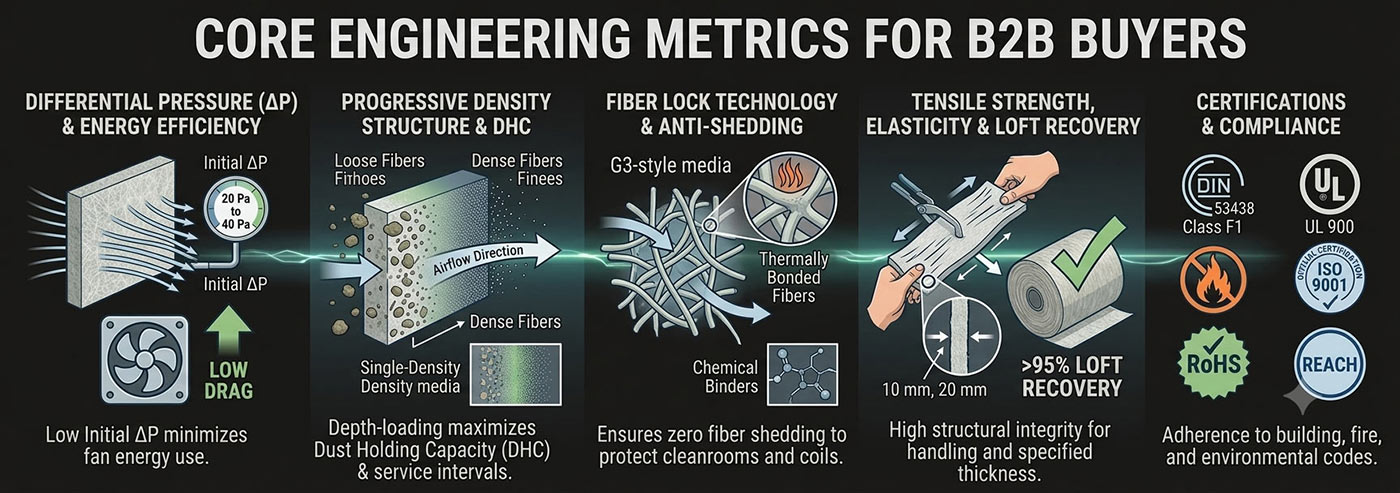
System fan power consumption correlates directly with airflow resistance. High-grade synthetic media is engineered for an ultra-low initial pressure drop (Initial ΔP)—typically operating between 20 Pa and 40 Pa under standard air velocities (1.5 m/s to 2.5 m/s). Lower initial drag keeps baseline fan energy consumption minimal while maintaining required ventilation rates.
Progressive Density Structure & Dust Holding Capacity (DHC)
Single-density media face-loads rapidly, causing sharp pressure spikes and frequent system shutdowns. High-performance media utilizes a gradual density structure—where fiber packing tightness increases progressively from the air-entering side to the air-leaving side.
Airflow Direction: [ Loose Fibers (Catch Coarse Dust) ] ──► [ Dense Fibers (Trap Fine Particles) ]
This depth-loading mechanism maximizes total Dust Holding Capacity (DHC), extending service intervals and protecting downstream bag or HEPA filters by up to 30% to 50%.
Fiber Lock Technology & Anti-Shedding Resistance
Under continuous high-velocity airflow, sub-standard synthetic media can suffer structural degradation and fiber shedding. Loose fibers entering the airstream can foul cooling coils, contaminate cleanrooms, or cause paint defects in industrial spray booths. High-grade media utilizes thermally bonded synthetic microfibers (without brittle chemical binders) to ensure zero fiber shedding and high shear resistance.
Tensile Strength, Elasticity, and Loft Recovery
During transit and installation, media is subject to mechanical stress. Premium polyester media exhibits high tensile strength and tear resistance during conversion. Furthermore, its high elasticity guarantees rapid loft recovery (>95%) when unpacking vacuum-compressed rolls, restoring specified nominal thicknesses (5 mm, 10 mm, 15 mm, or 20 mm) effortlessly.
Fire Safety and Environmental Certifications
Because intake filters sit directly in primary outdoor or return airstreams, strict building and safety codes apply. Industrial media must comply with flame-retardant standards such as DIN 53438 (Class F1) and UL 900. Additionally, compliance with global environmental standards like ISO 9001, RoHS, and REACH guarantees that the media is non-toxic, odorless, and free of hazardous heavy metals.
Real-World Field Challenges When Deploying Roll Media
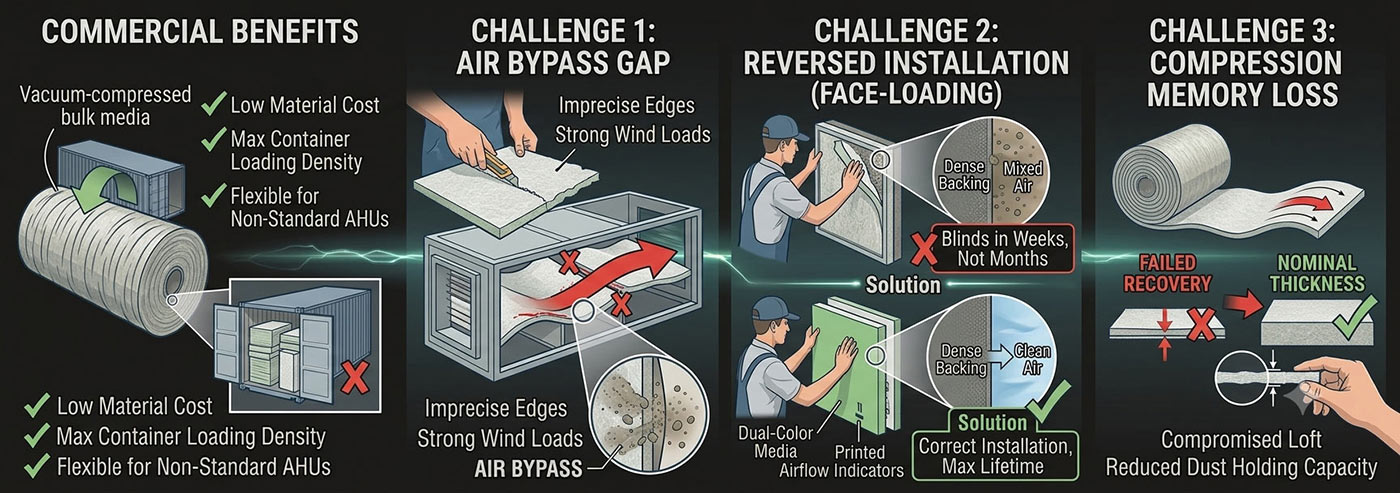
Purchasing bulk roll media (0.5 m to 2.0 m widths, 100 g/m² to 400 g/m²) offers undeniable commercial benefits: lower landed material costs, maximum ocean container loading density, and flexibility for non-standard AHU sizes.
However, maintenance teams frequently encounter operational friction during field application:
The “Air Bypass” Gap: Cutting pads manually on-site with utility knives often leaves ragged, imprecise edges. Under strong wind loads, soft pads bow, sag, or pull away from frame edges, creating gaps where unfiltered dirty air slips past the filter frame.
Reversed Installation (Face-Loading): Inexperienced technicians frequently install progressive-density media backward. When the dense backing faces incoming air, the filter blinds within weeks instead of months. Solution: Sourcing media with distinct dual-color layers or clear printed airflow indicators eliminates installation errors.
Compression Memory Loss: Media rolls tightly wound for export shipping sometimes fail to regain their full loft. If thickness is compromised, dust holding capacity drops instantly.
Bridging the Gap: Moving from Roll Media to Pre-Assembled Finished Filters
While raw roll media provides unmatched flexibility for custom site work, relying purely on manual pad cutting for large commercial facilities often leads to high labor costs and sealing risks.
When on-site maintenance labor is expensive, or when air handling units operate under high wind velocities, transitioning from pad refills to factory-assembled finished pre-filters is the logical operational upgrade:
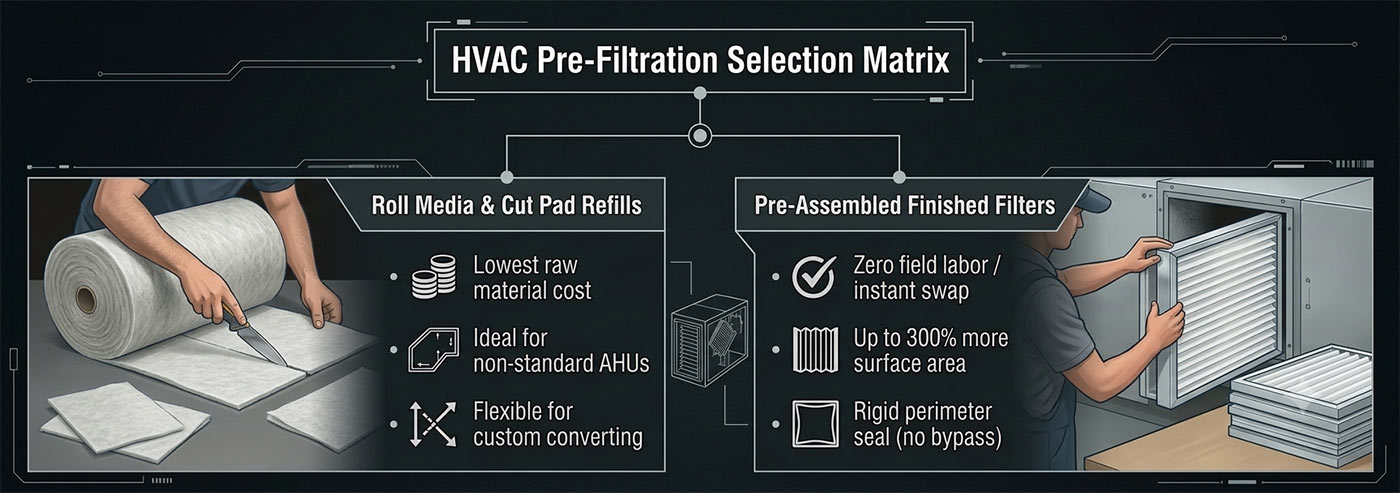
Pleated Panel Filters (Cardboard / Steel Frame): Pleating synthetic media inside a beverage-board or galvanized frame expands active filtration surface area by up to 300%. This lowers face velocity, reduces initial pressure drop, and extends service life significantly compared to flat pads.
Washable Metal Frame Filters: Built with aluminum or galvanized steel channels, these units withstand outdoor humidity or oily industrial air without structural deflection.
Replaceable Media Inner-Frame Systems: A hybrid model featuring a permanent metal outer frame with easily swappable synthetic pad inserts—combining the low shipping cost of pad refills with the rigid perimeter sealing of a finished filter.
Integrated Manufacturing: Raw Fiber to Completed Assemblies
Whether your supply chain strategy relies on converting bulk roll media or stocking pre-assembled finished filters, consistency is what ultimately protects your operating margins.
With over 20 years of specialized manufacturing experience, Chuqi New Materials operates a vertically integrated production ecosystem. By controlling the complete manufacturing process—from raw synthetic fiber thermal bonding and multi-layer gradient profiling to precision die-cutting and rigid frame assembly—we eliminate batch-to-batch variations, weight fluctuations, and fiber shedding issues.
Custom Roll Media: Thicknesses (5–20 mm), roll widths (0.5–2.0 m), and grammages (100–400 g/m²) tailored to your converting line.
Finished Filter Units: Certified G2–G4 / MERV 5–8 pleated panels, metal frame washable filters, and custom-sized pad sets built for global OEM and MRO projects.
Export-Ready Logistics: High-density compression packaging engineered to maximize container loading yield for both FCL and LCL ocean shipments.
Frequently Asked Questions (FAQ for B2B Procurement)
Q1: What is the difference between G2, G3, and G4 pre-filter media?
A: Under the EN779 rating system, G2, G3, and G4 classify synthetic pre-filters based on synthetic dust arrestance:
G2 (MERV 5): Arrestance 60%–80%, ideal for coarse fresh air intake and basic FCU protection.
G3 (MERV 6–7): Arrestance 80%–90%, widely used for return air grilles and primary AHU protection.
G4 (MERV 8): Arrestance >90%, the industrial standard for protecting secondary bag filters and cooling coils in commercial AHUs.
Q2: How often should HVAC Pre-Filter rolls or pads be replaced?
A: Replacement intervals depend on ambient dust concentration and airflow velocity. Under standard commercial operating conditions, pre-filter pads are typically replaced every 1 to 3 months, or when differential pressure reaches its recommended final resistance (Final ΔP ≈ 150 Pa to 250 Pa).
Q3: Can pre-filter media rolls be washed and reused?
A: While synthetic polyester media possesses high water resistance, non-woven thermal-bonded pre-filter pads are designed primarily as disposable depth-filtration media. Washing progressive-density media can disrupt the fiber orientation, lower dust capacity, and cause fiber shedding. For washable applications, metal mesh or coarse open-cell polyurethane foam is recommended.
Partnering for High-Efficiency Intake Air Filtration
Navigating the trade-offs between bulk roll media and factory-assembled pre-filters depends on your project scale, maintenance labor budget, and site velocity requirements. Partnering directly with an experienced primary manufacturer ensures you receive reliable filtration efficiency without paying middleman markups.
Whether you need bulk roll media for local converting or pre-cut finished panels engineered for immediate HVAC installation, Chuqi New Materials provides factory-direct support to meet your strict performance specifications.
Ready to Optimize Your HVAC Air Intake Systems?
Take the next step in streamlining your filtration supply chain:
Free Technical Consultation: Speak with our filtration engineers to determine the ideal media thickness, weight, and filtration grade (G2–G4 / MERV 5–8) for your application.
Sample Testing Kits: Request free physical media samples to test loft recovery, tensile strength, and airflow resistance on your own production or test lines.
Custom OEM & Bulk Pricing: Get competitive factory-direct quotes tailored to your exact roll widths or finished panel dimensions.
Contact Our Engineering & Export Team Today
Direct Technical Contact: chuqifilter@chuqimat.com
Send us your project specifications or custom dimension requirements today—our team typically responds with technical datasheets and quotes within 12 business hours.