
A HEPA (High-Efficiency Particulate Air) filter captures microscopic contaminants like pollen, dust, mold spores, and airborne bacteria through advanced particle dynamics rather than simple surface straining. To meet international standards such as EN 1822 and ISO 29463, a certified HEPA filter must remove at least 99.97% of airborne particles down to 0.3 microns (µm) in diameter.
Understanding how HEPA filtration operates and how to select the right configuration is essential for facility managers, HVAC engineers, and B2B buyers looking to balance indoor air quality, static pressure drop, and long-term operational efficiency.
The 4 Core Mechanisms of HEPA Air Filtration
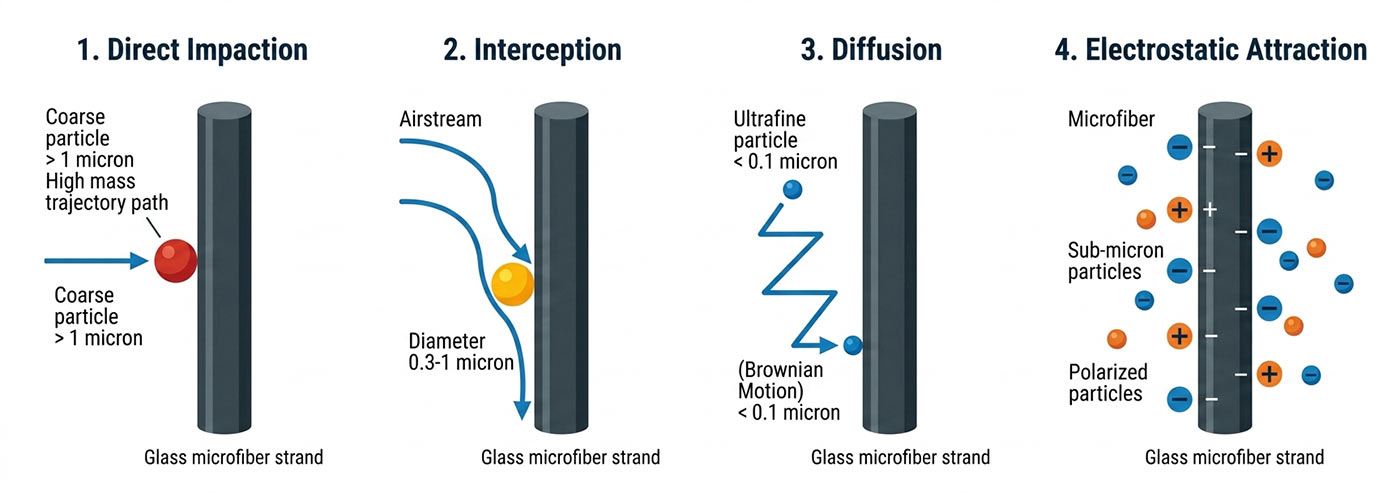
Unlike basic mesh screens, HEPA filter media consists of a dense, randomly arranged web of borosilicate micro glass fibers. As contaminated air moves through this matrix, four distinct physical mechanisms work simultaneously to trap particles of varying sizes.
Direct Impaction (Coarse Particles)
Target Particle Size: > 1.0 micron (e.g., pollens, coarse dust, mold spores)
How It Works: Due to high mass and momentum, large particles cannot adjust direction quickly when airflow swerves around the filter fibers. They travel along a straight trajectory, collide head-on with microfibers, and stick upon contact via surface adhesion forces.
Interception (Medium Particles)
Target Particle Size: 0.3 to 1.0 micron (e.g., fine industrial dust, smoke particles, pet dander)
How It Works: Medium-sized particles follow the airflow stream lines as air bends around the fibers. However, because a particle’s physical radius exceeds the distance between the airflow path and the microfiber surface, its outer edge brushes against the fiber and becomes permanently trapped.
Diffusion (Ultrafine Particles)
Target Particle Size: < 0.1 micron (e.g., viruses, combustion particulates, ultrafine aerosols)
How It Works: Sub-micron particles do not follow smooth air stream lines. Instead, they bump continuously into gas molecules, moving in an erratic zig-zag path known as Brownian motion. This random trajectory greatly increases their transit time through the fiber bed, maximizing the probability of striking a fiber.
Electrostatic Attraction (Supplemental Efficiency)
Target Particle Size: Variable sub-micron particulates
How It Works: Specialized synthetic media receive an electrostatic charge during manufacturing. This charge pulls oppositely charged or polarized particles toward the fiber web, boosting initial capture efficiency without increasing airflow resistance.
Understanding MPPS: Why 0.3 Microns is the Critical Standard
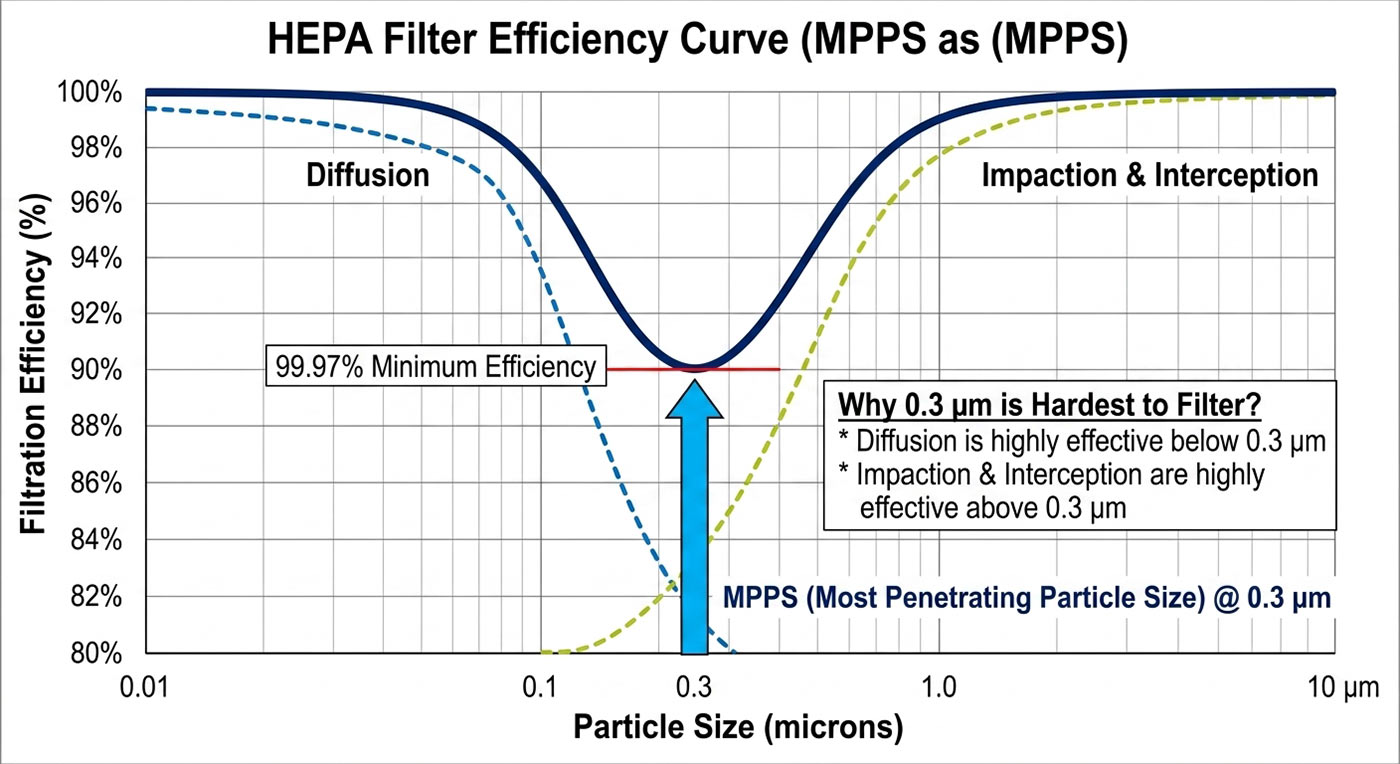
A common misconception in air filtration is that particles smaller than 0.3 microns are harder to capture. In particle physics, 0.3 microns represents the Most Penetrating Particle Size (MPPS).
Above 0.3 µm: Heavy mass makes impaction and interception highly effective.
Below 0.3 µm: Intense Brownian motion makes diffusion exceptionally efficient.
At 0.3 µm: The combined efficiency of diffusion, interception, and impaction reaches its lowest point.
Because 0.3 microns is the most difficult particle size to trap, international testing protocol standards use 0.3 µm as the benchmark baseline for HEPA certification.
How to Select the Right HEPA Filter for Industrial & Commercial Applications
Different operating environments require specific structural configurations to maintain proper air velocity, control pressure loss, and prevent air bypass.
| Application Environment | Performance Requirement | Recommended Filter Configuration |
| Pharmaceutical & Medical Cleanrooms | High cleanliness, uniform airflow, zero leak risk | Mini-pleat HEPA filters with gel seal or knife-edge frames for Fan Filter Units (FFUs) |
| Industrial Ventilation & Commercial HVAC | High dust loading, continuous heavy airflow | Deep-pleat aluminum separator HEPA filters or V-bank high-airflow units |
| Automotive Paint Spray Booths & High-Temp Facilities | Heat resistance, silicone-free execution | High-temperature HEPA filters with stainless steel frames and specialized sealant |
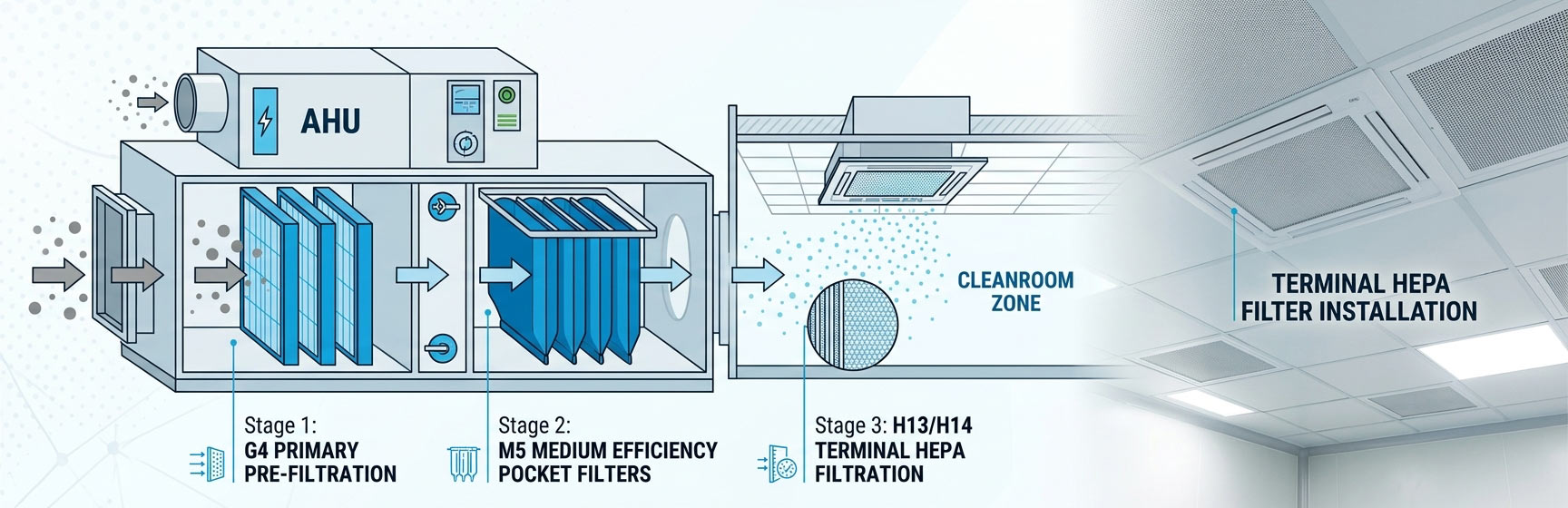
To minimize maintenance overhead and protect delicate high-efficiency media, industrial air systems rely on structured multi-stage pre-filtration upstream to optimize overall system performance and Total Cost of Ownership (TCO):
Stage 1 Primary Pre-Filtration (Coarse Dust Protection): Washable intake synthetic rolls or primary pleated panel filters capture coarse dust and large particulates (> 10 µm) right at the air intake, shielding downstream components from early clogging.
Stage 2 Secondary Medium Efficiency (Energy & Load Reduction): Nonwoven pocket filters trap intermediate particles (1.0–10 µm), absorbing up to 90% of bulk dust mass to maintain low initial pressure drop and reduce fan energy consumption.
Stage 3 Terminal HEPA Filtration (Sub-Micron Precision): High-efficiency mini-pleat or deep-pleat HEPA units focus strictly on sub-micron contaminants (down to 0.3 µm), extending element service life by up to 300% and minimizing costly cleanroom shutdown recertifications.
Designing an efficient, multi-stage air filtration system requires clear compatibility between pre-filters, medium-efficiency filters, and terminal HEPA units. To support HVAC contractors and OEMs in building low-resistance, long-life air handling systems, Chuqi New Materials provides comprehensive manufacturing support backed by over two decades of export expertise.
Direct Factory Manufacturing: We produce the full spectrum of air filtration components under one roof—from specialized roll media (including micro glass fiber paper, ceiling diffusion filters, and synthetic intake rolls) to finished pre-filters, pocket filters, and HEPA filter units.
Custom OEM/ODM Engineering: We support non-standard dimensions, flexible frame options (aluminum alloy, galvanized steel, stainless steel, or ABS plastic), custom pleat depths, gasket configurations, and efficiency grades from H10 to U17.
Strict Quality Control: Every finished HEPA element undergoes individual efficiency and scan testing to ensure zero bypass leaks and strict adherence to international EN 1822 parameters.
Global Supply Chain Support: Enjoy competitive direct-from-factory pricing, low MOQs, comprehensive technical datasheets, and reliable delivery for global B2B procurement.
Looking for factory-direct pricing, detailed technical datasheets, or custom dimensions for your filtration project? Contact our engineering sales team today to receive a tailored quotation within 24 hours.