
Compressed air purity is a critical operational parameter in high-precision manufacturing, pneumatic instrumentation, food and beverage processing, and pharmaceutical packaging. When ambient air is compressed by oil-lubricated or oil-free rotary screw and reciprocating compressors, it ingests atmospheric volatile organic compounds (VOCs), gaseous hydrocarbons, oil vapor aerosols, and residual odors.
In demanding industrial environments, standard coalescing filters and particulate separators are structurally incapable of capturing gas-phase molecular contaminants. Implementing specialized activated carbon adsorption stages is essential for meeting stringent air quality benchmarks such as ISO 8573-1 Class 1–2 hydrocarbon limits, protecting downstream pneumatic equipment, and preventing product contamination.
The Adsorption Physics of Hydrocarbon Vapor and VOC Removal
Unlike liquid aerosols or solid particulates that are intercepted via mechanical impaction, interception, or diffusion, gaseous VOCs and oil vapors require mass transfer through molecular adsorption.
Physical Adsorption via Van Der Waals Forces: Activated carbon media features an extensive internal microporous network (yielding specific surface areas exceeding 1,000 m2/g to 1,200 m2/g). Hydrocarbon molecules and VOC gases are drawn into these microscopic pores and held by physical intermolecular forces.
The Critical Role of Residence Time (Dwell Time): Adsorption kinetics depend directly on the contact duration between the compressed air stream and the carbon bed. Maintaining an optimal dwell time of 0.1 s to 0.2 s is mandatory to achieve complete mass transfer and prevent VOC breakthrough under fluctuating flow rates.
Managing Pressure Drop and Heat of Adsorption: High-pressure compressed air streams (typically 6 bar to 10 bar) alter adsorption dynamics. High-capacity carbon towers are engineered to maintain a stable initial pressure drop (150 Pa to 250 Pa), minimizing parasitic energy losses across the compressor network.
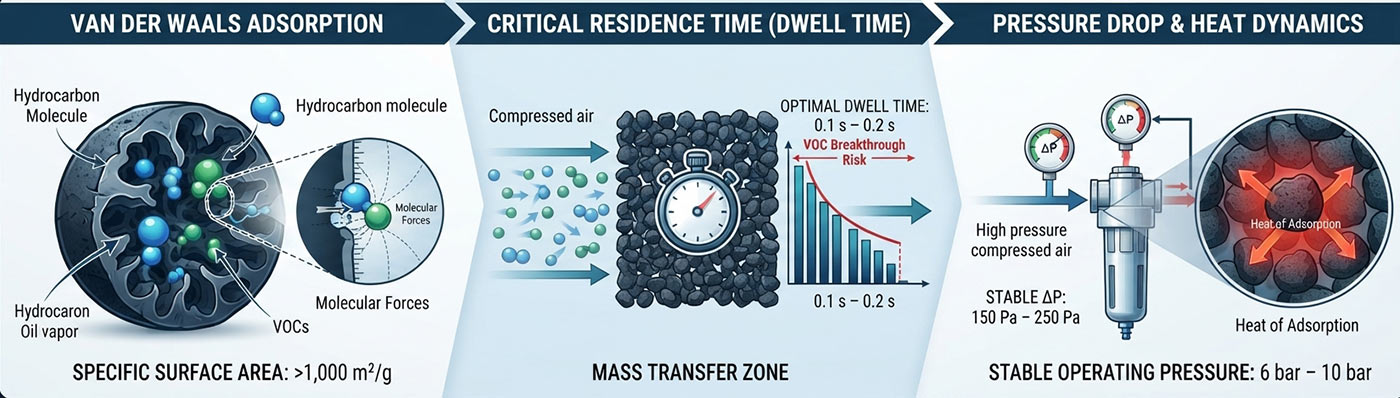
The Adsorption Physics of Hydrocarbon Vapor and VOC Removal
Industrial specifications rely on the ISO 8573-1 international standard to classify compressed air purity across solid particles, water, and oil content:
ISO 8573-1 Class 1: Imposes an ultra-strict total oil limit (including liquid, aerosol, and vapor) of <= 0.01 mg/m3. Achieving this grade requires deep-bed activated carbon or catalytic converters.
ISO 8573-1 Class 2: Permits a total oil threshold of <= 0.1 mg/m3, commonly managed via standard activated carbon adsorption cartridges paired with pre-filtration.
Protecting Critical Processes: Exceeding these limits in sensitive applications—such as semiconductor blow-off, pharmaceutical blister packaging, or medical breathing air—leads to catalyst poisoning, valve fouling, and regulatory non-compliance.
Side-by-Side Technical Specification Matrix: Carbon Adsorption vs. Alternative Technologies
| Performance Parameter | Activated Carbon Adsorption Filters | Catalytic Converter Systems | Refrigerant / Desiccant Dryers |
| Primary Contaminant Target | Gaseous VOCs, oil vapors, and organic odors | Carbon monoxide (CO) and heavy VOC oxidation | Moisture, water vapor, and liquid aerosols |
| Removal Mechanism | Molecular surface adsorption via micropores | Catalytic thermal oxidation into CO2 and H2O | Pressure swing adsorption (PSA) / condensation |
| Target ISO 8573-1 Oil Class | Class 1 to Class 2 (<= 0.01 to 0.1 mg/m3) | Class 1 (<0.003 mg/m3) | Ineffective for gas-phase VOC vapors |
| Typical Media Lifespan | 4,000 to 8,000 operating hours | 20,000+ operating hours (catalyst bed) | Regenerative desiccant towers (3 to 5 years) |
| Initial Pressure Drop | 150 Pa – 250 Pa | 300 Pa – 500 Pa | 100 Pa – 300 Pa |
Specifying High-Purity Compressed Air Filtration
To guarantee absolute compliance with international purity standards and protect pneumatic infrastructure from molecular contamination, deploying engineered carbon adsorption media is indispensable.
For high-capacity industrial compressed air purification:[Explore Industrial Activated Carbon Adsorption Housings and Cartridges]
To review primary filtration media and pre-filters: [Browse Air Intake and Pre-Filtration Media Catalog]
For foundational insights into structural VOC control frameworks: [How Do Industrial Activated Carbon Filters and V-Bank Systems Maximize VOC Removal?]