
In commercial and industrial HVAC engineering, selecting gas-phase air filtration media often presents a technical dilemma for procurement officers and system designers:
“How do we balance high VOC removal efficiency with low system static pressure?”
“Why do two carbon media rolls with identical weight specs exhibit a 300% difference in active lifespan?”
“How can we technically verify that we are purchasing true active carbon media rather than carbon-dyed synthetic fiber?”
As air quality regulations tighten globally, relying on superficial visual checks for filter media is no longer viable. This technical guide provides a deep dive into the thermodynamics, manufacturing characteristics, performance benchmarks, and quality verification protocols for Activated Carbon Filter Media —helping B2B buyers optimize their supply chain and product performance.
Technical Fundamentals: How Activated Carbon Media Operates
Activated carbon filter media is a engineered composite material consisting of a synthetic non-woven fibrous matrix (typically PET or PP) impregnated or thermally bonded with granular/powdered activated carbon (GAC/PAC).
Unlike mechanical filters that rely on inertial impaction, interception, and diffusion to catch solid particles, carbon media operates via Dual-Mechanism Filtration:
Technical Fundamentals: How Activated Carbon Media Operates
Activated carbon filter media is an engineered composite material consisting of a synthetic non-woven fibrous matrix (typically PET or PP) impregnated or thermally bonded with granular/powdered activated carbon (GAC/PAC).
Unlike mechanical filters that rely on inertial impaction, interception, and diffusion to catch solid particles, carbon media operates via Dual-Mechanism Filtration:
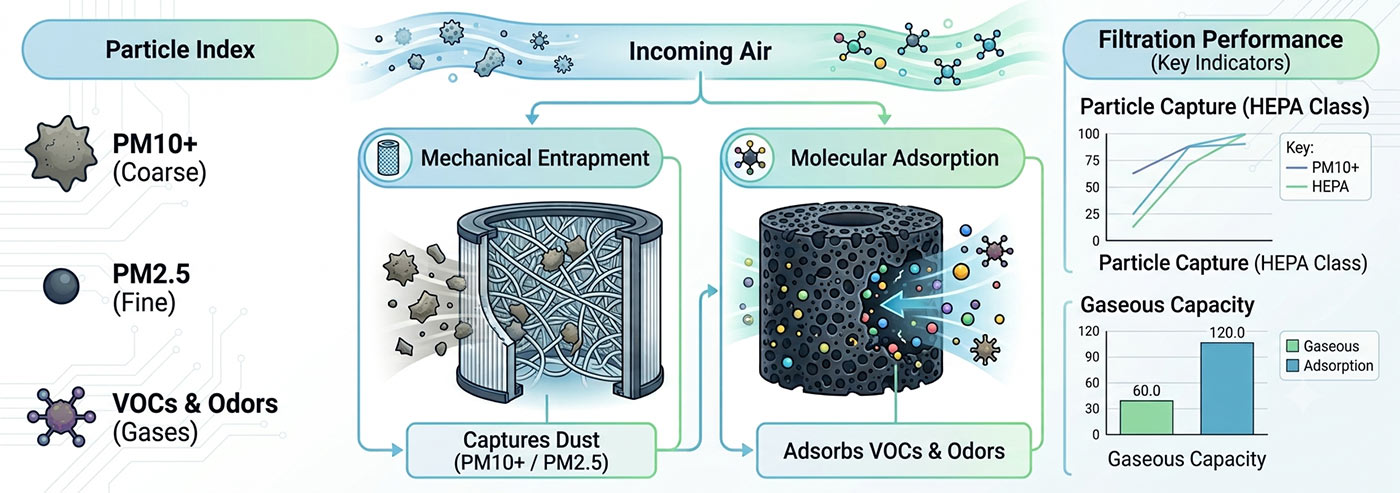
The Physics of Adsorption: Van der Waals Forces
The core performance of activated carbon relies on Physisorption (Physical Adsorption) within an extensive internal micropore network:
Specific Surface Area: Premium activated carbon provides an internal surface area ranging from 800 m²/g to over 1300 m²/g.
Pore Size Distribution:
Micropores (< 2 nm): Primary sites for capturing small VOC molecules (e.g., Benzene, Formaldehyde).
Mesopores (2 – 50 nm): Transportation channels for larger organic vapors.
Macropores (> 50 nm): Outer entry pathways.
Key Performance Metrics B2B Buyers Must Evaluate
When evaluating technical datasheets (TDS) or requesting laboratory test reports, focus on these critical performance benchmarks:
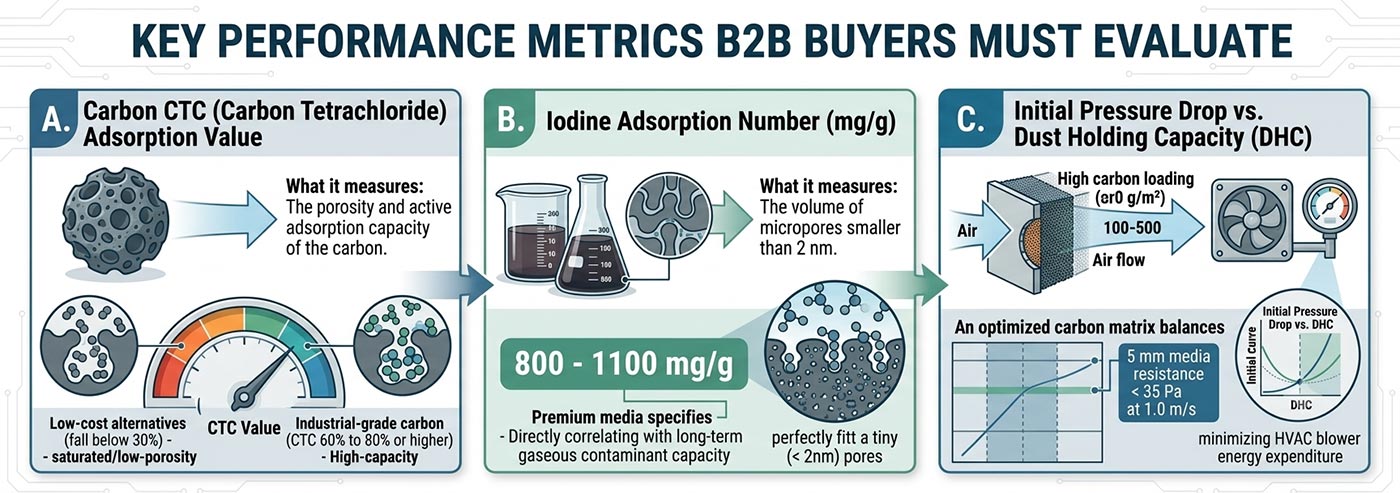
A. Carbon CTC (Carbon Tetrachloride) Adsorption Value
What it measures: The porosity and active adsorption capacity of the carbon.
Standard Benchmark: Industrial-grade carbon media should feature a CTC value of 60% to 80% or higher. Low-cost alternatives often fall below 30%, indicating saturated or low-porosity carbon.
B. Iodine Adsorption Number (mg/g)
What it measures: The volume of micropores smaller than 2 nm.
Standard Benchmark: Premium media specifies an Iodine value of 800 – 1100 mg/g, directly correlating with long-term gaseous contaminant capacity.
C. Initial Pressure Drop vs. Dust Holding Capacity (DHC)
An optimized carbon matrix balances high carbon loading (100 – 500 g/m²) with high air permeability. A standard 5 mm media should maintain an initial resistance of < 35 Pa at a face velocity of 1.0 m/s, minimizing HVAC blower energy expenditure.
Engineering Analysis: Premium vs. Substandard Carbon Media
To prevent field failures, warranty claims, and downstream contamination, buyers must understand the structural and chemical differences between genuine carbon media and inferior substitutes.
| Technical Parameter | High-Performance Carbon Filter Media | Low-Grade / Substandard Media |
| Carbon Source & Purity | Virgin coconut shell or high-grade coal carbon; High CTC (≥ 60%) | Recycled carbon powder, coal ash blend, or carbon-dyed synthetic dye |
| Bonding Technology | Thermal bonding / Hot-melt polymer matrix (Zero Powder Shedding) | Liquid glue spraying (clogs carbon micropores, drastically reducing CTC) |
| Pore Integrity | 90%+ open pore structure available for chemical capture | Micropores blinded by excess adhesive binders |
| Air Resistance Uniformity | Precision-carded fiber web ensures consistent pressure drop | Variable fiber density creating airflow channeling & bypass |
| Humidity Resistance | Synthetic hydrophobic matrix; structural stability up to 90% RH | Hydrophilic binders soften, causing media sag and collapse in humid HVAC ducts |
The Risk of “Blinded Micropores”
The most common defect in low-cost carbon media is adhesive blinding. When low-tier factories spray cheap liquid adhesives to bond carbon powder to non-woven fibers, the liquid glue seeps into the carbon’s micropores via capillary action.
Result: Even if the raw carbon had an Iodine value of 900 mg/g, the finished media loses up to 70% of its actual adsorption capacity, rendering it functionally useless for VOC removal.
Primary Commercial & Industrial Applications
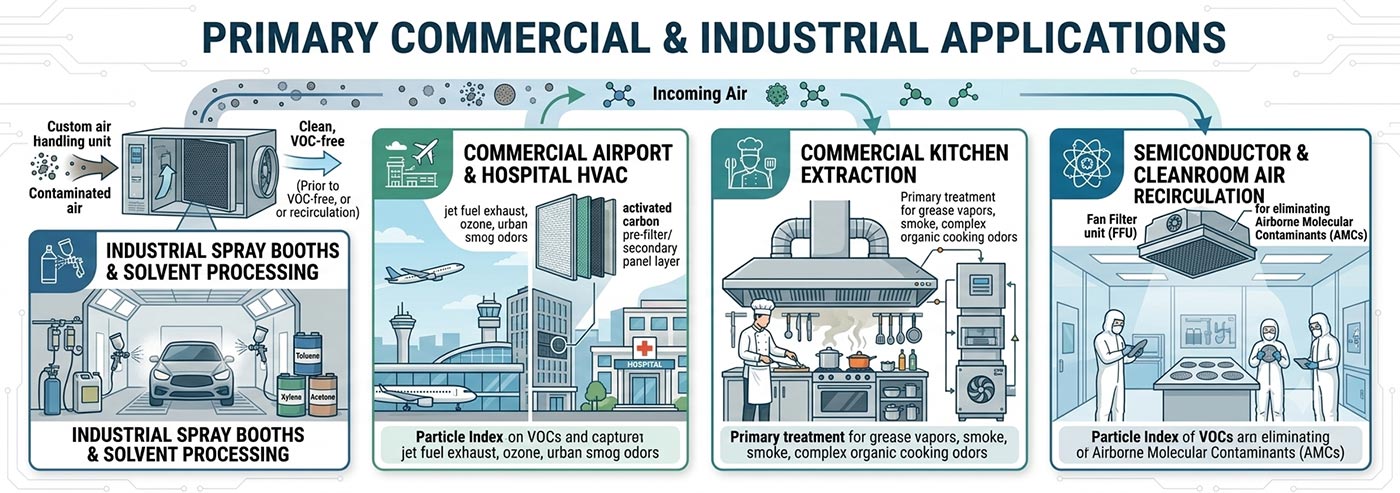
Because of its dual particulate/gas-phase capabilities, activated carbon media is widely integrated into custom HVAC and OEM filtration systems:
Industrial Spray Booths & Solvent Processing: Filtering Volatile Organic Compounds (VOCs) such as Toluene, Xylene, and Acetone prior to exhaust or recirculation.
Commercial Airport & Hospital HVAC (MERV 8 – MERV 13 Systems): Serving as a pre-filter or secondary panel layer to remove jet fuel exhaust, ozone, and urban smog odors.
Commercial Kitchen Extraction: Primary treatment for grease vapors, smoke, and complex organic cooking odors.
Semiconductor & Cleanroom Air Recirculation: Eliminating Airborne Molecular Contaminants (AMCs) that damage sensitive silicon wafer fabrication.
Step-by-Step B2B Procurement Protocol & QC Testing
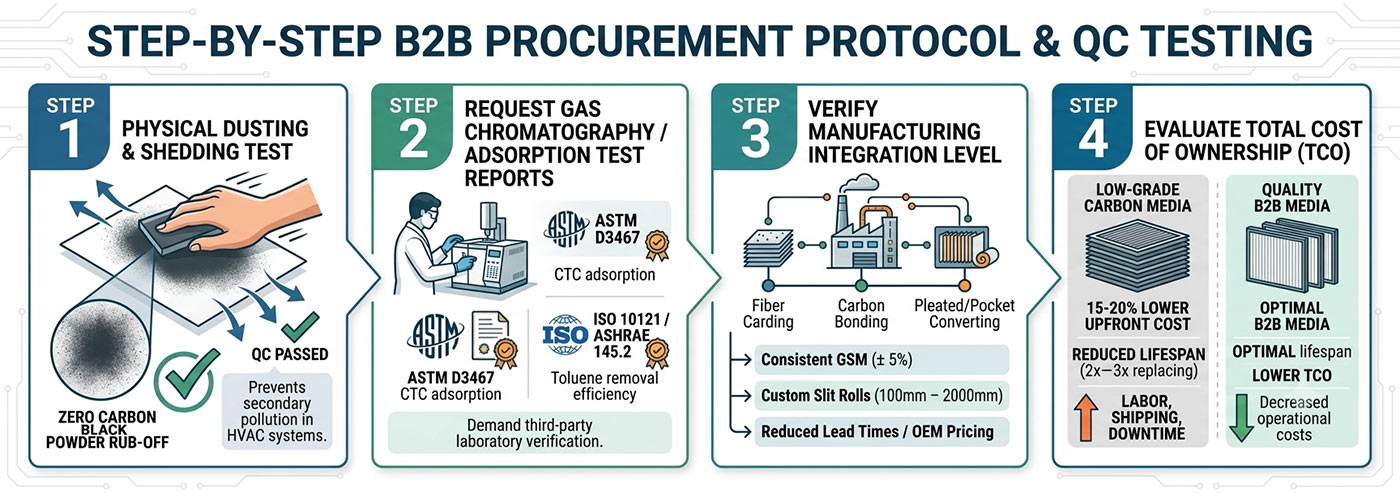
When sourcing bulk rolls or die-cut pads, implement this 4-step quality verification process prior to issuance of Purchase Orders (POs):
Step 1: Physical “Dusting & Shedding” Test
Rub the media surface vigorously over a white sheet of paper. Zero carbon black powder should rub off. Powder shedding in an operational HVAC system releases carbon particulates into cleanrooms or client offices, causing secondary pollution.
Step 2: Request Gas Chromatography / Adsorption Test Reports
Demand third-party laboratory verification for CTC adsorption (ASTM D3467) or Toluene removal efficiency (ISO 10121 / ASHRAE 145.2).
Step 3: Verify the Manufacturing Integration Level
Work with vertically integrated suppliers who manage production from base fiber carding and carbon bonding to final pleated/pocket filter converting. Integrated control guarantees:
Consistent GSM (Grams per Square Meter) tolerance within ± 5%.
Custom width slit rolls (100 mm – 2000 mm) tailored to your converting machinery.
Reduced lead times and factory-direct OEM pricing.
Step 4: Evaluate Total Cost of Ownership (TCO)
While low-grade carbon media may carry a 15–20% lower upfront roll cost, its reduced active lifespan requires 2x to 3x more frequent filter replacements, increasing labor, shipping, and downtime costs for the end user.
Partnering with CHUQI New Materials
With over 20 years of dedicated manufacturing experience in industrial air filtration materials, CHUQI New Materials engineered advanced thermal-bonding technologies to deliver high-CTC, zero-shedding activated carbon media to global OEM/ODM clients.
Whether you require bulk media rolls, custom die-cut pads, or finished pleated/pocket carbon filters, our engineering team ensures full batch consistency and rigorous laboratory testing.
 Need technical datasheets, custom GSM samples, or an RFQ comparison?
Contact CHUQI Technical Engineering Team or email us directly at chuqifilter@chuqimat.com for rapid technical response within 24 hours.