
In modern cleanroom engineering, HVAC design, and industrial contamination control, achieving ultra-clean air quality while controlling total energy consumption is a top operational challenge. Selecting the right mini-pleat HEPA filter directly impacts system air velocity, operational stability, and long-term energy costs.
Whether you are replacing filters in Fan Filter Units (FFU), optimizing pharmaceutical cleanrooms, or sourcing high efficiency air filter units for microelectronics production, understanding mini-pleat technology is essential for making informed procurement decisions.
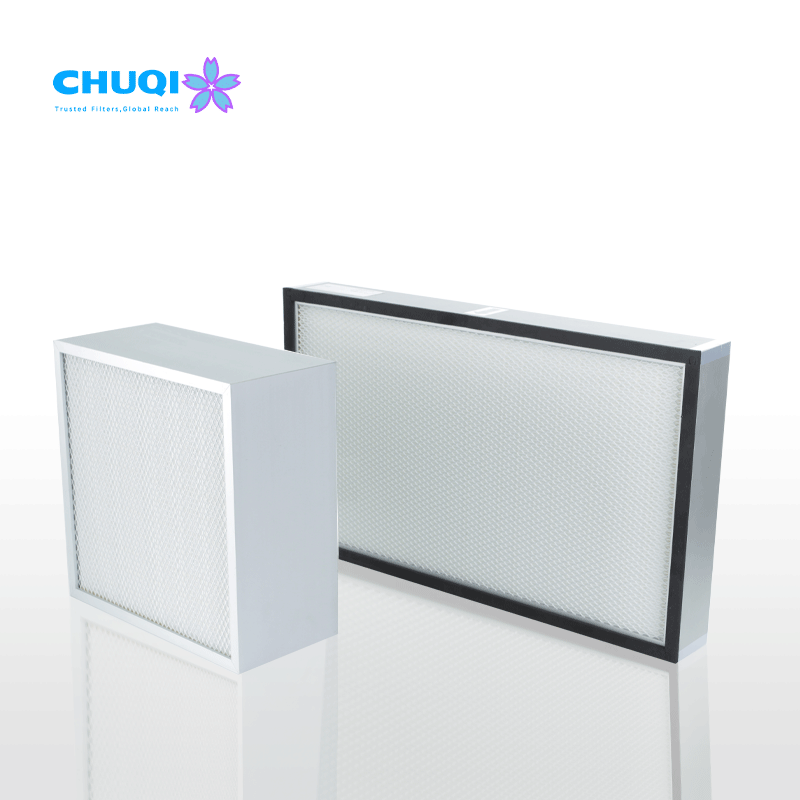
A mini-pleat HEPA filter is a compact, high-efficiency air filtration element that utilizes densely pleated glass fiber media separated by continuous, precise beads of hot-melt adhesive instead of traditional corrugated aluminum or paper separators. Designed to trap at least 99.97% (H13) to 99.995% (H14) of airborne particles as small as 0.3 microns, it represents the modern standard for terminal air filtration.
Standard Specification & Parameter Table
| Dimension (mm) | Rated Air Flow (m³/h) | Initial Resistance | Efficiency (Class) | Filter Media |
| 610 × 610 × 69 | 600–1000 | ≤ 220 Pa | 95%–99.99995% | Fiberglass |
| 760 × 610 × 69 | 800–1200 | ≤ 220 Pa | 95%–99.99995% | Fiberglass |
| 915 × 610 × 69 | 1000/1500 | ≤ 220 Pa | 95%–99.99995% | Fiberglass |
| 1170 × 570 × 69 | 1100/1800 | ≤ 220 Pa | 95%–99.99995% | Fiberglass |
| 1220 × 610 × 69 | 1200/2000 | ≤ 220 Pa | 95%–99.99995% | Fiberglass |
Key Technical Features
Ultra-fine Fiberglass Media & Comprehensive Efficiency Options: Constructed with high-grade micro-glass fiber paper, offering versatile filtration classes from H10 to U16 to meet demanding cleanroom and industrial requirements.
Precision Particle Capture Efficiency: Engineered to deliver high-efficiency performance, covering 95% @ 0.3μm, 99% @ 0.3μm, 99.9% @ 0.3μm, 99.99% @ 0.3μm, 99.999% @ 0.3μm, up to 99.9995% @ 0.12μm and 99.99995% @ 0.12μm.
Reliable Operating Parameters: Designed for stable, continuous performance under standard industrial conditions with a maximum operating temperature of 80°C and maximum relative humidity of 80% RH.
How Mini-Pleat Technology Works
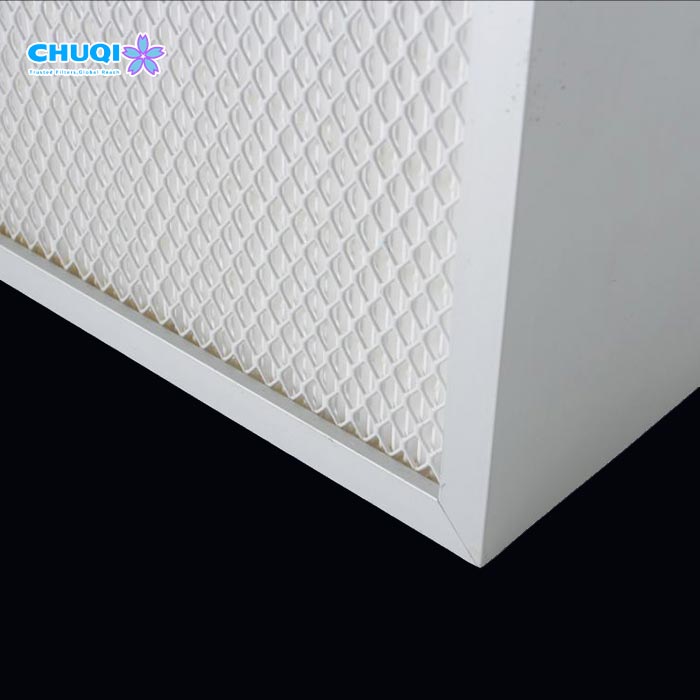
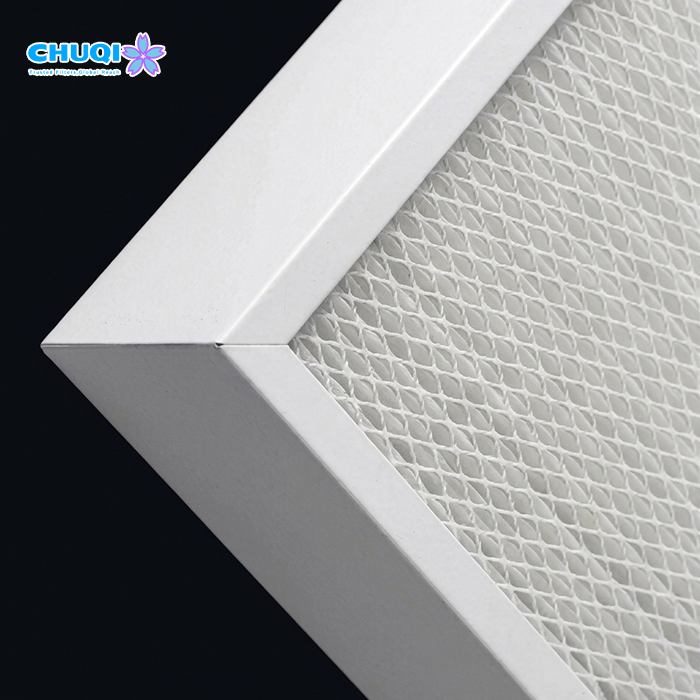
Unlike deep-pleat separator filters that rely on rigid aluminum dividers, a mini-pleat HEPA filter folds high-grade micro-glass fiber filter paper into shallow, tightly packed pleats (typically 20mm to 50mm in pleat depth). Thermoplastic hot-melt glue beads act as uniform spacers. This creates an uninterrupted, rigid media pack with uniform airflow channels and zero metal-to-media friction.
Key structural components engineered by a professional HEPA filter manufacturer include:
Filter Media: Ultra-fine, water-resistant fiberglass filter paper providing physical particle interception and inertial impaction.
Pleat Separators: Environmental hot-melt adhesive lines maintaining 3mm-5mm pleat spacing for optimal laminar airflow.
Frame Materials: Lightweight anodized aluminum alloy, stainless steel, or galvanized steel frame for corrosion resistance and structural rigidity.
Sealing System: Polyurethane sealant potting around the entire frame perimeter combined with continuous gel-seal or seamless EPDM gaskets to eliminate bypass leakage.
When evaluated against conventional deep-pleat aluminum separator filters, the mini-pleat design offers distinct technical and economic advantages:
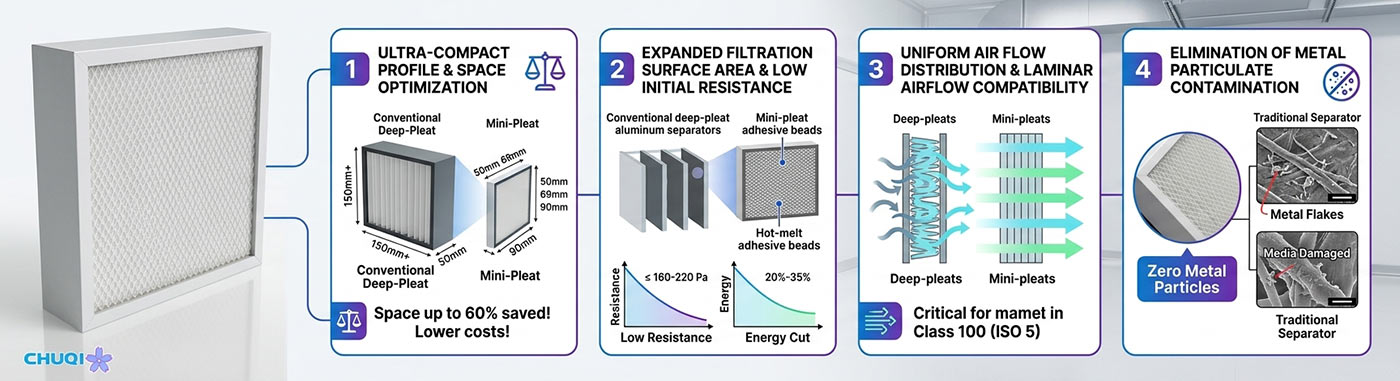
Ultra-Compact Profile & Space Optimization
Frame depths for mini-pleat filters typically range from 50mm, 69mm, to 90mm, compared to 150mm-292mm for traditional separator HEPA filters. The popular 610x610x69 HEPA filter configuration reduces spatial requirements by up to 60%, allowing cleanroom designers to minimize ceiling plenum height and lower overall facility construction costs.
Expanded Filtration Surface Area & Low Initial Resistance
By eliminating bulky aluminum separators, the mini-pleat structure packs up to 1.5 to 2 times more filter media surface area into the same face dimensions. More media area drastically reduces face velocity across the paper, resulting in a low pressure drop HEPA filter design (initial resistance often <= 160-220 Pa at rated airflow). This low resistance cuts HVAC fan energy consumption by 20%-35% annually.
Uniform Air Flow Distribution & Laminar Airflow Compatibility
The precise 3D arrangement of hot-melt glue beads prevents pleat collapse and media bunching. Air flows evenly across the entire face of the filter, delivering consistent unidirectional (laminar) airflow. This is critical for preventing turbulence and micro-particle re-entrainment in Class 100 (ISO 5) cleanrooms.
Elimination of Metal Particulate Contamination
In high-vibration environments, traditional aluminum separators can rub against fragile fiberglass media, causing fiber damage or shedding microscopic metal flakes. Mini-pleat construction removes metal separators entirely, guaranteeing zero metallic particle generation – a non-negotiable requirement in semiconductor and sterile pharmaceutical processing.
Mini-Pleat vs. Deep-Pleat Separator HEPA Filter
| Performance Parameter | Mini-Pleat HEPA Filter | Deep-Pleat Separator Filter | B2B Operational Benefit |
| Frame Depth Range | 50mm / 69mm / 90mm | 150mm / 220mm / 292mm | Saves up to 60% ceiling space; lowers building costs. |
| Initial Pressure Drop | Low (160 – 220 Pa) | Moderate to High (220 – 280 Pa) | Significantly reduces AHU/FFU fan energy consumption. |
| Effective Media Area | High (Dense mini-pleat geometry) | Moderate (Occupied by separators) | Higher dust holding capacity per unit volume. |
| Weight & Installation | Lightweight (Single-person handling) | Heavy (Requires dual installers) | Reduces installation labor time and ceiling grid stress. |
| Airflow Uniformity | Superior (Laminar flow compatible) | Good (Minor air channel turbulence) | Ensures consistent particle removal across clean zones. |
Due to their compact footprint, zero particle shedding, and energy-efficient design, industrial HEPA filter mini-pleat models are the primary choice across several demanding sectors:
Cleanroom Ceiling Grids & Fan Filter Units (FFU): In modular cleanrooms, FFUs require thin, high-capacity filters. The 610x610x69 HEPA filter and 1170x570x69mm sizes fit directly onto FFU aluminum grids without overloading structural ceiling supports.
Semiconductor & Microelectronics Fabrication: Chip manufacturing requires ISO Class 1 to Class 5 environments. H14 efficiency air filter mini-pleat units deliver strict sub-micron particle retention without metallic interference, protecting wafer yields.
Pharmaceutical & Bio-Cleanroom Environments: Sterile filling lines and GMP-compliant pharmaceutical suites utilize gel-sealed terminal HEPA filters to maintain sterile laminar boundary layers, ensuring 100% airtight sealing during PAO/DOP leak testing.
Laminar Flow Benches, Biosafety Cabinets & Clean Booths: Compact laboratory equipment relies on mini-pleat filters to provide uniform, turbulence-free protective air barriers in confined cabinet housings.
High-Efficiency HVAC & Pre-Filtration Upgrade Systems: When upgrading existing air handling units (AHU) to achieve higher air cleanliness without replacing fan units, engineers pair mini-pleat terminal filters with high-capacity secondary stages such as V-bank air filters or pocket filter media air handlers to optimize total system pressure drop.
Maintenance Cycles & Replacement Strategy
Implementing a proactive maintenance and replacement schedule ensures continuous compliance with ISO 14644 cleanroom standards while preventing unnecessary operational downtime.
Recommended Replacement Timeline by Application:
Standard Cleanrooms & FFUs (ISO Class 5-8): 24 to 36 months (when pre-filters are routinely maintained).
Pharmaceutical & Biological Safety Suites: 12 to 24 months (subject to annual PAO leak test certification).
Electronics & Semiconductor Clean Benches: 24 to 48 months under controlled ambient pre-filtration.
Key Indicators for Replacing Your Mini-Pleat HEPA Filter:
Final Differential Pressure Limit Reached: When operating resistance reaches 2 times the initial pressure drop (typically 400 Pa – 450 Pa), fan energy spikes, and the filter should be replaced.
Face Velocity Drop Below Target: If airflow velocity drops below required thresholds (e.g., < 0.35 m/s in laminar flow hoods) despite fan speed adjustment.
PAO/DOP Leak Detection Failure: Structural media damage or sealant degradation detected during aerosol integrity testing.
Pro Maintenance Tip: Protect your terminal HEPA filters with robust multi-stage pre-filtration. Utilizing primary G4 roll media alongside intermediate pocket filter media or F7/F8 V-bank air filters captures 85%+ of coarse dust before it reaches the HEPA stage – extending expensive HEPA filter service life by up to 200%.
As an experienced B2B source factory with over 20 years of manufacturing expertise, Chuqi New Materials controls the complete quality pipeline – from raw air filter media roll production to fully assembled custom HEPA filter wholesale solutions. Our mini-pleat HEPA filters feature precision hot-melt pleating, anodized aluminum framing, and 100% factory scan testing (EN 1822 / ISO 29463 compliance).
Looking for reliable terminal HEPA filter supplies or custom cleanroom solutions? Contact our engineering team today to request factory-direct pricing, custom dimension manufacturing, and technical datasheets.