
Why can an air filter capture a large amount of dust yet still allow fine particles to pass through?
The answer lies in how particles interact with the fibers inside the filter media. Air intake filter media does not capture every particle size with the same efficiency. Its performance depends on particle size, fiber structure and airflow conditions.
For industrial ventilation systems, HVAC pre-filters and air intake applications, understanding this relationship helps explain why a filter roll may perform well in one application but fail to address a fine-dust problem in another.
This guide explains how particle size affects dust capture, what filtration efficiency percentages actually mean, and how to choose intake filter media for your application.
1. Why Particle Size Matters in Air Filtration
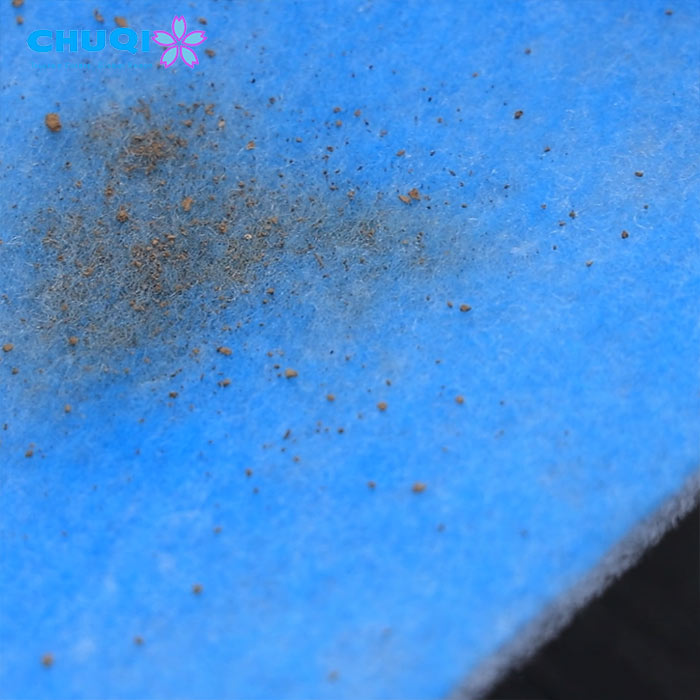
Dust is not made up of particles of one uniform size. Air entering an industrial facility may contain larger dust particles, smaller airborne particles and a mixture of contaminants from different processes.
These particles do not behave identically as they travel through filter media.
Larger particles may be captured through inertial impaction, while smaller particles can reach fibers through interception and diffusion. The contribution of each mechanism changes with particle size and operating conditions.
This is why a filter’s overall dust-capture percentage does not necessarily describe its performance against every particle size.
For example, a filter that retains a high proportion of the total dust mass may still allow a meaningful number of smaller particles to pass through. Whether that matters depends on the purpose of the filtration stage and the requirements of the equipment downstream.
The important distinction is between capturing dust in general and achieving the required removal efficiency for a particular particle-size range.
2. How Does Filter Media Capture Different Particle Sizes?
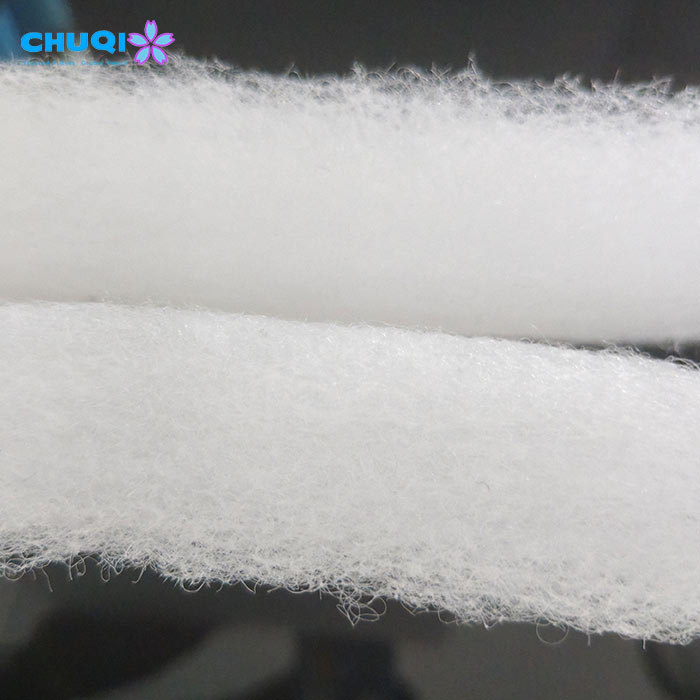
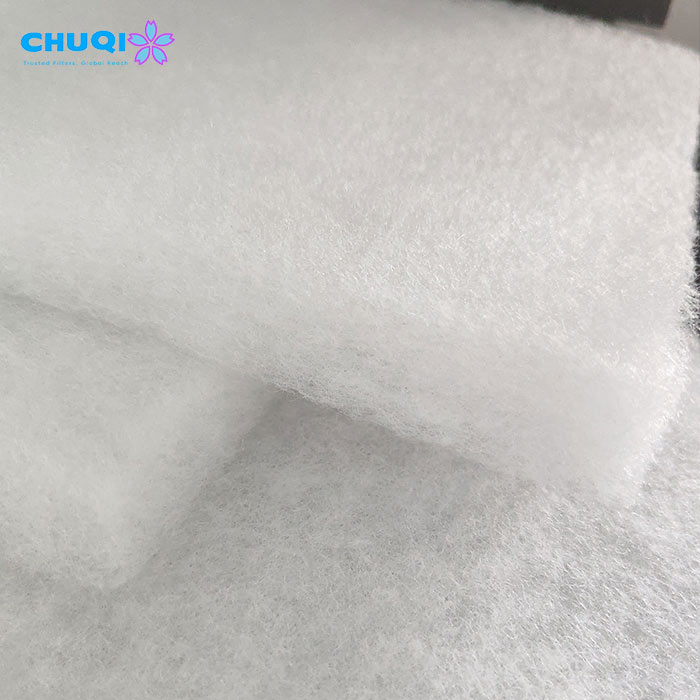
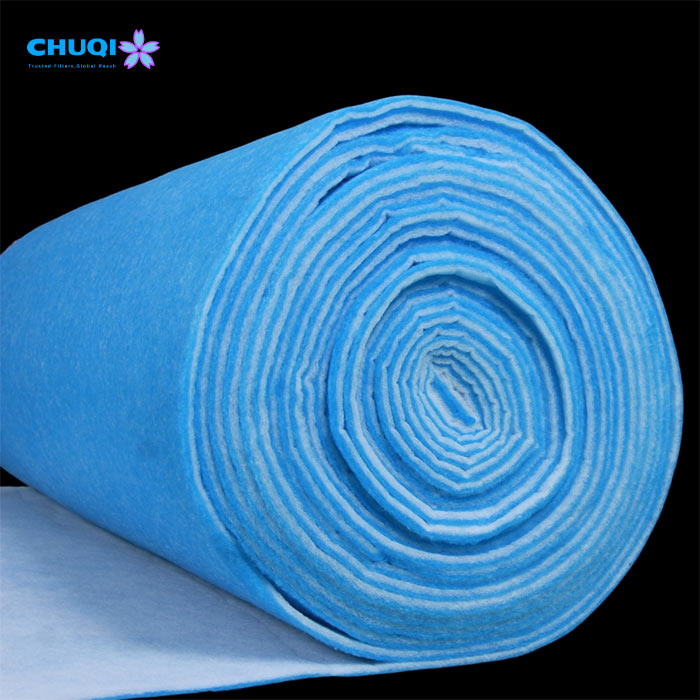
Synthetic air filter media typically uses a network of fibers to capture particles as air passes through it. Three mechanisms help explain how this works.
Inertial impaction: When particles cannot follow the airflow
As air moves around a fiber, its direction changes. Some particles have sufficient inertia that they cannot follow the airflow around the fiber and instead collide with its surface.
Particle size, density and airflow conditions influence this process. Larger particles often experience stronger inertial effects than smaller particles under otherwise comparable conditions.
Interception: When a particle passes close enough to a fiber
A particle may follow the airflow around a fiber but still touch its surface if its path passes sufficiently close to the fiber.
The particle does not need to be larger than the gap between fibers to be captured. Its diameter and the distance between its path and the fiber both matter.
Diffusion: How very small particles reach fibers
Very small particles undergo random motion due to interactions with surrounding gas molecules. This movement can bring them into contact with fibers even when the airflow carries them around the filter.
Diffusion helps explain why smaller particles are not always more difficult to capture than larger ones.
Together, these mechanisms explain why filtration efficiency varies with particle size. However, they do not establish the actual efficiency of a particular filter roll. That depends on its construction and operating conditions.
3. Does an Air Filter Roll Have a Fixed Micron Rating?
Not necessarily.
Unlike a simple sieve, fibrous filter media does not have one absolute opening size that determines which particles can pass through. Particles smaller than the apparent spaces between fibers may still be captured through interception and diffusion.
Consider a product description that says:
“Filters down to 5 microns.”
This sounds specific, but it does not tell you how efficiently particles around 5 µm are removed.
Does the filter capture some of these particles, most of them or nearly all of them? The micron description alone cannot answer that question.
For this reason, a nominal micron rating should not automatically be interpreted as a guaranteed particle-removal threshold.
When selecting intake filter media for a process with a defined particle-size requirement, the useful information is the filter’s efficiency over the relevant particle-size range, measured using an appropriate method.

4. What Does a Filtration Efficiency Percentage Really Mean?
A percentage becomes meaningful when you understand what is being measured.
Particle-count efficiency and dust-mass capture are two different ways to describe filtration performance.
Particle-count efficiency measures the proportion of particles removed within a specified size interval.
Dust-mass capture measures how much of the test-dust mass the filter retains under the specified test conditions.
These measurements answer different questions, so their results should not be treated as interchangeable.
A simple example of particle-count efficiency
Suppose a filter is tested for particles within one defined size interval.
| Measurement | Result |
|---|---|
| Particle concentration before filtration | 1,000 |
| Particle concentration after filtration | 300 |
| Particles removed | 700 |
| Calculated efficiency | 70% |
The calculation is:
Efficiency (%) = [1 − (Downstream concentration ÷ Upstream concentration)] × 100
In this example, the efficiency is 70%.
These figures are illustrative only and are not measured performance data for a Chuqi product. The result applies to the specified particle-size interval and test conditions, not to every particle in the air.
Why high dust-mass capture does not always mean high fine-particle efficiency
For spherical particles of equal density, mass increases with the cube of particle diameter.
One 10 µm particle therefore has approximately the same mass as 1,000 particles measuring 1 µm each.
This means that larger particles can contribute substantially to the total dust mass even when smaller particles are much more numerous.
Consequently, a high dust-mass capture result does not, by itself, prove that a filter achieves high removal efficiency for fine particles.
This distinction is particularly useful when comparing filter rolls advertised with similar efficiency percentages. The measurement basis matters just as much as the percentage itself.
5. G1, G2, G3 and G4: Do These Grades Tell You the Particle Size?
Traditional G1–G4 filter grades belong to the EN 779 classification system. They describe filter performance within that classification framework, but they do not represent absolute micron cut-offs.
For example, a G4 designation should not be interpreted as meaning that every particle above a specific diameter is removed and every smaller particle passes through.
ISO 16890 uses a different classification framework based on particulate matter categories, including ePM10, ePM2.5 and ePM1 where applicable.
These classifications should not be treated as directly interchangeable with traditional EN 779 grades or as single-particle-size efficiency readings.
For a broader explanation of the differences between traditional filter grades, read our related guide: G1 vs. G2 vs. G3 vs. G4 Filter Media: Efficiency and Key Differences.
The key point for filter buyers is simple: a grade helps describe filtration performance, but the suitability of a filter roll depends on the application and the performance required from that filtration stage.
6. Fine Dust Is Getting Through the Filter. What Could Be Wrong?
If fine dust appears downstream of an intake filter, replacing the media immediately may not solve the problem.
There are two important possibilities to consider: particles may be passing through the media, or air may be bypassing the media entirely.
Possibility 1: Air is bypassing the filter
Gaps around the frame, damaged media, displaced edges or poor installation can allow unfiltered air to pass through the system.
In this situation, even a higher-efficiency filter may fail to deliver the expected result because part of the airflow never passes through the media.
Inspecting the installed filter and its perimeter is therefore a useful first step.
Possibility 2: The media is not capturing enough of the particles
If the filter is installed correctly, the next question is whether its filtration performance matches the application.
A coarse pre-filter is often used to capture larger airborne contaminants and protect downstream filtration stages. It should not automatically be expected to provide the same fine-particle removal as a more specialized filtration stage.
If the process requires greater fine-particle removal, a different media specification or an additional downstream filter may be more appropriate.
Why a thicker filter roll may not solve the problem
Thickness is one aspect of filter media construction, but it does not independently determine particle-size efficiency.
Fiber diameter, fiber arrangement, porosity and other structural characteristics also influence particle capture and airflow resistance.
Two filter rolls with the same thickness can therefore have different performance. Increasing thickness alone is not a reliable way to resolve fine-dust penetration.
The better approach is to understand whether the problem comes from installation bypass, the media’s capture performance or the requirements of the overall filtration system.
7. How to Choose Intake Filter Media for Your Application
Choosing the right air intake filter media roll starts with understanding what the filtration stage needs to accomplish.
For general industrial ventilation and HVAC pre-filtration, factors such as dust loading, airflow resistance, service life and installation fit all contribute to the choice.
Where fine-particle removal is important, particle-size efficiency becomes an additional consideration.
Airflow conditions also matter. The same media may behave differently at different face velocities, affecting both filtration performance and pressure drop.
For flat media, average face velocity can be calculated as:
Face velocity (m/s) = Airflow (m³/h) ÷ [3,600 × Exposed filter area (m²)]
For example, an airflow of 3,600 m³/h through an exposed filter area of 1 m² gives an average face velocity of 1 m/s.
This is an illustrative calculation, not a recommended operating velocity for every filter roll.
The practical goal is to select media that balances the required particle capture with suitable airflow resistance and service life. The highest headline efficiency is not automatically the best choice for every pre-filtration application.
8. Find the Right Intake Filter Media for Your Application
Understanding particle-size efficiency makes it easier to distinguish between a filter that captures dust effectively and one that meets a specific fine-particle removal requirement.
Chuqi New Materials supplies air filtration media and filter products for industrial and HVAC applications. Our intake filter media range supports applications where media construction, filtration performance and operating conditions all matter.
If you are replacing an existing filter roll or looking for media suited to a particular ventilation application, explore our intake filter media products to learn more about the available options.
Looking for a suitable filter media roll? Contact our team to discuss your application and explore the options available for your filtration requirements.
Frequently Asked Questions
Q1. Does G4 filter media remove all particles above a certain size?
No. A traditional G4 designation is not an absolute micron cut-off. Actual particle capture varies with the media and test conditions.
Q2. Can coarse intake filter media capture fine particles?
Yes. Fibrous filter media can capture fine particles through mechanisms such as diffusion and interception. However, capturing some fine particles does not guarantee the removal efficiency required by a particular application.
Q3. Does a higher dust-capture percentage mean better fine-particle filtration?
Not necessarily. A mass-based dust-capture result and a particle-count efficiency result describe different aspects of filtration. To understand fine-particle performance, the relevant particle-size range and measurement method matter.
Q4. Will a thicker filter roll improve filtration efficiency?
Not automatically. Thickness is only one aspect of media construction. Fiber characteristics, porosity and airflow conditions also affect filtration performance and pressure drop.
Q5. What should I consider when choosing an intake filter media roll?
Start with the application, the type of dust being captured, the required filtration performance, airflow conditions, pressure drop and installation requirements. For applications with a defined fine-particle target, relevant particle-size efficiency data is particularly useful.