
To choose intake filter media, start with the required filtration grade, calculate face velocity from airflow and effective filter area, and then compare initial resistance at comparable test conditions. A lower pressure-drop figure alone does not mean a material is more suitable.
For example, Chuqi’s product data lists two G4 media options with initial resistance values of 25 Pa and 20 Pa at 1.5 m/s. It also lists two white G4 media thicknesses with the same initial resistance of 25 Pa at that velocity. These comparisons show why buyers should evaluate filtration grade, test conditions and material specifications together.
This guide explains how to calculate face velocity, compare initial resistance and select intake filter media for industrial air intake and HVAC pre-filtration applications.
If you need a basic introduction first, read our guide to what intake filter media is and where it is used.
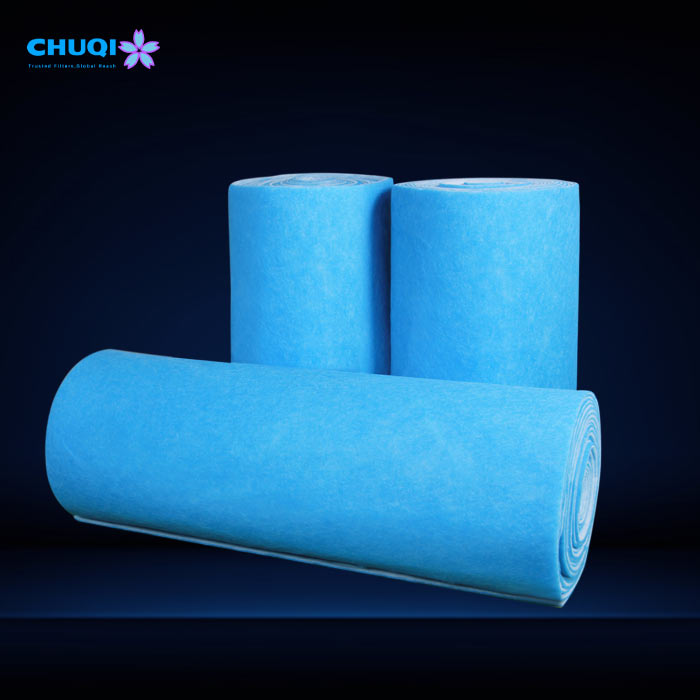
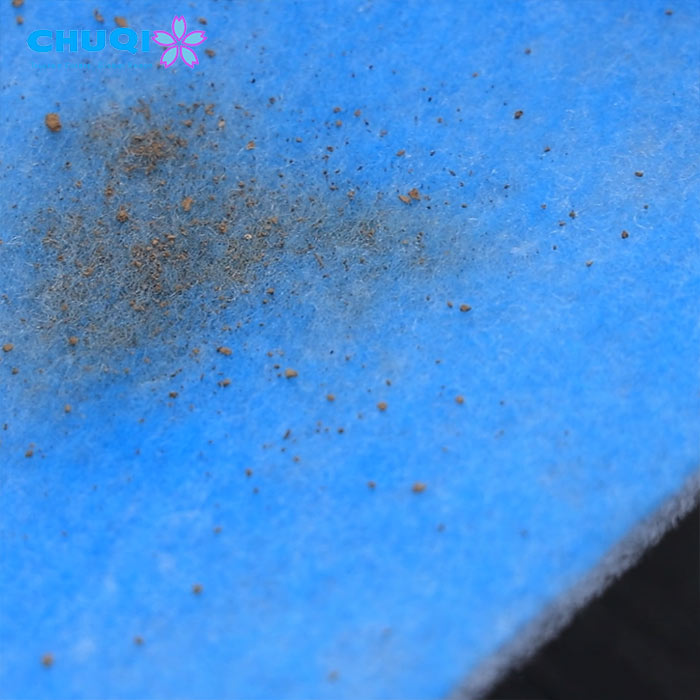
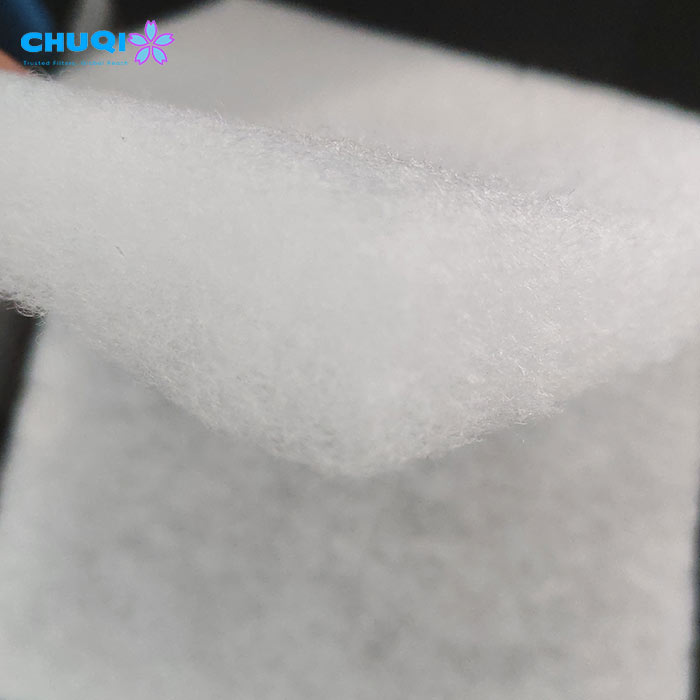
1. Calculate Face Velocity Before Comparing Filter Media
Face velocity is the average speed of air passing through the effective frontal area of a filter. It helps establish the operating point at which the media should be evaluated.
Use this formula for a flat-media arrangement:
Face Velocity (m/s) = Airflow (m³/h) ÷ [3,600 × Filter Face Area (m²)]
Where:
Airflow: The volume of air passing through the filter per hour, measured in m³/h.
Filter Face Area: The effective frontal area through which air enters the media, measured in m².
Face Velocity: The average air velocity through the filter face, measured in m/s.
Example: The Same Airflow, Two Different Filter Areas
Assume an intake system requires an airflow of 5,400 m³/h.
| Parameter | Larger face area | Smaller face area |
|---|---|---|
| Airflow | 5,400 m³/h | 5,400 m³/h |
| Effective face area | 1.0 m² | 0.5 m² |
| Calculation | 5,400 ÷ (3,600 × 1.0) | 5,400 ÷ (3,600 × 0.5) |
| Calculated face velocity | 1.5 m/s | 3.0 m/s |
The smaller face area doubles the average face velocity even though the airflow remains unchanged.
What does this mean for selection? If the equipment has limited filter space, evaluate candidate media at the resulting velocity. If the design allows a larger effective face area, calculate the lower velocity and use the corresponding media data to assess suitable options.
This formula calculates face velocity, not pressure drop. To compare initial resistance, use performance data measured at the relevant test velocity.
For pleated or bag-filter assemblies, distinguish the assembly’s frontal area from the total unfolded media area. They describe different aspects of the filter geometry and are not interchangeable inputs in this calculation.
2. How to Compare Intake Filter Media Pressure Drop
Initial resistance, commonly expressed in pascals (Pa), describes the pressure drop across clean filter media under specified test conditions.
A lower initial-resistance value may be beneficial when comparing suitable products under comparable conditions. However, the material must still meet the required filtration duty and fit the application.
Before comparing two options, check:
Filtration grade: Does the material meet the required filtration duty?
Test velocity: Were the resistance values measured at the same velocity?
Material specifications: Are the thickness, construction and dimensions suitable for the application?
Example 1: Can You Choose the Lowest Listed Pa Value?
The following values are reproduced from the Chuqi product specification data supplied for this article.
| Media description | Listed grade | Test velocity | Initial resistance |
|---|---|---|---|
| White, 10 ± 2 mm | G1 | 2.0 m/s | 12 Pa |
| White, 15 ± 2 mm | G2 | 1.5 m/s | 15 Pa |
| White, 15 ± 2 mm | G4 | 1.5 m/s | 25 Pa |
The 12 Pa option has the lowest listed initial resistance, but it has a different listed grade and was tested at a different velocity from the G2 and G4 options.
These values do not establish which material is best for a particular application because the products are not being compared under fully equivalent conditions.
Practical rule: First identify the required filtration grade. Then compare suitable candidates at comparable test velocities. Do not choose a lower-grade material simply to obtain a lower initial-resistance figure.
Example 2: Why Do Two G4 Media Options Have Different Resistance?
| Media description | Test velocity | Initial resistance |
|---|---|---|
| White, 15 ± 2 mm | 1.5 m/s | 25 Pa |
| Blue-white, 18 ± 2 mm | 1.5 m/s | 20 Pa |
Both products are listed as G4 and tested at the same stated velocity, but their initial-resistance values differ by 5 Pa.
This is a more direct comparison because the listed grade and test velocity match. The figures establish a difference in initial resistance at this specified test point, but they do not establish which material has a longer service life or better overall performance.
For a buyer, the next step is to confirm that both materials meet the application requirements and then review other relevant performance data before choosing between them.
Example 3: Does Thicker G4 Media Have Higher Initial Resistance?
| White G4 media thickness | Test velocity | Initial resistance |
|---|---|---|
| 15 ± 2 mm | 1.5 m/s | 25 Pa |
| 20 ± 2 mm | 1.5 m/s | 25 Pa |
The two listed thicknesses have the same initial resistance at the stated velocity.
This demonstrates that thickness alone cannot predict initial pressure drop. Media construction and other material characteristics also matter.
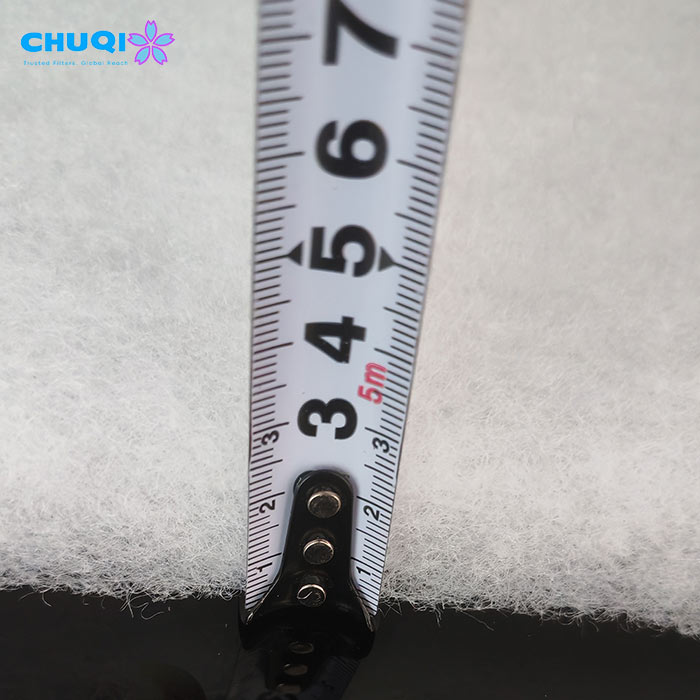
Thickness remains important when checking the available installation space. However, choosing thinner media does not automatically mean choosing lower-resistance media.
These figures do not establish that the two materials have equal dust-holding capacity, service life or performance after dust loading.
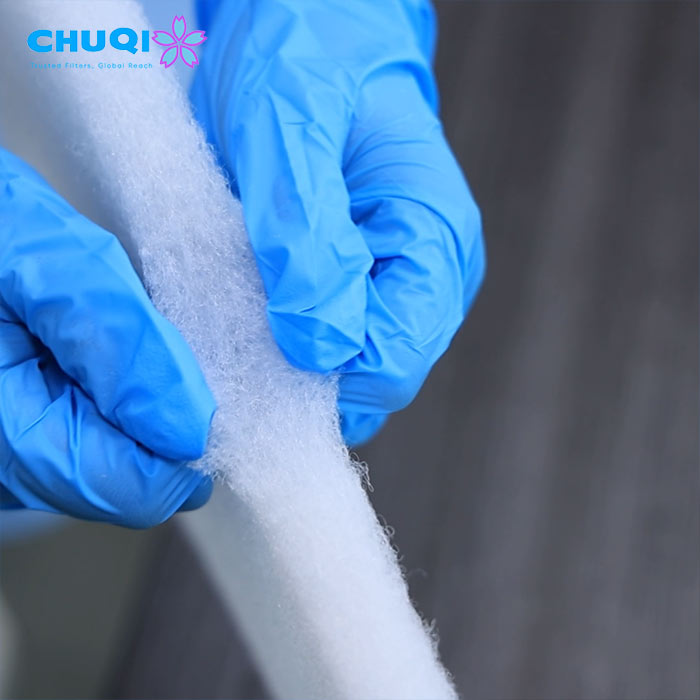

3. Initial Resistance vs. Final Resistance
Initial resistance describes the pressure drop of clean media at a specified test condition. Final resistance is a separate reference value and should not automatically be treated as the replacement threshold for every installation.
Chuqi’s supplied product data lists final-resistance values of 200 Pa or 250 Pa for the relevant products. These values should be checked against the corresponding product specifications rather than assumed to apply to every media option.
As dust accumulates, resistance changes. Actual replacement timing depends on dust loading, operating conditions and the equipment’s maintenance criteria.
Initial resistance alone cannot predict the complete pressure-drop curve, service life, replacement frequency or operating energy consumption. Where available, use loading-performance data and the equipment manufacturer’s maintenance guidance to support those decisions.
4. How to Select Intake Filter Media for Different ApplicationsReplacing Media in an Existing Filter Holder
For replacement applications, start with the existing installation and its operating requirements.
Confirm the required filtration grade and media dimensions.
Determine the airflow passing through the effective filter face area.
Calculate the average face velocity.
Compare suitable media using initial-resistance data at comparable test velocities.
Check the equipment’s maintenance requirements before changing the existing material.
This process helps prevent unsuitable substitutions based only on thickness or a lower listed Pa value.
Manufacturing Finished Air Filters
For filter manufacturers, media selection should be considered alongside the finished filter design.
The pressure-drop data for a piece of flat media do not automatically represent the pressure drop of a completed filter. The assembly’s effective area, geometry, support structure and other design features can affect its performance.
A practical development sequence is:
Required airflow → Available filter area → Working face velocity → Candidate media → Finished-filter evaluation
Where the design allows flexibility, assess the effective filter area early rather than treating media substitution as the only way to change the operating point.
Supplying Media Rolls or Pre-Cut Pads
For distributors and industrial buyers, product descriptions should preserve the conditions attached to each resistance figure.
For example:
Initial resistance: 25 Pa at a listed test velocity of 1.5 m/s.
This is more informative than describing the product simply as “low-resistance G4 media.”
When supplying pre-cut pads, distinguish the pad’s dimensions from the roll’s overall width and length. The roll format describes how the material is supplied; it does not by itself establish the airflow capacity of every finished pad.
5. What Information Helps You Choose the Right Media?
To compare intake filter media for a new design or an existing installation, start with the information available to you.
| Information | Why it matters |
|---|---|
| Required airflow (m³/h) | Establishes the air volume the system needs to move |
| Effective filter face area | Allows the average face velocity to be calculated |
| Required filtration grade | Helps narrow the candidate materials |
| Initial resistance and test velocity | Makes resistance comparisons meaningful |
| Required thickness and dimensions | Checks compatibility with the holder or assembly |
| Operating and maintenance requirements | Helps assess suitability beyond clean-media resistance |
You do not need every parameter finalized before beginning a discussion. Existing filter dimensions, the equipment model or a drawing can provide a useful starting point for reviewing potential media options.
Find Intake Filter Media for Your Application
The right intake filter media must meet the required filtration duty, fit the available installation space and provide suitable resistance at the intended operating condition.
Explore Chuqi’s intake filter media range to review available material options.
If you are selecting replacement media or developing a finished filter, share your target airflow, filter dimensions, required grade and available installation space. Chuqi can help you review relevant media options for further evaluation.
Frequently Asked Questions
Q1: Is lower initial resistance always better?
A: No. Lower initial resistance can be beneficial when comparing suitable materials under comparable test conditions, but the material must still meet the required filtration duty and fit the application.
Q2: How do I calculate filter media face velocity?
A: Divide airflow in m³/h by 3,600 multiplied by the effective filter face area in m².
Formula: Face Velocity (m/s) = Airflow (m³/h) ÷ [3,600 × Filter Face Area (m²)]
For example, an airflow of 5,400 m³/h passing through a face area of 1.0 m² produces an average face velocity of 1.5 m/s.
Q3: Does thicker intake filter media always have higher pressure drop?
A: No. In the listed Chuqi examples, white G4 media at 15 ± 2 mm and 20 ± 2 mm both have an initial resistance of 25 Pa at 1.5 m/s. Thickness alone is not enough to predict resistance.
Q4: Can I compare pressure-drop values tested at different velocities?
A: Not as a direct, like-for-like comparison. Air velocity affects resistance, so check the test conditions and compare products at equivalent velocities where possible.
Q5: Does initial resistance tell me how often the media needs replacing?
A: No. Initial resistance describes clean media at a specified test point. Replacement frequency also depends on dust loading, operating conditions and the equipment’s maintenance criteria.