
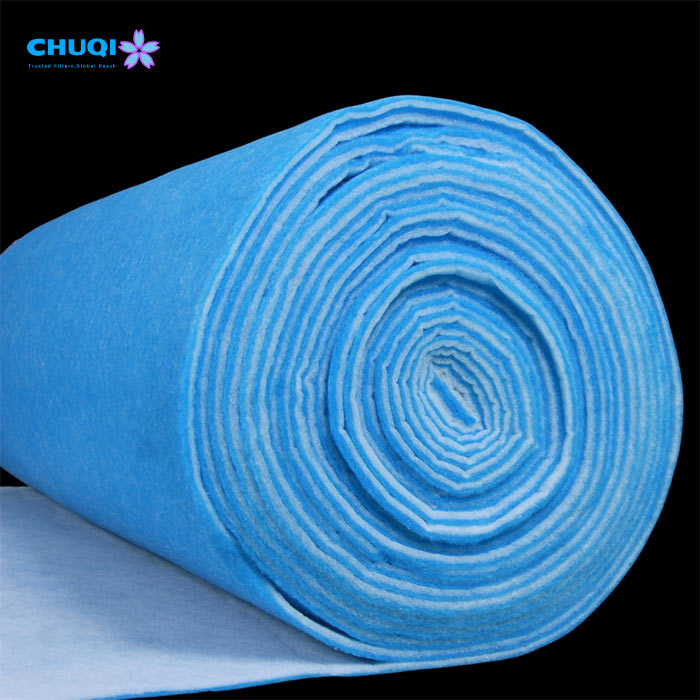
Intake filter media is a fibrous material installed in an air intake filtration system to capture airborne particles before the air moves further into the equipment. It is commonly used in HVAC systems, air handling units (AHUs), spray booth intake ventilation and other applications that require preliminary air filtration.
Unlike a complete panel filter or framed filter, intake filter media can be supplied as continuous rolls or pre-cut pads without a permanent filter frame. This allows equipment manufacturers, filter converters, distributors and maintenance teams to cut or install the material according to their requirements.
However, not every fibrous filter material is suitable for every intake application. A material that fits a filter holder may still be unsuitable if its filtration performance, airflow resistance, thickness or operating limits do not match the equipment.
This guide explains how intake filter media works, how to distinguish it from other filter products, what its physical characteristics tell you, and how to choose between rolls and pre-cut pads.
For an overview of different pre-filter media types and their selection criteria, see our air pre-filter media buyer’s guide.
1. How Does Intake Filter Media Actually Work?
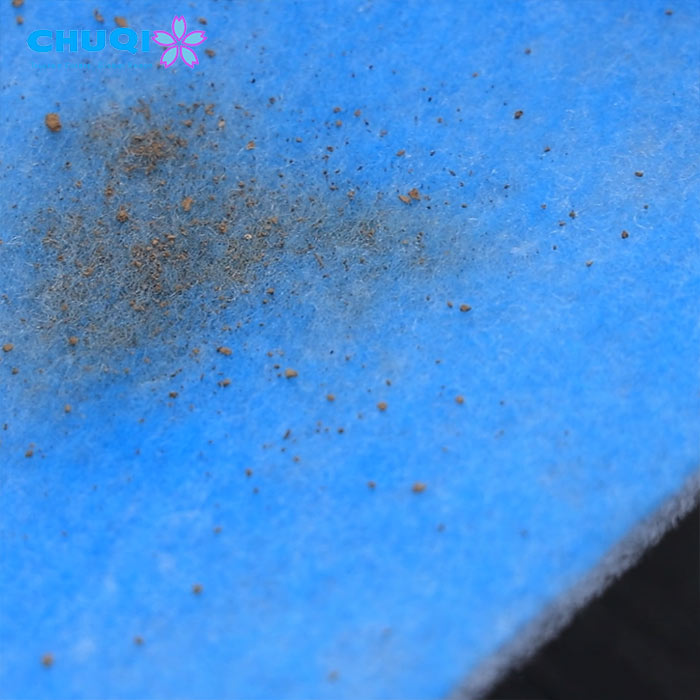
Intake filter media works by allowing air to pass through a network of fibers while capturing a portion of the particles carried by that air.
The process is different from using a solid barrier with holes large enough for air to pass through. In fibrous filtration, particles can be captured through several mechanisms, including interception, inertial impaction and diffusion. Their relative importance depends on particle size, airflow velocity and the media’s fiber structure.
For example, when dusty outdoor air enters an AHU, larger airborne particles may collide with fibers or pass close enough to contact them. Some particles remain attached to the fibers while the air continues downstream.
The media therefore performs two jobs simultaneously:
It allows the required volume of air to pass through.
It captures a portion of the airborne particles without creating excessive resistance for the system.
These requirements must be considered together. A material that captures particles effectively but creates excessive resistance may not be suitable for the equipment. Conversely, a material with low resistance is not necessarily an effective filter for the particles of concern.
Why Is Intake Filter Media Often Used as the First Filtration Stage?
Consider a ventilation system that uses two filtration stages:
Outdoor air → Intake pre-filter → Fine filter → Conditioned air
The pre-filter captures part of the incoming particle load. The downstream filter then performs its designated filtration task.
Without an appropriate pre-filter, the downstream filter may receive a greater particle load and require more frequent replacement under otherwise comparable conditions. The actual effect depends on the air quality, filter combination, operating hours and maintenance practices.
This is why intake filter media should be evaluated as part of the complete filtration system rather than as an isolated piece of material.
One important limitation: pre-filter media does not automatically remove gases, solvent vapors or every fine airborne particle. Applications involving these contaminants may require additional technologies selected for the specific pollutant.
For a more detailed breakdown, read what pre-filter media can and cannot remove.
2. Where Is Intake Filter Media Installed?
The term “intake filter media” describes the material’s role in the airflow path. Understanding where the air enters the equipment helps identify whether a particular product is appropriate.
HVAC Systems and Air Handling Units
In HVAC equipment, intake filter media may be installed in a filter rack, holder or compatible supporting frame upstream of other filtration stages or air-handling components.
For example, a maintenance technician replacing media in an AHU may remove a used piece from its holder and install a new piece cut to the required dimensions. The media itself provides filtration, while the holder keeps it in position and helps direct air through the intended filtration area.
Three checks are particularly important during replacement.
First, check how the media is retained. Is it held by a rigid frame, a wire support, a retaining grid or another arrangement? A replacement that cannot be secured properly may sag or leave gaps around its edges.
Second, check the finished dimensions and thickness. A pad that is too small can leave an air bypass around the edges. A pad that is too thick may be difficult to install or compress differently from the original material.
Third, check the original performance requirements. A visually similar replacement may have different airflow resistance or particle-capture characteristics. Physical fit alone does not establish functional equivalence.
These details matter to HVAC contractors, facility maintenance teams, AHU manufacturers and distributors supplying replacement media.
Spray Booth Intake Ventilation
Spray booth filtration requires particular attention to the material’s location because several visually similar products can perform different jobs.
A simplified spray booth airflow path may include:
Incoming air → Intake filtration → Ceiling diffusion stage → Spray area → Exhaust filtration
The exact arrangement varies by booth design. In some systems, intake pre-filtration and ceiling filtration are separate stages; in others, the specified filtration arrangement differs.
Intake filter media is intended for the incoming-air filtration task for which it is specified. Ceiling diffusion media helps distribute incoming air across the booth, while exhaust paint-arrestor media captures paint overspray carried toward the exhaust system.
These materials should not be substituted for one another simply because all three may be supplied as rolls or cut sheets.
For example, a distributor sourcing consumables for a spray booth should identify whether the customer needs intake pre-filter media, ceiling filter media or exhaust paint-arrestor media before comparing products. Ordering the wrong category can result in a material that fits the general dimensions but does not perform the required job.
If your focus is spray booth ceiling or exhaust filtration, evaluate those products according to their own application requirements rather than treating them as interchangeable intake media.
Industrial Ventilation Systems
Industrial facilities may also use intake filter media to filter air entering ventilation equipment.
The key distinction is between filtering incoming ventilation air and collecting dust directly from a production process.
For example, a factory may have an air intake supplying replacement air to a production area and a separate extraction system capturing dust generated by a cutting, grinding or material-handling operation.
Both systems handle airborne particles, but their design requirements are different. The intake system treats incoming air, while the extraction system is designed to capture contaminants generated at or near the source.
A filter material suitable for preliminary intake filtration should not automatically be assumed suitable for a dust collector. The particle load, operating conditions, airflow arrangement and filtration requirements may differ substantially.

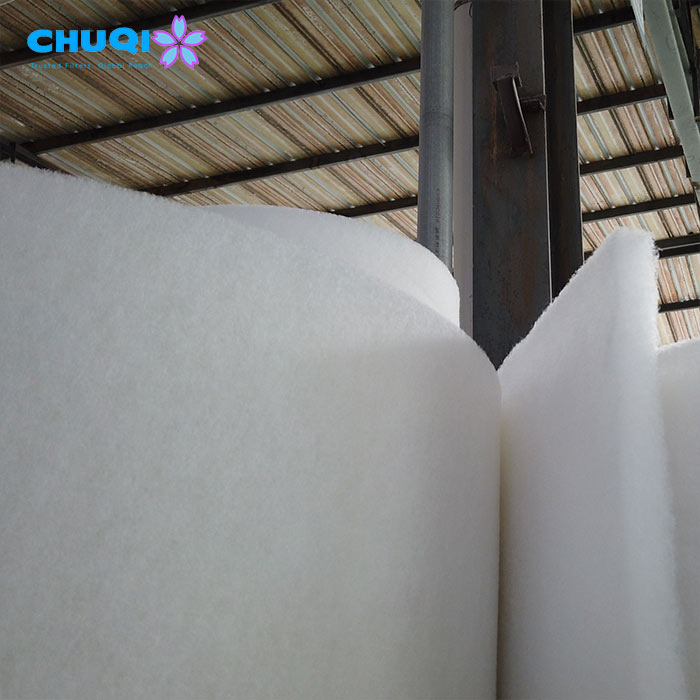
3. What Is Synthetic Intake Filter Media Made Of?
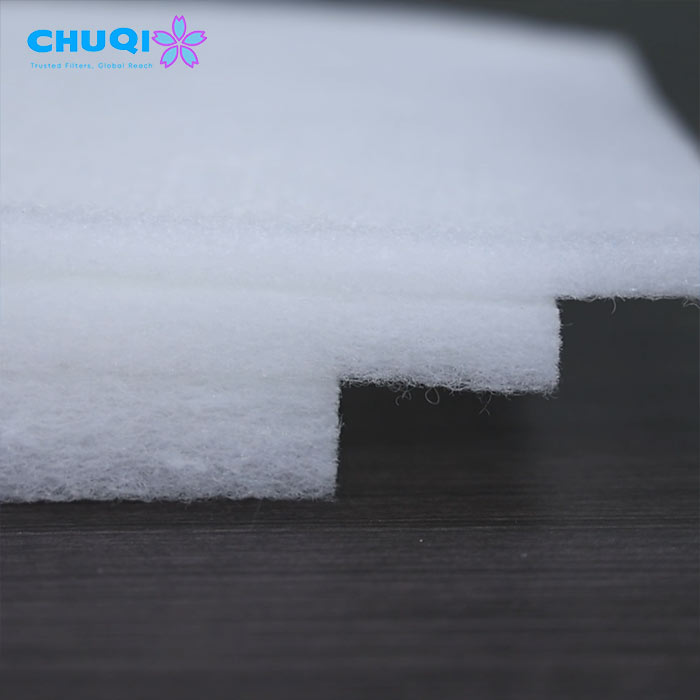
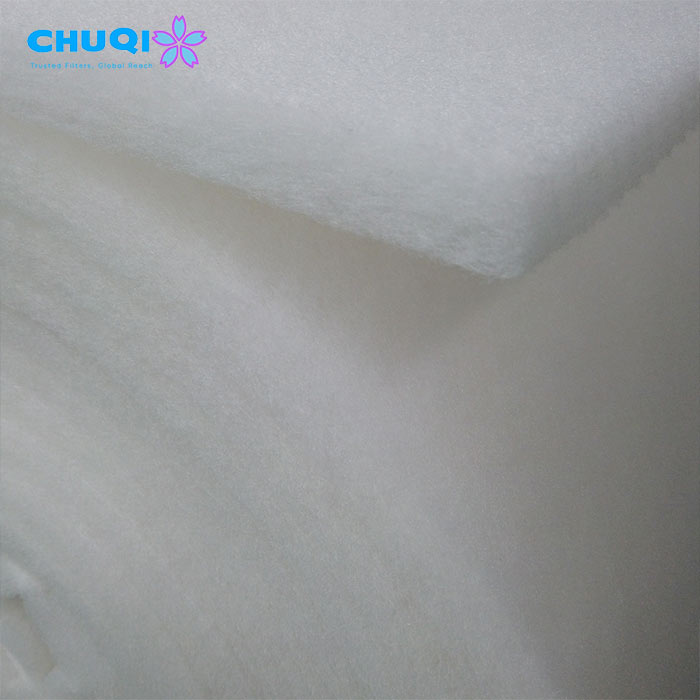
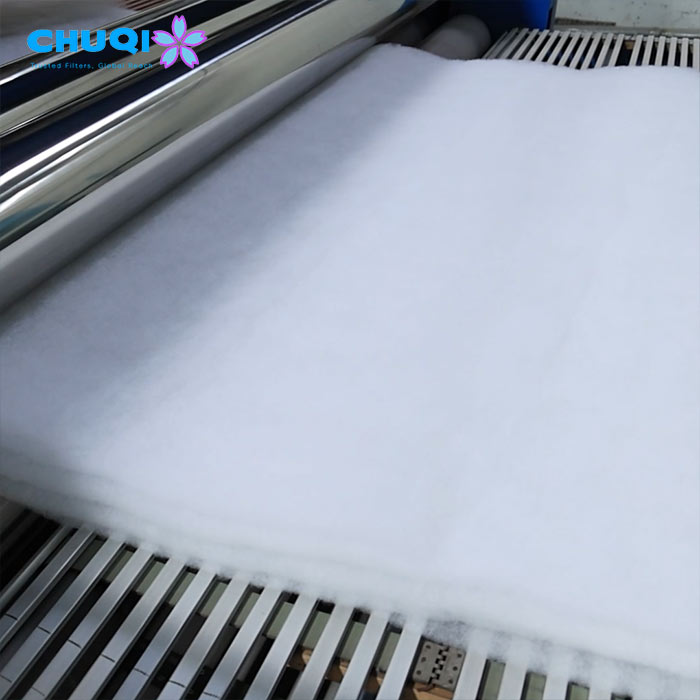
Synthetic intake filter media is generally made from manufactured fibers formed into a porous, nonwoven structure. Polyester is used in some commercial products, although fiber composition and manufacturing methods vary.
The fibers form a three-dimensional network rather than the regular interlaced pattern of woven fabric. Air passes through the spaces between fibers, while particles can be captured through interactions with the fiber surfaces.
When comparing synthetic filter media, three physical characteristics deserve separate attention.
| Characteristic | What It Tells You | What It Cannot Tell You on Its Own |
|---|---|---|
| Thickness | The physical depth of the material | Its filtration efficiency or service life |
| Basis weight | The mass of media per unit area, commonly expressed in g/m² | Its exact airflow resistance or particle-capture performance |
| Fiber structure | How fibers are arranged and distributed through the material | The complete performance of the finished product without test information |
This distinction is important when purchasing replacement material. Two products may have similar thicknesses but different fiber structures. Two products with similar basis weights may also differ in how the fibers are bonded and distributed.
Consequently, thickness and basis weight are useful for identifying and comparing materials, but neither should be used as a substitute for the relevant performance specifications.
What Is Progressive-Density Filter Media?
Some synthetic filter media uses a progressive-density structure, in which the fiber arrangement changes through the material’s depth.
In a typical design, the air-entry side is more open and the structure becomes denser toward the air-exit side. This arrangement can distribute particle capture through the depth of the media rather than concentrating all captured particles at the surface.
However, progressive-density construction is not a universal feature of all intake filter media. It must be confirmed for the particular product.
When evaluating a product, look for a manufacturer’s description of its construction, any specified airflow direction and the applicable performance data. Do not assume that a material is progressive-density simply because one side looks more open than the other.
Does Thicker Filter Media Always Perform Better?
No. Greater thickness does not automatically mean higher filtration efficiency, lower pressure drop or longer service life.
Consider two replacement materials that appear equally thick. One may contain a different fiber distribution or bonding structure, resulting in different filtration behavior. Likewise, a thicker material may create greater resistance under a particular operating condition without providing a corresponding improvement in the performance required by the system.
The appropriate comparison therefore includes the material’s intended application, dimensions, airflow resistance and available filtration-performance information.
For buyers, the practical rule is simple: use thickness to check physical suitability, not as a standalone measure of filter quality.
Does White or Blue-White Filter Media Indicate Its Grade?
No universal color standard allows buyers to determine a filter’s grade from its appearance alone.
Chuqi’s intake filter media range includes white and blue-white options. Color can help distinguish products visually, but it does not independently establish filtration efficiency, pressure drop, fiber composition or airflow direction.
If you are replacing existing media, a photograph can help identify its appearance and construction. It should be combined with dimensions, product identification and technical information before confirming a replacement.
4. Filter Media Rolls vs. Pre-Cut Pads: Which Format Makes More Sense?
The difference between rolls and pre-cut pads is primarily the way the material is supplied and prepared for use. The best format depends on how many sizes you handle, how frequently the material is replaced and whether cutting is already part of your operation.
When Are Filter Media Rolls the Better Choice?
A continuous roll provides material that can be cut into multiple pieces. This can be useful for filter converters, equipment manufacturers and distributors handling several dimensions.
Imagine a filter converter supplying replacement pads for three types of equipment. If the required pad sizes can be cut from a common roll width, roll stock may allow the converter to manage the raw material centrally and prepare finished pieces as needed.
The potential advantages include:
Using a common material supply for multiple finished dimensions.
Preparing replacement pieces when demand arises.
Managing cutting and conversion as part of an existing production process.
Reducing the need to stock every finished size separately.
However, roll stock also introduces work. The buyer must account for cutting labor, equipment, material waste, storage and the accuracy of finished dimensions.
If the required pieces are awkward to arrange across the roll width, or if only a small quantity is needed, cutting losses and handling costs may outweigh the benefits of purchasing continuous material.
When Are Pre-Cut Filter Pads More Practical?
Pre-cut pads arrive in specified dimensions, so the customer does not need to cut each piece before use.
Consider a maintenance team that replaces the same media dimensions during scheduled servicing. If the dimensions are stable and the annual usage is predictable, receiving ready-cut pads can reduce preparation work and simplify replacement.
Pre-cut pads can also help distributors organize inventory around established replacement sizes. Each size can be identified and stored as a finished product rather than being cut after a customer places an order.
The trade-off is inventory flexibility. A distributor serving many different equipment models may need to hold multiple finished sizes. If demand for an individual size is unpredictable, some stock may remain unused.
How Can You Compare the Two Formats Properly?
Do not compare only the purchase price per roll with the price per pad. The relevant comparison is the cost of obtaining usable pieces in the required dimensions.
| Cost or Operational Factor | Rolls | Pre-Cut Pads |
|---|---|---|
| Material preparation | Requires cutting where finished pieces are needed | Cutting is completed before supply |
| Labor and equipment | May require local cutting resources | Usually less local preparation |
| Material waste | Depends on roll width, cutting layout and required dimensions | Cutting yield is handled upstream, although it may still affect the supplier’s cost |
| Inventory | Can support several dimensions from shared stock | Inventory is organized around finished sizes |
| Best fit | Businesses with suitable conversion workflows and varied size requirements | Businesses prioritizing repeat sizes and ready-to-install supply |
For a fair comparison, consider the cost per usable piece, cutting losses, labor, storage and the consequences of holding the wrong dimensions.
Neither format is automatically cheaper. The better option is the one that fits the actual supply and handling process.
For a more focused comparison, read air filter media rolls vs. pre-cut pads.

5. How Can You Identify the Right Replacement Intake Filter Media?
A common purchasing challenge occurs when the original material has no readable label or the equipment documentation is incomplete.
In this situation, the goal is not to guess the product from appearance. It is to collect enough information to distinguish a physically compatible replacement from one that also meets the application’s performance requirements.
Step 1: Identify the Application and Position
Determine where the material is installed and what the filtration stage is intended to do.
Is it installed at an AHU intake, in an industrial ventilation unit or at a spray booth intake? Is it a loose media pad, or is it part of a framed filter assembly?
This step helps rule out products designed for different functions, such as spray booth exhaust paint-arrestor media.
Step 2: Measure the Existing Material
Record the length, width and thickness of the existing piece, preferably before it has been compressed or distorted by use.
If the media sits inside a holder, also check the available space and how the material is retained. The nominal dimensions of the old media and the dimensions of the holder may not be identical.
For example, a replacement cut too narrowly may leave gaps around the perimeter. A piece that is too large may fold or compress during installation, potentially affecting airflow distribution.
Do not assume that a visually close fit is sufficient. The replacement must sit securely in the intended installation.
Step 3: Find Any Available Product Identification
Check for a product label, part number, maintenance record, equipment manual or previous purchase record.
These records can provide more reliable information than visual inspection alone. If a known product designation is available, use it to retrieve the corresponding specifications rather than inferring a grade from the material’s color or thickness.
Step 4: Compare the Technical Requirements
Once the application and dimensions are known, compare the available product information.
Relevant details may include fiber composition, thickness, basis weight, filtration performance and airflow resistance. Operating temperature and other environmental limits should also be checked when they are relevant to the installation.
Not every parameter has the same importance in every application. The original equipment requirements and the filtration task should determine which characteristics need to be matched.
Step 5: Decide Whether Rolls or Pre-Cut Pads Fit the Workflow
If the replacement is used repeatedly in one or more known dimensions, pre-cut pads may simplify maintenance. If several dimensions are required and suitable cutting resources are available, rolls may provide greater flexibility.
For distributors and equipment manufacturers, repeatability is also important. The selected supply format should make it practical to identify the product and reproduce the required dimensions across future purchases.
A useful starting point: if the original specification is unavailable, an equipment model, photograph, existing media sample or set of measurements can help establish the product category. These details do not independently prove performance equivalence, but they make the next technical review more focused.
6. Explore Chuqi Intake Pre-Filter Media
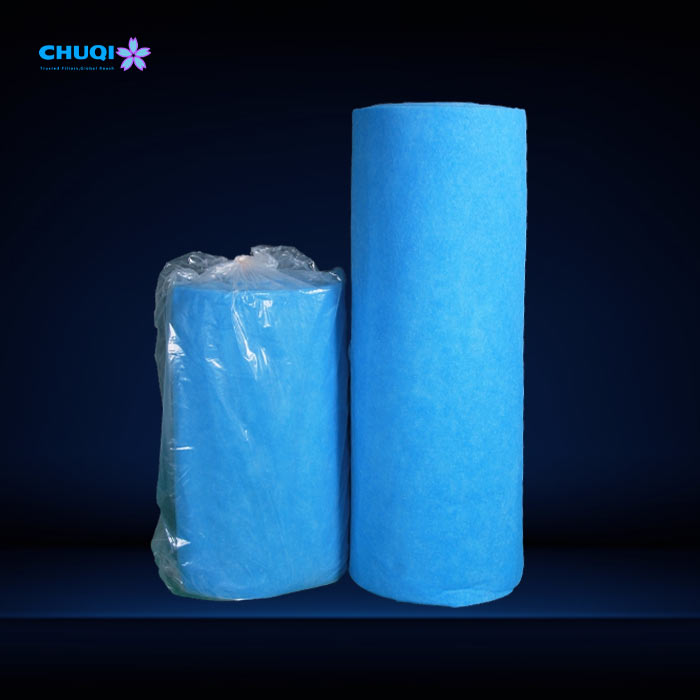
Chuqi supplies synthetic intake pre-filter media for B2B applications, with options including white and blue-white media, bulk rolls and custom pre-cut pads.
The product range is intended to support different supply workflows, from media conversion and distribution to replacement supply for compatible equipment.
Bulk rolls: for businesses that cut media into the dimensions required by their customers or production processes.
Pre-cut pads: for applications where specified finished dimensions simplify handling and replacement.
Custom-sized media: for equipment manufacturers and distributors that need dimensions suited to their established products.
Individual products may differ in thickness, basis weight, construction and filtration-grade designation. These specifications should be reviewed for the actual product and application rather than inferred from color or appearance.
Visit Chuqi’s intake filter media product page to review the available range and product information.
If you are evaluating a replacement or planning repeat supply, you can begin with the application, existing dimensions or a sample of the current media. This provides a practical basis for identifying suitable product options and discussing whether roll or pre-cut supply is more appropriate.
Frequently Asked Questions About Intake Filter Media
Q1. Is intake filter media the same as a complete air filter?
A: No. Intake filter media is the fibrous material responsible for capturing particles. A complete air filter may also include a frame, support grid, seals and other components needed for installation. Whether media alone is suitable depends on the equipment’s filter-holder design.
Q2. Can I replace intake filter media with any material of the same thickness?
A: No. Equal thickness does not establish equivalent filtration performance or airflow resistance. Before replacing the material, check its intended application, dimensions, installation requirements and available technical specifications.
Q3. How can I tell whether a material is intake filter media or spray booth exhaust filter media?
A: Start with its installation position and intended function. Intake media is used for incoming-air filtration, while exhaust paint-arrestor media is designed for capturing paint overspray in the exhaust path. Appearance alone is not a reliable way to distinguish them.
Q4. Does blue-white intake filter media have a higher filtration grade than white media?
A: Not necessarily. Color is not a universal filtration-grade designation. Compare the product’s actual specifications and performance information to determine whether it meets the application’s requirements.
Q5. Is filter media sold in rolls more economical than pre-cut pads?
A: It depends on material utilization, cutting labor, waste, order volume and inventory costs. Rolls may suit businesses converting material into multiple sizes, while pre-cut pads may reduce preparation work for repeat replacement dimensions. Compare the cost of usable finished pieces rather than purchase price alone.
Q6. Can I determine filter performance from thickness or basis weight?
A: Neither measurement is sufficient on its own. Thickness describes physical depth, while basis weight describes mass per unit area. Filtration performance and airflow resistance depend on the media’s construction and the conditions under which it is evaluated.
Q7. What information should I prepare when sourcing replacement intake filter media?
A: Start with the application, installation position and dimensions of the existing material. A product label, equipment model, photograph or sample may help identify the product. The required performance specifications should then be checked against the application.
Q8. Can intake filter media be supplied in custom dimensions?
A: Custom-sized media may be available depending on the product and supplier’s manufacturing capabilities. For an initial discussion, the required dimensions and intended application are useful starting points. Additional specifications can be confirmed as the product requirements become clearer.