
An RFQ for custom HEPA filters should define the required product configuration, installation interface, filtration performance, order quantities and delivery conditions. The clearer these requirements are, the easier it is for a manufacturer to assess the application and prepare a quotation that matches your purchasing needs.
For OEM equipment manufacturers, industrial filtration buyers, engineering teams and air filter distributors, a complete request for quotation (RFQ) helps reduce specification gaps, clarify commercial responsibilities and make supplier quotations easier to compare.
You do not need to finalize every technical detail before contacting a manufacturer. Start with the information you already have, such as an equipment drawing, an existing filter model, installation dimensions, required airflow or a preliminary specification. Clearly identify what is confirmed and what still needs technical review.
This guide explains what to include in a custom HEPA filter RFQ, how to organize technical and purchasing requirements, and how to compare quotations before approving a filter configuration for production.
What Information Should a Custom HEPA Filter RFQ Include?
A useful RFQ gives the manufacturer enough information to identify the requested configuration, evaluate the available technical data and understand the expected supply scope.
Use the following checklist to organize your inquiry.
Custom HEPA Filter RFQ Checklist
| Information Required | What to Include |
|---|---|
| Application and supply scope | Equipment type, process, operating environment and required supply items |
| Product identification | Existing filter model, customer part number or equipment reference |
| Drawing and dimensions | Drawing number, revision, width, height, depth, tolerances and installation interface |
| Sealing and mounting | Gasket arrangement, contact surfaces, mounting features and airflow orientation |
| Filtration performance | Required filter class, applicable standard, airflow and allowable pressure drop |
| Operating conditions | Temperature, humidity, condensation and relevant process exposure |
| Order quantities | Sample quantity, initial production quantity and forecast annual demand |
| Quality and documentation | Required test reports, material records, traceability and acceptance criteria |
| Packaging and identification | Product labels, private-label requirements and packing instructions |
| Delivery and commercial terms | Destination, requested timing, quotation currency, payment terms and requested Incoterms® rule |
Not every item must be finalized before the first inquiry. If a requirement is unknown, mark it as pending confirmation rather than allowing it to become an unstated assumption in the quotation.
For multiple filter configurations, assign each one a drawing number, customer part number or other unique reference. This helps connect technical comments, prices and order quantities to the correct product.
1. Define the Application and Supply Scope
Start by explaining where the HEPA filter will be used and what you need the manufacturer to supply.
For example, a request for a HEPA filter for a cleanroom provides application context, but it does not establish whether the inquiry concerns a standalone filter, a replacement for an existing housing or a complete filtration assembly.
Identify the Required Product
Specify whether you require only the finished filter or additional items such as a housing, mounting components or other parts of an assembly.
For an OEM project, explain whether the filter must fit an existing equipment interface or whether the equipment design can still be adjusted.
For a replacement project, provide the existing filter identification, equipment reference and available installation information.
The supply boundary should be clear enough to prevent a quotation for a filter element from being mistaken for an offer covering a complete filtration system.
Describe the Operating Environment
The application name alone does not define the required filter construction.
Relevant operating conditions may include:
Operating temperature and humidity
Condensation or moisture exposure
Chemical or cleaning-agent exposure
Process-specific contaminants
Continuous operating conditions and maintenance requirements
Only include conditions relevant to the actual application. If a condition has not been established, identify it as an open technical question for review.
This gives the manufacturer a more reliable basis for assessing suitable materials, seals and construction options.
2. Provide the Correct Drawing and Installation Details
A custom HEPA filter must fit the intended equipment and sealing interface, not simply match a nominal catalogue size.
Provide the latest available drawing and identify the dimensions and features that control installation.
Distinguish Quotation Drawings from Approved Drawings
Include the drawing number and revision wherever available.
If the drawing is preliminary, state that it is being supplied for quotation review. Identify any dimensions, interfaces or construction details that remain open.
A quotation based on one drawing revision should not automatically be treated as covering a later revision. Changes to depth, frame construction, seals or mounting details may require further technical and commercial review.
Before manufacturing is released, the approved drawing and applicable specification should be clearly identified.
Show the Sealing and Mounting Interface
Width, height and depth do not fully define how a HEPA filter connects to its housing.
Where applicable, show:
Gasket location and dimensions
Sealing contact surfaces
Mounting and retaining features
Airflow direction or orientation
Relevant dimensional tolerances
State the dimension units and the agreed order, such as width × height × depth. Confirm whether listed dimensions include or exclude gasket thickness.
Where installation integrity is important, an interface drawing is more useful than relying on a photograph alone.
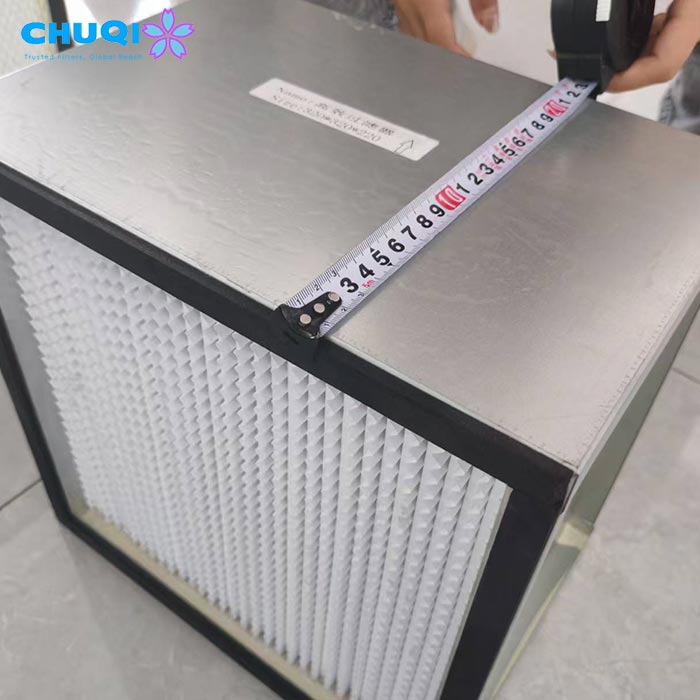
Use Photographs and Existing Samples as Supporting References
If a drawing is unavailable, provide clear photographs of the complete filter, side profile, seals, mounting features and product label.
An existing filter sample can also help the manufacturer assess its visible construction and dimensions.
However, photographs and physical appearance cannot independently establish filtration efficiency, rated airflow, pressure drop or the original manufacturing tolerances. Additional technical information may be needed before a final configuration can be confirmed.

3. Make the Performance Requirements Measurable
A custom HEPA filter quotation should state the conditions under which the proposed product is expected to perform.
Terms such as “high efficiency” and “low resistance” describe preferences, but they do not provide a complete acceptance basis.
Specify Airflow and Pressure Drop Together
Provide the required airflow and allowable initial pressure drop at the relevant airflow condition.
A pressure-drop target without its associated flow condition is incomplete. Likewise, a required airflow does not establish whether the resulting resistance is acceptable to the equipment.
If the equipment has a known total airflow, explain how many filters are installed and how the airflow is distributed. The airflow assigned to each filter may need to be confirmed separately.
When comparing supplier data, use consistent airflow conditions, pressure-drop definitions and test boundaries. Initial pressure drop, operating pressure drop and final resistance are different concepts and should not be treated as interchangeable.
For further technical guidance, see HEPA Filter Pressure Drop: What Affects It and How to Specify It.
Identify the Required Filter Class and Test Standard
If the project requires H13, H14 or another filtration classification, identify the applicable standard and the specific project requirements.
Under EN 1822, HEPA filter classifications are associated with defined efficiency requirements evaluated using the most penetrating particle size (MPPS). A general efficiency percentage should not automatically be treated as equivalent to a specified classification.
Clarify what evidence is required for acceptance. Media performance data, finished-filter test reports and verification of an installed filtration system address different aspects of performance.
If a customer specification requires a particular test method, acceptance criterion or reporting format, attach the relevant requirement rather than relying on an informal summary.
The applicable standard, test method and required evidence should be agreed for the project rather than assumed from the product name alone.
Separate Mandatory Requirements from Preferred Targets
Not every requirement has the same degree of flexibility.
For example, an existing equipment interface may be fixed, while a different filter depth may be possible. The required airflow may be mandatory, while the initial pressure-drop target requires further review.
Identify which conditions cannot change and which alternatives may be considered.
If a manufacturer proposes a different material, seal or construction, request a separate explanation of the proposed change and its effect on the original requirements. An alternative should not be presented as fully compliant unless that compliance has been established.
4. Separate Samples, Initial Orders and Forecast Demand
For OEM and bulk purchasing projects, sample requirements and production quantities should be stated separately.
A request for “one sample followed by bulk orders” does not establish the expected quantity, approval process or pricing basis.
Define the Purpose of Sample Approval
State what the sample is intended to confirm.
Installation fit, agreed filtration performance and customer approval are separate activities. Depending on the project, each may require different evidence or review steps.
If sample approval is required before production, identify who will approve the sample and what documents or test results are needed.
A successful fit check should not automatically be treated as approval of every performance requirement.
Link Quantities to Each Configuration
For every drawing or part number, specify:
Sample quantity
Initial production order quantity
Forecast annual demand, if available
Expected ordering frequency, if relevant
Clearly distinguish forecast demand from a committed purchase order.
If multiple configurations are involved, request pricing for each relevant quantity and configuration. This makes it easier to compare quotations without confusing projected demand with confirmed order volume.
Clarify MOQ and Additional Charges
Do not assume that the sample quantity, minimum order quantity (MOQ) and repeat-order quantity are identical.
Ask the manufacturer to specify any applicable MOQ and whether it applies per configuration, per order or on another agreed basis.
Where relevant, request separate identification of development, tooling, fixture, special testing or custom packaging charges. These costs may or may not apply to a particular project, so they should be confirmed rather than assumed.
For recurring OEM orders, also clarify how future drawing revisions, specification changes and repeat orders will be handled.
5. Clarify Documentation, Packaging and Identification
A quotation should define the complete supply scope, including any required records, labels and packaging.
Specify the Required Documentation
A general statement such as “certificates required” may not identify the evidence needed for the project.
Instead, specify the intended documents, such as:
Finished-filter performance test reports
Material declarations
Product identification and traceability records
Documentation addressing a specific customer requirement
Inspection or acceptance records in a prescribed format
The actual documentation available depends on the product, testing arrangements and agreed supply scope. Confirm that the required records can be provided before treating them as part of the quotation.
Where a customer requires a specific document template, provide it for review. A manufacturer’s standard report may not contain every field required by the purchasing specification.
Explain Labeling and Packaging Requirements
If the filters require customer part numbers, private-label artwork, individual packaging or specific shipping protection, include the available instructions.
State whether artwork and packaging specifications are approved or preliminary.
A later request for different labels or packaging may change the supply scope and cost. These requirements should therefore be agreed before the quotation is finalized.
6. Define Delivery Timing and International Commercial Terms
A quotation deadline, sample completion date, production dispatch date and destination arrival date are different milestones.
Identify the date that matters to your project and whether it depends on drawing approval, sample acceptance or another event.
Confirm When Lead Time Starts
If the quotation specifies a lead time, ask the manufacturer to confirm the event from which it is calculated.
Depending on the agreed terms, the lead time may begin after drawing approval, payment, receipt of final technical information or another defined milestone.
A requested delivery date is a planning requirement, not a confirmed manufacturing commitment until the supplier accepts it.
Specify the Destination and Incoterms® Rule
Provide the destination and requested quotation basis.
Where an Incoterms® rule is used, identify the rule, named place or port and applicable version. Incoterms® define specific delivery responsibilities, costs and risks between the seller and buyer; the named location is an important part of that allocation.
They do not replace payment terms, technical acceptance criteria or the product specification.
The quotation should also clarify the currency, payment terms, validity period and estimated shipping arrangements where applicable.
For international purchases, specify the units used for dimensions, airflow and pressure. Consistent units make technical review and final approval easier.
7. Can You Request a Quote Without Complete Specifications?
Yes. An initial discussion about custom HEPA filters can begin with an existing filter reference, equipment drawing, photographs, available dimensions or an application description.
The important step is to distinguish confirmed information from unresolved requirements.
A manufacturer may be able to provide preliminary feedback or a quotation based on clearly stated assumptions. Some configurations may require additional information before a firm technical or commercial offer can be issued.
A preliminary quotation does not mean that open requirements have been approved for production.
If confidential drawings or proprietary equipment information are involved, agree on an appropriate method for sharing and handling those materials before sending restricted documents.
What to Send If You Have Only an Existing Filter
If the original specification is unavailable, begin with the following information:
Photographs of the complete filter, label and mounting interface.
Available width, height and depth measurements.
Equipment type and application.
Known airflow or performance requirements.
Estimated sample and production quantities.
These details provide a starting point for review. Additional drawings, measurements or performance information may still be necessary before a final configuration can be confirmed.
9. How to Compare Custom HEPA Filter Quotations
Compare quotations against the same technical definition and purchasing basis rather than looking at unit price alone.
Use the following comparison points:
| Comparison Item | What to Verify |
|---|---|
| Product configuration | Filter dimensions, construction, seals and drawing revision |
| Performance | Required classification, airflow, pressure drop and applicable test conditions |
| Technical compliance | Mandatory requirements met and open items clearly identified |
| Documentation | Required reports, records and acceptance evidence included |
| Quantity and pricing | Price matched to the same configuration and order quantity |
| Additional charges | MOQ, tooling, testing, development and packaging charges where applicable |
| Delivery | Lead-time basis, destination, named delivery place and commercial terms |
| Quotation assumptions | Exclusions, proposed alternatives and requirements awaiting confirmation |
A lower unit price may reflect a different configuration or exclude costs included in another offer. That does not automatically make the quotation unsuitable, but the differences should be understood before making a purchasing decision.
Review technical assumptions, proposed alternatives and the included supply scope as carefully as the headline price.
Before production is released, confirm the approved drawing, applicable specification and any required sample-approval conditions. Conflicting revisions across emails and quotation documents should not replace a clearly agreed final reference.
Common Questions About Custom HEPA Filter RFQs
Q: Can a manufacturer quote custom HEPA filters from a photograph?
A: A photograph can support an initial assessment, particularly when it shows the complete filter, label, sealing arrangement and mounting features. However, it does not independently establish filtration performance, rated airflow or final manufacturing tolerances. Additional measurements, documents or a physical reference may be needed.
Q: What information is most important for an OEM HEPA filter quotation?
A: Start with the application, drawing or existing filter reference, installation dimensions, required filtration performance and expected order quantities. Also identify the operating conditions and any mandatory documentation. Missing details should be listed for technical review rather than assumed.
Q: Is annual demand enough to obtain bulk pricing?
A: Annual demand provides useful planning context, but the immediate order quantity, product mix and ordering pattern also matter. Distinguish forecast demand from committed orders and request prices against clearly defined quantities and configurations.
Q: Does accepting a quotation approve the filter for production?
A: Not necessarily. Commercial acceptance does not automatically resolve open technical requirements. The agreed process should identify which drawing, specification and sample-approval conditions must be completed before production release.
Q: Can I request a quotation if some technical parameters are unknown?
A: Yes. You can start with an existing filter model, equipment drawing, photographs or available application information. The manufacturer can review the information, identify missing requirements and advise whether a preliminary quotation is possible or further technical confirmation is needed.
Ready to Discuss Your Custom HEPA Filter Project?
Chuqi New Materials works with customers on custom industrial HEPA filter requirements for OEM and bulk purchasing projects. If you are developing a new filtration assembly or reviewing an existing filter, start with the information you already have.
You can share an equipment drawing, existing filter reference, installation dimensions or required operating airflow. Our team can review the available information and identify the details that need further technical confirmation before discussing a proposed configuration.
You do not need to finalize every parameter before starting the conversation.
Review the relevant product information and identify the configuration that matches your application.
Request a Custom HEPA Filter Quote
Contact our team with your technical requirements, estimated quantities and delivery expectations to begin the quotation review.
The final configuration, performance requirements, documentation and commercial terms should be confirmed for the specific project before production is released.