
In industrial finishing, automotive OEM coating, and heavy machinery spray applications, achieving a mirror-like finish requires strict control over airflow and particulate matter. A single floating dust particle can ruin a multi-layer clear coat, while uncaptured overspray degrades exhaust fans, violates regional environmental standards (such as US EPA NESHAP or EU VOC directives), and creates serious fire hazards.
Building and maintaining an efficient spray booth requires a deep understanding of air dynamics, pressure drops, and multi-stage filtration.
In this comprehensive engineering guide, we will break down:
Paint Booth Filters Explained: Understanding each filter stage and media type.
How to Build a Paint Booth Filter System: Airflow calculation, cabin design, and media selection.
How to Install Paint Booth Filters: Step-by-step installation best practices to prevent bypass leaks.
Part 1: Paint Booth Filters Explained – The Multi-Stage Filtration Matrix
A professional paint booth relies on a balanced dual-directional airflow ecosystem:
Intake Filtration (supplying clean, laminar air into the cabin)
Exhaust Filtration (capturing paint overspray and VOC particulates before air discharge)
Relying on a single filter stage is a recipe for failure. High-efficiency spray booths use a 4-stage filtration matrix to optimize dust-holding capacity, extend fan lifespan, and guarantee paint adhesion quality.
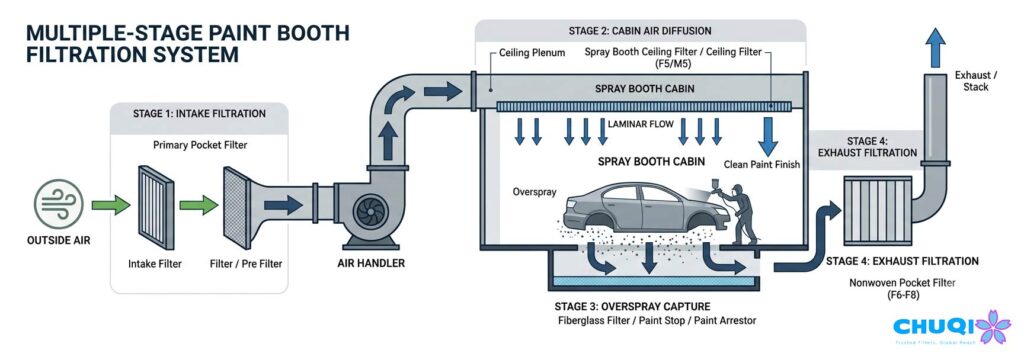
Stage 1: Pre-Filtration (Air Intake Management)
Before outdoor ambient air enters the spray booth heating/air handling unit (AHU), coarse particulate matter (insects, large dust, pollen) must be trapped.
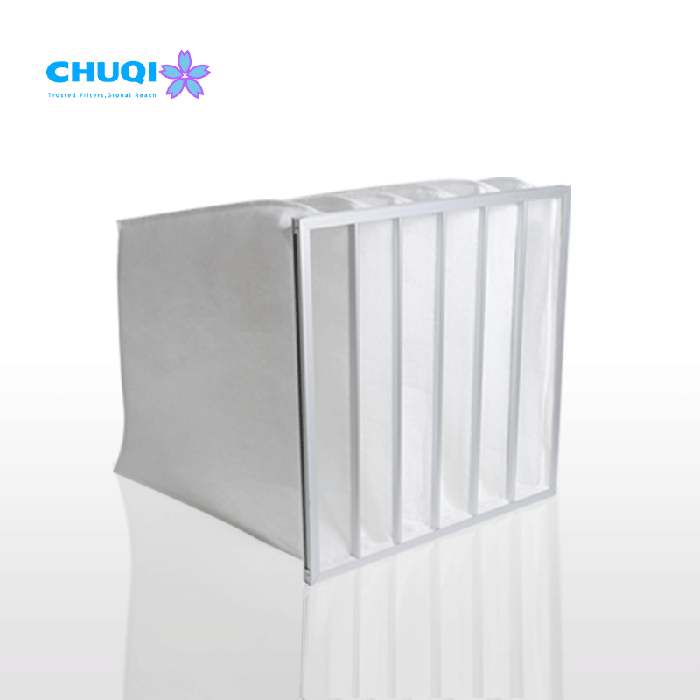
Primary Pocket Filter: Installed in the fresh air intake chamber, these synthetic pocket filters offer high airflow capacity and low initial resistance. They trap 80%+ of coarse dust (>10um), shielding downstream heating elements and secondary filters from rapid clogging.
Intake Filter / Pre Filter: Placed at duct entry ports or air makeup units, this high-density synthetic fiber media serves as the first line of defense, ensuring stable pressure distribution across intake ducts.
Stage 2: Main Cabin Air Diffusion (Ceiling Filtration)
The air entering the spray cabin must be 100% dust-free and distributed in a uniform, non-turbulent (laminar) down-flow pattern.
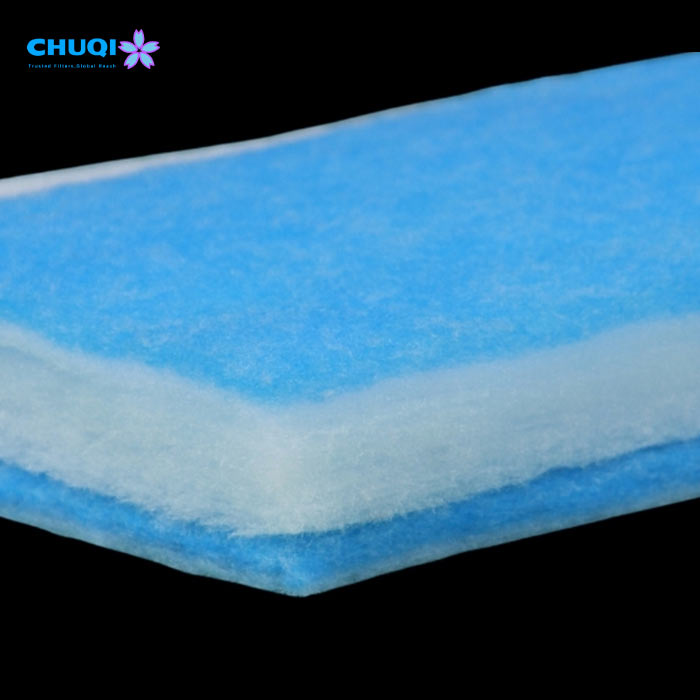
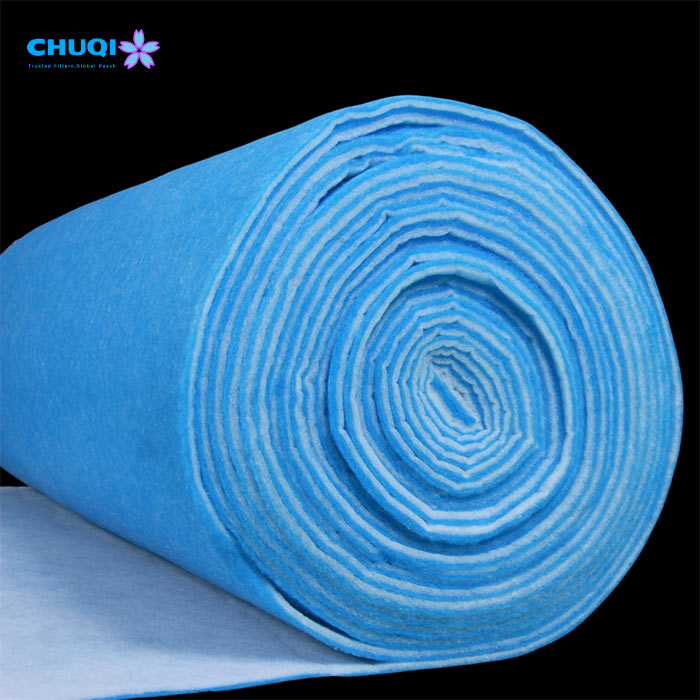
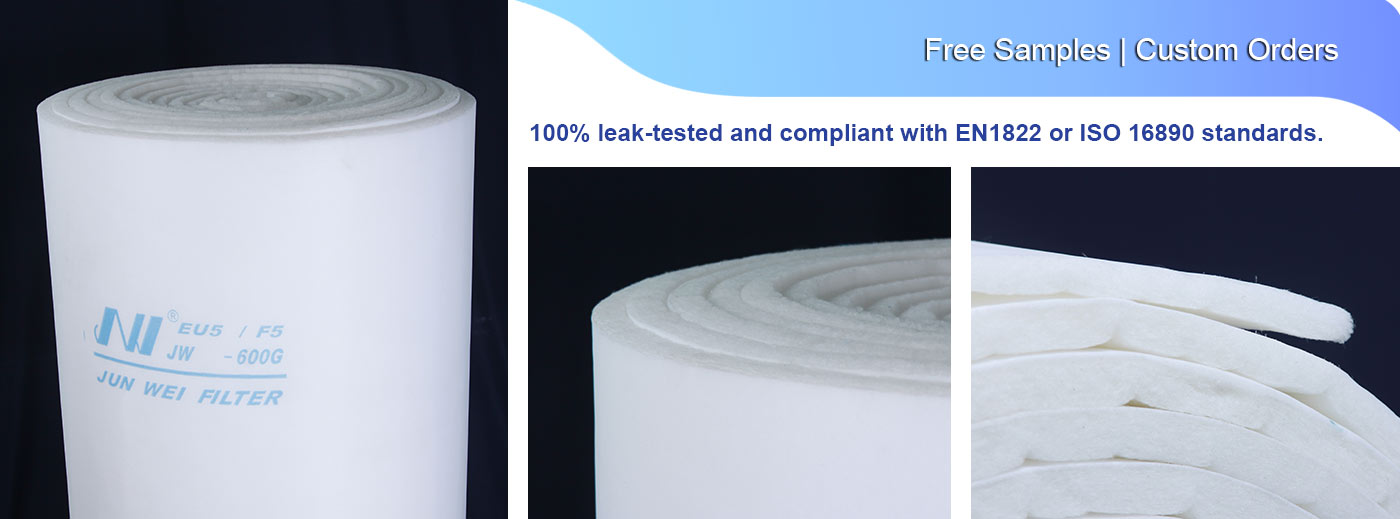
Spray Booth Filter / Ceiling Filter : Positioned directly above the spray area, high-grade ceiling diffusion media features a progressive density structure thermally bonded with sticky tackifiers. This ensures fine particle entrapment down to 1-5 um while preventing trapped dust from migrating due to continuous airflow vibration.
Stage 3: Overspray Capture (Floor & Exhaust Pit Filtration)
As atomized paint sprays toward the workpiece, 30% to 50% becomes overspray. Liquid paint droplets must be captured before reaching exhaust ducts.
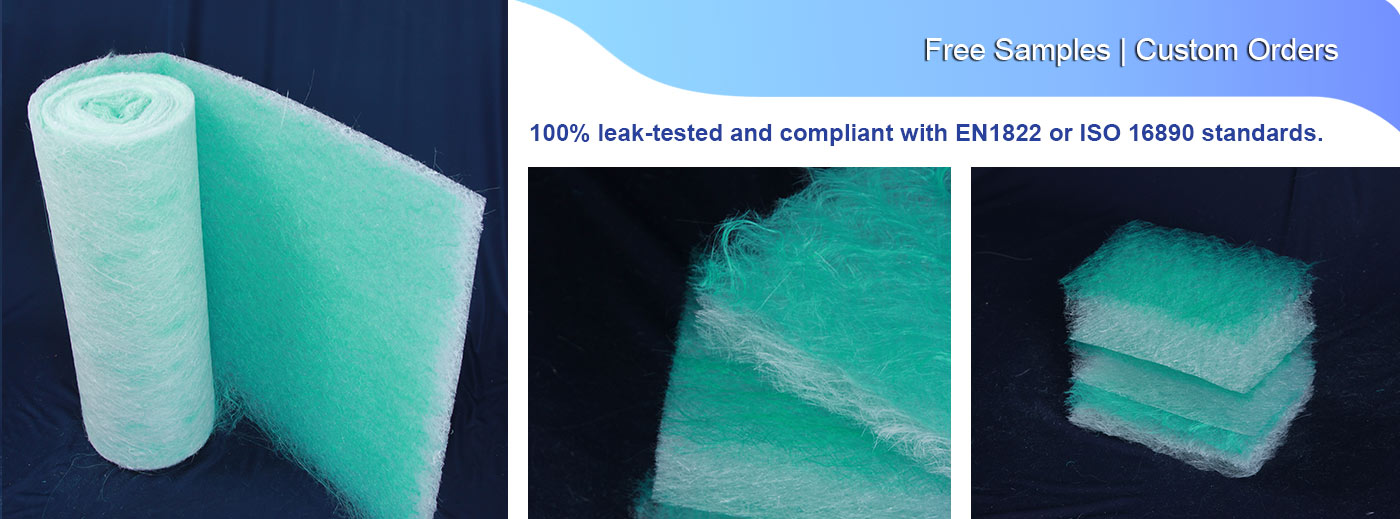
Fiberglass Filter / Paint Stop / Floor Filter / Paint Arrestor: Engineered with continuous monofilament glass fibers featuring a open progressive weave structure, fiberglass paint arrestors collect overspray droplets deep within the media depth rather than surface-blinding. This maximizes paint holding capacity and maintains consistent air velocity across the spray booth floor.
Stage 4: Secondary Exhaust & Environmental Compliance
To protect exhaust turbines, ducting, and comply with atmospheric emission standards, secondary exhaust filtration is required behind the paint arrestor floor mats.
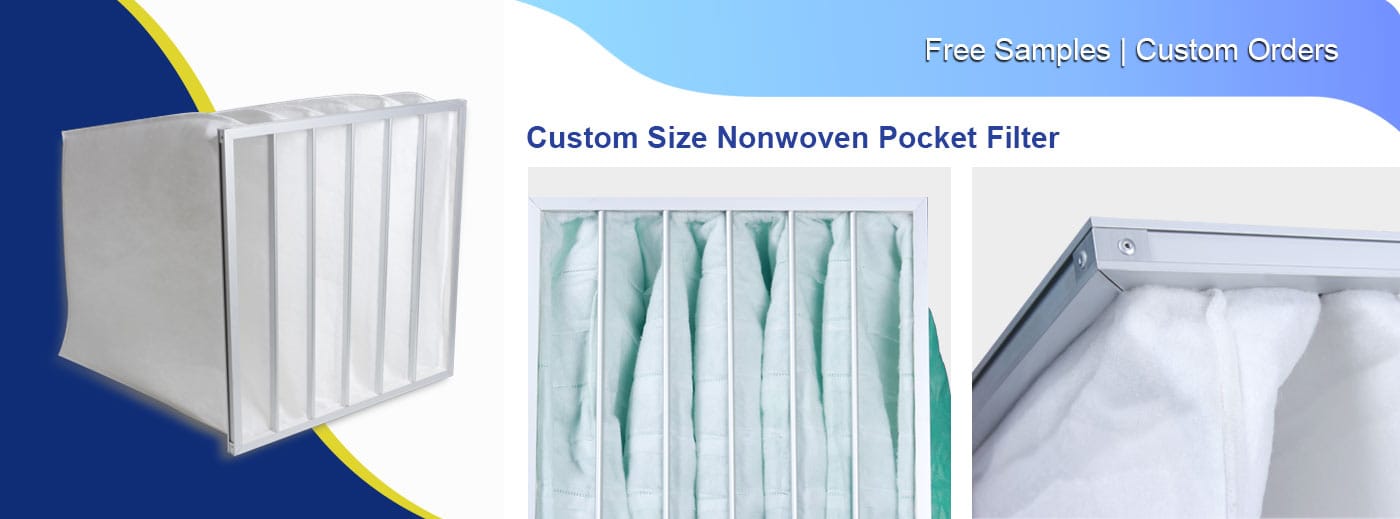
Nonwoven Pocket Filter : Utilizing ultra-fine synthetic nonwoven fibers arranged in multi-pocket designs, these medium-efficiency bag filters trap lingering dry overspray dust and fine particulates ((1-3um)) before air discharges into the atmosphere.
| Filtration Stage | Filter Type & Media | Target Efficiency Class (EN779 / ISO16890) | Key Function | Typical Replacement Cycle |
| Stage 1: Fresh Air Intake | Primary Pocket Filter / Intake Pre-Filter | G3–G4 / Coarse 50–70% | Traps large ambient dust, protects heating coils & fans | 100–150 Operating Hours |
| Stage 2: Cabin Ceiling | Spray Booth Ceiling Filter | F5 / M5 / Coarse 90%+ | Laminar air diffusion, traps 1–5µm fine particles | 300–500 Operating Hours |
| Stage 3: Overspray Pit | Fiberglass Paint Stop Floor Filter | Paint Arrestance 98%+ | Captures liquid paint overspray droplets | 40–80 Spray Hours |
| Stage 4: Secondary Exhaust | Nonwoven Pocket Filter | F6–F8 / ePM10 60–85% | Traps fine dry overspray dust, protects exhaust turbine | 200–400 Operating Hours |
Part 2: How to Build a Paint Booth Filter System
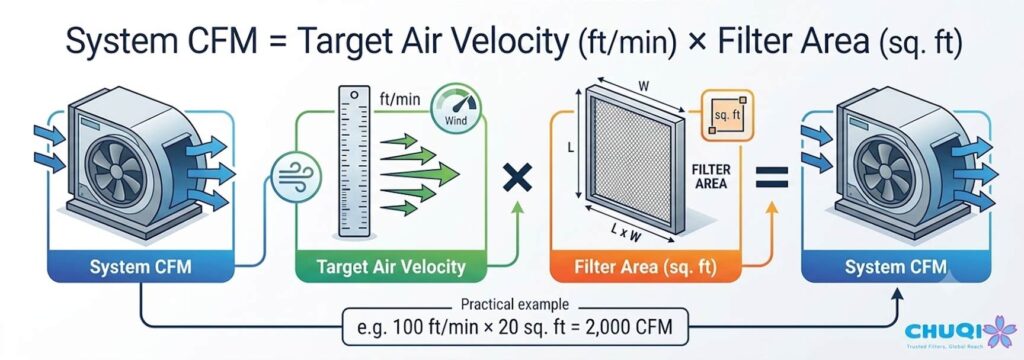
Designing a paint booth filtration system requires balancing CFM (Cubic Feet per Minute), Air Velocity, and Static Pressure Drop.
Step 1: Determine Cabin Airflow Configuration
Downdraft Booths: Air enters through ceiling filters and flows vertically down into floor pit arrestors. Provides the cleanest finishes and safest operating conditions.
Semi-Downdraft Booths: Air enters through the front ceiling and exhausts through the rear lower wall. Ideal for facilities without concrete floor pits.
Crossdraft Booths: Air enters through front doors equipped with intake filters and flows horizontally across the vehicle into rear exhaust banks. Economic option for general industrial coating.
Step 2: Calculate Filter Area and Air Velocity
To achieve optimal paint atomization and safety compliance:
Target Downward Velocity: 0.5–1.0 m/s (100 FPM) across the working zone.
Exhaust Velocity: Maintain 1.2–1.5 m/s through the fiberglass floor filter to capture overspray without pulling paint off the workpiece.
Formula for Required Ceiling Filter Area:
Ceiling Filter Area (m²) = Required Air Volume (m³/h) ÷ (3600 × Target Face Velocity (m/s))
Step 3: Build the Multi-Stage Pressure Balance Architecture
A common design flaw in DIY or low-cost paint booths is inadequate static pressure control. As filters load with paint and dust, resistance increases.
To maintain continuous airflow without starving the exhaust fan:
Intake Plenum: Mount Intake Filters/Pre Filters or Primary Pocket Filters in a sealed chamber before the supply blower.
Ceiling Plenum Frame: Construct an airtight drop-ceiling frame with perimeter clamping gaskets. Ensure zero gaps between Ceiling Filter rolls.
Exhaust Pit / Wall Frame: Position heavy-duty steel floor grates over a recessed pit lined with Fiberglass Paint Arrestor Mats. Install secondary Nonwoven Pocket Filters in the downstream duct flange.
Magnehelic Pressure Gauges: Install differential pressure transmitters across the ceiling bank and exhaust pit to monitor pressure drop(ΔP) in real time.
Part 3: How to Install Paint Booth Filters (Step-by-Step Guide)
Improper installation causes air bypass—where dust and overspray sneak around filter edges, rendering high-efficiency media useless. Follow these master technician procedures for flawless installation.
Installing Ceiling Diffusion Filters (Spray Booth Filter / Ceiling Filter)
Pre-Clean the Cabin: Turn off all blowers, thoroughly pressure wash or tack-wipe cabin walls, ceiling frames, and light fixtures to remove loose scale.
Check Media Orientation: Ceiling Filters feature a progressive density design with a sticky resin backing on the air-leaving side and a white mesh/textile grid. Ensure the smooth/tacky side faces DOWN toward the spraying cabin.
Cut with Overlap Allowance: Measure the ceiling frame grid. Cut media pads or continuous rolls with a 20–30mm oversize margin to ensure compressed, friction-fit perimeter seals within hold-down clamps.
Inspect Clamping Gaskets: Ensure perimeter neoprene rubber gaskets are flexible and intact. Tighten frame clamps evenly to compress filter edges down to 50% original thickness without tearing the media.
Installing Fiberglass Floor Paint Arrestor Filters
Clean Pit Floor & Grate Supports: Remove dried paint sludge and debris from floor pit channels.
Identify Fiber Density Gradient: Fiberglass Paint Stop media features a color-coded gradient (typically green/blue on the air-entry side and white on the air-leaving side).
Position Media Correctly: Lay the fiberglass roll across the floor pit channels with the colored open-weave side facing UP (toward the painter) and the dense white side facing DOWN (toward the exhaust pit).
Avoid Over-Compression: Do not stomp or over-stretch the roll. Compression reduces internal void volume, causing early surface blinding and reduced overspray holding capacity.
Installing Primary & Nonwoven Pocket Filters
Pocket Orientation: Always install Primary Pocket Filters and Nonwoven Pocket Filters with pockets running VERTICALLY (perpendicular to the ground). Vertical pockets prevent sagging under dust load and maintain uniform airflow channels.
Gasket Compression: Apply self-adhesive closed-cell EVA sealing tape around the filter header frame flange. Clamping frames tightly against the holding bank structure prevents high-velocity bypass leaks.
Why Global Procurement Teams Choose Chuqi New Materials
At Chuqi New Materials, we specialize in manufacturing high-performance industrial air filtration media and equipment. We understand that finishing quality relies directly on media consistency, tensile strength, temperature resistance, and flame retardancy.
Our Industrial Manufacturing Capabilities:
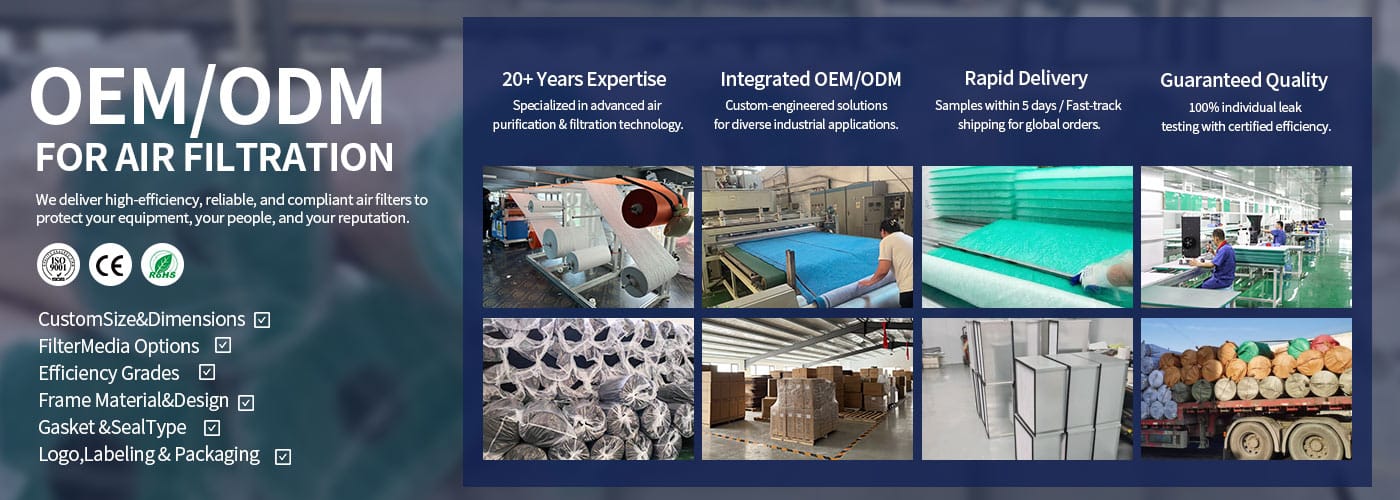
Strict OEM/ODM Customization: Custom roll widths, pre-cut pads, pocket dimensions, and specialized tackifier formulas engineered for your specific booth model.
International Standards Compliance: Our filtration media undergoes rigorous testing to meet EN779, ISO16890, DIN 53438 F1 flame retardancy, and UL 900 standards.
Full-Spectrum Product Matrix: From low-resistance Intake Pre-Filters and high-capacity Fiberglass Floor Paint Arrestors to sticky Ceiling Diffusion Media and precision Nonwoven Pocket Filters, we supply complete turnkey filtration solutions for global exporters, automotive plants, and coating line builders.
Upgrade Your Paint Booth Filtration Today
Whether you are designing a brand-new automotive finishing facility or optimizing an existing industrial coating line, choosing high-grade filtration media reduces rework costs and protects your exhaust infrastructure.
【Contact Chuqi New Materials Technical Sales Team】 to request custom technical datasheets, free sample swatches, or bulk factory-direct export quotes.