
To compare paint stop media thickness and basis weight, first match the units, measurement conditions, and definition of the reported weight. Then review the material structure and relevant performance data.
Thickness describes material depth. Basis weight describes mass per unit area. Neither value alone establishes capture efficiency, paint-holding capacity, or service life. For buyers comparing fiberglass paint arrestor media, these specifications are useful starting points—not a complete performance ranking.
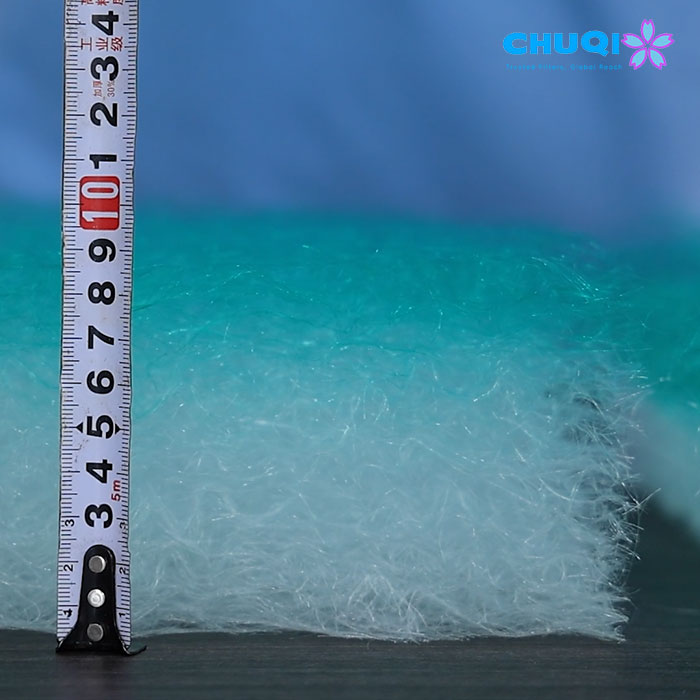


What Do Thickness and Basis Weight Measure?
Thickness and basis weight describe different physical characteristics. A thicker material is not necessarily heavier per unit area, and a higher basis weight does not necessarily mean greater thickness.
| Specification | Common Units | What It Measures | What It Does Not Establish Alone |
|---|---|---|---|
| Thickness | mm, in. | Material depth under the stated conditions | Capture efficiency, paint-holding capacity, or service life |
| Basis weight | g/m², g/ft² | Material mass per unit area | Thickness, fibre distribution, or overall filtration performance |
Thickness Depends on How the Material Is Measured
Fiberglass paint stop media is lofty and compressible. A sample resting freely may give a different thickness reading from one under a measuring foot or compressed within a retaining frame.
Distinguish nominal thickness from a measured result. A nominal value identifies the stated product thickness; it should not be treated as a precise reading under every condition.
When comparing measured values, look for a consistent method, applied pressure, and sample condition. An informal measurement taken while pressing the material down by hand is not directly comparable with a supplier’s reported value unless the conditions are understood.
Thickness matters for installation fit, but similar thickness alone does not establish interchangeability.
Basis Weight Is Mass per Unit Area
Basis weight, also called mass per unit area, describes the mass of material over a defined area. GSM means grams per square metre, written as g/m².
The basic calculation is:
Basis weight = sample mass ÷ sample area.
For a result in g/m², use mass in grams and area in square metres.
Basis weight is not total roll weight. Roll width and length determine the material area, while cores and packaging add weight without adding media. Gross roll weight therefore cannot be used directly as a substitute for basis weight.
Also check whether the reported value describes glass fibre mass or total media mass, including binder or other components.
Basis Weight Is Not Bulk Density
Basis weight is mass per area; bulk density is mass per volume.
Two products can have the same basis weight but different thicknesses. Even an average bulk density calculated from those values would not show how fibres are distributed through the media.
For purchasing, use the stated parameter and complete unit rather than general descriptions such as “denser” or “heavier-duty.”
Check GSM and g/ft² Before Comparing Grades
GSM and grams per square foot are different units. A matching number does not mean matching basis weight.
| Unit | Meaning | Conversion |
|---|---|---|
| g/m², or GSM | Grams per square metre | Divide by approximately 10.764 to obtain g/ft² |
| g/ft² | Grams per square foot | Multiply by approximately 10.764 to obtain g/m² |
For example, 22 g/ft² is approximately 237 g/m²—not 22 GSM.
This conversion only aligns the units. It does not establish equivalent material construction or performance.
“22 Gram” Is Not a Complete Specification
Descriptions such as “15 gram” or “22 gram” need context. They may be shorthand for a defined basis weight or part of a product grade reference.
Before comparing them, establish:
The complete area unit.
What components the weight includes.
Whether the number is a reported specification or a grade designation.
Do not automatically read a number in a product name as GSM.
Keep Thickness Units and Tolerances Separate
One inch equals 25.4 mm, but converting units does not define a product’s dimensional tolerance.
If a specification lists a nominal thickness in inches and an approximate metric equivalent, agree on which value is used for ordering. A rounded conversion should not accidentally become a separate acceptance requirement.
The measurement method remains important after conversion: two values expressed in millimetres are not necessarily comparable if they were measured under different conditions.
Is Thicker or Heavier Paint Stop Media Better?
Not automatically. Thickness and basis weight help identify physical differences, but their significance depends on the construction and intended application.
Greater Thickness Does Not Necessarily Mean More Material
Thickness is influenced by fibre arrangement and loft. A thicker structure may have the same mass per unit area as a thinner one.
An increase in thickness alone therefore does not prove greater paint-holding capacity or a longer replacement interval.
Higher Basis Weight Does Not Rank Every Performance Characteristic
Higher basis weight means more mass over the same area, provided the reporting basis is consistent. It does not fully describe fibre size, arrangement, or the passages through which air flows.
Avoid assuming that higher basis weight always means:
Higher capture efficiency.
Higher pressure drop.
Longer service life.
Within a clearly defined product series, supporting data may explain how a change in basis weight affects performance. Across different constructions or suppliers, the number alone is a weaker basis for comparison.
Matching Both Values Does Not Prove Equivalence
Two products with matching nominal thickness and basis weight may still differ in fibre size, arrangement, binder, support construction, or structure through the depth of the media.
Those differences are not fully represented by two physical specifications. Matching both values can help identify a candidate, but it does not confirm a direct replacement.
For replacement sourcing, see How to Find Replacement Fiberglass Paint Arrestor Media Without a Part Number.
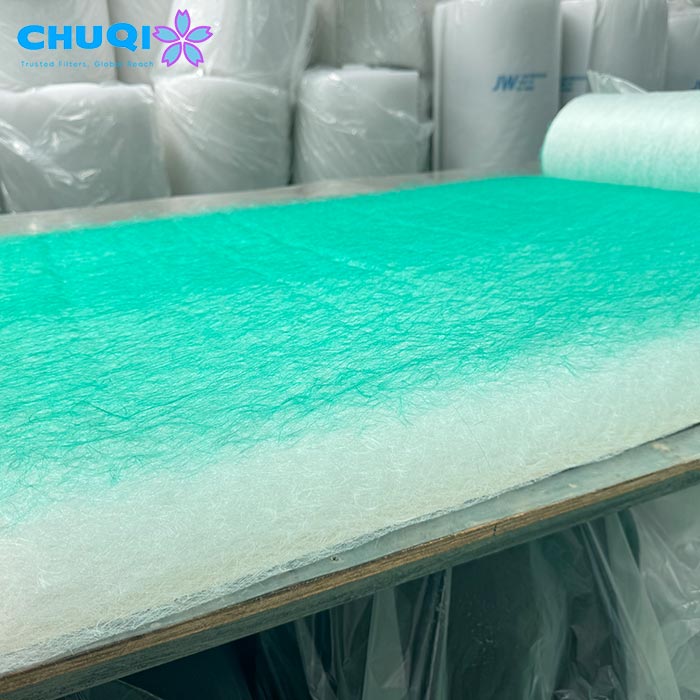

Compare Performance on the Same Test Basis
Physical specifications describe the material. Performance data helps assess what it does under defined conditions.
Before ranking products, check whether the reported results share a comparable test basis.
| Performance Item | Check Alongside the Result |
|---|---|
| Initial pressure drop | Face velocity, sample condition, and test configuration |
| Paint overspray capture | Test method, challenge material, and definition of the reported result |
| Paint-holding capacity | Loading method, reporting units, and test endpoint |
| Service interval | Operating load, running hours, and replacement criteria |
Pressure Drop Needs a Corresponding Face Velocity
A lower initial pressure-drop figure does not automatically mean lower resistance in the same application.
If the values were measured at different face velocities or with different configurations, the figures should not be ranked without further context.
Paint-Holding Capacity Needs a Defined Endpoint
Paint-holding capacity depends on how the media is loaded and when the test ends.
Two results can use the same unit yet remain unsuitable for direct comparison if their loading conditions or endpoints differ. The larger number should not automatically be interpreted as longer field life.
Test Results Are Not a Fixed Replacement Schedule
Actual replacement intervals also depend on overspray load, operating hours, and site requirements.
Test data can support selection, but it should not be converted into a fixed number of operating days for every installation.
For broader application-based selection, see How to Choose Fiberglass Paint Stop Media for Your Spray Booth.
A Practical Way to Compare Two Specification Sheets
Read the data in a consistent order: align the units, check the measurement basis, and then assess the differences relevant to your application.
| Specification | First Check | Purchasing Question |
|---|---|---|
| Thickness | Units, nominal or measured value, and measurement conditions | Does it meet the installation requirement? |
| Basis weight | Area unit and included components | Is there a genuine difference in mass per unit area? |
| Construction | Available fibre and structure information | Are important differences missing from the two headline specifications? |
| Initial pressure drop | Face velocity and test configuration | Can the reported resistance values be compared? |
| Other performance | Method, units, and test conditions | Does the evidence address the intended application? |
Missing information should remain an open question—not be replaced with an assumption.
If the area unit is missing, establish it before comparing weight. If the thickness methods differ, clarify the conditions. If performance data lacks a supporting test basis, avoid using thickness or GSM as a substitute.
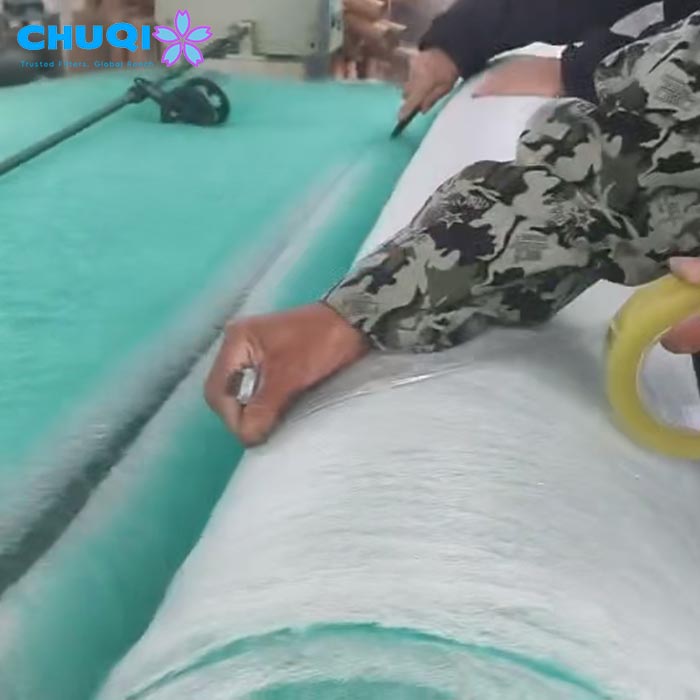
A sample can help with visual inspection, dimensional checks, and cutting or handling assessment. Touch, appearance, and simple weighing do not replace filtration performance evaluation.
When the Specifications Leave Questions, Take a Closer Look
A sample can add practical context when data sheets leave material differences unclear. It lets you examine the media’s condition and assess handling during cutting or installation, while keeping those observations separate from performance claims.
You can explore Chuqi’s fiberglass paint arrestor media or share the specifications you are comparing to discuss the differences. For a physical reference, contact Chuqi to request a free sample. Sample specifications, quantities, and shipping arrangements require confirmation.
Frequently Asked Questions
1. Is thicker paint stop media always better?
No. Thickness describes material depth under the stated conditions. It does not independently establish capture efficiency, paint-holding capacity, or service life. Compare the construction, installation requirements, and relevant performance data.
2. Does higher GSM mean higher filtration efficiency?
Not necessarily. GSM measures mass per unit area, not capture efficiency. Fibre structure and test conditions also matter, so a higher GSM value is not sufficient evidence of higher efficiency.
3. Are “22 gram” and “22 GSM” the same?
Not necessarily. 22 GSM means 22 g/m². “22 gram” needs an area unit or a defined grade description. If it means 22 g/ft², the equivalent is approximately 237 g/m².
4. Can two products with the same thickness and basis weight perform differently?
Yes. Those values do not fully describe fibre arrangement, binder, or structure through the depth of the media. Comparable performance information is still needed to assess equivalence.
5. Can thickness measurements taken under different conditions be compared directly?
Not reliably. Applied pressure, sample condition, and measurement method can affect the thickness reading of compressible media. Understand those conditions before treating the results as directly comparable.