
MPPS (Most Penetrating Particle Size) is the particle size at which a filter exhibits its lowest filtration efficiency under specified test conditions. In HEPA filter testing, MPPS provides the particle-size basis for evaluating performance where penetration is greatest.
MPPS is not a fixed particle size of 0.3 μm, and it does not represent the smallest particle a HEPA filter can capture. Its value depends on the filter medium and the applicable test conditions.
For engineers, OEM equipment manufacturers, quality teams and industrial filtration buyers, understanding MPPS helps clarify what a test result actually demonstrates. Before approving a HEPA filter, confirm the applicable test standard, the product evaluated, the operating conditions and whether the supplied documentation covers the required performance.
What Does MPPS Mean in HEPA Filter Testing?
MPPS stands for Most Penetrating Particle Size. It identifies the particle size at which filtration efficiency reaches its minimum under the specified test conditions.
A filter’s efficiency varies with particle size. When efficiency is plotted against particle size, the curve typically has a minimum or least-efficient region. The corresponding region is the MPPS.
The same relationship can be expressed using penetration, which describes the proportion of challenge particles passing through the filter. At MPPS, penetration reaches its maximum under the relevant test conditions.
In simple terms:
MPPS: The particle size associated with the lowest filtration efficiency.
Efficiency at MPPS: The proportion of challenge particles removed at that particle-size basis.
Penetration at MPPS: The proportion of challenge particles passing through at that basis.
This distinction matters when engineers compare HEPA filter test reports or evaluate whether a supplier’s documentation supports a project specification.
Is MPPS the Same as a Filter’s Pore Size?
No. MPPS is not a pore-size rating.
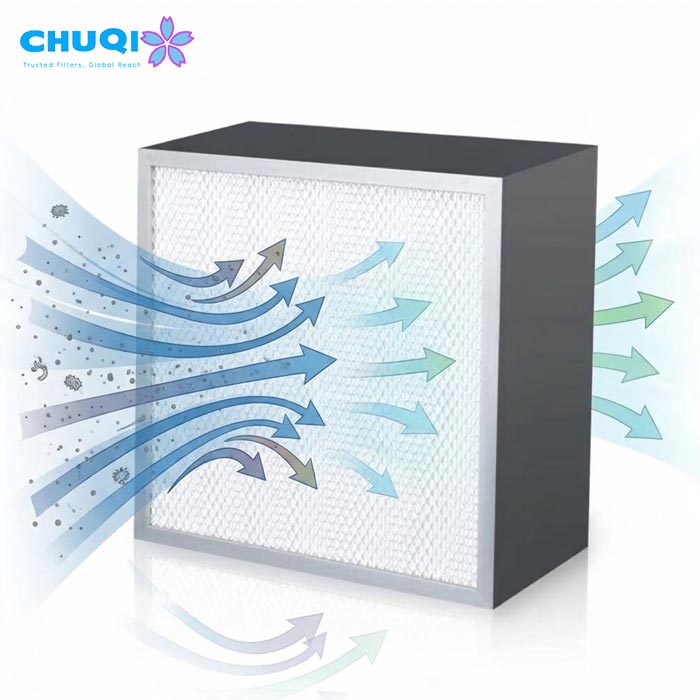
HEPA filtration does not work like a simple sieve in which particles smaller than a fixed opening automatically pass through. Particle capture involves several mechanisms, including diffusion and interception, whose relative contributions vary with particle size and operating conditions.
As a result, filtration efficiency does not continuously decrease as particle size becomes smaller. The interaction of the capture mechanisms produces a least-efficient particle-size region.
A filter tested at MPPS should therefore not be described as unable to capture particles smaller than the MPPS.
For a broader explanation, see our guide to How HEPA air filters capture particles.
Why Is MPPS Not Always 0.3 Microns?
MPPS depends on the filter medium and the applicable test conditions. It should not be assigned solely from a commonly quoted particle-size value.
Some mechanical filter media have an MPPS within the approximate 0.1–0.3 μm range, but this is not a universal specification. The actual basis must be established through the applicable evaluation method rather than assumed for every medium or finished filter.
MPPS Efficiency vs. Efficiency at 0.3 μm
These two statements describe different measurement bases:
| Measurement statement | What it means |
|---|---|
| Efficiency at 0.3 μm | Efficiency evaluated at a specified particle size of 0.3 μm |
| Efficiency at MPPS | Efficiency evaluated at the most penetrating particle-size basis established under the applicable conditions |
A reported efficiency at 0.3 μm does not automatically establish the filter’s efficiency at MPPS. Likewise, an MPPS-based result should not be rewritten as a fixed-particle-size result unless the supporting data justify that statement.
For procurement and technical approval, request the actual test basis rather than assuming that 0.3 μm is the MPPS for every HEPA filter.
How Is MPPS Used in HEPA Filter Testing?
Under the applicable high-efficiency filter testing framework, determining the MPPS and evaluating the finished filter are related but distinct activities.
The filter medium provides part of the performance basis. The complete filter assembly must be evaluated according to the applicable classification requirements and test scope.
1. Establish the Relevant MPPS Basis
The filter medium is evaluated across particle sizes under specified conditions to identify the least-efficient region.
This establishes the relevant MPPS basis for the subsequent evaluation. The exact procedure depends on the applicable standard and test method.
It should not be assumed that every finished filter must independently undergo the same complete particle-size sweep. The required procedure depends on the product evaluation scope and the applicable method.
2. Evaluate the Finished Filter
A media test result is not automatically a finished-filter classification.
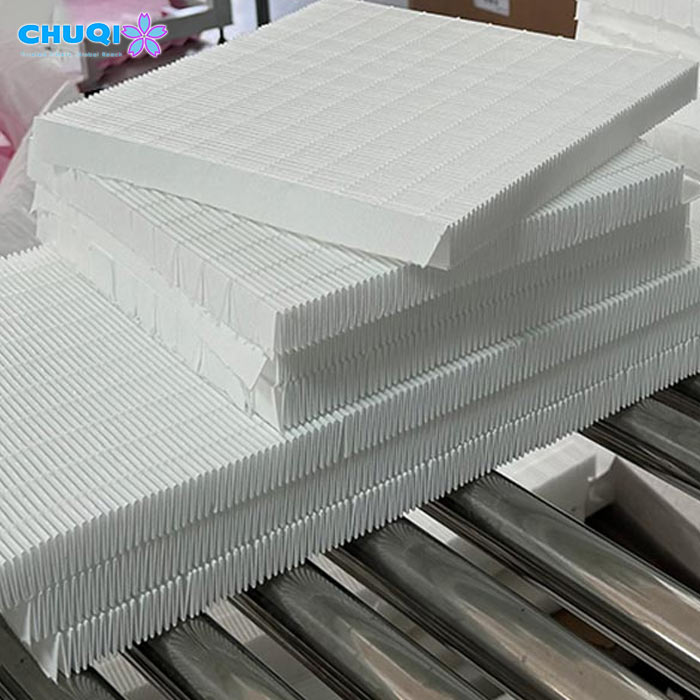
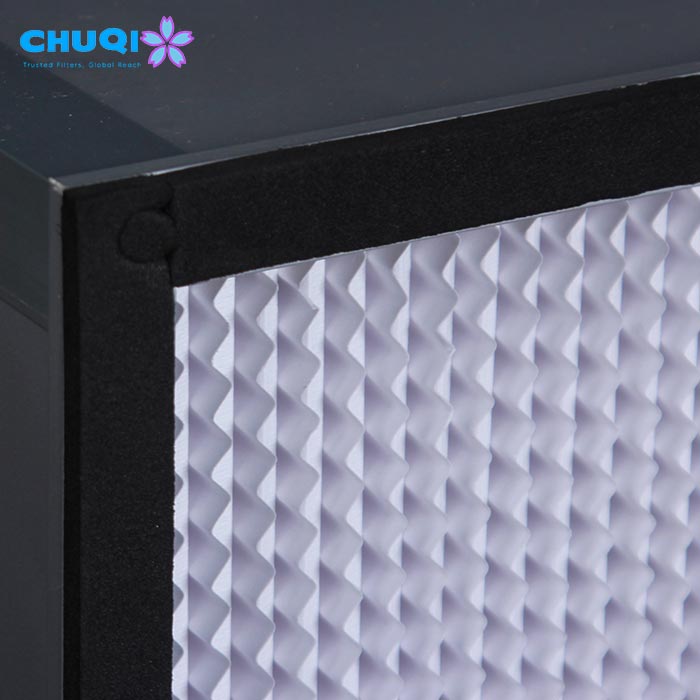
The complete filter includes the media pack, frame, sealant and other construction features. The applicable evaluation must address the assembled product in accordance with the relevant requirements.
Test airflow and other specified conditions are important because a result obtained at one operating point should not be presented as unconditional proof of performance at every airflow.
When reviewing documentation, identify whether the report concerns a material sample, filter medium or complete filter element.
3. Distinguish Overall Efficiency from Local Leakage Evaluation
Overall efficiency describes the integrated performance of the tested filter under the specified conditions.
Local evaluation addresses performance at particular areas or potential leakage locations, as required by the applicable test method.
These results are not interchangeable. A high overall-efficiency result does not, by itself, demonstrate identical performance at every local point.
The required overall-efficiency and local-leakage evidence depends on the applicable classification standard, test method and product evaluation scope. A report containing one overall percentage should not automatically be interpreted as a complete record of all required integrity evaluations.
What Does Efficiency at MPPS Actually Tell You?
Efficiency at MPPS describes particle removal at the relevant most-penetrating particle-size basis under the stated test conditions.
Penetration expresses the proportion of challenge particles passing through the filter. When both values are expressed as percentages:
Penetration (%) = 100% − Efficiency (%)
For example, an overall efficiency of 99.995% corresponds to an overall penetration of 0.005%.
This calculation explains the mathematical relationship between efficiency and penetration. It does not replace the test method or establish that a particular filter has achieved that result.
H13 and H14: Overall Efficiency and Penetration Limits
The following values are commonly used to describe the overall MPPS classification limits under EN 1822:
| Filter class | Minimum overall efficiency at MPPS | Maximum overall penetration |
|---|---|---|
| H13 | ≥ 99.95% | ≤ 0.05% |
| H14 | ≥ 99.995% | ≤ 0.005% |
These are classification limits, not measured results for a specific filter. Confirm the applicable standard edition and the complete requirements before using these values in a project specification.
Under these overall limits, H14 permits one-tenth of the maximum overall penetration allowed for H13. This is a more precise comparison than describing H14 as having “ten times higher efficiency.”
Local performance requirements, where applicable, must be evaluated separately under the relevant classification and test requirements.
A Practical Penetration Example
Assume an illustrative upstream particle count of 100,000 particles on the relevant measurement basis.
At a penetration of 0.005%, the corresponding downstream count would be:
100,000 × 0.00005 = 5 particles
This example illustrates the proportion represented by a penetration percentage. It is not a prescribed test sample size, a complete testing procedure or a prediction of particle concentration in an occupied room.
Actual filter testing follows the applicable method, including its measurement and data-processing requirements.
A Classification Limit Is Not an Individual Test Result
A classification table defines the required performance limits for a class. A test report records results for the tested product or sample within its stated scope.
These documents serve different purposes.
For example, a catalogue that identifies a filter as H14 is not equivalent to a test record reporting measured performance for an identifiable filter configuration.
When project-specific evidence is required, clarify which documentation must accompany the offered product. Do not treat a classification limit as proof of an individual test result.
How to Compare MPPS Results in HEPA Filter Test Reports
Two high-efficiency percentages are not necessarily comparable. Before comparing results, establish what was tested, how it was tested and which product the result represents.
1. Confirm the Test Object
Determine whether the document concerns:
Filter media or a media sample
A complete finished filter element
Overall efficiency
Local leakage or integrity evaluation
A media report should not be treated as equivalent to a finished-filter report. Likewise, an overall-efficiency result should not be compared directly with a local penetration result as though both describe the same characteristic.
2. Check the Standard and Test Conditions
Identify the applicable standard, edition, test method and relevant operating conditions.
Airflow or media-velocity conditions can affect how the result should be interpreted. If the report mentions MPPS without making its basis clear, request the information needed to determine whether the result applies to the proposed filter and operating requirement.
The goal is not to require every supplier to use an identical document layout. It is to establish whether the evidence supports a valid technical comparison.
3. Match the Evidence to the Offered Configuration
The test evidence should be relevant to the product being quoted.
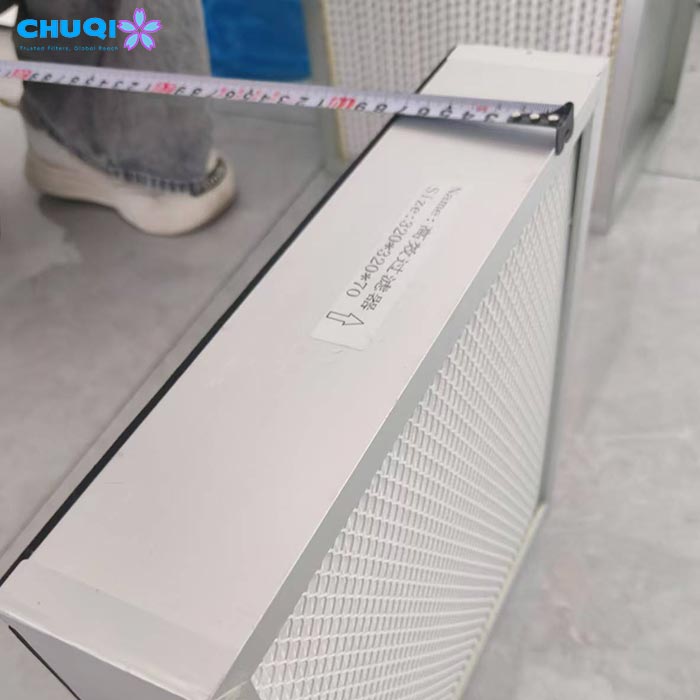
Check available product identification, dimensions, media construction and other configuration details that help establish this connection.
A result for one configuration should not automatically be assigned to another if the media, construction, dimensions or operating conditions differ.
If a supplier provides a sample report for reference, distinguish it from the documentation agreed for the actual supply.
What MPPS Testing Does Not Prove
MPPS testing provides important evidence about filtration performance, but the result must be interpreted within its scope.
It Does Not Establish Performance at Every Airflow
A test result applies under its stated conditions. It should not automatically be extended to higher airflow, a different media velocity or another filter configuration.
If the intended operating conditions differ from the test basis, confirm what additional evaluation or supporting data are required.
It Does Not Independently Prove Installed Filter Integrity
Factory evaluation assesses the filter under defined test conditions. It does not independently establish the condition of the filter-to-housing interface after installation.
The installed assembly may also depend on seals, mating surfaces, retention arrangements and installation quality. Where required, installed-system integrity must be addressed through the applicable field verification procedure.
It Does Not Guarantee a Cleanroom Classification
A filter’s MPPS efficiency is not a cleanroom classification.
Cleanroom verification involves additional requirements and assessments, which may include airflow characteristics, installed filter integrity and airborne particle concentration.
A satisfactory filter test result should not be promoted as proof that an entire room or production process meets a specified cleanliness class.
It Does Not Predict Filter Service Life
An efficiency result at MPPS does not establish how many months a filter will remain suitable for use.
Service life depends on the application, contaminant loading, operating conditions, pressure-drop changes, physical condition and applicable maintenance criteria.
Do not convert a filtration-efficiency percentage into a fixed replacement interval.
Frequently Asked Questions
Q: What does MPPS stand for in HEPA filter testing?
A: MPPS stands for Most Penetrating Particle Size. It is the particle size at which filtration efficiency reaches its minimum under specified test conditions.
Q: Is MPPS always 0.3 μm?
A: No. MPPS depends on the filter medium and test conditions. A value of 0.3 μm should not be assumed to represent the MPPS of every filter.
Q: Does MPPS mean a HEPA filter cannot capture smaller particles?
A: No. MPPS identifies the least-efficient particle-size region under the relevant conditions. It is not the minimum particle size that a filter can capture.
Q: What is the difference between efficiency at MPPS and efficiency at 0.3 μm?
A: Efficiency at 0.3 μm refers to a specified particle size. Efficiency at MPPS refers to the most penetrating particle-size basis established under the applicable conditions. The two values should not be treated as interchangeable without supporting evidence.
Q: What is the difference between overall efficiency and local leakage evaluation?
A: Overall efficiency describes integrated filter performance under the test conditions. Local evaluation examines specific areas or potential leakage locations according to the applicable method. The required evidence depends on the classification standard and test scope.
Q: Does an MPPS test report prove that a filter is suitable for every operating airflow?
A: No. A test result applies within its stated conditions and scope. Suitability at a different airflow or for a different configuration requires appropriate supporting evidence.
Q: What should I check in a supplier’s HEPA filter test report?
A: Confirm the applicable standard and edition, test object, operating conditions, reported efficiency, evaluation scope and connection between the tested product and the offered configuration. Also clarify any additional documentation required by the project.
Need Help Reviewing Your Industrial HEPA Filter Requirements?
If you are evaluating a new filtration assembly, sourcing a replacement or reviewing supplier documentation, start with the information already available.
Share your project specification, existing filter reference, equipment drawing or required operating conditions with Chuqi. HEPA filter configuration and identify which technical details and documentation requirements still need confirmation.
As a source factory offering custom filtration solutions, Chuqi can discuss your application and customization requirements without requiring every parameter to be finalized before the initial conversation.
Explore our industrial HEPA filter product range to review available product options, then contact our team to discuss your project requirements.
If you are evaluating a new filtration assembly, sourcing a replacement or reviewing supplier documentation, start with the information already available.
Share your project specification, existing filter reference, equipment drawing or required operating conditions with Chuqi. HEPA filter configuration and identify which technical details and documentation requirements still need confirmation.As a source factory offering custom filtration solutions, Chuqi can discuss your application and customization requirements without requiring every parameter to be finalized before the initial conversation.Explore our industrial HEPA filter product range to review available product options, then contact our team to discuss your project requirements.CTA: Discuss Your Custom HEPA Filter Requirements