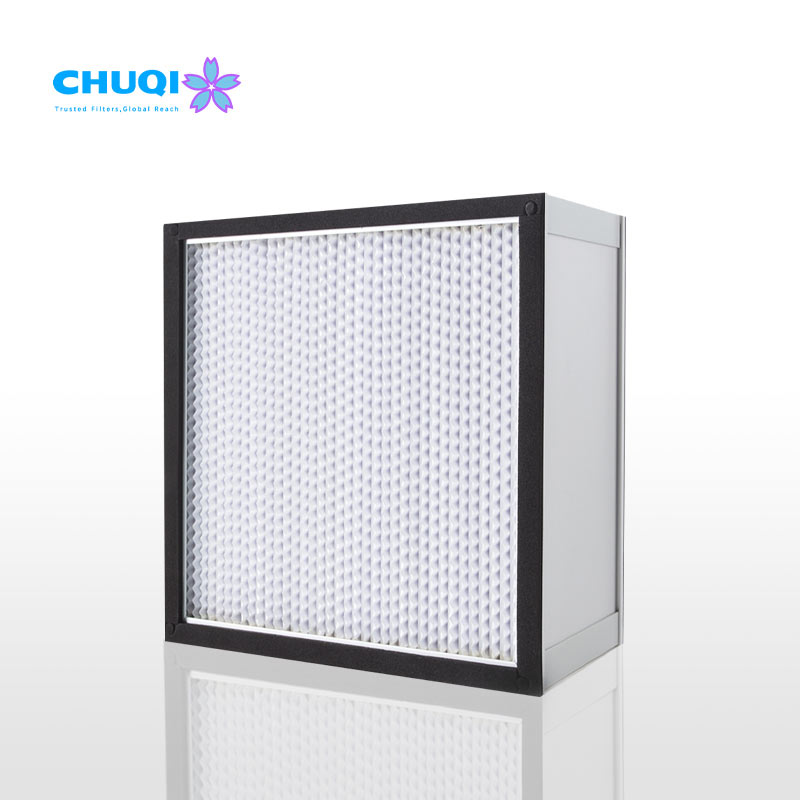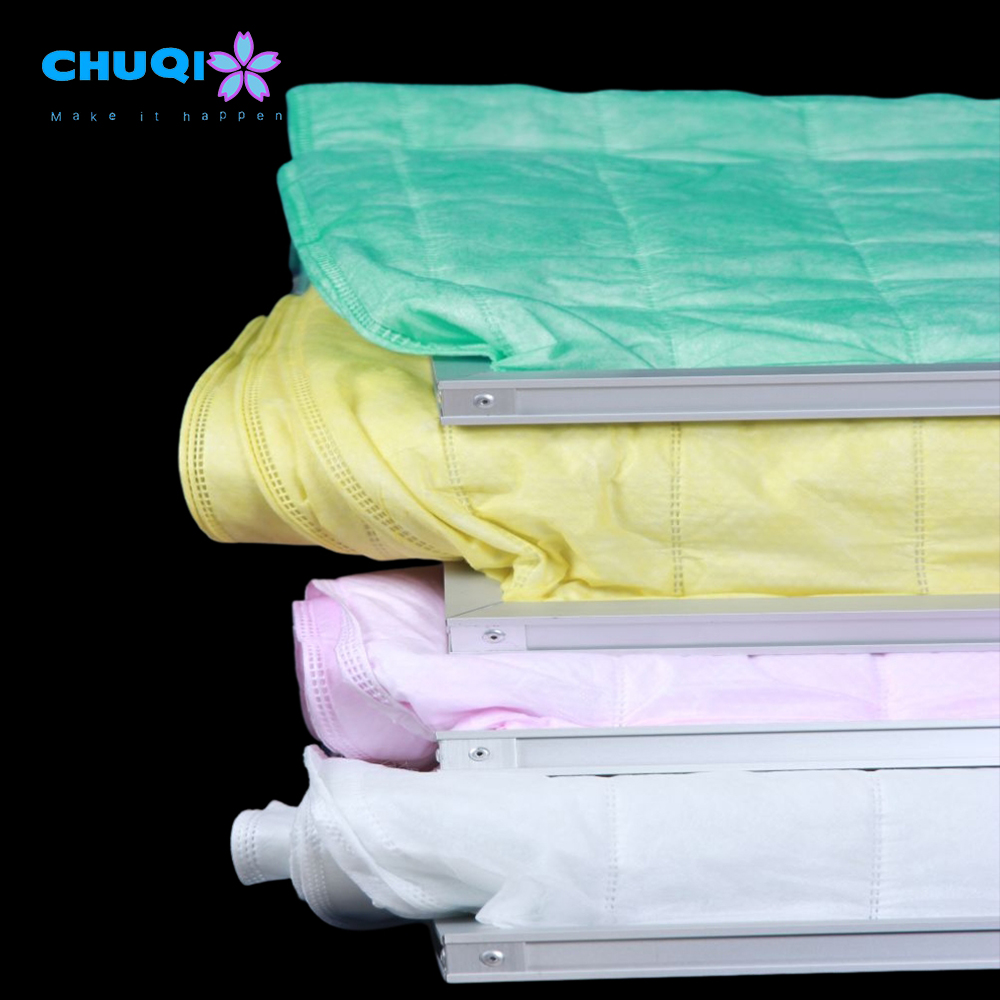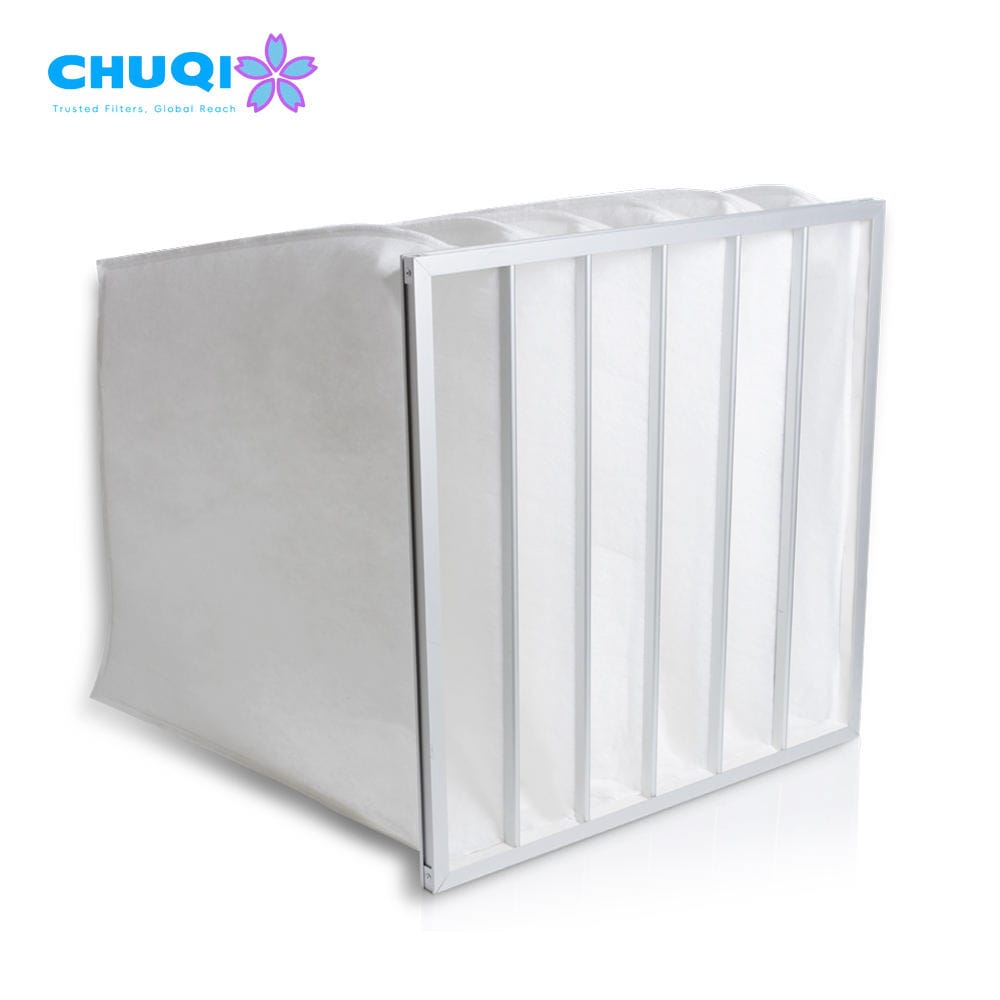
A pocket air filter (also known as a bag filter) serves as a primary or secondary filtration barrier in commercial and industrial Air Handling Units (AHUs). Engineered with extended pocket geometry and progressive-density synthetic media, it delivers high Dust Holding Capacity (DHC) while maintaining low initial static pressure drop (Delta P). Upgrading to ultrasonically welded, ISO 16890-certified pocket filters prevents air bypass, reduces fan energy consumption, and extends the operational lifespan of expensive downstream HEPA filters by up to 200%.
Industrial Pocket Air Filters: ISO 16890 Performance & HVAC TCO Guide
1. Introduction: Quantifying Filtration Performance in Industrial AHUs
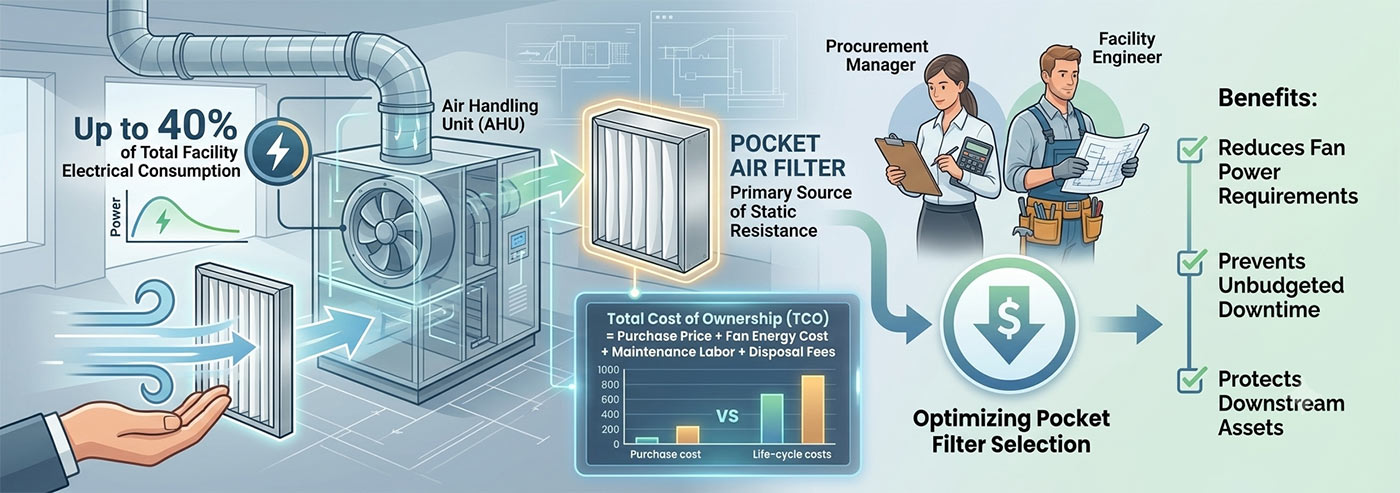
In commercial HVAC systems and industrial Air Handling Units (AHUs), ventilation fans account for up to 40% of total facility electrical consumption. Within these continuous-duty systems, air filters represent the primary source of operational static resistance.
For procurement managers and facility engineers, evaluating a pocket air filter solely by initial unit purchase cost is a critical financial oversight. The true cost of filtration is determined by Total Cost of Ownership (TCO):
TCO Calculation Formula:
Total Cost of Ownership (TCO) = Purchase Price + Fan Energy Cost + Maintenance Labor + Disposal Fees
Optimizing pocket filter selection directly reduces fan power requirements, prevents unbudgeted system downtime, and protects downstream high-efficiency filtration assets.
2. Energy Efficiency Analysis: Static Pressure Drop (Delta P) vs. Fan Kilowatts
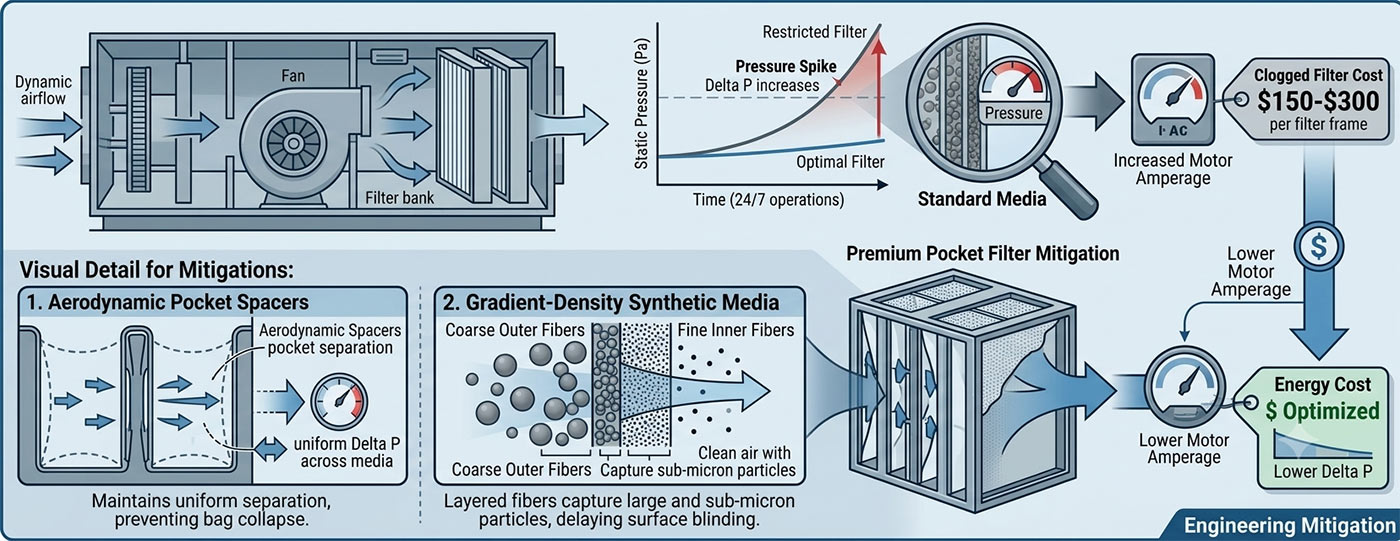
The primary driver of HVAC energy expenditure is static pressure drop (Delta P, measured in Pascals / Pa). When an AHU fan pushes air through restricted or clogged filter media, fan motor amperage increases proportionally to maintain constant airflow volume (CFM or m³/h).
The Financial Impact of Pressure Resistance
In continuous 24/7 industrial operations:
Engineering Calculation Rule: Every additional 10 Pa of initial pressure drop across a filter bank adds approximately $150 to $300 in excess electricity costs per filter frame annually, depending on local kWh commercial tariffs.
Engineering Mitigations
Premium pocket filters prevent premature pressure spikes through:
Aerodynamic Pocket Spacers: Maintains uniform pocket separation under variable air volume (VAV) airflow, preventing bag collapse and media contact.
Gradient-Density Synthetic Media: Coarse outer fibers capture larger airborne particulates, while fine inner fibers trap sub-micron particles, delaying surface blinding.
3. ISO 16890 vs. EN 779 Compliance Standards
Global procurement mandates compliance with ISO 16890, which replaced the legacy EN 779 standard. B2B buyers must specify pocket filters based on real-world particulate size efficiency:
| Legacy EN 779 Grade | ISO 16890 Classification | Targeted Filtration Efficiency | Primary Industrial Applications |
| G4 | ISO Coarse 60%–85% | Coarse particulates (>10 μm) | Basic pre-filtration, HVAC supply air |
| M5 / M6 | ePM10 ≥ 50% | Industrial dust, pollen, coarse spores | Commercial buildings, spray booth inlet |
| F7 | ePM1 ≥ 50% – 65% | Fine combustion particles, smog | Automotive paint lines, food processing |
| F8 / F9 | ePM1 ≥ 65% – 80% | Sub-micron aerosols, fine soot | Pharmaceutical pre-filtration, cleanroo |
4. Critical Structural Standards: Preventing Bypass and Fiber Migration
Structural failure during operation leads to downstream coil fouling, product contamination, or premature destruction of terminal HEPA filters
Essential Sourcing Specifications
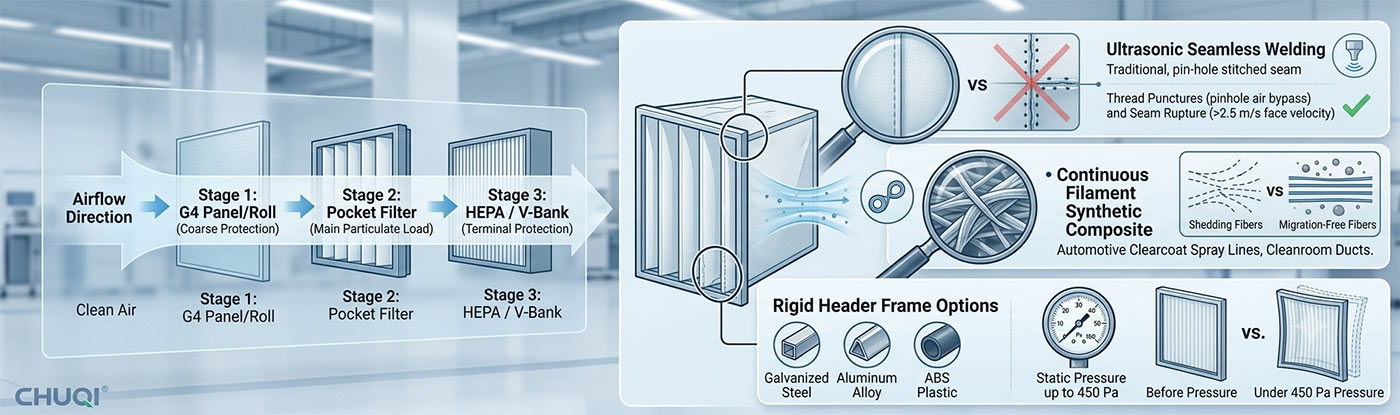
Ultrasonic Seamless Welding: Replaces traditional needle stitching. Thread punctures create pinhole air bypass and risk seam rupture under high face velocity (>2.5 m/s).
Continuous Filament Synthetic Composite: Eliminates fiber shedding (migration) into sensitive work zones (e.g., automotive clearcoat spray lines or cleanroom ducts).
Rigid Header Frame Options: Galvanized steel, aluminum alloy, or ABS plastic header frames (20mm or 25mm depth) to prevent frame deflection under static pressure loads up to 450 Pa.
5. Multi-Stage Filtration Strategy: Optimizing System Life Cycle
A pocket air filter provides maximum ROI when deployed within a structured multi-stage filtration system:
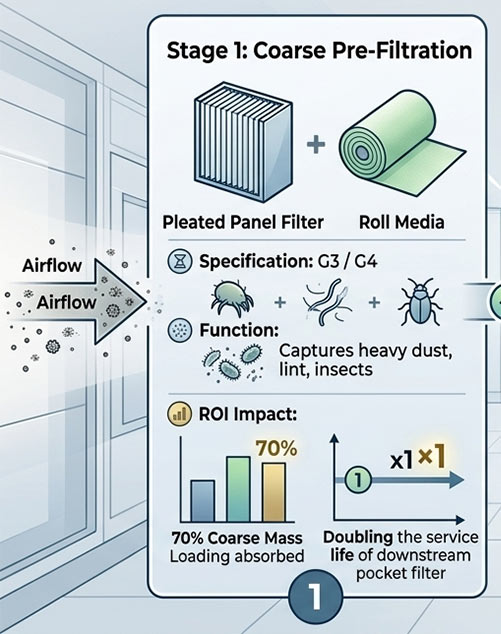
Stage 1: Coarse Pre-Filtration (Pleated Panel Filters & Roll Media)
Specification: G3 / G4 Pleated Panels or Synthetic Filter Media Rolls.
Function: Captures heavy dust, lint, and insects directly upstream.
ROI Impact: Absorbs 70% of coarse mass loading, doubling the service life of the downstream pocket filter.
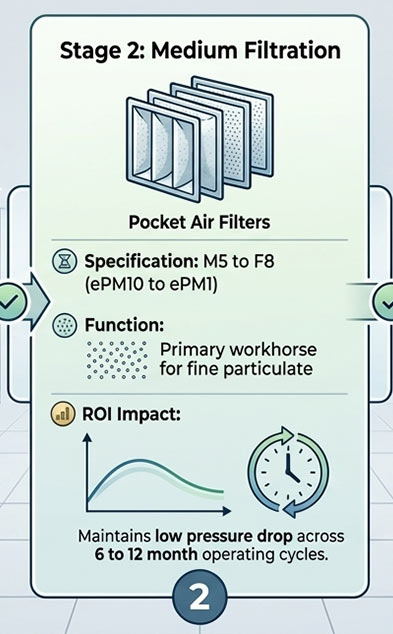
Stage 2: Medium Filtration (Primary & Secondary Pocket Filters)
Specification: M5 to F8 (ePM10 to ePM1) Pocket Air Filters.
Function: Serves as the primary workhorse for fine particulate separation.
ROI Impact: Maintains low pressure drop across extended operating cycles (6 to 12 months).
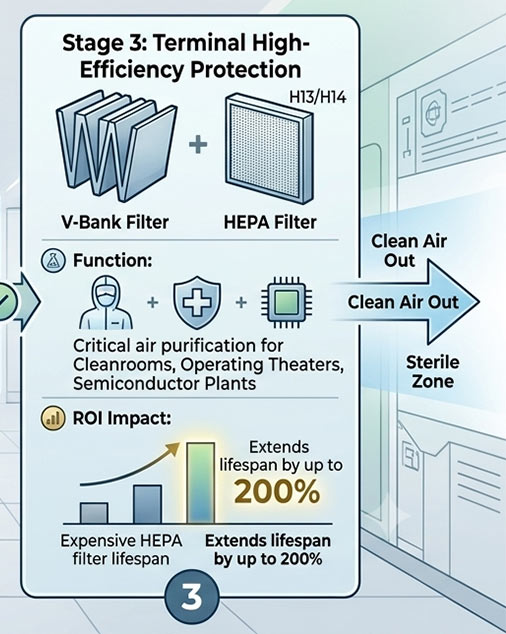
Stage 3: Terminal High-Efficiency Protection (V-Bank & HEPA Filters)
Specification: Rigid V-Bank Filters or Terminal HEPA Filters (H13/H14).
Function: Critical air purification for cleanrooms, operating theaters, and semiconductor plants.
ROI Impact: A clean Stage 2 pocket filter extends expensive HEPA filter lifespan by up to 200%.
6. Logistics Optimization: Volume Reduction for Global Distribution
Air filters are high-volume, low-weight commodities that incur high ocean volumetric freight costs. High-recovery synthetic pocket media allows for compact compression packaging during shipping.
Container Loading Efficiency: Reduces shipping volume by up to 35%–40% without causing permanent media deformation or pocket seam damage.
Landed Cost Improvement: Substantially lowers per-unit ocean freight charges for overseas OEM clients and distributors.
Direct Factory Sourcing & OEM Engineering Services
Request Technical Datasheets & Factory Direct Quotations
Standard and custom-dimension pocket air filters manufactured to ISO 16890 standards. We provide direct OEM private labeling, certified laboratory test reports, and bulk container export packaging.

Frequently Asked Questions
Q1: What is the recommended final pressure drop for changing out pocket air filters?
A: While pocket air filters can structurally withstand static pressures up to 450 Pa, the standard economic changeout limit is 250 Pa to 300 Pa. Operating beyond this point results in exponential fan energy costs that far exceed the price of a replacement filter.
Q2: Can synthetic pocket air filters replace fiberglass pocket filters?
A: Yes. Modern progressive-density synthetic meltblown composites match or exceed the efficiency of fiberglass while eliminating the risk of hazardous fiber shedding into the airstream.
Q3: What header frame size is standard for industrial AHUs?
A: The most common global header frame depths are 25 mm (1 inch) and 20 mm, with nominal face dimensions such as 592 x 592 mm (24 x 24 inches) and 287 x 592 mm (12 x 24 inches). Custom OEM sizes can be fabricated based on AHU track dimensions.