
Reticulated filter foam and a regular polyurethane sponge can start out as the same material. Both are flexible polyurethane foams, both can be cut into the same shape, and both can be dyed the same color. What separates them is a step that happens after foaming: reticulation, which removes the thin membranes inside the foam and leaves an open skeletal network.
The difference is easy to describe but hard to see. A regular sponge and a reticulated foam can look alike on a shelf. Polyester-based and polyether-based reticulated foams can look nearly identical in the hand. As a result, buyers sometimes receive a “filter sponge” that is not reticulated at all, or a replacement that matches the original in color and pore size but not in base material.
This guide explains what reticulation changes, how reticulated foam differs from the other materials commonly called “sponge,” how the polyester and polyether types are told apart, and what a visual check can and cannot tell you.
For an overview of reticulated foam as an air pre-filtration material, see Reticulated Foam Filter Media: A Guide to Air Pre-Filtration.
Key Takeaways
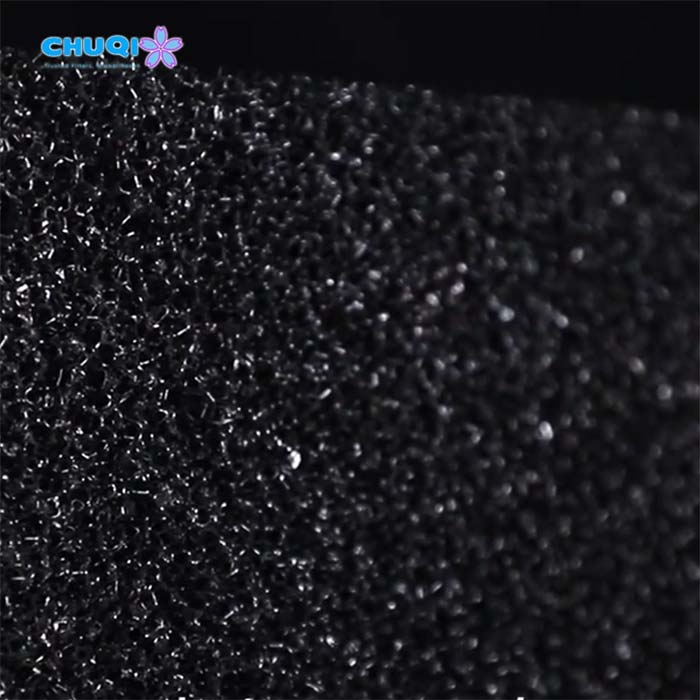
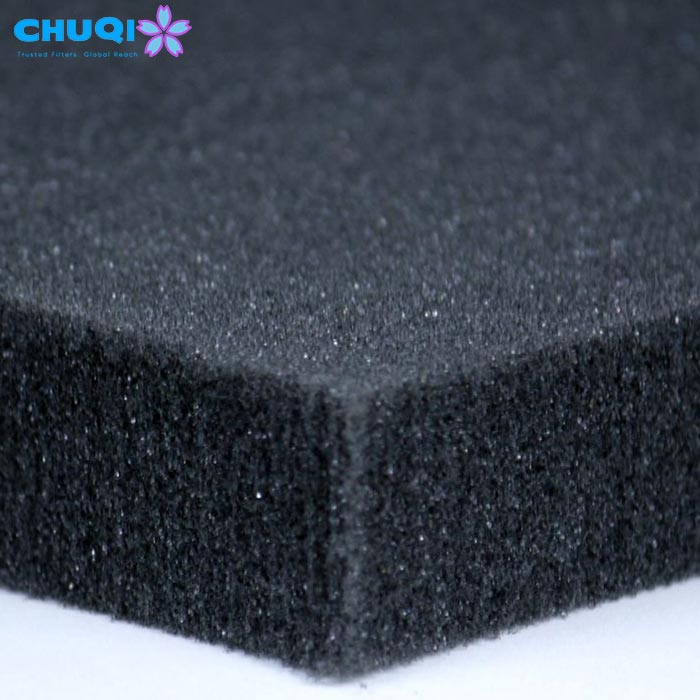
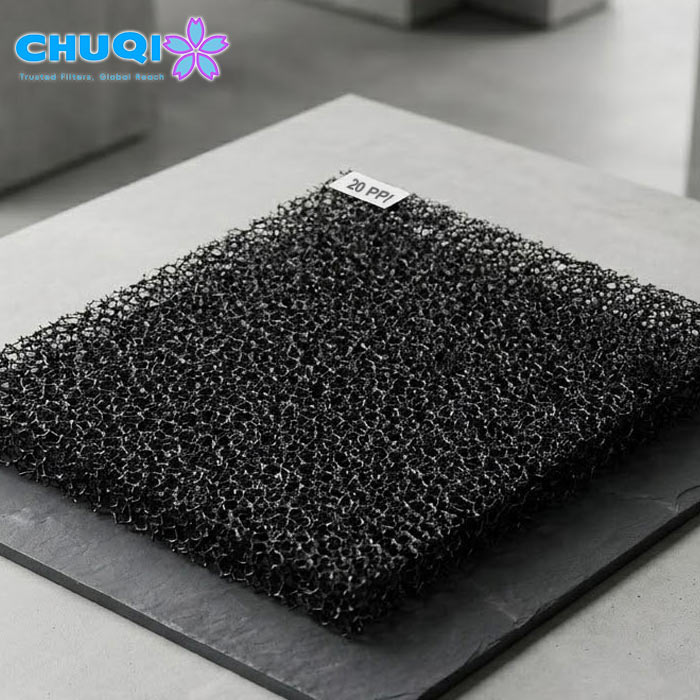
Reticulated foam is a foam whose cell membranes have been removed. What remains is a three-dimensional network of struts. Conventional foam keeps many of those membranes, even when it is described as “open-cell.”
Reticulation is a separate process step. It is done either thermally, with a controlled gas flame front, or chemically, with a caustic bath.olmogiuseppespa+1
“Sponge” covers many different materials: conventional polyurethane foam, cellulose sponge, melamine foam and closed-cell foams. They differ in base material as well as in structure.
Polyester-based and polyether-based reticulated foams are different materials with different resistance profiles. They often cannot be told apart by eye. Infrared spectroscopy (FTIR) can distinguish them.
A visual check can suggest whether a foam is reticulated. It cannot confirm the base chemistry, density, exact PPI or performance. Those need documents or tests.
1. What Makes Reticulated Foam Different from Regular Sponge?
Short answer: In regular polyurethane foam, many cells are still separated by thin membranes, sometimes called “windows.” Reticulated foam has been processed to remove those membranes. Only the struts, the edges where neighboring cells meet, are left, forming an open three-dimensional network. The base polymer can be the same; the internal structure is not.
How Polyurethane Foam Forms Its Cells
Flexible polyurethane foam forms when gas bubbles expand inside a reacting polymer. Each bubble becomes a cell. The polymer collects in two places: along the edges where cells meet, called struts, and in the thin films stretched across the faces between cells, called membranes or windows.
In conventional foam, many of those membranes stay in place, fully or partly. They hold the structure together, but they also block parts of the path between cells.
What Reticulation Removes
Reticulation is a post-process that removes the cell membranes while leaving the struts intact.olmogiuseppespa+1 It works because the membranes are thin, with a high surface area and low mass, so they break down far more easily than the struts.Two industrial methods are used:
| Method | How it works | Effect on the struts |
|---|---|---|
| Thermal reticulation (“zapping”) | Foam is placed in a pressure vessel, the vessel is evacuated and filled with a hydrogen–oxygen mixture, and the mixture is ignited. A flame front passes through the foam and melts the membranes. | Melted membrane material fuses onto the struts, leaving a flame-polished strut surface. |
| Chemical reticulation (“quenching”) | Foam passes through a caustic bath at controlled concentration, temperature and speed, which dissolves the membranes. | The struts are left without the fused, glazed surface that thermal reticulation produces. |
Either way, the result is a windowless skeletal network: cells connected through open faces instead of separated by films.
Side-by-Side Comparison
| Characteristic | Regular (conventional) PU foam | Reticulated PU foam |
|---|---|---|
| Base polymer | Polyurethane (polyester- or polyether-based) | Polyurethane (polyester- or polyether-based) |
| Cell membranes | Many fully or partly intact | Substantially removed |
| Internal structure | Cells partly separated by films | Open network of struts |
| Additional process step | None after foaming | Thermal or chemical reticulation |
| Pore-count designation | Not usually sold by PPI | Usually specified by nominal PPI |
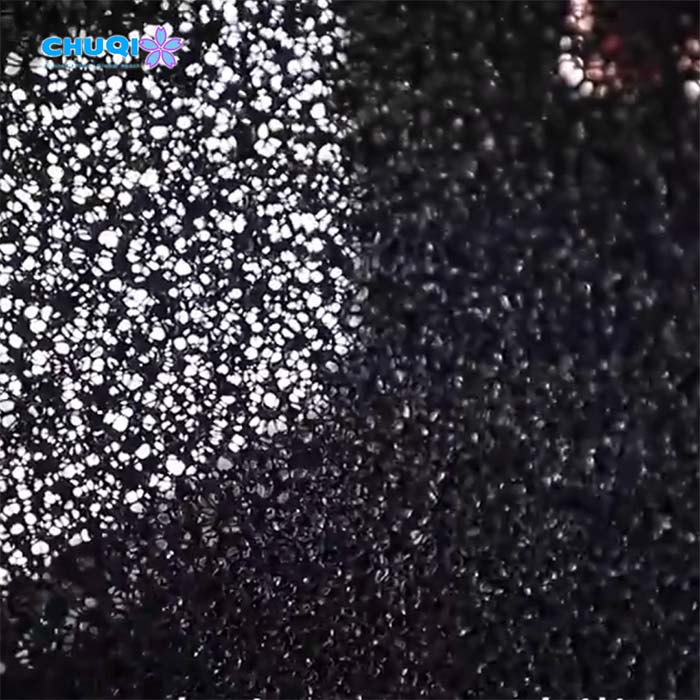
| Under backlight or magnification | Reflective films visible across many cell faces | Mostly open faces outlined by struts |
2. Is "Open-Cell Foam" the Same as Reticulated Foam?
Short answer: No. “Open-cell” means the cells are interconnected rather than sealed, but conventional open-cell foam still has membranes across many cell faces. “Reticulated” means those membranes have been deliberately removed. All reticulated foam is open-cell. Most open-cell foam is not reticulated.
Why the Terms Get Confused
Flexible polyurethane foams are generally described as open-cell, because air can pass through them, unlike closed-cell foams such as polyethylene.However, conventional open-cell foam still has a thin membrane between many of its skeletal ribs. Reticulation is the step that removes them.
The foam industry also distinguishes degrees of reticulation. A material in which only open pores remain is called fully reticulated. If some pores are still closed or partly closed, it is partially reticulated.
What This Means in a Specification or Quotation
“Open-cell polyurethane foam” in a product description does not confirm reticulation. If your application needs reticulated foam, the document should say so explicitly, for example “reticulated polyurethane foam, polyester-based, nominal 30 PPI.” A description such as “open-cell filter sponge” leaves the structure undefined.
| Term | What it confirms | What it does not confirm |
|---|---|---|
| Closed-cell | Cells are sealed from each other | — |
| Open-cell | Cells are interconnected | That membranes have been removed |
| Reticulated | Membranes have been removed by a reticulation process | Base chemistry, PPI, density or dimensions |
| Fully reticulated | Substantially only open pores remain | Base chemistry, PPI, density or dimensions |
3. Which Materials Are Commonly Called "Sponge"?
Short answer: “Sponge” is an everyday word, not a material specification. It is used for conventional polyurethane foam, cellulose sponge, melamine foam, closed-cell foams and reticulated polyurethane foam. These differ in base material and cell structure. Using “sponge” alone in a purchase document leaves the product undefined.
| Commonly called | Base material | Cell structure |
|---|---|---|
| Polyurethane sponge (conventional foam) | Flexible polyurethane | Interconnected cells with many membranes intact |
| Reticulated filter foam | Flexible polyurethane, then reticulated | Open strut network, membranes removed |
| Melamine sponge | Melamine resin (thermoset) | Open-cell network of thin, hard strands |
| Cellulose sponge | Regenerated cellulose | Fibrous, water-absorbent porous matrix |
| Closed-cell “sponge” (e.g., PE foam) | Polyethylene or similar | Sealed cells that block air and water |
Why This Matters When Sourcing
Two parts can look similar and still be made from completely different materials. For example, a white melamine foam and a white reticulated polyurethane foam may appear comparable from a distance, but they are different polymers. Reticulated filter foam should be identified by base material, the word “reticulated” and a nominal PPI, not by the general term “sponge” or “foam.”
4. Polyester vs Polyether Reticulated Foam: How Are They Identified?
Short answer: Reticulated polyurethane foam is made from either polyester polyols or polyether polyols. The two contain different chemical linkages and have different resistance profiles. Polyether types resist hydrolysis better. Polyester types generally offer higher tensile and tear strength and better resistance to many organic solvents. They often look alike, so they are identified from documentation or by infrared spectroscopy, not by eye.
What Differs Between the Two
The difference lies in the polyol used to make the foam. Polyester-based polyurethane contains ester linkages, and polyether-based polyurethane contains ether linkages. That difference in chemistry leads to different behavior:
| Characteristic | Polyester-based (ester) | Polyether-based (ether) |
|---|---|---|
| Characteristic linkage | Ester (–COO–) | Ether (–C–O–C–) |
| Hydrolysis resistance | Lower; ester groups are susceptible to hydrolytic attack | Higher; the ether group is not readily attacked |
| Resistance to organic solvents | Generally better | Generally lower |
| Tensile and tear strength | Generally higher | Generally lower |
| Appearance | Often similar to ether foam | Often similar to ester foam |
These are general material tendencies, not guaranteed values for a particular product. Actual properties depend on the specific formulation, grade and test conditions. Suitability for a given environment, such as humidity, temperature or chemical exposure, should be confirmed against the actual operating conditions. For installation and service considerations, see Reticulated Foam Air Pre-Filters: Equipment Applications and Installation.
Our range: Our product literature describes polyester-based and polyether-based reticulated foam. The base material available for a selected PPI, thickness and supply format is confirmed for each order and stated on the order documents.
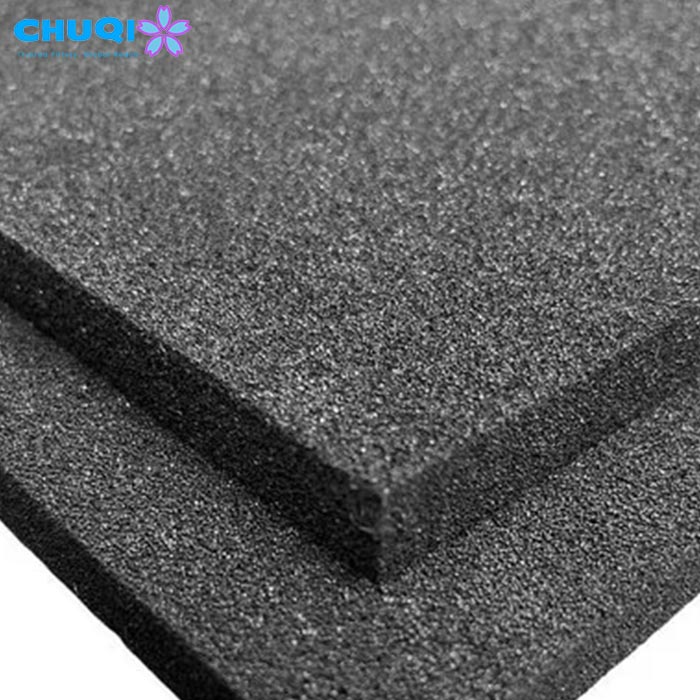
5. How to Observe Reticulated Foam by Appearance?
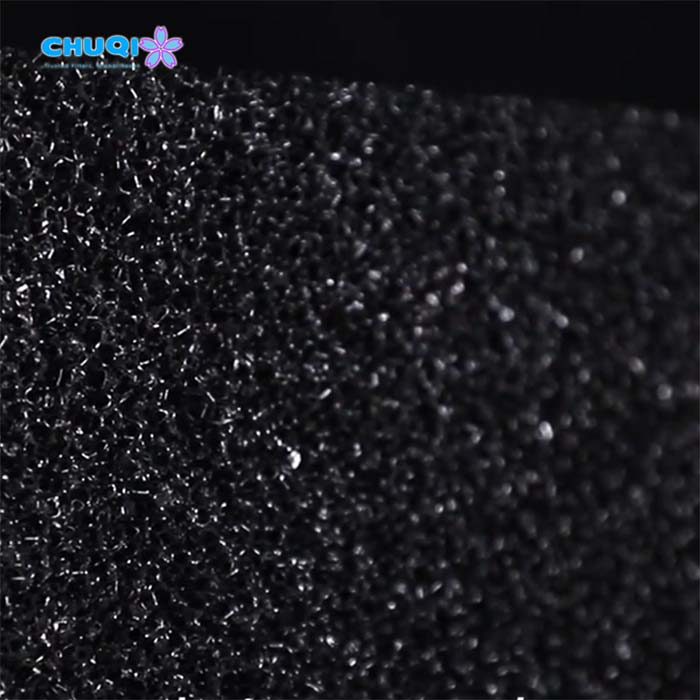
When inspecting a reticulated filter foam sample or performing incoming quality control (IQC), visual inspection—both with the naked eye and under magnification—is the most direct first step.
What Can Be Observed by Appearance
Pore Uniformity: Examine the surface and cross-section to check whether the cell structure is evenly distributed and free of localized dense spots, oversized voids, or closed pores.
Cell Reticulation: Reticulated foam undergoes a thermal or chemical opening process. Under magnification, you should see a clear 3D open-cell network of interconnected struts without leftover cell membranes.
Structure Comparison: Directly compare the relative coarseness across different PPI grades (e.g., the large honeycomb-like struts of 10 PPI versus the fine micro-pore texture of 60 PPI).
Workmanship & Cut Quality: Check for consistent color across the material and inspect whether the edges are cleanly cut without fraying, tearing, or crushing.
What Cannot Be Judged by Appearance Alone
Filtration Efficiency & Dust Holding Capacity: While pore size indicates nominal particle retention, actual filtration performance must be verified through standardized airflow and dust-loading tests.
Airflow Resistance & Pressure Drop: The resistance felt by air passing through the foam cannot be measured visually; it requires dedicated pressure differential testing.
Chemical & Environmental Resistance: Features like UV stability, hydrolytic resistance, or acid/alkali tolerance depend on the polymer base (e.g., polyether vs. polyester) and cannot be determined purely by sight.
6. How to Identify Reticulated Foam When Sourcing or Replacing
Short answer: Describe the material by base chemistry, structure and pore count, not by “sponge” or color. When matching an existing part, check the original documentation first, then compare the structure against an identified reference. Confirm chemistry by documentation or FTIR where the difference matters.
Write the Material Description Completely
| Weak description | Complete description |
|---|---|
| Black filter sponge | Reticulated polyurethane foam, polyether-based, nominal 30 PPI, black |
| Open-cell foam, 20 PPI | Reticulated polyurethane foam, polyester-based, nominal 20 PPI |
| Same as sample | Reticulated polyurethane foam matching approved sample [ID], base material [ester/ether], nominal [__] PPI |
Thickness, supply format, dimensions and tolerances are then added as described in Reticulated Filter Foam Specifications: PPI, Thickness, Sheets and Rolls.
When Matching an Existing Part
Look for documentation. Check drawings, previous purchase orders, labels or certificates for a base-material designation and PPI.
Check the structure. Use backlighting or magnification to see whether the cell faces are open or covered.
Compare against an identified reference. Use a sample of known material and PPI, viewed at the same scale.
Confirm chemistry where it matters. If the operating environment involves moisture, heat or chemical exposure and no documentation exists, have the base material confirmed by FTIR.
Record the result. Write the confirmed material, structure and PPI into the specification so the next order does not depend on appearance.
How to verify a supplier’s material and process evidence is covered in How to Evaluate a Reticulated Filter Foam Manufacturer.
Reticulated filter foam and regular sponge may share a base polymer, but they do not share a structure. Reticulation removes the cell membranes and leaves an open strut network, and that is the property a filter foam specification depends on.
Three points to remember:
“Open-cell” is not the same as “reticulated.” Ask for reticulated foam by name.
Polyester and polyether are different materials. State the base material, because it usually cannot be seen.
Appearance is an indication, not a confirmation. Use documentation, reference samples and tests where the difference matters.
If you need to match an existing part or are unsure which base material you have, send us a description of the original material, any documents or labels, and a sample or photographs if available. We will help you confirm the material before quotation.