
In high-end automotive refinishing, OEM assembly, and industrial liquid coating, the ceiling filter (tackifier diffusion media) is the final active barrier protecting the paint room from airborne particulates. Rated typically at EN779: M5 / F5 or ISO 16890: ePM10 50%–70%, these progressive-density polyester filters utilize a specialized tackifier (tack adhesive) to trap micro-dust particles as small as 5–10 microns.
However, a critical mechanical feature often decided during B2B procurement is the downstream (clean air side) backing material: Mesh Backing (Grid Reinforcement) versus Cloth Backing (Non-Woven / Fabric Scrim).
While both designs provide ceiling support, their impact on fiber migration, laminar airflow dynamics, initial pressure drop, and surface defect rates varies significantly.
This guide provides an engineering-level comparison to help spray booth manufacturers, distributors, and plant managers choose the right backing technology.
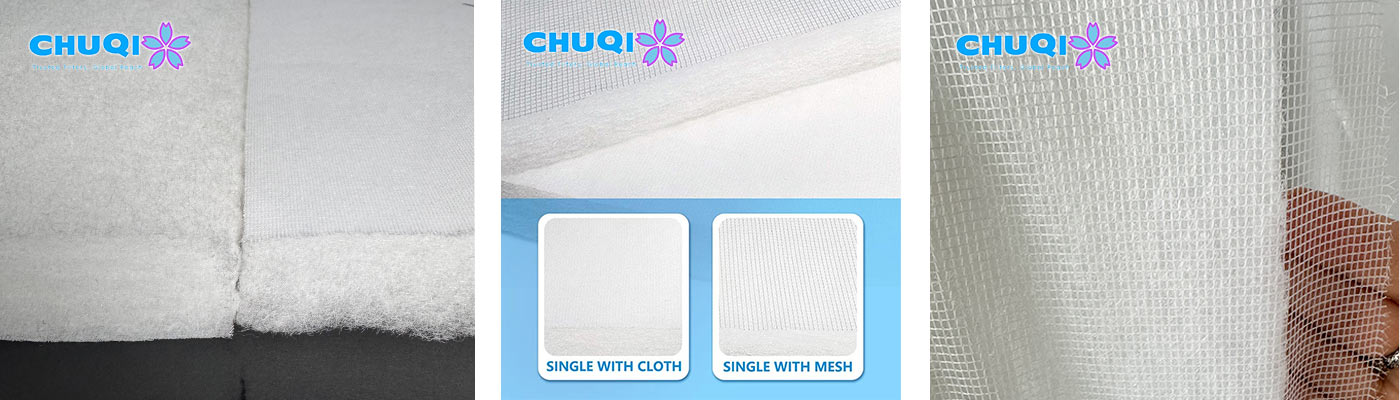
| Technical Parameter | Mesh-Backed Ceiling Filter (Grid Reinforcement) | Cloth-Backed Ceiling Filter (Non-Woven/Fabric Scrim) |
| Clean-Side Backing | Synthetic woven mesh or plastic diamond grid | Thermally-bonded high-density polyester/glass fiber cloth |
| Filter Grade Standard | EN779: M5 / F5 (DIN 24185) | EN779: M5 / F5 (DIN 24185) |
| Fiber Shedding Risk | Low-to-Moderate (Protects against tears; loose fibers may shed) | Zero (Near-100% containment of upstream fibers) |
| Airflow Velocity & Uniformity | Standard diffusion (Open area grid >85%) | Superior Laminar Flow (Micro-porous diffusion effect) |
| Initial Pressure Drop | 25 – 30 Pa @ 0.25 m/s | 30 – 38 Pa @ 0.25 m/s |
| Final Recommended Resistance | 450 Pa | 450 Pa |
| Average Arrestance (Gravimetric) | ≥ 96% | ≥ 98% |
| Structural Rigidity & Span | High (Resists sagging across large plenum grids) | Moderate (Requires frame tensioning or positive draft) |
| Flame Retardancy Standard | DIN 53438-F1 / UL Class 900 | DIN 53438-F1 / UL Class 900 |
| Target Application | Auto repair shops, general industrial & machinery coating | OEM automotive plants, high-gloss clearcoats, cleanrooms |
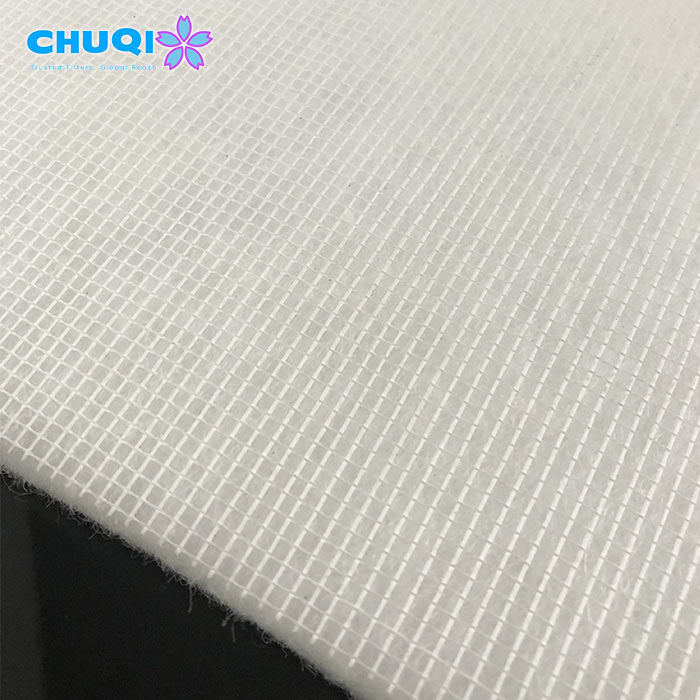
A mesh-backed ceiling filter features a synthetic net or polypropylene diamond grid thermally laminated to the exit face of progressive-structure polyester fibers. Designed for commercial spray booths, it balances structural stability with high airflow performance.
Key Engineering Features:
Structural Skeleton: The high-tenacity mesh acts as a load-bearing lattice, preventing filter sagging or ballooning across wide ceiling frames under continuous blower pressure.
Low Aerodynamic Resistance: With over 85% open area on the clean side, the mesh minimizes airflow resistance (Initial Pressure Drop: ~25 Pa at 0.25 m/s), reducing fan energy consumption.
Progressive Density Filtration: A gradient fiber structure captures larger dust particles upstream and finer particles deeper within the media, maximizing dust-holding capacity.
Thermal Lamination: Solvent-free thermal bonding fuses the grid directly to the media without adhesive layers that restrict airflow or release VOCs
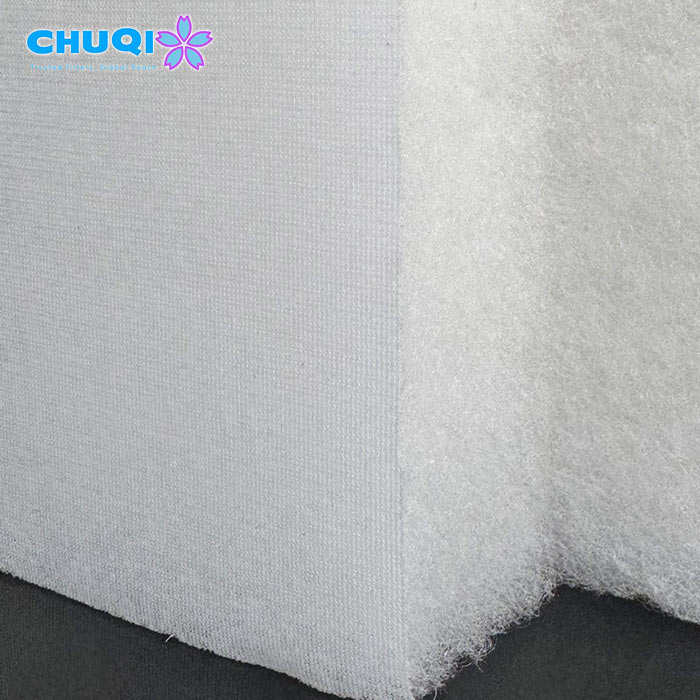
A cloth-backed ceiling filter utilizes a high-density non-woven fabric, spunbond scrim, or woven glass-fiber cloth tightly bonded across the clean-air output face. Designed for automotive OEM lines and high-gloss refinishing booths, it prioritizes surface defect prevention and uniform air distribution.
Key Engineering Features:
Complete Fiber Containment (Zero Migration): The dense fabric scrim completely encloses the tacky polyester matrix, preventing loose synthetic fibers from detaching and landing on wet paint.
Laminar Airflow Diffusion: The microporous cloth acts as a precision air equalizer, converting turbulent airflow into a uniform, parallel downward air column (laminar downdraft: 0.25 – 0.35 m/s).
Secondary Polishing Filtration: The fine scrim serves as a final barrier on the clean side, trapping residual sub-micron dust particles that pass through the main filter body.
Solvent & Temperature Resistance: Thermally stabilized fibers resist paint solvents, elevated temperatures, and humidity without softening or releasing chemical binders.
Premium Finishing Reliability: By eliminating paint defects like fisheyes and nibs, cloth-backed media drastically reduces post-paint rework and re-spray costs.
3. Deep-Dive Engineering Comparisons
A. Fiber Migration & Paint Defect Prevention
In automotive OEM coating and high-gloss clearcoat applications, a single 100-micron synthetic fiber landing on a freshly sprayed surface causes a fisheye, crater, or nib defect, requiring costly manual sanding and re-spraying.
Mesh Backing: Holds the filter sheet together but leaves open spaces where loose surface fibers can occasionally break free due to air vibration.
Cloth Backing: Fully seals the outgoing surface, making fiber migration mathematically near-zero.
B. Air Flow Distribution (Downdraft Turbulence Control)
In a downdraft spray booth, turbulent air creates vortices that suspend paint overspray around the painter or robot arm.
Mesh Backing: Air flows through large grid openings directly, relying solely on the density of the polyester pad for air distribution.
Cloth Backing: The fine fabric backing creates backpressure across the ceiling plenum, forcing air to equalize across every square meter. This yields an optimal laminar downdraft velocity (0.25 – 0.35 m/s) across the entire spray line.
C. Mechanical Rigidity vs. Flexibility
Mesh Backing: Highly rigid. Ideal for large ceiling frames without full wire mesh under-supports.
Cloth Backing: Softer and more pliable. Requires a well-constructed ceiling grid matrix or proper plenum positive pressure to prevent center dipping.
4. What is your Coating Application?
To maximize operational efficiency and coating quality, align your filter selection with the specific booth type:
1. High-Precision Finishing Applications
Target Industries: OEM Automobile Lines, High-Gloss Clearcoat / Piano Black, Cleanroom Coating Lines
Recommended Product: Cloth-Backed Ceiling Filters
Key Benefits:
Zero Fiber Migration
Laminar Airflow Equalization
Maximum Finish Perfection
2. Standard Refinish & General Coating Applications
Target Industries: Collision Repair Shops, Machinery & Steel Structures, Commercial Furniture / Woodwork
Recommended Product: Mesh-Backed Ceiling Filters
Key Benefits:
Low Initial Pressure Drop
High Tensile Rigidity
Cost-Effective Bulk Supply
5. Frequently Asked Questions (FAQ)
Q1: Which backing type is better if our spray booth lacks support frames?
Mesh-backed ceiling filters are recommended. The high-tenacity synthetic diamond mesh provides superior structural rigidity, preventing the filter media from sagging or ballooning under heavy intake blower pressure when spanning wide plenum frames without middle supports. In contrast, cloth-backed media is soft and flexible, requiring tight frame clamping or positive draft tension to prevent sagging.
Q2: Does a mesh-backed filter risk fiber shedding on the clean side?
Minimal, but cloth-backed provides higher safety. A mesh-backed filter relies on a progressive density fiber structure with thermo-bonded finishing, but its open grid leaves tiny air gaps. A cloth-backed filter features a high-density non-woven scrim that acts as an absolute physical barrier, trapping 100% of loose upstream fibers. For critical clearcoat and zero-defect painting, cloth-backed media offers an extra layer of contamination protection.
Q3: Does a cloth-backed ceiling filter shorten fan blower lifespan?
No. While the initial pressure drop of cloth-backed media is slightly higher (30 – 38 Pa vs. 25 – 30 Pa at 0.25 m/s), standard spray booth intake blowers (such as backward-curved or forward-curved centrifugal fans) are engineered with static pressure reserves up to 450 – 500 Pa. The incremental 5 – 8 Pa resistance from the fabric scrim represents less than 2% of the total system design static pressure and has zero impact on motor thermal overload or bearing longevity. As long as routine filter replacement schedules are maintained, overall fan blower service life remains unchanged.
Q4: Are both mesh and cloth ceiling filters flame retardant?
Yes. Premium technical ceiling filters must conform to the DIN 53438 Class F1 self-extinguishing safety standard (Testing of combustible materials; response to ignition by a small flame). Under test conditions, the flame front must extinguish naturally without reaching the top measuring mark or producing flaming droplets. Both mesh-backed and cloth-backed variants utilize flame-retardant polyester fibers and halogen-free adhesives to guarantee strict fire safety compliance in volatile paint booth environments.
Q5: Are mesh and cloth ceiling filters equally easy to cut for custom fit?
Yes, but cloth-backed offers better edge sealing. Both materials can be cut using standard utility knives or CNC cutting tables. However, cloth-backed media yields smoother edge profiles that compress easily into holding channels, forming an airtight perimeter seal. Mesh-backed media has a slightly stiffer edge due to the plastic grid, requiring firm holding frame pressure to ensure complete edge sealing along spray booth filter frames.
Source Direct from an ISO-Certified Filtration Manufacturer
Selecting between mesh and cloth backing comes down to balancing acceptable defect rates against operational budget.
With over 20 years of manufacturing and global export experience, Chuqi New Materials produces full-range, high-tack ceiling filter rolls and pads (M5/F5 grades) fully compliant with international industrial filtration standards.
100% Virgin Polyester Synthetic Fibers
Fully Impregnated Tackifier Adhesive (No Dry Spots)
Custom Roll Widths, Precision Pre-Cut Pads & Tailored Backing Options (Mesh or Cloth)
Complete DIN 53438-F1 & ISO 16890 Test Certifications Available
Need technical datasheets, factory-direct OEM pricing, or free evaluation samples?
Contact Our Engineering Sales Team today to optimize your spray booth filtration efficiency.