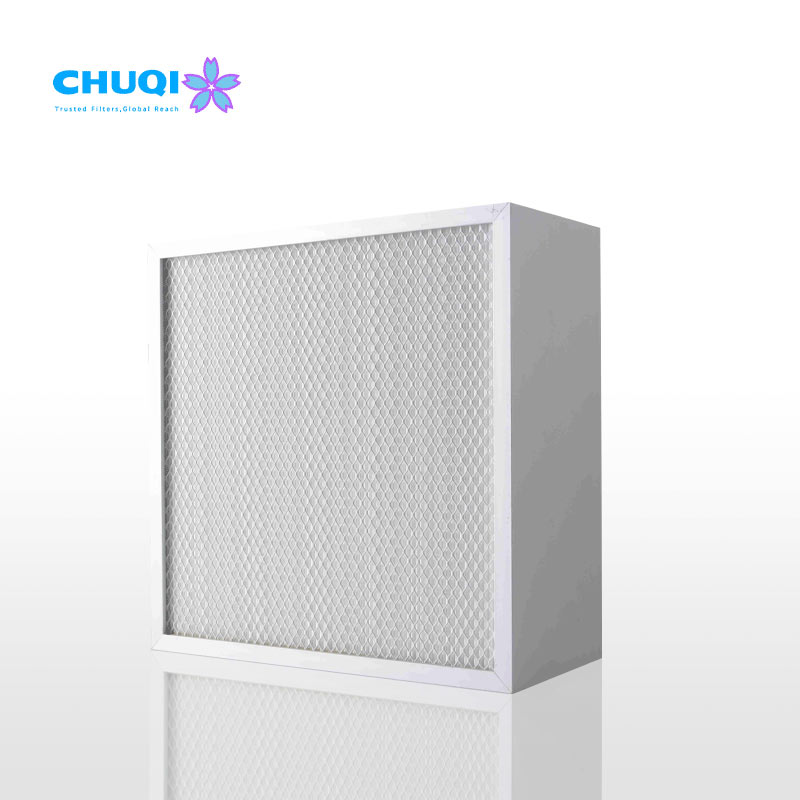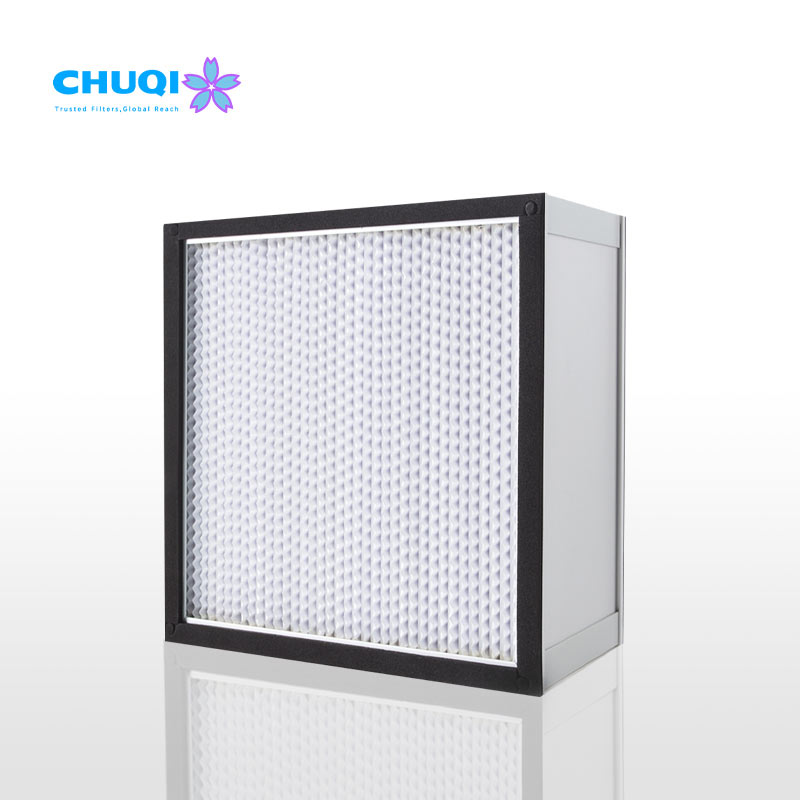
In modern cleanroom engineering, pharmaceutical processing, microelectronics manufacturing, and high-spec HVAC systems, High-Efficiency Particulate Air (HEPA) filters serve as the definitive standard for critical contamination control.
Understanding the precise physics, structural classifications, resistance dynamics, and replacement cycles of HEPA filtration is essential for facility managers, HVAC engineers, and industrial buyers seeking to optimize indoor air quality (IAQ) and maintain strict regulatory compliance.
This comprehensive guide delivers an in-depth technical breakdown of HEPA filter technology, performance metrics, selection frameworks, and operational best practices.
What is a HEPA Filter? (Definition & MPPS Physics)
A HEPA filter is an extended-surface, dry-type mechanical air filter constructed from a dense mat of randomly aligned microscopic borosilicate glass fibers (ranging from 0.5 to 2.0 microns in diameter).
The 0.3-Micron Standard and MPPS
According to U.S. Department of Energy (DOE) and international standards, a standard True HEPA filter must remove at least 99.97% of airborne particles as small as 0.3 microns (µm).
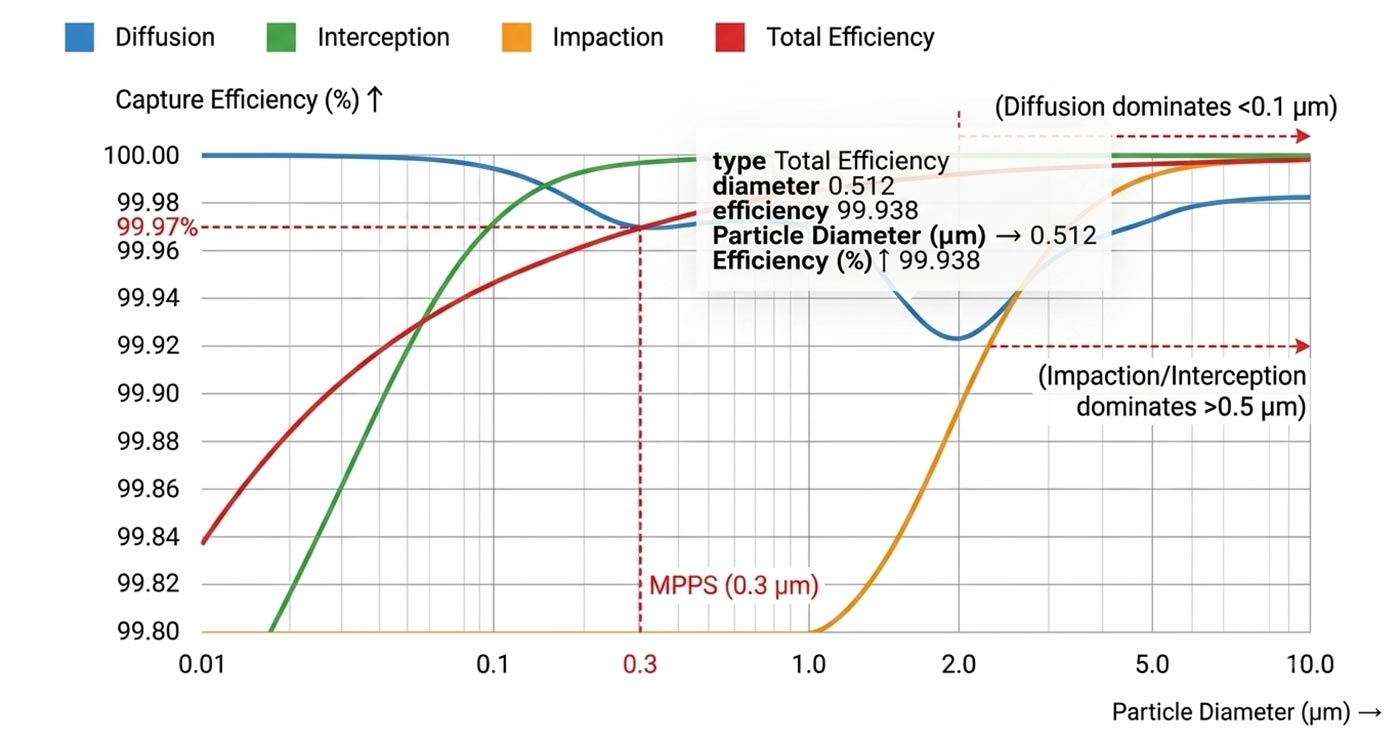
Why is 0.3 microns used as the baseline benchmark? This particle size represents the Most Penetrating Particle Size (MPPS):
Physics of MPPS: Particles larger than 0.3 microns possess sufficient mass to be captured easily via inertial impaction and interception. Conversely, particles smaller than 0.3 microns exhibit high kinetic energy and collide with gas molecules, causing Brownian motion that drives them into filter fibers.
The Filtration Dip: The 0.3-micron boundary sits precisely where diffusion efficiency decreases and inertial impaction has not yet reached full dominance. Therefore, 0.3 microns is the hardest particle size to trap. If a filter achieves 99.97% capture efficiency at MPPS, its efficiency for particles both larger (>0.3 µm) and smaller (<0.1 µm) is higher (often exceeding 99.99%).
How Does a HEPA Filter Work? (The Four Mechanisms)
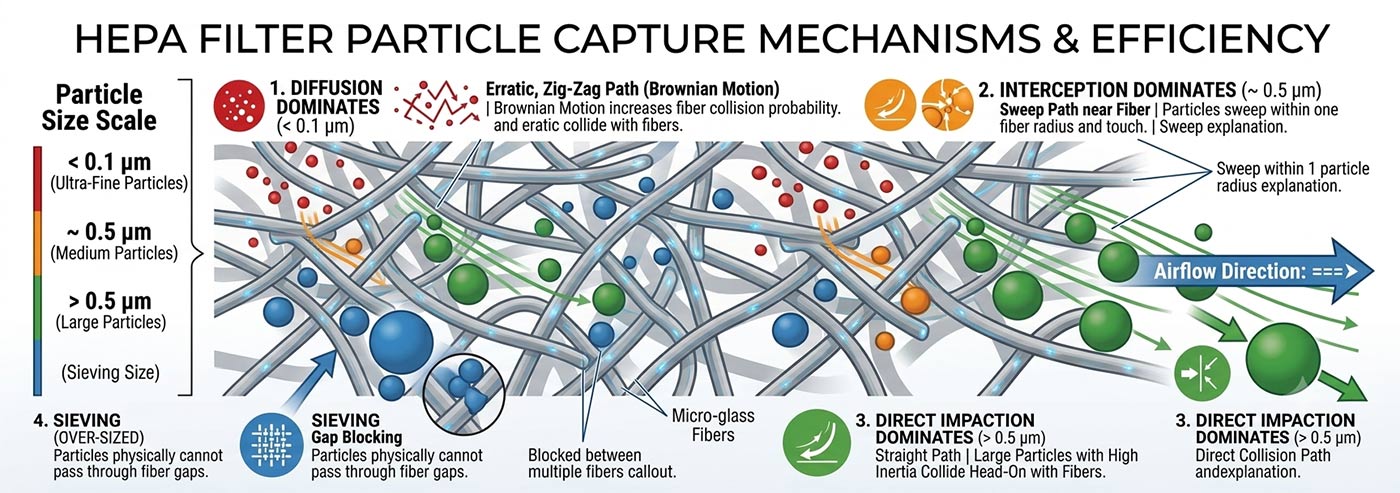
Unlike a mechanical sieve that simply screens out particles larger than its mesh pore size, a HEPA filter media operates through four distinct physical mechanisms working simultaneously:
1. Direct Impaction
Target Particle Size: Typically > 1.0 µm.
Mechanism: High-mass particles possess heavy inertia. As the airstream diverts around a glass fiber, these particles cannot adjust direction fast enough and collide directly with the fiber face, sticking via van der Waals forces.
2. Interception
Target Particle Size: Typically 0.1 µm to 1.0 µm.
Mechanism: Smaller particles follow the airflow streamlines closely. However, if the trajectory of a particle brings it within a distance equal to its own radius from a fiber, the particle touches the fiber surface and becomes attached.
3. Diffusion
Target Particle Size: Ultra-fine particles < 0.1 µm (including viruses and nano-dust).
Mechanism: Particles under 0.1 microns interact continuously with surrounding gas molecules, causing erratic, non-linear Brownian movement. This random “zigzag” path significantly increases the time the particle spends within the media matrix, maximizing the probability of contact with a fiber.
4. Sieving
Target Particle Size: Coarse dust particles larger than the distance between adjacent media fibers.
Mechanism: Pure mechanical blocking where the physical gap between neighboring fibers is smaller than the particle diameter.
What Particles Does a HEPA Filter Remove?
A True HEPA filter removes a wide spectrum of physical, biological, and chemical-carrier contaminants down to the sub-micron scale:
Microbiological Pathogens: Bacteria (e.g., Staphylococcus, Legionella), mold spores, fungi, and viral carriers (viruses attached to airborne droplet nuclei).
PM1, PM2.5 & PM10 Particulates: Fine combustion ash, carbon black, diesel exhaust particles, and fine crystalline silica dust.
Allergens & Organic Dust: Dust mite feces, pollen grains, pet dander, insect fragments, and bio-aerosols.
Industrial Process Pollutants: Solder fumes, pharmaceutical active powders, welding haze, and cleanroom cross-contaminants.
Chemical & Odor Limitations
HEPA filters trap particulates, not individual gas molecules. They do not absorb:
Volatile Organic Compounds (VOCs) such as benzene, formaldehyde, and toluene.
Acid gases, sulfur dioxide, or ammonia.
Odors and smoke vapors.
Engineering Solution: High-performance cleanroom and HVAC systems integrate Activated Carbon (Chemical/Gas-Phase) Media upstream or downstream of the HEPA filter to adsorb gaseous molecular contaminants (AMC).
HEPA Filter Efficiency Classes & Global Standards
Industrial buyers must evaluate HEPA performance according to recognized standards: European EN 1822 / ISO 29463 and American ASME AG-1 / IEST-RP-CC001.
EN 1822 / ISO 29463 Classification Matrix
| Filter Group | Filter Class | MPPS Overall Efficiency (%) | MPPS Overall Penetration (%) | Local MPPS Efficiency (%) | Common Applications |
| EPA (Efficient) | E10 | ≥ 85% | ≤ 15% | – | Pre-filtration, Commercial HVAC |
| EPA | E11 | ≥ 95% | ≤ 5% | – | Industrial Exhaust, Secondary Stage |
| EPA | E12 | ≥ 99.5% | ≤ 0.5% | – | High-end Residential, Hospital Wards |
| HEPA (True HEPA) | H13 | ≥ 99.95% | ≤ 0.05% | ≥ 99.75% | Cleanrooms (ISO Class 7-8), Operating Theaters |
| HEPA | H14 | ≥ 99.995% | ≤ 0.005% | ≥ 99.975% | Pharma Cleanrooms (ISO Class 5), Microelectronics |
| ULPA (Ultra Low) | U15 | ≥ 99.9995% | ≤ 0.0005% | ≥ 99.995% | Semiconductor Photolithography (ISO 3-4) |
| ULPA | U16 | ≥ 99.99995% | ≤ 0.00005% |
Different Structural Types of HEPA Filters
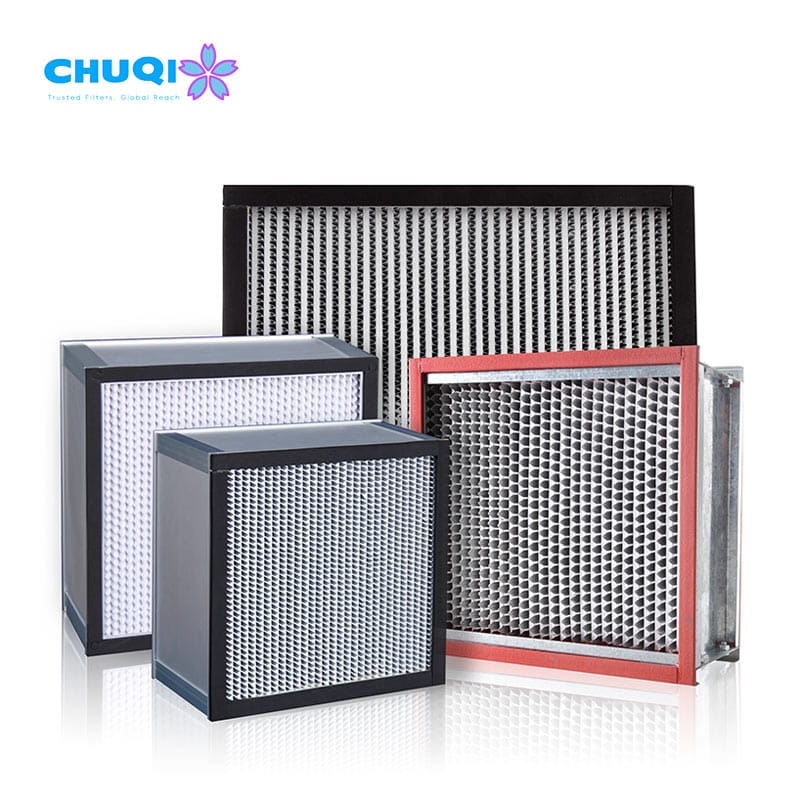
Choosing the right physical construction depends on airflow capacity (CFM / m³/h), velocity profiles, available space, and initial system static pressure limits.
1. Deep-Pleat HEPA Filters
Construction: Aluminum foil or craft paper corrugated separators physically separate continuous sheets of glass fiber pleats (depth: 150mm to 292mm).
Advantages: Exceptionally robust structure, excellent resistance to turbulent air surges and high humidity.
Typical Use: Main supply systems for industrial cleanrooms, heavy manufacturing exhaust, and primary air handling units (AHUs).
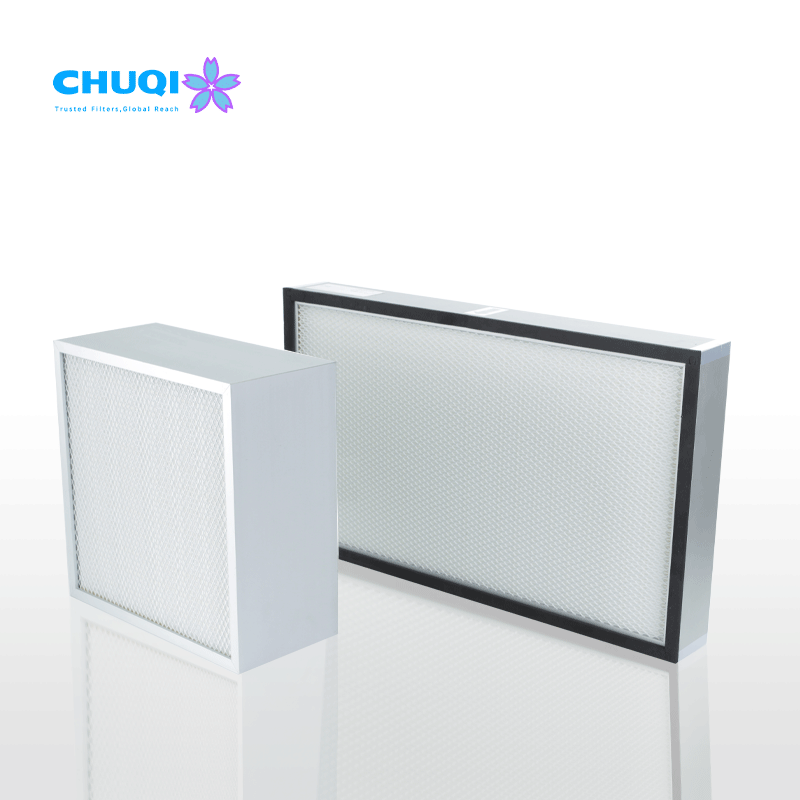
2. Mini-Pleat HEPA Filters
Construction: Thermoplastic hot-melt beads act as fine spacers between media pleats, creating a compact package (depth: 50mm to 90mm).
Advantages: Uniform airflow distribution, lighter weight, reduced frame depth, lower initial pressure drop per unit face area.
Typical Use: Cleanroom ceiling grid modules (FFUs – Fan Filter Units), laminar flow benches, biosafety cabinets.
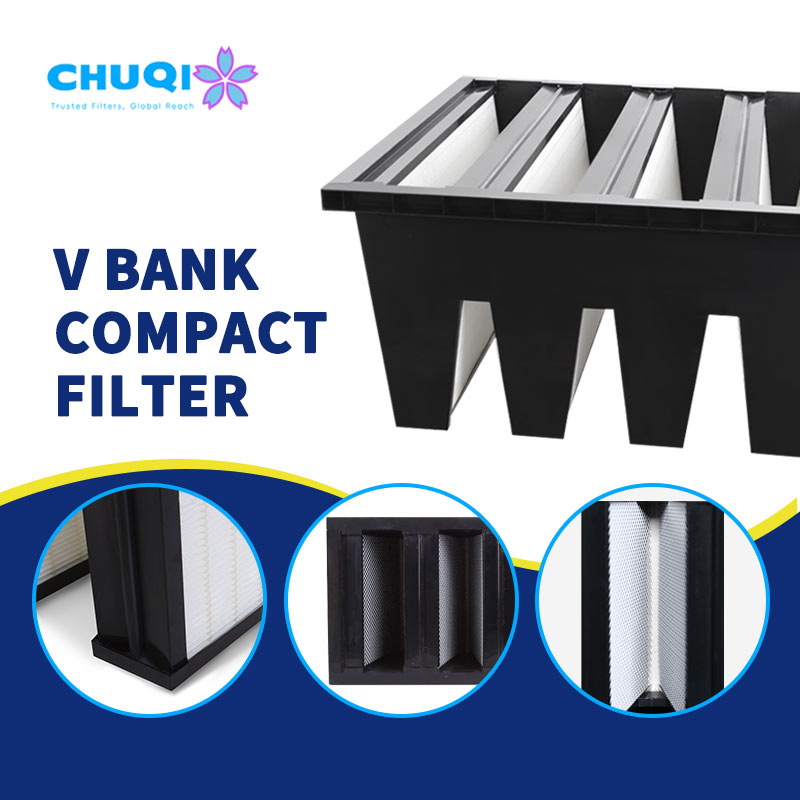
3. V-Bank (V-Pack) HEPA Filters
Construction: Multiple mini-pleat packs mounted in a V-shaped configuration inside a rigid ABS or galvanised steel frame.
Advantages: Dramatically expands total active filtration surface area (up to 2–3x higher than standard panel filters), allowing for ultra-high airflow rates up to 4,000 m³/h at lower pressure drop.
Typical Use: Central commercial HVAC systems, gas turbine air intakes, high-volume AHUs where retrofitting space is limited.
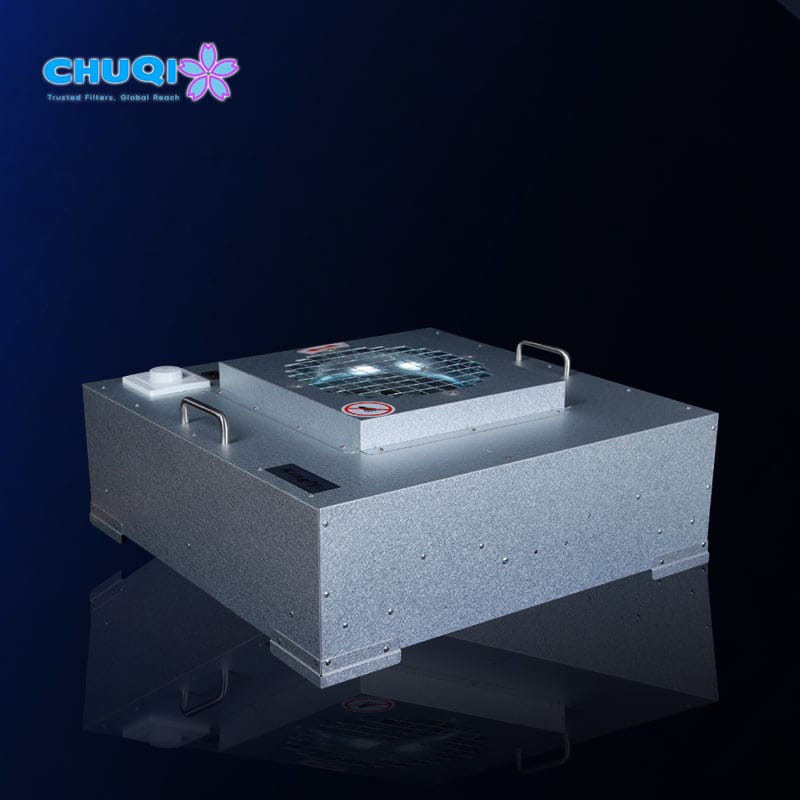
4. Fan Filter Units (FFU)
Construction: An integrated terminal filtration module combining an internal high-efficiency centrifugal fan/motor assembly with a lightweight mini-pleat HEPA or ULPA filter in an aluminum or stainless steel housing.
Key Advantages: Provides localized, highly uniform vertical laminar airflow without requiring complex central ductwork systems. Equipped with adjustable speed controls to balance cleanroom pressure differentials effortlessly.
Typical Use: Cleanroom ceiling grids (ISO Class 3 to Class 8), semiconductor manufacturing lines, pharmaceutical filling zones, and modular clean benches.
Benefits vs. Limitations of HEPA Filters
Key Benefits
Certified Ultra-High Removal Efficiency: Guarantees 99.97% to 99.995% capture of hazardous particles, fulfilling WHO, FDA cGMP, and ISO 14644 compliance.
Reliable Bio-Contamination Control: Traps airborne bacteria and viral carriers without relying on chemicals or producing harmful secondary byproducts (like ozone).
Protection of Downstream Equipment: Prevents sub-micron particulate buildup on sensitive sensors, optical devices, and cleanroom ductwork.
Key Limitations
High Initial Static Pressure Drop: Clean HEPA filters typically exhibit an initial resistance of 150 Pa to 250 Pa, requiring higher blower motor horsepower.
Inability to Remove Gas Phase Contaminants: Ineffective against VOCs, moisture, odors, and chemical gases unless combined with carbon adsorption.
Sensitivity to Moisture and Oversized Loading: Direct liquid water droplets can blind glass fiber media, while coarse dust quickly clogs HEPA pleats if pre-filtration is absent or poor.
Engineering HEPA Filters for HVAC Systems
Integrating HEPA filters into central HVAC systems requires strict engineering evaluation to avoid system failure or motor burnout.
Critical Engineering Considerations
Fan Static Pressure Capacity: Standard panel filters produce 30 Pa to 80 Pa of resistance, whereas H13/H14 HEPA filters start at 150 Pa to 250 Pa and operate up to a final resistance of 500 Pa. Verify that your Air Handling Unit (AHU) motor has sufficient external static pressure (ESP) capacity.
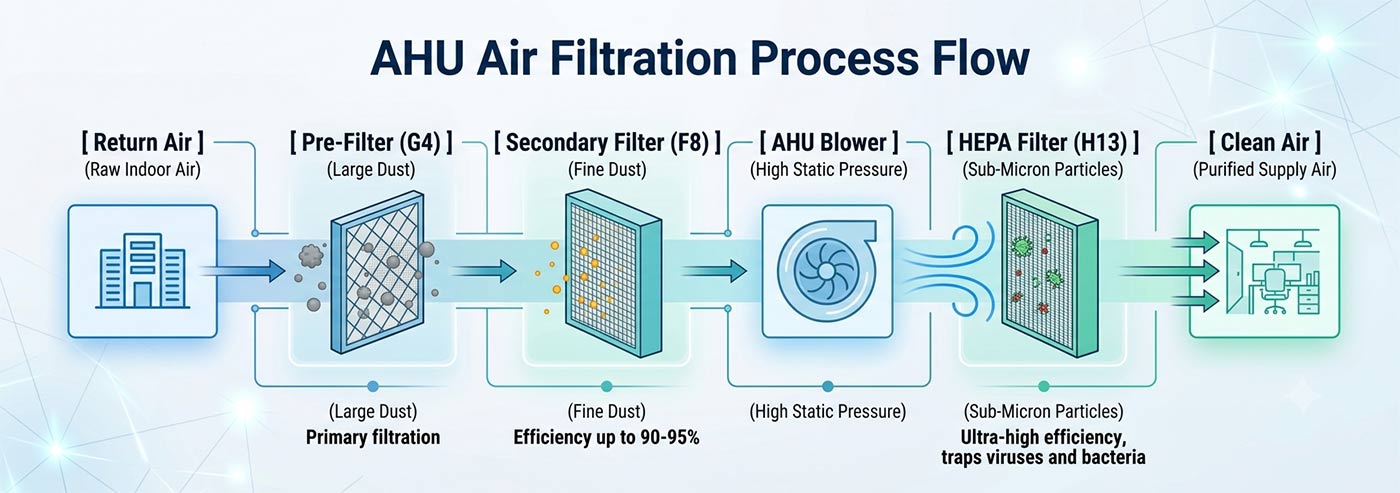
Multi-Stage Pre-Filtration (Mandatory): Never expose a HEPA filter directly to raw ambient air. Implement a progressive multi-stage filtration strategy:
Stage 1 (Coarse Pre-Filter): G3 / G4 panel (ISO Coarse 60-80%) to catch lint, hair, and bulk dirt.
Stage 2 (Fine Secondary Filter): F7 / F8 pocket or rigid filter (ePM1 60-85%) to capture fine dust (1 to 10 µm).
Stage 3 (Terminal Filter): H13 / H14 True HEPA filter to catch ultra-fine sub-micron particulates.
Duct Air Tightness & Housing Gaskets: Because HEPA filters build up high differential pressure, air will leak around unsealed frame edges. Use continuous knife-edge fluid seals (gel seals) or high-density closed-cell EPDM gaskets to eliminate bypass leaks.
HEPA Filter Maintenance, Replacement & Testing
To maintain system air balance and cleanroom integrity, follow standardized maintenance routines.
Recommended Replacement Schedule Matrix
| Filter Stage | Filter Grade | Typical Service Life | Replacement Trigger Metric |
| Primary Pre-Filter | G3 – G4 | 1 to 3 Months | Visual loading or Pressure Drop (ΔP) ≥ 150 Pa |
| Secondary Filter | F7 – F9 | 6 to 12 Months | Pressure Drop (ΔP) ≥ 250 Pa |
| Terminal HEPA Filter | H13 – H14 | 24 to 48 Months | Pressure Drop (ΔP) ≥ 500 Pa or failed PAO leak test |
Diagnostic Signals for Immediate Replacement
Differential Pressure Gauge (ΔP): Reading reaches the filter’s rated terminal resistance (typically double or 2.5x initial pressure drop, e.g., 500 Pa).
PAO / DOP Integrity Leak Test Failure: In-situ aerosol photometer testing reveals localized pinhole leaks exceeding 0.01% penetration.
Airflow Velocity Reduction: Cleanroom face velocity drops below standard design rates (e.g., < 0.45 m/s ± 20% for laminar flow hoods).
Source Certified HEPA & Industrial Filtration Solutions
Selecting the optimal HEPA configuration requires aligning frame materials (anodized aluminum, galvanized steel, stainless steel), gasket media, pleat geometry, and certified efficiency classes with your specific operational requirements.
At Chuqi New Materials, we specialize in manufacturing high-performance industrial air filtration materials and custom HEPA filter assemblies backed by over 20 years of production expertise. From raw media production to fully integrated filter assembly, our vertically integrated manufacturing facility guarantees stringent quality control, compliance with EN 1822 / ISO 29463 standards, and factory-direct pricing.
Work with Our Air Filtration Specialists
Whether you require standard H13/H14 HEPA panels, high-flow V-bank modules, high-temperature units, or custom OEM dimensions for your local market:
[ Contact Our Engineering Team for Technical Specifications & Fast Quotes ]
Send your project drawings or custom parameters to our team today at chuqifilter@chuqimat.com, and receive a technical recommendation and competitive bulk quote within 24 hours.