
Quick Summary for Automotive Refinishing & Industrial Painters: High-efficiency ceiling diffusion media is the critical final barrier in downdraft spray booths. In this comprehensive technical guide, our filtration engineering team breaks down filter replacement schedules, airflow dynamics, proper mesh-side installation, and defect root-cause analysis to help you eliminate surface flaws and protect your booth equipment.
At CHUQI we don’t just manufacture high-grade non-woven air filtration media—we test and perfect it under real-world spray environments. Every season, our factory welcomes engineering interns into our R&D lab and quality control lines. During a recent internship rotation, one of our trainees asked a fundamental question:
“Why do some auto body shops change their ceiling filters every 3 months while others wait over a year, only to suffer from severe dust inclusions and costly re-works?”
This question touches on the core of spray booth management. Whether you manage a high-volume collision center or distribute industrial paint booth supplies, understanding your ceiling diffusion mats (commonly 560G/600G media) is the key to achieving flawless paint finishes and protecting costly blower fans.
Here is our technical breakdown addressing the four most critical spray booth filtration questions.
1. How Often Should You Replace Spray Booth Ceiling Filters?
There is no universal calendar date, as lifespan depends on daily operating hours, shop cleanliness, and pre-filter maintenance. However, industry benchmarks and static pressure metrics provide clear guidelines:
Operating Hours Benchmark: High-efficiency ceiling filter media should be replaced every 500 to 1,000 spraying hours (typically 3 to 6 months in busy body shops, or up to 12 months in low-volume facilities).
Differential Pressure Gauge (Manometer): The most accurate scientific measure is static pressure drop. When the pressure differential across the ceiling plenum rises by 0.5″ to 1.0″ W.C. (Water Column / ~125–250 Pa) above clean initial resistance, the media is saturated and must be replaced immediately.
Visual & Physical Cues: Visible graying, yellowing, media sagging, or a noticeable drop in downward laminar air speed.
Pro Tip from Our R&D Interns: Want to double your ceiling filter’s lifespan? Simply replace your primary air intake pre-filters every 2 to 4 weeks. Pre-filters capture up to 80% of coarse airborne dust before it ever reaches the ceiling plenum.
2. What Happens When Ceiling Filters Are Clogged?
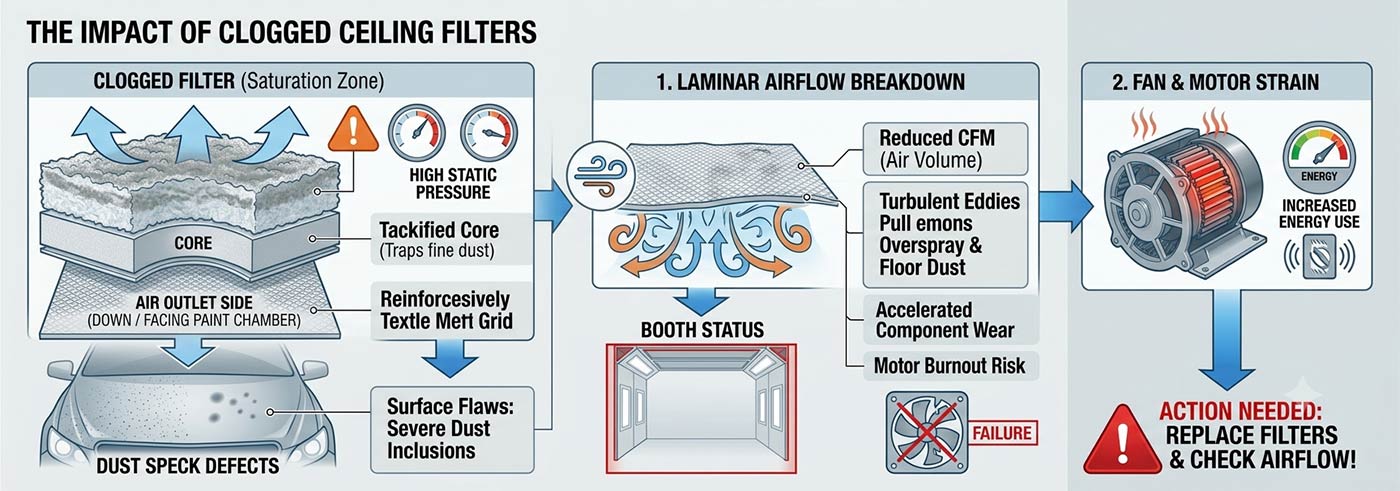
A clogged ceiling diffusion mat creates a severe domino effect that compromises both paint coating quality and mechanical HVAC equipment.
Impact on Paint Quality
Laminar Airflow Breakdown: Quality ceiling filters create uniform, vertical laminar airflow (straight downward air current). When clogged unevenly, air creates turbulent eddies that pull overspray and floor dust back onto the wet vehicle surface, resulting in severe dust inclusions.
Slow Evaporation & Flashing Issues: Restricted airflow reduces Cubic Feet per Minute (CFM). This slows down solvent evaporation, leading to orange peel, run marks, or uneven clear-coat cures.
Impact on Blower Fans & Motors
Blower Motor Overheating & Strain: High static resistance forces the supply intake fan to work under extreme load, causing higher energy consumption, excessive fan vibration, and premature motor burnout.
Negative Booth Pressure Leakage: If intake air drops below the exhaust rate, the spray chamber drops into negative pressure. Unfiltered workshop dust will instantly be sucked into the booth through door seals, hinges, and seams.
3. Ceiling Filter Installation: Which Side Faces Down (Air Outlet Side)?
Installing a ceiling diffusion filter upside down is a common mistake that causes instant coating defects.
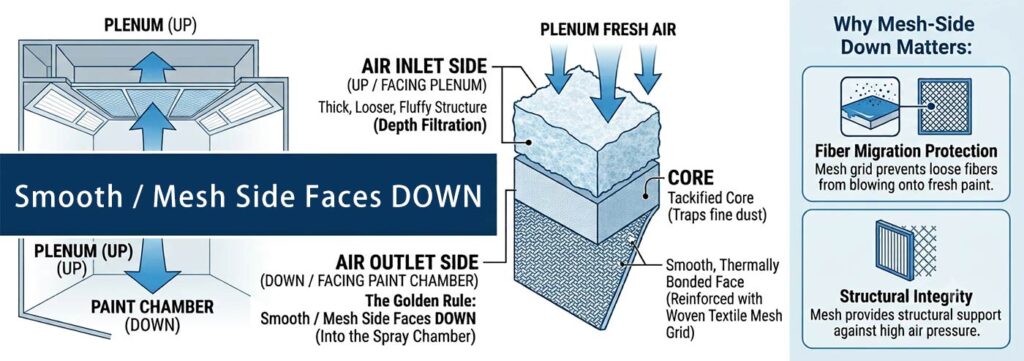
The Golden Rule: Smooth / Mesh Side Faces DOWN (Into the Spray Chamber)
Air Inlet Side (UP / Facing Plenum): Features a thicker, looser, fluffier synthetic polyester structure. This layer progressively captures coarse dust through deep-bed filtration.
Air Outlet Side (DOWN / Facing Paint Chamber): Features a smooth, thermally bonded face reinforced with a woven textile mesh grid (or glue/tacky layer).
Air Inlet (UP): Thick / Fluffy Structure
Core: Tackified Core (Traps fine dust)
Air Outlet (DOWN): Woven Mesh / Smooth Finish
Why Mesh-Side Down Matters:
Prevents Fiber Migration: The reinforced textile grid locks in synthetic fibers, guaranteeing that zero filter fibers blow off onto fresh paint.
Structural Integrity: The grid prevents the filter pad from sagging or flapping under continuous air pressure from the supply fan.
4. Paint Defects: Is It Leakage from the Ceiling Filter, Pre-Filter, or Floor Pit Media?
When micro-particles and specs appear on horizontal paint surfaces (hood, roof, trunk), painters often blame the wrong filter. Use our diagnostic chart to pinpoint the root cause:
| Defect / Particle Type | Primary Suspect | Root Cause & Action Needed |
| Micro-specks (1–10 microns) on top panels | Ceiling Filter | Ceiling media saturated, bypass gaps around ceiling frame clips, or filter installed upside down. |
| Coarse dirt specks & heavy debris | Intake Pre-Filter | Pre-filter torn, loose, or bypassed, allowing large street dust into the intake ducting. |
| Lint, clothing fibers, or overspray clumps | Booth Environment / Painter Attire | Static electricity on plastic parts, unwashed spray suits, or dusty floor grids. |
| Bottom edge / lower panel contamination | Exhaust Pit Filter | Saturated fiberglass floor media causing overspray bounce-back from the pit. |
How to Confirm Ceiling Filter Leakage:
Check the Perimeter Seals: Even a 1 cm gap between the filter roll and the ceiling frame allows high-velocity air to bypass the filter entirely.
Inspect under Magnification: Synthetic polyester strands point directly to damaged ceiling media, whereas organic fibers come from painter clothing or paper wipes.
Ready to Elevate Your Paint Finish Quality?
Don’t let sub-par filtration cause expensive re-works or damage your ventilation equipment. Whether you need custom-cut pads, master rolls, or OEM filtration solutions, CHUQI is here to support your operation.
Take the Next Step:
 Request Free Samples: Test our premium 560G/600G ceiling diffusion media in your facility today.
- Get Technical Datasheets: Contact our engineering team for detailed technical parameters, airflow resistance charts, and custom quote options.
 Request Free Samples: Test our premium 560G/600G ceiling diffusion media in your facility today.
 Get Technical Datasheets: Contact our engineering team for detailed technical parameters, airflow resistance charts, and custom quote options.
- Email Our Tech Team: chuqifilter@chuqimat.com
- WhatsApp : +86-19153383344
 Email Our Tech Team:
  WhatsApp :