
Low-Resistance Mini-Pleat HEPA/ULPA Filters: Strategic Advantages for Cleanrooms
Certified Sub-Micron Interception
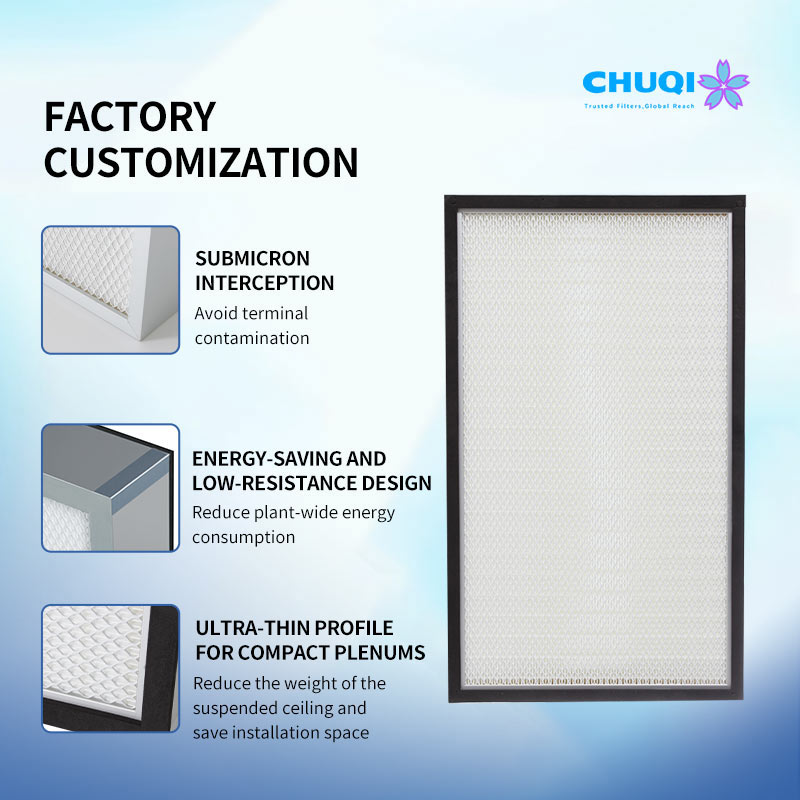
Engineered to meet strict EN1822 and ISO cleanroom standards, our H10-U16 Mini Pleat Filter modules deliver verified efficiency up to 99.99995% at MPPS. They reliably intercept sub-micron airborne contaminants, providing the high-level air purity required for pharmaceutical cleanrooms and critical processing environments.
Energy-Efficient Low Drag Performance
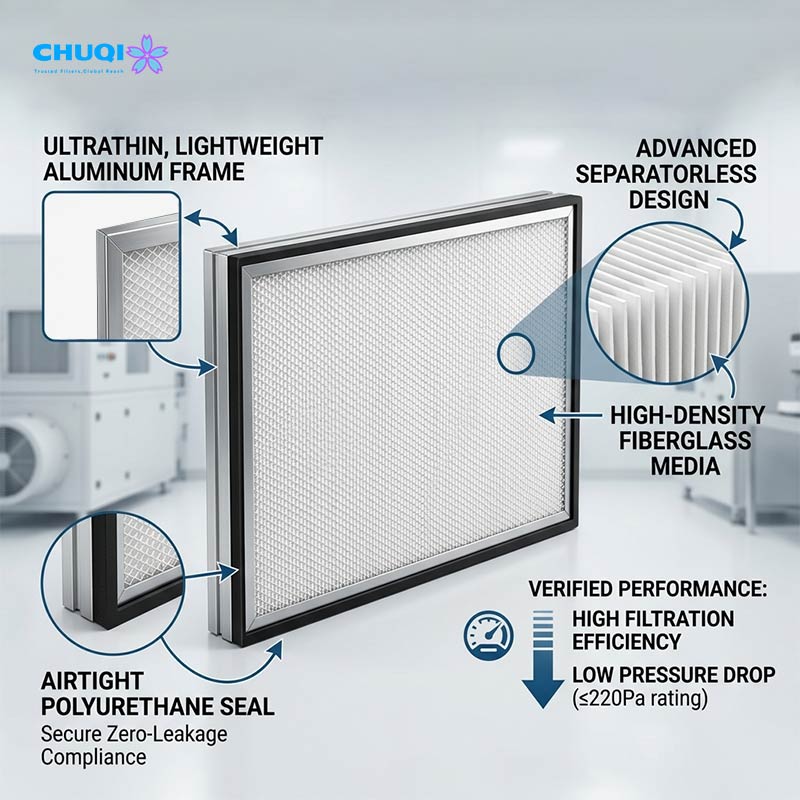
By replacing heavy corrugated metal spacers with continuous adhesive spacing, our Close-Pleated HEPA Filter structure minimizes internal airflow drag. This Low Pressure Drop HEPA Filter design maintains an initial resistance of ≤220Pa, drastically easing HVAC fan loads and cutting long-term facility operational costs.
Symmetric Geometry for Uniform Laminar Airflow
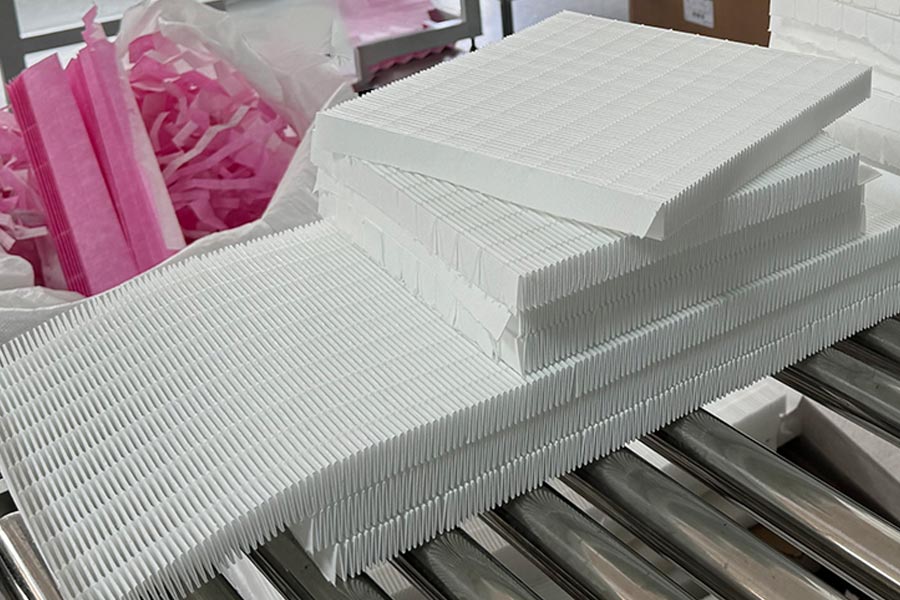
Automated Hot-Melt Separator HEPA Filter technology ensures exact, stable pleat spacing across the entire media pack. This consistent airflow pathway eliminates localized turbulence and air velocity dead zones, making it an ideal Terminal HEPA Filter Panel for maintaining strict laminar face velocity.
Ultra-Thin Profile for Flexible System Retrofits
Designed with a compact profile, these lightweight units minimize structural depth and ceiling weight loads. They provide an easy-to-install, space-saving solution for cleanroom terminal ceiling grids, laminar flow cabinets, and FFU replacement modules.
High-Quality Mini-Pleat HEPA Filter Materials & Precision Structural Customization
High-Efficiency Micro Glass Fiber Media
Made with ultra-fine, water-resistant micro glass fiber HEPA filter media, our pleat packs offer high dust-holding capacity and consistent sub-micron particle interception without fiber shedding or efficiency degradation over time.
Anodized Corrosion-Resistant Frame Options
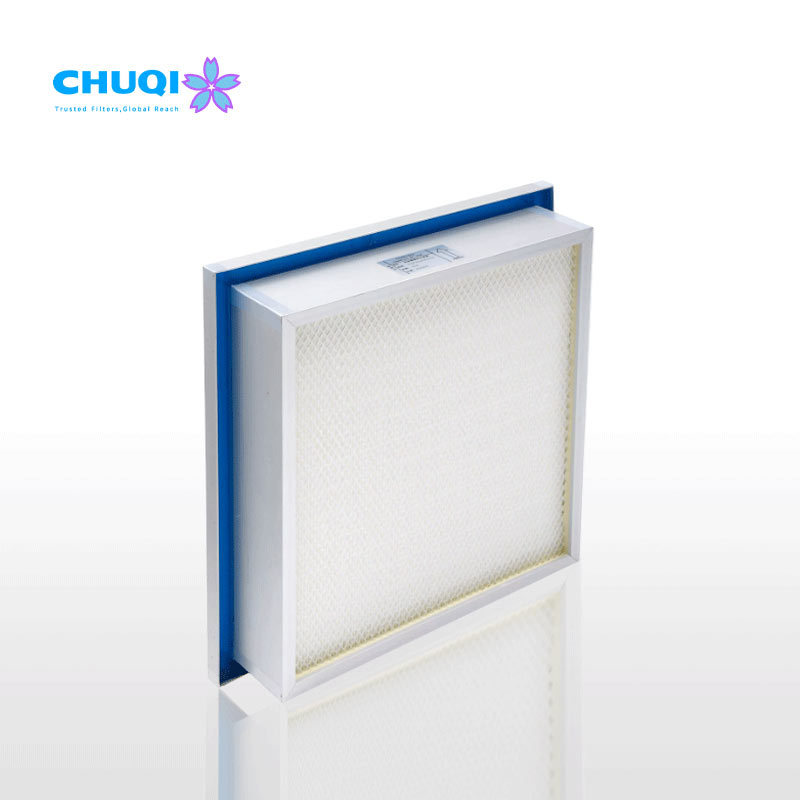
Built as a rigid, lightweight aluminum frame mini HEPA filter, the extrusion features a corrosion-resistant anodized finish that withstands chemical wiping and cleanroom moisture. Galvanized steel or stainless steel frame options are also available upon request.
Zero-Leakage Polyurethane & Gel Seal Integration
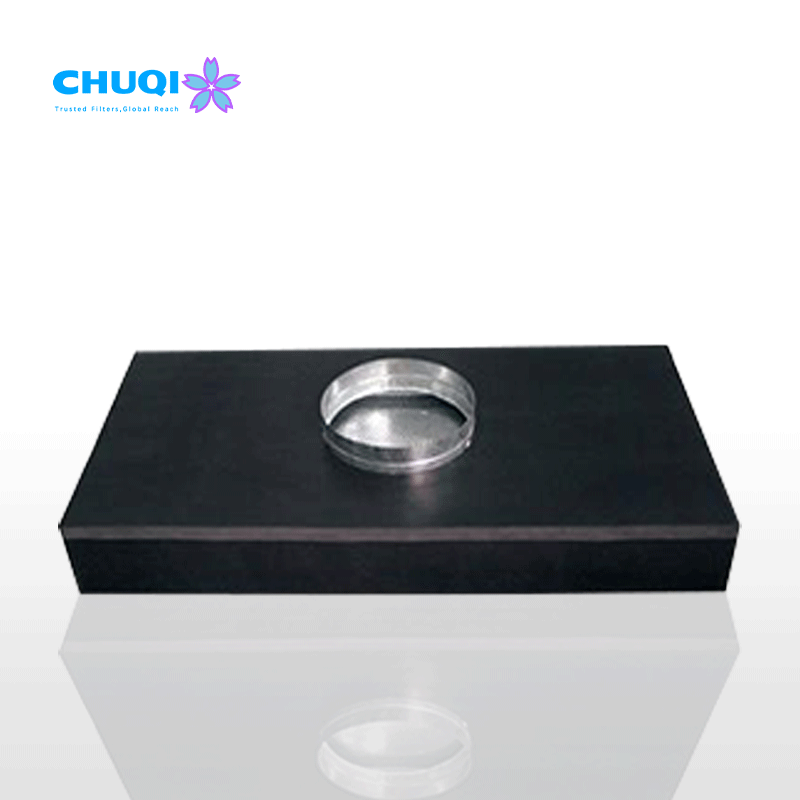
The media pack is continuously potted into the channel using a seamless polyurethane sealant to prevent micro-leaks. For knife-edge terminal housing grids, we supply gel seal mini pleat HEPA filter configurations for absolute airtight sealing.
Tailored Custom Size & Structural Engineering
We supply custom size mini pleat HEPA filter units with flexible framing depths (from 38mm to 150mm), customized gasket placements (upstream, downstream, or side-seal), and integrated faceguards for maximum handling protection.
Industrial Applications for Mini-Pleat HEPA Filters
Semiconductor & Microelectronics Cleanrooms
Installed directly into terminal ceiling supply grids, our mini-pleat HEPA filter for semiconductor cleanrooms eliminates sub-micron airborne particles in wafer fabrication, micro-lithography, and optical coating facilities to maximize product yields.
Fan Filter Units (FFU) & Laminar Flow Workstations
Designed with a low-profile aluminum housing, this compact mini-pleat FFU filter replacement panel integrates seamlessly into motorized Fan Filter Units, laminar flow benches, and cleanroom isolators to maintain stable air velocity.
Pharmaceutical & Biotechnology Processing
Deployed inside sterile filling suites and GMP-compliant cleanrooms, our high-efficiency pharmaceutical mini-pleat HEPA filter systems provide certified, zero-leakage air containment to prevent cross-contamination and micro-organism ingress.
Industrial Laboratories & Sensitive HVAC Systems
Serving as the critical final filtration barrier, this mini-pleat HEPA filter for laboratory air systems fits into localized containment hoods, medical cleanrooms, and high-efficiency AHU terminals to safeguard dust-sensitive research and processing environments.
| Evaluation Dimension | Our Industrial Grade Mini-pleat HEPA Filter | Standard Market Alternatives |
|---|---|---|
| Factory Compliance Inspection | 100% individual scanning and leak testing before shipment; complete compliance reports provided for cleanroom auditing. | Rely on random batch checks; undocumented seal integrity frequently fails laser particle counter inspections on-site. |
| Filtration Performance Stability | High-density glass fiber resists structural shifting, maintaining steady micro-particle capture without efficiency drop. | Loose synthetic fibers degrade quickly, causing early particle breakdowns and short service lifespans. |
| Bulk On-Time Delivery Logistics | Scalable automated media pleating and framing assembly lines ensure highly predictable shipping schedules for large projects. | Manual assembly methods limit production volume, causing shipping delays that stall large HVAC installations. |
| Structural Framing Integration | Anodized aluminum alloy frame provides exceptional rigidity, low weight, and total corrosion resistance in damp setups. | Untreated wood or cheap sheet metals distort easily under pressure, causing bypass leaks and mold issues. |
| Aerodynamic Energy Consumption | The separatorless mini-pleat pattern maintains a low initial resistance of ≤220Pa, keeping fan energy consumption low. | Thick corrugated dividers restrict airflow paths, driving up pressure drops and inflating monthly factory power bills. |
| Flexible OEM/ODM Support | Agile, professional customization for exact frame widths, custom polyurethane depths, and specialized gel-seal channels. | Limited to standard stock sizes; unable to modify frame styles or casing depths for tight cleanroom plenums. |
| Dimension | Rated Air Flow | Initial resistance | Efficiency (class) | Media |
|---|---|---|---|---|
| 610×610×69mm | 600–1000m³/h | ≤220Pa | 95–99.99995% | Fiberglass |
| 760×610×69mm | 800–1200m³/h | |||
| 915×610×69mm | 1000/1500m³/h | |||
| 1170×570×69mm | 1100/1800m³/h | |||
| 1220×610×69mm | 1200/2000m³/h |
Note: These are standard specifications. For custom sizes or technical inquiries, 【please contact our engineering team.】
Custom Mini-Pleat HEPA Filter Manufacturing for Industrial Projects
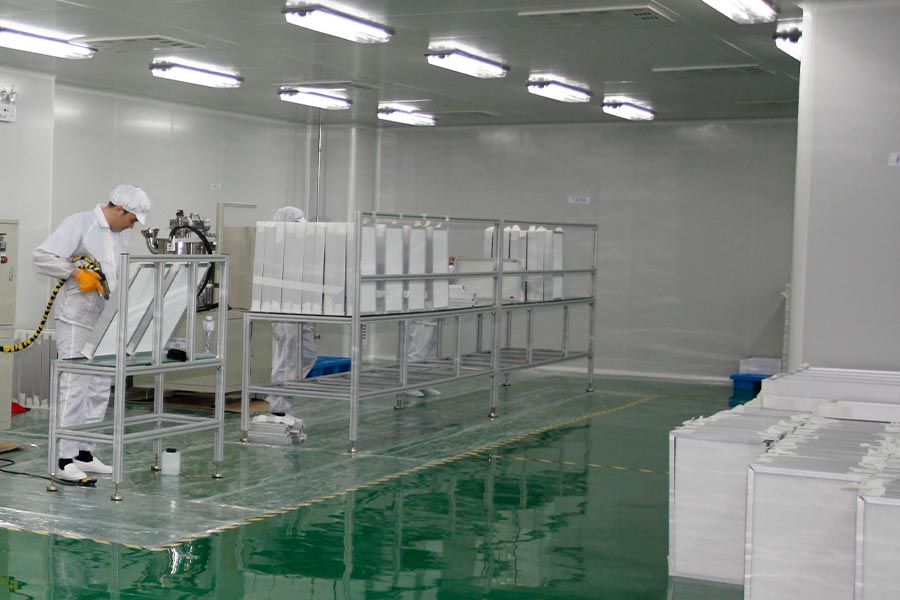
As an established mini-pleat HEPA filter manufacturer, we operate automated production lines equipped with high-precision hot-melt dispensing technology. This guarantees uniform pleat spacing across every separatorless HEPA filter pack, delivering low airflow resistance, structural integrity, and verified filtration efficiency for critical cleanroom environments.
With flexible production capabilities and extensive raw material reserves, we easily fulfill any mini-pleat HEPA filter bulk order for large-scale engineering installations. Whether you require a custom size mini pleat HEPA filter tailored to specific casing dimensions or scalable OEM solutions for ongoing facility maintenance, our direct supply chain minimizes lead times and reduces wholesale procurement costs.
Q1: Mini-pleat vs. Deep-pleat HEPA filter: What is the main structural difference?
The main difference lies in the separator technology and overall casing depth. Traditional deep-pleat units use corrugated aluminum spacers between pleats, resulting in a thicker frame (150–300mm) and higher airflow turbulence. In contrast, a separatorless HEPA filter uses continuous hot-melt adhesive beads to maintain precise pleat spacing. This compact structure allows for a lower profile (38–90mm), expands effective media area, and fits easily into tight ceiling plenums and localized FFU modules.
Q2: How does a low pressure drop mini-pleat HEPA filter reduce facility operational costs?
By replacing bulky aluminum dividers with ultra-thin hot-melt spacers, a low pressure drop mini-pleat HEPA filter maximizes the total media surface packed within the frame. This expanded filtration area lowers face velocity across the glass fiber media pack, keeping initial resistance at ≤220Pa. Lower airflow resistance directly reduces fan motor strain in cleanroom AHU systems, delivering long-term electrical energy savings.
Q3: Which seal configuration should I choose: Gel seal or Polyurethane (PU) gasket?
Selection depends on your cleanroom ceiling grid interface. A standard polyurethane gasket mini-pleat HEPA filter utilizes a continuous foam strip compressed mechanically against flat framing grids, ideal for general cleanroom modules. For zero-leak critical spaces—such as sterile pharmaceutical filling lines—a gel seal mini-pleat HEPA filter features a fluid polyurethane gel channel that engages with a knife-edge ceiling frame to establish a complete airtight seal.
Q4: How often should a cleanroom mini-pleat HEPA filter be replaced?
In standard cleanrooms supported by proper primary pre-filtration (F7–F9 grades), a high-efficiency cleanroom mini-pleat HEPA filter typically operates for 12 to 24 months. Replacement should be guided by performance parameters: when final pressure drop reaches twice the initial resistance (or ≥450Pa), when cleanroom airflow velocity drops below EN1822/ISO thresholds, or when annual PAO/DOP scan testing reveals unsealable leaks during cleanroom audits.
Q5: What is the efficiency distinction between H13, H14, and U15 mini-pleat HEPA filters?
The distinction is based on particle collection efficiency at MPPS (Most Penetrating Particle Size, ~0.3µm) certified under EN1822 standards:
H13 Grade (≥99.95%): Standard efficiency for commercial cleanrooms, operating rooms, and general AHU final filtration.
H14 Grade (≥99.995%): High-spec efficiency required for sterile pharmaceutical GMP suites and biological safety cabinets.
U15 ULPA Grade (≥99.9995%): Ultra-low penetration filtration engineered specifically for advanced semiconductor wafer fabrication and optical processing lines.
Related Posts
Frequently Asked Questions About G4 Pocket Filters
Q: Can this 495x495x600mm pocket filter be used in high-moisture cleanrooms?
A: Yes. The non-shedding synthetic media, anodized alloy frame, and internal steel support ribs are specifically engineered for high moisture resistance. This 495x495x600mm industrial pocket air filter operates reliably in relative humidity levels up to 80% RH without media degradation or mold growth.
Q: What is the primary benefit of using a G4 grade pocket filter in cleanrooms?
A: The main advantage is its exceptional deep-pocket dust retention paired with extreme structural integrity. By capturing heavy particulate loads early in the air handling process, this G4 primary filter stabilizes system airflow and drastically extends the service life of expensive secondary and final-stage HEPA filters.
Q: Is this industrial bag filter compatible with standard AHU (Air Handling Unit) tracks?
A: Absolutely. Designed to standardized international dimensions (495x495x600mm), this primary pocket filter seamlessly integrates into standard cleanroom AHU holding frames, HVAC filter racks, and industrial intake duct channels.
Q: How do this filter's design and seal prevent air bypass leakage?
A: Zero bypass is guaranteed through a two-step structural design:
An integrated acetate ethyl seal gasket along the frame face creates an airtight perimeter lock against track walls.
Ultrasonically fused pocket seams prevent media tearing even under severe pressure spikes (up to 120% of nominal rating).
Q: How do I know when to replace the 495x495x600mm pocket filter?
A: We recommend monitoring the differential pressure across your cleanroom intake system using a manometer. When the static pressure drop increases significantly above the low initial resistance of 70 Pa (typically reaching the recommended final resistance of 200–250 Pa), the filter should be replaced to ensure optimal energy efficiency and air quality.