
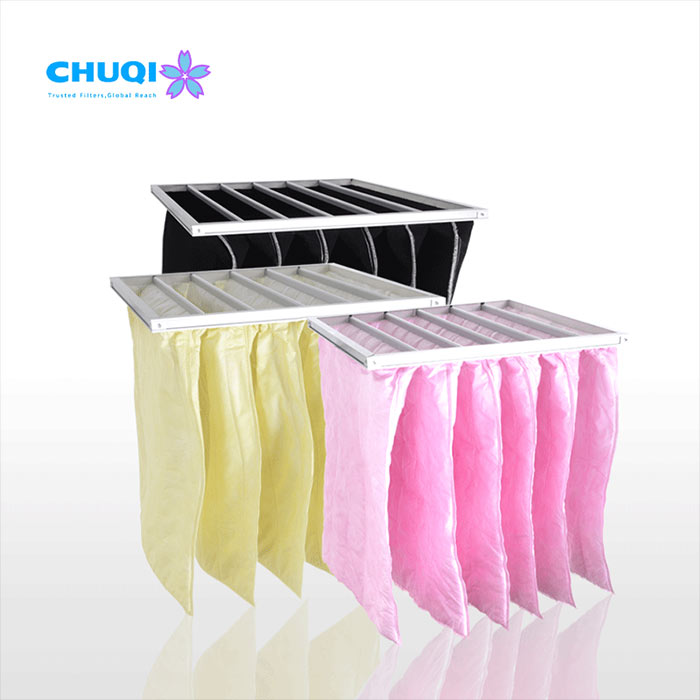
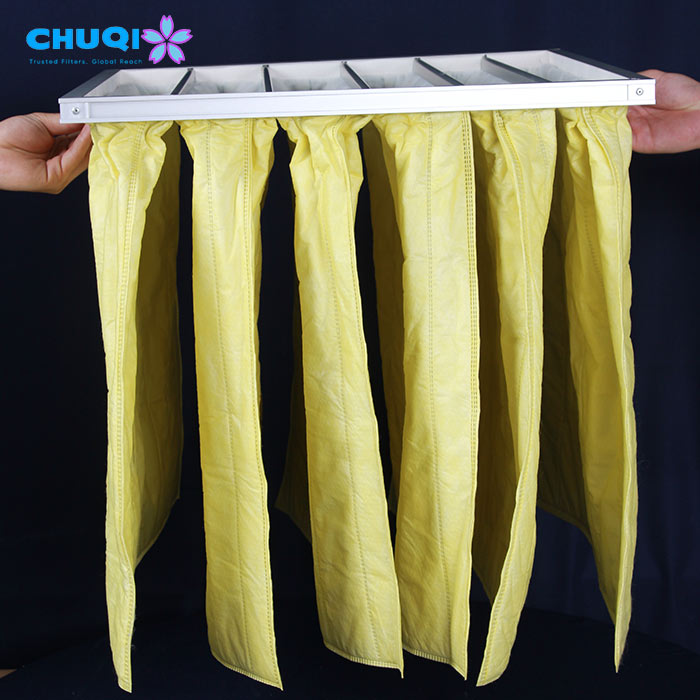
In many commercial and industrial HVAC systems, filtri a tasche in AHU systems provide an important intermediate filtration stage. Their extended pockets create a larger media area within a relatively compact filter frame, allowing them to handle substantial airflow in applications where flat filters alone may not provide the desired filtration arrangement.
However, installing a filtro a maniche with a suitable efficiency rating does not automatically guarantee effective filtration.
Air may bypass the filter through gaps around the frame. Uneven airflow can cause different pockets to operate under different conditions. Restricted pocket expansion can also reduce the effective use of the available media area.
Understanding how a bag filter interacts with the AHU helps explain why filtration performance depends on the complete system, not just the filter specification.
1. How Does an AHU Air Filtration System Work?
An air handling unit processes air through a combination of filtration and air-treatment components. Depending on its application, an AHU may include outdoor air intakes, return-air mixing sections, filters, heating or cooling coils, fans, dampers, and other equipment.
The filtration arrangement is designed to remove airborne particles before the air reaches sensitive equipment or is supplied to occupied and production areas.
A typical filtration sequence may look like this:
Incoming or Mixed Air → Pre filtro → Filtro a maniche → Optional Filtro finale → Air Supply
This is a simplified example rather than a fixed AHU layout. The position of the fan, coils, mixing section, and filters varies between equipment designs.
Each filtration stage has a different role.
Pre filtro: Captures a portion of the incoming dust load, particularly larger airborne particles.
Filtro a sacco: Provides further particle removal through an extended filter media area.
Filtro finale: Provides additional high-efficiency filtration when required by the application.
This staged arrangement helps distribute the filtration workload instead of relying on one filter to handle all incoming particles.
For example, an industrial AHU operating in an area with significant outdoor dust exposure may use an initial filter to reduce the coarse particle load, followed by a bag filter for further filtration. This helps limit the amount of dust reaching downstream components.
The actual filter combination depends on the air quality target, equipment design, and operating environment.
2. Where Does a Bag Filter Fit in the AHU Filtration Process?
A bag filter is commonly installed in an intermediate filtration section of an AHU, often downstream of a pre-filter.
Its position allows it to capture additional airborne particles after the initial filtration stage has already reduced part of the incoming dust load.
This arrangement is useful because the bag filter does not have to handle the entire coarse dust load by itself. Instead, each filtration stage contributes to the overall air-cleaning process.
Why is the bag filter often placed after a pre-filter?
Incoming air can contain a mixture of particle sizes. If a downstream bag filter receives the full incoming dust load without suitable initial filtration, larger particles may accumulate in the media more quickly.
A pre-filter removes part of this initial load, helping the bag filter perform its intended intermediate filtration role.
In applications requiring higher air cleanliness, a final HEPA filter may be installed downstream.
For example, a cleanroom AHU may use a pre-filter and bag filter before the final HEPA stage. The upstream filters help reduce the particle load reaching the HEPA filter, while the final stage provides the high-efficiency filtration required by the cleanroom design.
The bag filter’s position is not universal. Some AHUs have different internal component sequences, so the complete filtration arrangement should be understood as part of the equipment design.
3. How Does Airflow Move Through a Pocket Bag Filter?
A filtro a sacco tascabile works by directing air through porous filter media while retaining airborne particles within its fiber structure.
Its main structural difference from a flat panel filter is the use of extended pockets.
When the AHU operates, air enters the filter section and passes through the media surfaces. The pockets expand under airflow, allowing a larger media area to participate in filtration.
How are airborne particles captured?
Particle removal occurs through several physical mechanisms:
Impatto inerziale: Larger particles cannot follow changes in airflow direction as easily and may collide with filter fibers.
Intercettazione: Particles following the airflow come close enough to fibers to make contact and become retained.
Diffusione: Very small particles move irregularly through the air and may encounter fibers through Brownian motion.
The relative contribution of these mechanisms depends on particle size, airflow conditions, and the characteristics of the filter media.
As dust accumulates, the available airflow passages within the media become increasingly restricted. Filter resistance therefore generally rises during operation.
Why does the pocket structure matter?
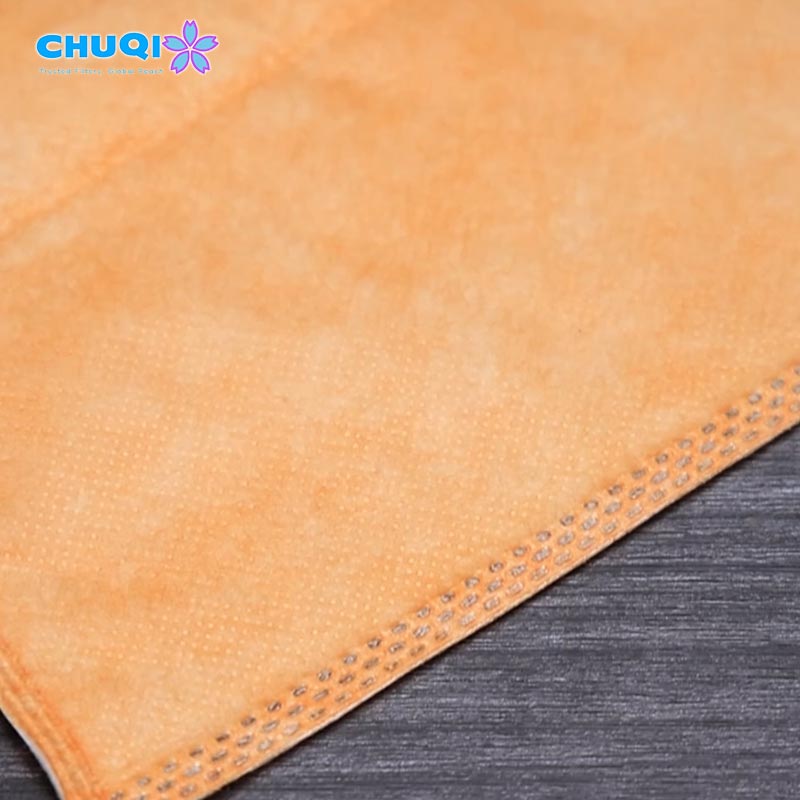
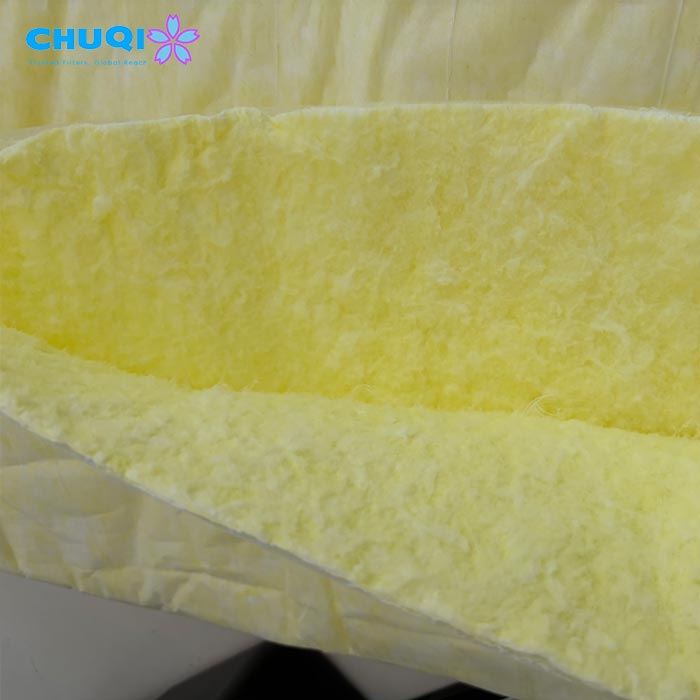
The extended pockets provide more filter media area than a comparable flat surface within the same general frame footprint.
This helps distribute the airflow across a larger media surface, supporting the filter’s ability to handle the airflow required by many HVAC applications.
However, the available media area is useful only when air can reach it effectively. Pockets that are compressed, obstructed, or unable to expand freely may not use their full surface area as intended.
This is why pocket filters need to be considered as complete assemblies, including their media, pocket construction, and installation environment.
4. Why Do AHU Systems Use Multiple Filtration Stages?
An AHU often handles air containing different particle sizes and concentrations. Using multiple filtration stages allows the system to distribute the particle-removal workload.
Rather than requiring one filter to capture everything, each stage performs a defined function.
Pre-filtration reduces the initial dust load
The pre-filter captures part of the incoming dust before air reaches the bag filter.
This helps reduce coarse particle accumulation in the downstream media and supports more practical filter maintenance.
Bag filtration provides intermediate particle removal
The bag filter captures additional particles that pass through the pre-filter.
Its extended media area makes it suitable for many HVAC applications requiring an intermediate filtration stage.
The actual filtration performance depends on the tested filter classification and operating conditions. Specifications may reference ISO 16890, while some international product documents and existing equipment designs still use historical EN 779 classifications such as F7 and F8.
In North American projects, ASHRAE 52.2 may also appear in filter performance specifications. These standards use different classification and testing approaches, so their ratings should not be treated as directly interchangeable.
Final filtration supports more demanding air-quality requirements
Where the application requires high-efficiency particle removal, an additional final filtration stage may be installed.
Filtri HEPA are commonly used for this purpose in cleanrooms, pharmaceutical facilities, and other controlled environments.
The upstream bag filter helps reduce the particle load reaching the final filter. However, the HEPA filter’s own efficiency, integrity, installation, and system design remain essential to achieving the required air cleanliness.
For a more detailed discussion of this arrangement, see our related topic: Bag Filters as HEPA Pre-Filters: How They Protect Final Filtration Stages.
The benefit of multi-stage filtration is not simply that more filters are installed. It is that the filtration workload is distributed according to the role of each stage, helping the complete AHU operate as a coordinated air-cleaning system.
5. How Does Bag Filter Installation Affect Airflow and Performance?
A bag filter’s performance after installation depends on how the complete filter assembly interacts with the AHU housing.
Even when the filter media has suitable efficiency, installation conditions can affect how much air actually passes through it.
Air bypass around the filter frame
Air follows the path of least resistance. If gaps exist between the filter frame and the mounting section, part of the airflow may pass around the filter instead of through the media.
This is known as air bypass.
The problem is that bypass air carries untreated particles downstream. As a result, the effective filtration performance of the installed filter section may be lower than the performance of the filter media itself.
A suitable frame fit and sealing arrangement help direct airflow through the intended filtration surface.
Airflow direction and pocket support
Bag filters are generally designed for a specified airflow direction, commonly indicated by an arrow on the frame or in the product documentation.
The intended direction is important because the pockets are designed to expand and operate under a particular airflow arrangement.
Incorrect installation can affect pocket movement and mechanical support, potentially leading to abnormal deformation or unstable operation.
Clearance around the pockets
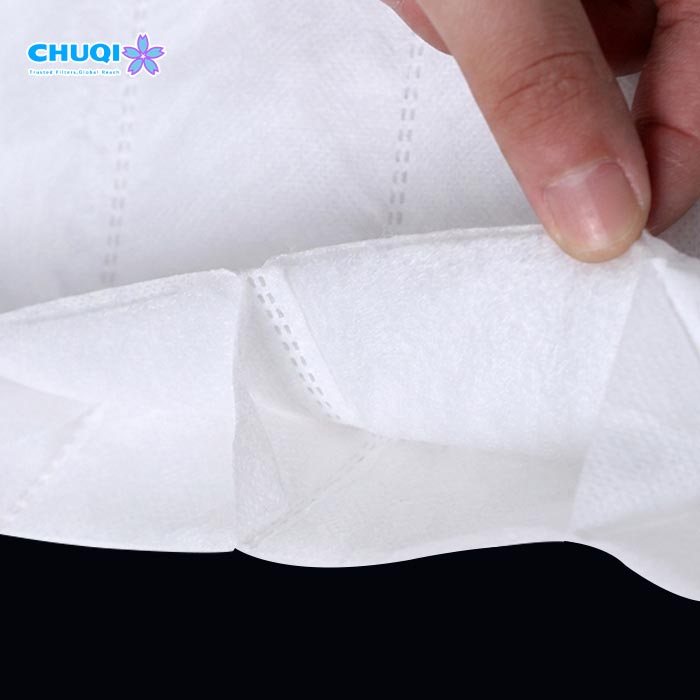
Filtri tascabili require enough room for their bags to expand during operation.
If the pockets press against neighboring filters, internal AHU components, or other obstructions, their movement may be restricted.
This can reduce the effective use of the media area and disturb airflow distribution across the filter section.
The available installation space therefore affects more than physical fit. It also determines whether the filter can operate as intended.


6. What Causes Uneven Pocket Inflation and Other AHU Filter Problems?
Pocket expansion is a normal part of bag filter operation. The pockets are designed to open under airflow rather than remain flat.
The concern is uneven expansion, excessive deformation, or restricted pocket movement.
These conditions may indicate an issue with the airflow pattern, installation arrangement, or filter assembly.
Uneven pocket expansion
If some pockets expand more than others, the filter may be receiving uneven airflow.
Nearby duct transitions, bends, dampers, or internal AHU components can influence how air reaches the filter face. When the airflow is concentrated in certain areas, the pockets may operate under different conditions.
Pockets pressing against each other
When adjacent pockets touch or become compressed, the available media surface may not be used effectively.
Restricted movement can also change the airflow distribution through the remaining open areas.
This is particularly relevant when the available space in the AHU is limited or when the filter configuration is poorly matched to the mounting section.
Air leakage around the frame
A poorly fitted filter or ineffective sealing can allow untreated air to bypass the media.
This may lead to particle carryover downstream even though the filter itself appears undamaged.
Increasing resistance and reduced airflow
Dust accumulation generally increases filter resistance over time.
If resistance becomes too high for the system’s operating conditions, the AHU may experience reduced airflow or increased fan demand, depending on the fan characteristics and control strategy.
A rising pressure drop is part of normal dust loading, but an unusually rapid increase may indicate heavy incoming dust, unsuitable filter operation, or another system issue.
For a more focused explanation of these operating problems, see our related article: Why Do Pocket Filters Collapse, Inflate or Block Airflow?
7. How Does Airflow Distribution Affect Bag Filter Performance in AHUs?
The airflow approaching a bag filter is not always perfectly uniform.
This is an important consideration in AHU design because different parts of the filter may receive different airflow rates, even when the filter itself has consistent dimensions and media construction.
Consider an AHU where air approaches the filter after passing through a bend or a sudden change in duct cross-section.
The resulting airflow pattern may be stronger in one area and weaker in another. When this uneven flow reaches the filter, different pockets can experience different operating conditions.
How uneven airflow affects filter operation
Uneven dust loading
Areas receiving more particle-laden airflow may accumulate dust at a different rate from other areas. This can result in uneven loading across the filter assembly.
Different pocket operating conditions
Pockets exposed to different airflow conditions may expand differently. Some may receive greater airflow loading, while others may not use their available media area as effectively.
Less effective use of the total media area
A pocket filter is designed to distribute airflow across an extended media surface. If airflow is concentrated in only part of the filter face, the available media area may not contribute equally to filtration.
What helps create more uniform airflow?
The AHU’s internal airflow path has a significant influence on the conditions at the filter face.
A well-designed transition into the filter section, appropriate spacing around internal components, and a suitable mounting arrangement can help reduce unnecessary airflow disturbances.
The filter assembly also needs to remain stable during operation. Consistent pocket construction and suitable frame dimensions help maintain the intended filter geometry.
The important distinction is that airflow distribution is a system-level issue. It cannot always be corrected by changing the filter media or choosing a different efficiency grade.
When an AHU experiences uneven filtration behavior, the airflow path leading to the filter deserves as much attention as the filter itself.
8. Why Does Filter Manufacturing Quality Matter in AHU Applications?
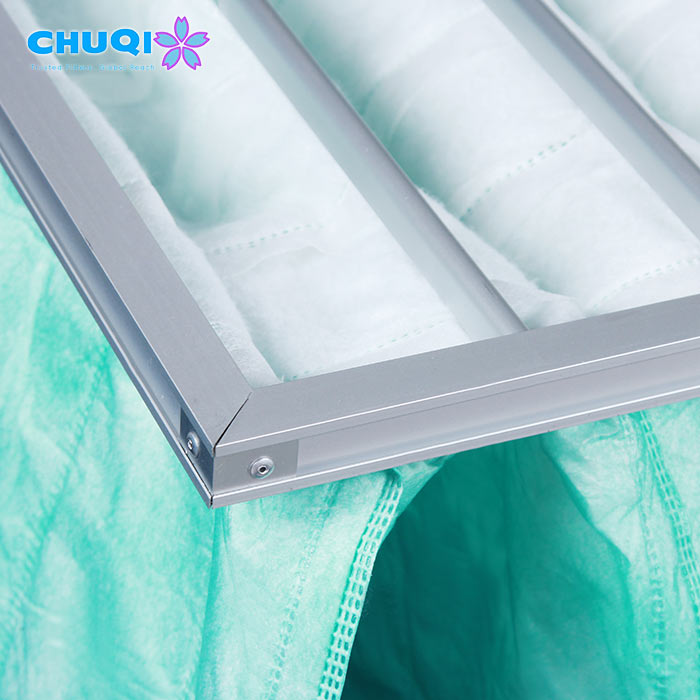
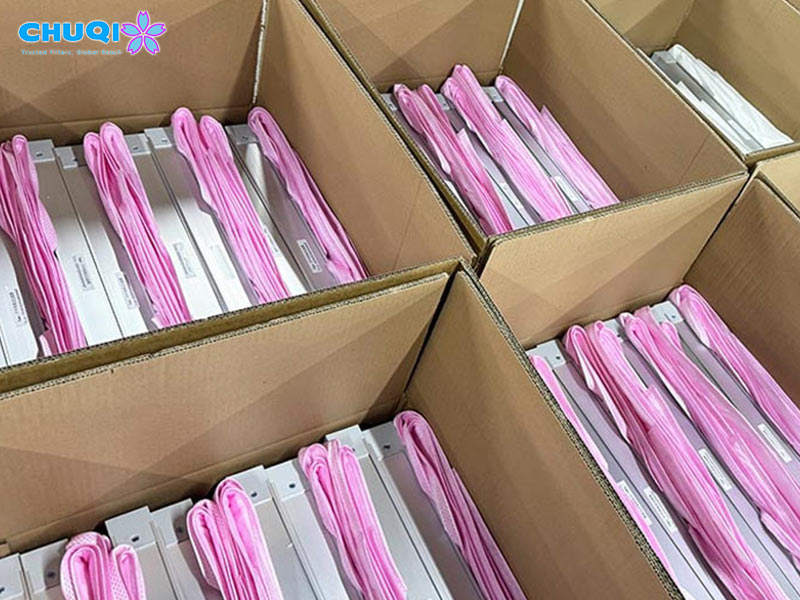
A bag filter is a complete assembly of filter media, pockets, seams, and a supporting frame. The consistency of these components influences how the filter fits and operates inside an AHU.
For AHU manufacturers, filtration equipment suppliers, and HVAC distributors, consistent product construction also matters when filters are supplied repeatedly for the same equipment model.
Media consistency supports predictable filtration
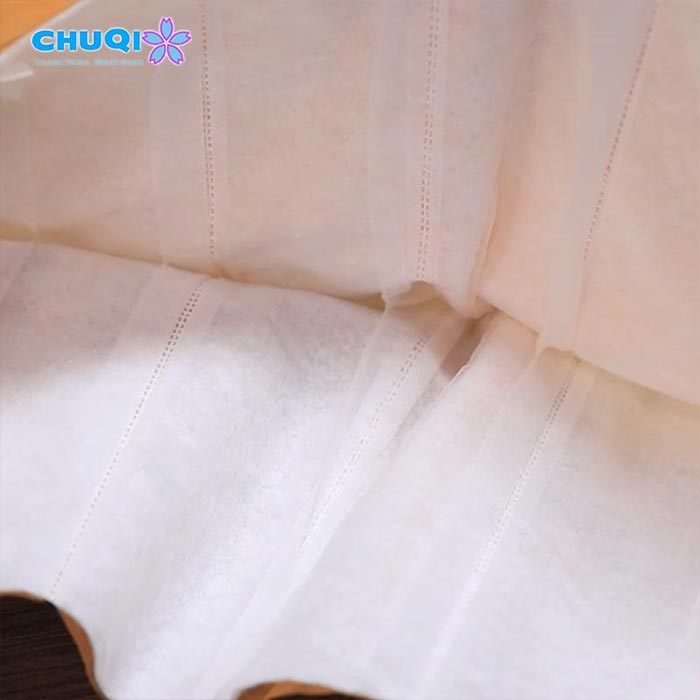
Differences in fiber distribution, media structure, or bonding can affect how air passes through the filter material.
Consistent media production helps reduce unwanted variation across the filter surface and supports more predictable finished-filter performance.
Pocket construction supports operating stability
The pocket seams and connections hold the filter structure together under continuous airflow.
Consistent construction helps the pockets maintain their intended shape and reduces the risk of problems caused by weak or irregular connections.
Frame accuracy supports installation compatibility
The frame provides the mounting interface between the filter and the AHU.
Dimensional consistency and suitable assembly help the finished filter fit its intended installation section and support effective sealing.
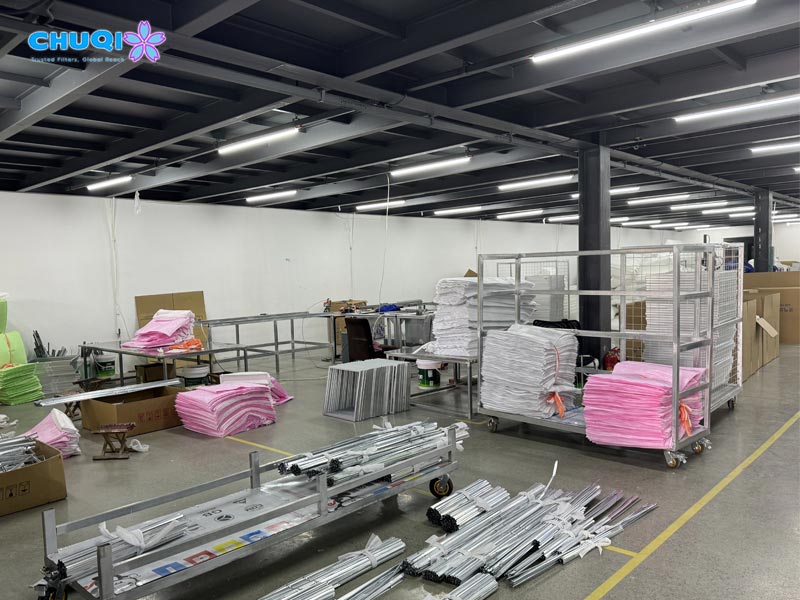
At Chuqi, materiale filtrante dell'aria produzione e finished air filter manufacturing are carried out within our own factory.
This manufacturing continuity connects media production with pocket construction and final filter assembly. It gives the production process a closer link between material consistency, component compatibility, and the finished product.
For customers sourcing bag filters for different AHU configurations, this capability supports the development of products suited to different dimensions, frame arrangements, and application requirements.
For broader guidance on pocket filter applications and selection, see Perché scegliere i filtri dell'aria tascabili? La guida definitiva alla selezione B2B per i sistemi HVAC..

Supporting Better Filtration Across the AHU
Bag filters are an important part of many commercial and industrial AHU filtration systems. Their performance depends on more than media efficiency: airflow distribution, installation clearance, frame sealing, pocket stability, and manufacturing consistency all influence how effectively the complete filter assembly operates.
When these factors work together, bag filters can perform their intended intermediate filtration role, helping protect downstream equipment and support stable HVAC operation.
Chuqi manufactures materiale filtrante dell'aria and filtri aria finiti for industrial and HVAC applications. Explore our pocket filter solutions or contact our team to discuss filtration products for your AHU application.
9. Frequently Asked Questions About Bag Filters in AHU Systems
Bag filters are commonly installed in an intermediate filtration section, often downstream of a pre-filter. Their exact position depends on the AHU layout, airflow arrangement, and required filtration stages.
What is the main function of a bag filter in an AHU?
A bag filter provides intermediate particle filtration by directing air through extended filter media pockets. Its larger media area supports airflow through the filtration section while capturing airborne particles.
Why do AHUs use bag filters instead of only panel filters?
Bag filters use extended pockets to provide a larger media area within a compact frame. This makes them suitable for applications requiring intermediate filtration and greater media area than a comparable flat filter arrangement.
Does airflow direction matter for an AHU bag filter?
Yes. Bag filters are designed for a specified airflow direction. Incorrect installation may affect pocket expansion, mechanical support, and operating stability.
Why do bag filter pockets expand during operation?
The pockets expand under airflow so their media surfaces can participate in filtration. Uneven expansion or restricted movement may indicate uneven airflow, installation limitations, or an issue with the filter assembly.
Can bag filters be used before HEPA filters?
Yes. Bag filters are commonly used as an upstream filtration stage before HEPA filters in systems requiring high-efficiency final filtration. They help reduce the particle load reaching the final filter, while the overall arrangement depends on the application’s air-cleanliness requirements.
Can bag filters be customized for different AHU systems?
Yes. Bag filters can be manufactured with different dimensions, pocket configurations, frame types, and filtration grades to suit different AHU designs. Custom manufacturing is useful when standard filter dimensions do not match the equipment’s mounting arrangement.